
Bonita Ash
Bonita Ash
Couldn't load pickup availability
The Compact, Cleaner Ash — Bonita Ash for Smaller Phoenix Yards & Patios
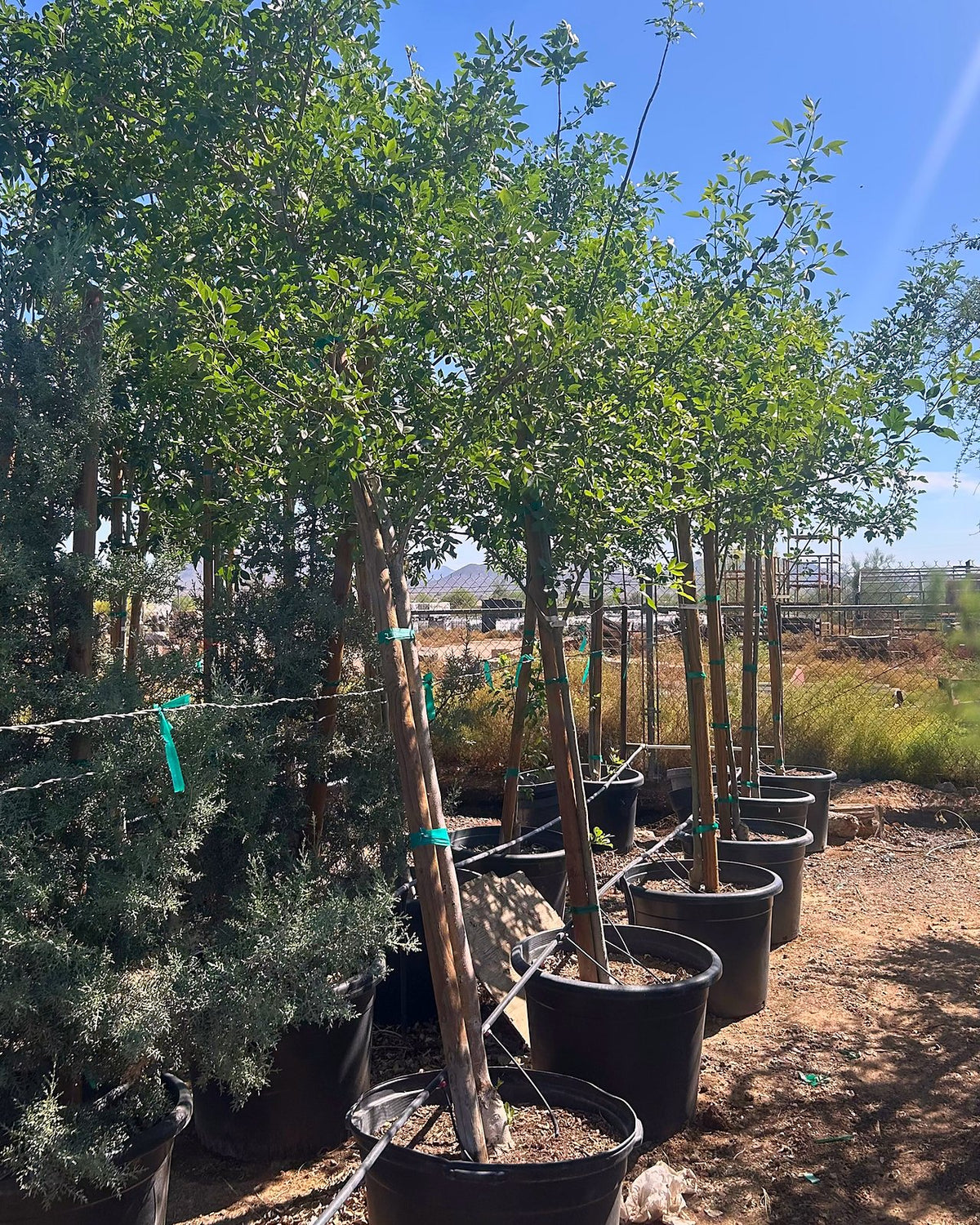
Bonita Ash (Fraxinus velutina 'Bonita') is Phoenix's premier compact shade tree for homeowners who love the look of an ash but need a neater, more manageable size. A refined cultivar of Arizona Ash, Bonita was selected for its tighter, more uniform canopy, stronger branch structure, and cleaner growth habit — delivering beautiful deciduous shade without the sprawling spread of standard ash trees. This fast-growing tree offers lush green summer foliage, golden fall color, and full-sun toughness. Whether you're shading a patio in Scottsdale, fitting a shade tree into a smaller backyard in Tempe, or creating a tidy lawn tree in Chandler — Bonita Ash is the cleaner, better-behaved choice.
Bonita Ash Plant Details
| Attribute | Detail |
|---|---|
| Scientific Name | Fraxinus velutina 'Bonita' |
| Common Names | Bonita Ash, Arizona Ash, Modesto Ash |
| Mature Height | 25–40 feet |
| Mature Width | 20–30 feet |
| Growth Rate | Fast — 2–4 feet per year in Phoenix |
| Sun | Full sun (6+ hrs). Handles reflected heat from walls and hardscape. |
| Water | Moderate when young; low-moderate once established. Drought-tolerant. |
| USDA Zones | 7–11 (Phoenix is Zone 9b–10a) |
| Soil | Well-draining. Adapts to Arizona caliche soils with proper planting. |
| Foliage | Deciduous — lush green summer; golden yellow fall color before drop |
| Canopy Shape | Compact, rounded — tighter than standard Arizona Ash |
Bonita Ash Uses in Phoenix Landscapes
Patio & Smaller Backyard Shade Tree
Bonita Ash's more compact 20–30 foot spread makes it perfect for smaller Phoenix backyards and covered patio applications where a full-size ash would overwhelm the space. Plant it 15–20 feet from your patio cover or seating area and it will shade the space within just a few growing seasons. Its tighter crown also makes it a cleaner-looking tree over time — less pruning required to maintain good structure in Peoria, Gilbert, or Mesa yards.
Lawn Tree and Front Yard Focal Point
With its upright growth habit and tidy rounded canopy, Bonita Ash is an excellent lawn tree or front yard specimen. It tolerates regular lawn irrigation well, performs beautifully in turf settings, and provides the seasonal interest that many Phoenix homeowners miss — golden fall color and leafy green summer shade. Space trees 20–25 feet apart for a canopy row effect along driveways.
Street Tree Planting
Bonita Ash is a popular street tree selection in Phoenix-area municipalities because its more contained size reduces conflicts with power lines and overhead infrastructure compared to larger ash varieties. Its strong branch attachment angles and improved structure make it more wind-resistant during monsoon season — a critical advantage for street-side planting in Scottsdale and Chandler.
Shade Canopy for Desert Landscapes
Planted among native desert plants like Agave, Desert Spoon, and Texas Sage, Bonita Ash provides dappled summer shade that allows understory desert plants to thrive while keeping outdoor spaces comfortable. Pair with drought-tolerant groundcovers like Trailing Rosemary or Desert Marigold for a complete, low-water phoenix landscape design that delivers four-season interest.
Best Time to Plant Bonita Ash in Phoenix
Fall planting (October through November) gives Bonita Ash the best possible start in Phoenix. Warm soil promotes root development while the cooler air reduces transplant stress — giving the tree a full 6–8 months of root establishment before it faces its first Phoenix summer. Spring planting (February through April) is a solid second option. Avoid summer planting from June through September when heat stress and transplant shock combine to make establishment significantly more difficult.
How to Plant Bonita Ash
- Dig wide, not deep — excavate a hole 2–3 times the width of the root ball but only as deep as the root ball. The tree should sit at or slightly above grade to prevent water pooling at the crown.
- Check for caliche — break through any hardpan caliche layer before planting to ensure proper drainage. Poor drainage is one of the leading causes of ash tree stress in Phoenix yards.
- Backfill with native soil — a light blend of 80% native soil and 20% compost is ideal. Do not over-amend, as this can discourage roots from spreading outward.
- Spacing — plant 20–25 feet apart for a canopy row; 15–20 feet from patios, structures, and walls for shade applications.
- Build a water basin — form a 3–4 inch soil berm around the outer edge of the planting area to direct water down to the root zone.
- Mulch — apply 2–3 inches of bark or wood chip mulch inside the basin to retain soil moisture and regulate temperature. Keep mulch several inches away from the trunk.
Watering Bonita Ash in Phoenix
First Year Watering Schedule
- Weeks 1–2: Every 1–2 days, deep and slow (20–30 min per session)
- Months 1–2: Every 3–4 days, consistently deep
- Months 3–6: Every 7–10 days (5–7 days during peak summer heat)
- After Year 1: Every 10–14 days in summer; every 3–4 weeks in winter
Drip Irrigation Setup
Place drip emitters 18–24 inches from the trunk using 2–4 GPH emitters. Water deeply and slowly to encourage deep root growth, which improves drought tolerance and wind stability. Established Bonita Ash (2–3 years) requires significantly less supplemental irrigation than during the establishment phase — especially in fall and winter.
How fast does Bonita Ash grow in Phoenix? Bonita Ash grows 2–4 feet per year in Phoenix under good conditions — making it a fast shade solution for homeowners. Consistent summer irrigation during the first 1–2 years is the key driver of growth rate.
What's the difference between Bonita Ash and Arizona Ash? Bonita Ash is a selected cultivar of Arizona Ash bred for a more compact crown, stronger branch structure, and tidier growth habit. Standard Arizona Ash can reach 40–50 feet with a sprawling spread; Bonita tops out around 25–40 feet with a neater 20–30 foot spread — making it significantly more appropriate for smaller Phoenix yards.
Is Bonita Ash drought-tolerant once established? Yes — after the first 1–2 years of consistent establishment watering, Bonita Ash becomes moderately drought-tolerant and can handle deep, infrequent irrigation. During establishment, steady moisture is essential, especially through the first Phoenix summer.
Does Bonita Ash drop leaves in Phoenix? Yes, Bonita Ash is deciduous. It drops its leaves in late fall or early winter (typically November–January in Phoenix) and re-leafs in spring. The fall color display — soft golden yellow — is one of its most desirable traits in a desert landscape that has little fall color.
Can Bonita Ash handle Phoenix summer heat? Absolutely — Bonita Ash is highly heat-tolerant and thrives in full-sun Phoenix conditions. It handles reflected heat from walls and hardscape well, making it one of the more adaptable deciduous shade trees for the Phoenix Valley.
You May Also Like
- Fan-Tex Ash — a larger ash cultivar with superior branch structure and extra-large canopy for Phoenix properties needing big shade fast.
- Arizona Ash — the classic large-canopy fast-growing shade tree, ideal for wide open Phoenix lots where maximum spread is welcome.
- Shamel Ash — a large, evergreen ash that stays green year-round, offering constant shade without seasonal leaf drop.
- Little Leaf Ash — Arizona's native compact ash for the smallest spaces, patios, and drought-focused Phoenix landscapes.
- Chinese Pistache — a stunning fall-color deciduous tree for Phoenix that pairs beautifully with ash trees in mixed landscape designs.
How Many Bonita Ash Do I Need?
Bonita Ash is a compact shade and lawn tree, not a hedge. With a tidy 20 to 30 foot spread, one tree shades a patio or anchors a front yard. For a canopy row along a driveway or street, space the trees so the rounded crowns meet.
| Planting | Spacing Guidance |
|---|---|
| Single patio / lawn specimen | 15 to 20 ft from the patio, wall, or structure |
| Driveway / canopy row | 20 to 25 ft on center |
| Informal grouping | Odd-numbered groups of 3, 20 ft apart |
Bonita Ash Season-by-Season in Phoenix
- Spring (Feb–Apr): Fresh green leaves flush out on the tidy rounded crown and the canopy fills in fast. Strong second planting window after fall.
- Summer (May–Sep): Provides dense, cooling shade through the worst Valley heat and handles reflected heat off walls and pavement. Keep young trees on steady deep water through their first summers; the improved branch structure stands up well to monsoon wind.
- Fall (Oct–Nov): Soft golden-yellow color, a rare fall show for the desert. Prime planting season in the Valley.
- Winter (Dec–Jan): Deciduous and dormant; drops its leaves and re-leafs in spring. Fully cold-hardy through Valley frost.
At a Glance
✔ Heat-Loving (Reflected-Heat Tolerant) ✔ Drought-Tolerant ✔ Shade-Providing ✔ Low-Maintenance ✔ Cold-Hardy to 0°F
Plant It With
- Fan-Tex Ash: Larger ash cousin for big shade where the lot has room, in a matched ash palette.
- Arizona Ash: The full-size native parent for wide-open lots that want maximum spread.
- Chinese Pistache 'Red Push': Pairs beautifully for layered fall color in a mixed deciduous planting.
- Desert Spoon: Low-water native accent that thrives in the dappled shade beneath the canopy.
Is Bonita Ash Right for Your Yard?
Bonita Ash is a fit for smaller and mid-size yards that want fast, clean deciduous shade with golden fall color: patios, lawns, front-yard focal points, and street plantings, all in full sun with deep periodic water. It needs sharp drainage through caliche and steady water while young. It is not a fit if you want a low-water or evergreen tree, since it drops its leaves in winter and asks for more irrigation than true desert natives during establishment.
Customer Reviews
The tree appeared to be recently repotted and not as mature as thought in its 25” container. Almost all of its potting soil/dirt fell off in the container. I'm had plans to purchase a second tree of the same, but I will allow time for this one to grow and make sure it survives.
Share