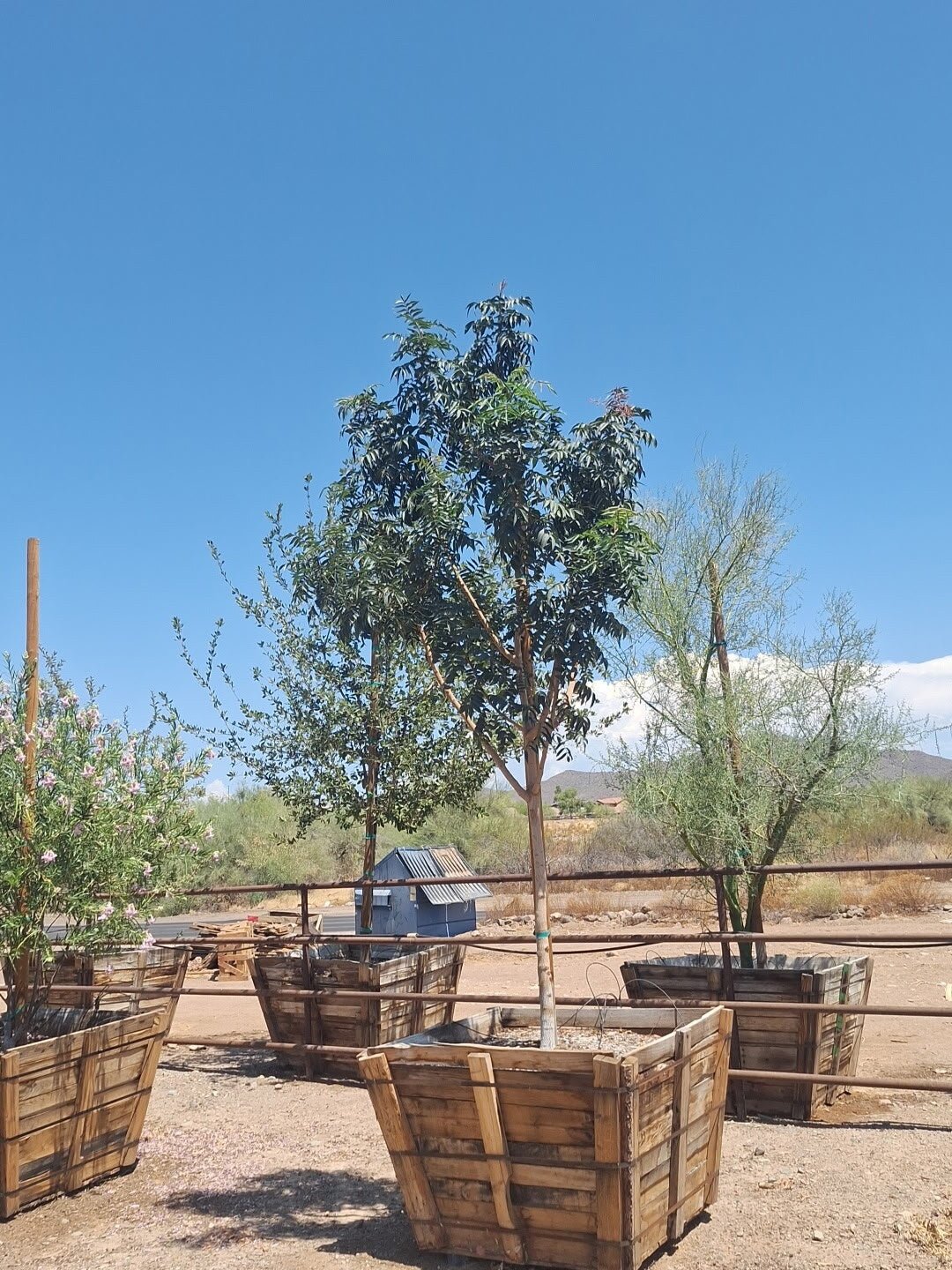


Chinese Pistache 'Red Push'
Chinese Pistache 'Red Push'
Couldn't load pickup availability
Phoenix's Best Fall Color Shade Tree — Chinese Pistache 'Red Push'
Chinese Pistache 'Red Push' (Pistacia chinensis 'Red Push') is the most spectacular deciduous shade tree you can plant in the Phoenix Valley. It erupts in vivid crimson red new growth each spring, matures to a dense dark-green canopy through summer, and ignites in fiery orange-red fall color that rivals anything in New England — all while thriving on surprisingly little water. Whether you're adding summer shade to a Scottsdale patio, making a statement along a Chandler driveway, or anchoring a front yard in Gilbert with year-round drama, Chinese Pistache 'Red Push' delivers four seasons of spectacle.
Chinese Pistache 'Red Push' Plant Details
| Attribute | Detail |
|---|---|
| Scientific Name | Pistacia chinensis 'Red Push' |
| Common Names | Red Push Pistache, Chinese Pistache, Red Push Tree |
| Mature Height | 30–35 feet |
| Mature Width | 25–30 feet |
| Growth Rate | Moderate — 1.5–2 feet per year in Phoenix with regular water |
| Sun | Full sun (6+ hrs). Excels in Phoenix's intense reflected heat. |
| Water | Low to moderate once established. Highly drought-tolerant after year 2. |
| USDA Zones | 7–11 (Phoenix is Zone 9b–10a) |
| Soil | Adaptable. Tolerates Arizona's alkaline, caliche-heavy soils with proper drainage. |
| Foliage | Deciduous — brilliant red new growth in spring; fiery orange-red fall color |
| Fall Color | Exceptional — orange, red, and burgundy; one of the best fall trees for Phoenix |
Chinese Pistache 'Red Push' Uses in Phoenix Landscapes
Premium Shade Tree for Patios and Outdoor Living Spaces
'Red Push' develops a broad, rounded canopy of 25–30 feet that provides deep, cooling shade — reducing patio temperatures by 10–20°F on Phoenix summer days. Unlike evergreen shade trees, it drops its leaves in winter to let warming sun through when you want it. Plant it 15–20 feet from your patio or seating area to enjoy maximum shade coverage. It pairs beautifully with a decomposed granite groundscape and Ruellia borders for a classic Phoenix landscape.
Specimen and Focal Point Tree
No Phoenix tree matches 'Red Push' for four-season visual drama. The vivid red spring flush is a neighborhood showstopper, the dense summer canopy is lush and rich green, and the fall display — deep oranges and reds in October–November — is virtually unmatched in the Valley. Plant as a single specimen in a lawn or open landscape bed in Mesa, Tempe, or Peoria for maximum impact. Stake newly planted trees during their first year.
Street Tree and Driveway Lining
'Red Push' is one of the most commonly specified street trees in the Phoenix Valley for a reason: it tolerates heat, reflected pavement, and alkaline soils while providing generous canopy. Space trees 20–25 feet apart for a continuous driveway canopy. At 3/5 gallon, they establish quickly; 24/25-gallon and 36" box specimens give you immediate impact.
Driveway planting spacing: 40 ft driveway — 2 trees / 80 ft — 4 trees / 120 ft — 6 trees (planted 20–25 ft on center)
Shade and Privacy Combination
Planted in a row 15–20 feet apart, 'Red Push' trees create a stunning seasonal privacy screen that doubles as a shade canopy — excellent for blocking second-story sightlines or framing a back fence in Chandler or Gilbert. For year-round privacy, pair 'Red Push' with evergreen understory plants like Green Hopseed or Indian Laurel Fig beneath the canopy.
Best Time to Plant Chinese Pistache 'Red Push' in Phoenix
Fall (October–November) is the prime planting window — soil warmth promotes fast root establishment while cool air limits transplant stress. Trees planted in fall will be well-rooted before their first Phoenix summer and often produce their signature red spring flush in their very first season. Spring planting (February–March) works well if you plan to water diligently through the first summer. Avoid planting in June–August; the extreme heat stresses newly planted trees and demands very intensive watering.
How to Plant Chinese Pistache 'Red Push'
- Dig wide, not deep — excavate 2–3x the root ball width, same depth as the container to prevent crown rot
- Check for caliche — break through any caliche hardpan with a pick axe or chisel to ensure deep drainage
- Backfill with native soil — minimal amendments needed; a 20% compost mix helps in very sandy or compacted soils
- Spacing — 20–25 feet from structures and other trees; 15 feet minimum from foundations
- Stake and wrap the trunk — stake for 12 months using two soft ties; wrap the lower trunk to prevent sun scald
- Water basin + mulch — build a 4–6 inch earthen ring and apply 3 inches of bark mulch over the root zone
Watering Chinese Pistache 'Red Push' in Phoenix
First Year Watering Schedule
- Weeks 1–2: Every 1–2 days, deep and slow (30–40 minutes)
- Month 1–2: Every 3–4 days
- Month 3–6: Every 7–10 days (5–7 days in peak summer heat)
- After Year 1: Every 10–14 days in summer; every 3–4 weeks in winter
Drip Irrigation
Install 2–4 emitters (2 GPH each) at the drip line (not at the trunk) to encourage deep, wide root development. Move emitters outward as the tree grows. Established 'Red Push' trees are surprisingly drought-tolerant — many mature specimens in Phoenix thrive on monthly deep watering plus summer rainfall.
How fast does Chinese Pistache 'Red Push' grow in Phoenix? Expect 1.5–2 feet per year with regular watering and full sun. Trees planted at 15 gallons can reach 12–15 feet in 5–6 years. The 24/25-gallon and 36" box sizes give you an immediate 10–15 foot tree with an established canopy.
What makes 'Red Push' different from standard Chinese Pistache? 'Red Push' is a selected cultivar prized for its more intense and reliable red spring growth flush versus standard Pistacia chinensis. In the Phoenix Valley, it consistently shows the vivid crimson new growth that makes it such a landmark tree, even in Arizona's alkaline soils.
Does Chinese Pistache 'Red Push' get fall color in Phoenix? Yes — and it's one of the best fall-color trees available in the desert Southwest. In Phoenix, fall color typically arrives October through December, varying by year and microclimate. Trees in cooler microclimates (north-facing exposures, higher elevations in Scottsdale or Fountain Hills) often show the best color.
Is it pet-friendly? Pistacia chinensis berries can cause mild GI upset if consumed in large quantities by dogs or cats. The tree is not considered highly toxic, but it's advisable to keep pets from eating fallen berries. The foliage and wood are not toxic.
What size should I buy? For immediate impact and a statement landscape, the 24/25-gallon and 36" box sizes arrive as established trees with real presence. The 3/5 gallon and 15-gallon sizes are economical for multiple-tree plantings like driveways or privacy rows, establishing quickly when planted in fall.
You May Also Like
- Indian Laurel Fig (Ficus microcarpa nitida) — fast-growing evergreen column tree; excellent paired with 'Red Push' for year-round privacy and summer shade.
- Italian Cypress (Cupressus sempervirens) — dramatic vertical accent that pairs perfectly with the rounded canopy of 'Red Push' in formal landscape designs.
- Mediterranean Fan Palm (Chamaerops humilis) — multi-trunk palm that provides year-round architectural interest underneath a 'Red Push' canopy.
- Purple Hopseed Bush (Dodonaea viscosa 'Purpurea') — drought-tolerant privacy shrub with burgundy foliage that echoes the fall colors of 'Red Push'.
How Many Chinese Pistache 'Red Push' Do I Need?
'Red Push' matures to a broad 25 to 30 foot canopy, so it is planted singly as a specimen or in an evenly spaced row for a driveway or shade line. Use this guide to estimate counts:
| Goal | Spacing | Trees needed |
|---|---|---|
| Single front-yard or patio specimen | n/a | 1 |
| Driveway or street line, 40 ft | 20 ft on center | 2 to 3 |
| Driveway or street line, 80 ft | 20 to 25 ft on center | 4 |
| Driveway or street line, 120 ft | 20 to 25 ft on center | 5 to 6 |
Hold trees back 15 feet from foundations and 20 to 25 feet from other large canopies so each crown can round out fully.
Chinese Pistache 'Red Push' Season-by-Season in Phoenix
- Spring (Feb–Apr): The signature crimson new-growth flush that gives 'Red Push' its name. Strong second planting window; stake young trees before monsoon season.
- Summer (May–Sep): Dense, rich-green canopy delivers deep cooling shade through triple-digit heat and reflected heat off pavement. Holds up to monsoon storms once staked and established.
- Fall (Oct–Dec): The headline season. Foliage turns brilliant orange, red, and burgundy, often the best fall color in the Valley. Prime planting season as well. Cooler north-facing and higher-elevation spots color up best.
- Winter (Dec–Jan): Drops its leaves to let warming winter sun through. Fully cold-hardy in the Valley (rated to roughly 0°F, zone 7), so frost is a non-issue here.
At a Glance
✔ Heat-Loving (Reflected-Heat Tolerant) ✔ Drought-Tolerant ✔ Shade-Providing ✔ Low-Maintenance ✔ Cold-Hardy to 0°F
Plant It With
- Indian Laurel Fig: fast evergreen column that adds year-round privacy beneath the deciduous 'Red Push' canopy.
- Italian Cypress: vertical evergreen accent that contrasts the rounded pistache crown in formal designs.
- Purple Hopseed Bush: drought-tolerant burgundy-leafed screen that echoes the tree's fall color.
- Green Hopseed: evergreen privacy shrub for an understory screen that stays full all winter.
Is Chinese Pistache 'Red Push' Right for Your Yard?
'Red Push' thrives in full sun and reflected heat, in adaptable alkaline or caliche soil with decent drainage and room for a 25 to 30 foot canopy. It is drought-tolerant after year two, fully frost-hardy here, and gives the best fall color of any common Valley tree. Not a fit if: you need an evergreen or a low-litter pool tree, since it is deciduous and drops leaves and small berries in fall. Keep fallen berries away from pets, who can get mild stomach upset from eating them, and stake and trunk-wrap newly planted trees through their first year.
Customer Reviews
Healthy tree, nice shape, good size, arrived in excellent condition.
I ordered a 10/15 gallon 'Red Push' Chinese Pistache tree from Three Timbers. They delivered a beautiful specimen, well-shaped and healthy. I look forward to watching it develop, the foliage changing with the seasonal cool-down ahead. Great purchase!
Share