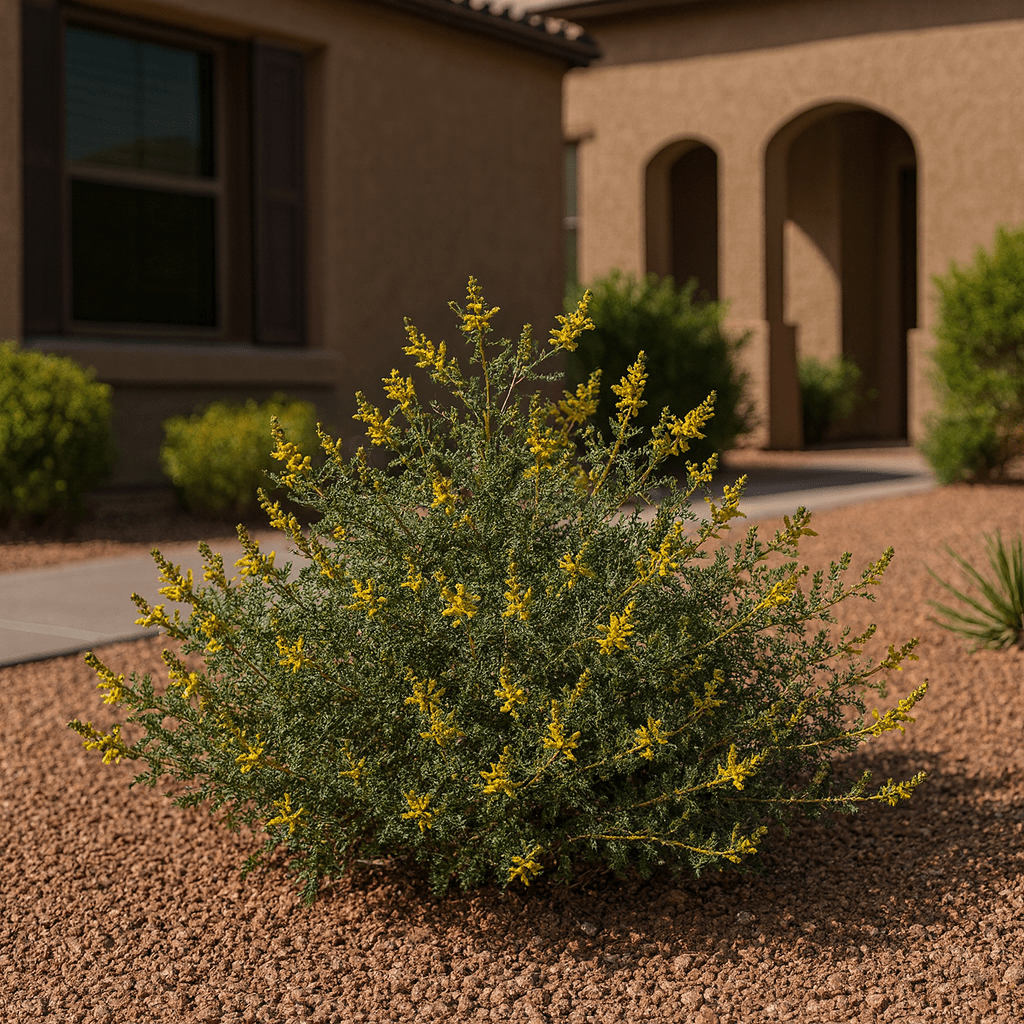


Yellow Dalea
Yellow Dalea
Couldn't load pickup availability
Phoenix's Best Low-Water Golden Groundcover: Yellow Dalea
Yellow Dalea (Dalea capitata) is one of the most underrated groundcovers in the Phoenix Valley: a low, fine-textured, semi-evergreen Chihuahuan Desert native from Mexico that covers itself in clusters of bright golden-yellow flowers in spring and again in fall. Heat-tough, drought-adapted, and virtually maintenance-free, it thrives in full sun across Scottsdale, Chandler, Mesa, and Gilbert with almost no supplemental irrigation once established. Whether you need a tidy low-growing filler, a pollinator-attracting border plant, or a water-wise alternative to traditional flowering shrubs, Yellow Dalea delivers.
Yellow Dalea Plant Details
| Attribute | Detail |
|---|---|
| Scientific Name | Dalea capitata |
| Common Names | Yellow Dalea, Capitata Dalea, Yellow Prairie Clover |
| Mature Height | 6–18 inches |
| Mature Width | 3–4 feet |
| Growth Rate | Moderate — 1–2 feet per year in Phoenix |
| Sun | Full sun (6+ hrs). Handles intense reflected heat from walls and pavement. |
| Water | Very low once established. Extremely drought-tolerant. |
| USDA Zones | 8–11 (Phoenix is Zone 9b–10a) |
| Soil | Well-draining. Tolerates rocky, sandy, and Arizona caliche soils. |
| Foliage | Semi-evergreen: fine-textured, lemon-scented bright green leaves; may drop leaves in a hard frost |
| Bloom Color | Bright golden yellow clusters |
| Bloom Season | Spring and fall |
Yellow Dalea Uses in Phoenix Landscapes
Spring & Fall Color in Low-Water Gardens
Yellow Dalea blooms twice a year, in spring and again in fall, so it brings bright golden-yellow color to the garden on both sides of the summer heat. The flower clusters pair beautifully with the silver and green textures of a desert planting. In Scottsdale and Paradise Valley xeriscapes, it's frequently used as a seasonal color anchor alongside Desert Marigold and Blackfoot Daisy. Plant in groups of 3–5 spaced 3 feet apart for a mass of golden color that draws immediate attention.
Low-Growing Borders & Groundcovers
At a compact 6–18 inches tall and 3–4 feet wide, Yellow Dalea is perfectly sized for front-of-border planting, low garden edging, and as a mounding groundcover alternative in Phoenix and Chandler landscapes. Its naturally tidy, dome-shaped form requires minimal or no pruning to maintain its shape, making it ideal for low-maintenance designed landscapes. Space plants 3 feet apart for a full, continuous low border effect.
Pollinator & Wildlife Gardens
Despite its small flower size, Yellow Dalea is a significant pollinator plant — it attracts native bees, butterflies, and other beneficial insects through its spring and fall bloom. In Mesa, Tempe, and Gilbert gardens designed to support pollinators, Yellow Dalea's fall flush provides a valuable late-season nectar source. It pairs exceptionally well with Autumn Sage, Desert Marigold, and Chuparosa in multi-season pollinator garden designs.
Xeriscape & Rock Garden Filler
Yellow Dalea's fine silver-green texture contrasts beautifully with coarser desert plants, making it an excellent filler in Phoenix xeriscapes and rock gardens. Its low-mounding form fills in gaps between boulders, accent plants, and shrubs while adding seasonal gold color. Try pairing it with Desert Spoon, Red Yucca, and Blue Nolina for a water-wise planting with dramatic textural variation.
Best Time to Plant Yellow Dalea in Phoenix
Fall (October–November) is the ideal planting window for Yellow Dalea in the Phoenix area — and the bonus is that you'll often see your first bloom display shortly after planting during the fall bloom season. The warm soil temperatures encourage rapid root establishment while cooler air temperatures reduce transplant stress significantly. Spring planting (February–April) is also a solid option. Avoid peak summer planting (June–August) when possible, as intense heat significantly stresses newly transplanted specimens.
How to Plant Yellow Dalea
- Dig wide, not deep — Excavate a hole 2–3x the width of the root ball and only as deep as the root ball. Yellow Dalea prefers its crown at or slightly above grade for best drainage.
- Check for caliche — Break through any hardpan caliche layer to ensure proper drainage. Yellow Dalea is highly sensitive to standing water around its roots.
- Backfill with native soil — Use excavated soil to backfill. Yellow Dalea actually prefers lean, native soils and does not need compost amendments.
- Spacing — Space 3 feet apart for borders and mass plantings; 4 feet for individual specimens with full room to spread.
- Build a water basin — Create a 3–4 inch earthen berm around the plant to concentrate irrigation water at the root zone during establishment.
- Mulch — Apply 2–3 inches of decomposed granite or gravel mulch to conserve moisture and moderate soil temperature.
Watering Yellow Dalea in Phoenix
First Year Watering Schedule
- Weeks 1–2: Water every 1–2 days, deep and slow (20–30 minutes) to thoroughly saturate the root ball and surrounding soil.
- Months 1–2: Reduce to every 3–4 days as roots begin establishing into native soil.
- Months 3–6: Water every 7–10 days (every 5–7 days during peak Phoenix summer heat).
- After Year 1: Extremely drought-tolerant. Water every 14–21 days in summer; monthly in winter, or rely on natural Phoenix rainfall entirely.
Drip Irrigation
Place drip emitters 12–18 inches from the plant base. Use 1 GPH emitters. Once established, Yellow Dalea is one of the most water-efficient groundcovers available for Phoenix landscapes — many mature plants thrive on rainfall alone in typical Phoenix winter and spring conditions with minimal supplemental irrigation even in summer.
When does Yellow Dalea bloom in Phoenix?
Yellow Dalea blooms twice a year in Phoenix: a spring flush and a fall flush. It is semi-evergreen and often drops its leaves after cold winter nights (around 25°F), then leafs out again in spring.
How big does Yellow Dalea get?
Yellow Dalea reaches 6–18 inches tall and 3–4 feet wide at maturity in Phoenix conditions. Its naturally mounding, dome-shaped form requires minimal pruning to maintain. It grows at a moderate rate, typically adding 1–2 feet per year under good conditions.
Is Yellow Dalea deer resistant?
Yes, Yellow Dalea has good deer resistance due to its aromatic foliage, which deer typically avoid. It's a reliable choice for properties near desert open space in Scottsdale, Cave Creek, and North Phoenix where deer browsing pressure can be significant.
Can Yellow Dalea handle Phoenix's full summer heat?
Yes — Yellow Dalea is native to the Chihuahuan Desert of northern Mexico and fully adapted to Phoenix's intense summer heat, including temperatures above 110°F. Once established, it may slow its growth during peak summer, then rebounds vigorously with fall rains and cooler temperatures. Expect some winter leaf drop after cold nights.
You May Also Like
- Black Dalea — The rich purple-flowering cousin of Yellow Dalea, perfect for combining for a complementary color contrast in the same border.
- Desert Marigold — Another brilliant yellow native wildflower for Phoenix that extends the yellow color theme through spring and summer.
- Autumn Sage — A long-blooming native salvia that bridges the gap between Yellow Dalea's fall bloom and the summer growing season.
- Brittlebush — Arizona's most iconic native shrub, with big spring yellow blooms that echo Yellow Dalea's spring flush.
- Damianita — A compact golden-flowering native shrub that pairs beautifully with Yellow Dalea in low-water xeriscape designs.
How Many Yellow Dalea Do I Need?
At a 3 to 4 foot mature width, space Yellow Dalea about 3 feet apart for a continuous low border or mounding groundcover effect, or plant in odd-numbered groups of 3 to 5 for a mass of spring and fall gold. Give a stand-alone specimen about 4 feet of room to fill into its tidy dome shape.
| Border Length | Plants Needed (3 ft spacing) |
|---|---|
| 10 ft | 4 |
| 20 ft | 7 |
| 30 ft | 11 |
Yellow Dalea Season-by-Season in Phoenix
- Spring (Feb to Apr): New foliage flushes after any winter leaf drop, followed by the spring bloom flush. A good second planting window once nights warm.
- Summer (May to Sep): Holds its low mound through full sun and reflected heat above 110°F. Growth slows in the worst heat, then rebounds with monsoon moisture and cooler nights.
- Fall (Oct to Nov): The star season. Golden flower clusters open heavily, and it is the prime planting window: roots establish fast and you often get bloom right away.
- Winter (Dec to Jan): Out of bloom. Semi-evergreen, so expect some or all leaves to drop after cold nights, but it is cold-hardy to about 15°F, so no cover is needed in a normal Valley winter.
At a Glance
✔ Pollinator-Friendly ✔ Heat-Loving (Reflected-Heat Tolerant) ✔ Drought-Tolerant ✔ Semi-Evergreen ✔ Low-Maintenance ✔ Deer & Rabbit-Resistant ✔ Cold-Hardy to 15°F
Plant It With
- Black Dalea: the purple-flowering cousin, for a two-tone Dalea border with staggered bloom.
- Desert Marigold: extends the yellow theme into spring and summer with airy native color.
- Damianita: another compact golden-flowering mound that echoes the fine texture.
- Brittlebush: a larger native that flowers gold in spring, overlapping Dalea's spring flush.
Is Yellow Dalea Right for Your Yard?
It thrives in full sun and reflected heat with fast-draining, lean soil, so break through caliche and skip the compost. It is ideal for low borders, rock gardens, and water-wise mass plantings where you want spring and fall color. It is not a fit for a low spot that holds water (it is sensitive to wet roots) or for a shaded bed where bloom and the tight mounding form both fall off.
Customer Reviews
Share