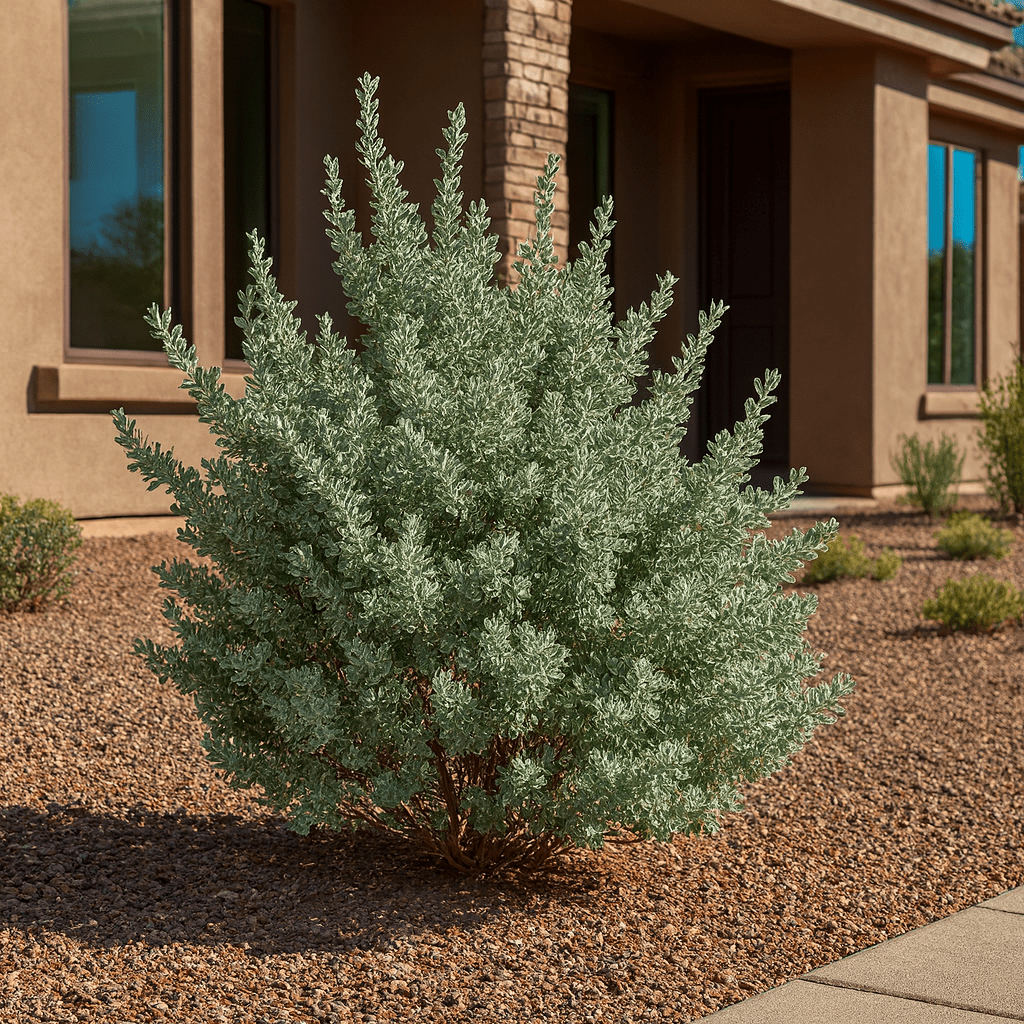

White Cloud
White Cloud
Couldn't load pickup availability
The Brightest White-Blooming Texas Sage for Phoenix Landscapes
White Cloud (Leucophyllum frutescens 'White Cloud') is one of the most striking Texas Sage varieties you can grow in the Phoenix Valley. This compact evergreen shrub features silvery-gray foliage that erupts with pure white tubular flowers after summer monsoon rains — a showstopping display that repeats multiple times per season. It's one of the few white-flowering desert shrubs that truly thrives in extreme Phoenix heat with zero supplemental water once established. Whether you're building a water-wise Scottsdale front yard, lining a Chandler driveway, or adding a flowering hedge to a Gilbert property — White Cloud delivers reliable beauty with almost no maintenance.
White Cloud Plant Details
| Attribute | Detail |
|---|---|
| Scientific Name | Leucophyllum frutescens 'White Cloud' |
| Common Names | White Cloud Texas Sage, White Cloud Sage, White Texas Ranger |
| Mature Height | 4–6 feet |
| Mature Width | 4–6 feet |
| Growth Rate | Moderate — 1–2 feet per year in Phoenix |
| Sun | Full sun (6+ hrs). Handles reflected heat from walls and pavement. |
| Water | Very low once established. Extremely drought-tolerant. |
| USDA Zones | 8–11 (Phoenix is Zone 9b–10a) |
| Soil | Well-draining. Thrives in Arizona caliche soils — avoid overamending. |
| Foliage | Evergreen — silvery-gray leaves year-round |
| Bloom Season | Summer through fall — triggered by humidity and monsoon rains |
White Cloud Uses in Phoenix Landscapes
Flowering Desert Hedge
White Cloud makes an outstanding informal hedge or screen along property lines, driveways, and fence lines. Space plants 4 feet apart for a dense, continuous hedge that blooms with pure white flowers after every monsoon storm. The silvery foliage provides year-round interest even between bloom cycles. A proven favorite for HOA-compliant xeriscape designs in Gilbert, Mesa, and Queen Creek.
Foundation & Border Planting
Use White Cloud as a foundation shrub along south or west-facing walls where it thrives in reflected heat. Its compact, rounded form needs minimal pruning to stay tidy. Plant 3–4 feet from the wall and 4 feet apart for a continuous border. The white blooms pop against adobe, stucco, and stone facades — a signature look for Scottsdale and Paradise Valley homes.
Water-Wise Accent & Mass Planting
Group 3–5 White Cloud plants in a desert bed for a dramatic mass planting that lights up with white flowers after summer rains. Combine with purple-flowering Texas Sage varieties like Heavenly Cloud or Rio Bravo for a stunning two-tone monsoon bloom display. Add Red Hesperaloe or Yellow Bells for complementary color in Peoria, Glendale, and Tempe landscapes.
Best Time to Plant White Cloud in Phoenix
Fall (October–November) is the ideal planting window. Warm soil and cooler air temperatures reduce transplant stress and give the shrub 6–8 months of root growth before its first Phoenix summer. Spring (February–April) is the second-best window. Avoid summer planting when possible — while White Cloud loves heat, new transplants struggle in 110°F temperatures.
How to Plant White Cloud
- Dig wide, not deep — 2–3x the root ball width, same depth as the nursery container.
- Check for caliche — break through any hardpan layer for drainage (Texas Sage rots in standing water).
- Backfill with native soil only — do NOT add compost or organic matter; Texas Sage thrives in lean, alkaline desert soil.
- Spacing — 4 feet apart for hedges; 5–6 feet for standalone specimens.
- Water basin — build a 3–4 inch ring to direct water to roots during establishment only.
- Mulch — 2–3 inches of gravel mulch (avoid organic mulch, which retains too much moisture).
Watering White Cloud in Phoenix
First Year Watering Schedule
- Weeks 1–2: Every 3–4 days, deep soak
- Month 1–3: Every 7–10 days
- Month 3–6: Every 10–14 days
- After Year 1: Little to no supplemental water needed — thrives on rainfall alone
Drip Irrigation
Place a single 1 GPH emitter 12 inches from the base during establishment. Once established (after 1 year), you can remove the emitter entirely. Overwatering is the #1 killer of Texas Sage — established plants actually bloom better when kept dry.
How fast does White Cloud grow in Phoenix?
At a moderate pace of 1–2 feet per year, reaching its full 4–6 foot size in 3–4 years. Larger nursery sizes (10–15 gallon) provide near-instant hedge coverage.
Why isn't my White Cloud blooming?
Texas Sage blooms are triggered by humidity, not watering. White Cloud typically blooms after monsoon storms when humidity rises above 50%. Overwatering actually reduces blooming. Be patient and let the monsoons do their work.
Can I prune it into a formal hedge?
You can, but it's not recommended. Hard pruning removes flower buds and produces an unnatural look. Instead, let it grow into its natural rounded shape and lightly tip-prune only if needed. The informal look is what makes Texas Sage so attractive.
What's the difference between White Cloud and other Texas Sage varieties?
White Cloud is the premier white-flowering variety. Most other Leucophyllum cultivars bloom in purple, violet, or lavender. The white flowers against silver foliage give it a unique, clean look that pairs beautifully with darker-flowered varieties.
You May Also Like
- Heavenly Cloud Sage — A purple-flowering Texas Sage that creates stunning contrast when planted alongside White Cloud.
- Yellow Bells — Bright yellow trumpet flowers that bloom all summer and complement the white blooms.
- Red Hesperaloe — Coral-red flower spikes that pair beautifully with the silvery foliage of Texas Sage.
- Ruellia — A low-growing purple groundcover that fills in nicely under White Cloud hedges.
How Many White Cloud Do I Need?
White Cloud matures at 4 to 6 feet wide and is set on 4 foot centers for a dense informal hedge, or 5 to 6 feet apart as standalone specimens. For a mass planting, group in odd numbers of 3 or 5. Use this table as a starting point at 4 foot spacing:
| Hedge Run | Plants Needed (4 ft spacing) |
| 20 ft | 6 plants |
| 30 ft | 8 plants |
| 40 ft | 11 plants |
| 60 ft | 16 plants |
White Cloud Season-by-Season in Phoenix
- Spring (Feb–Apr): Silvery foliage looks its cleanest and the plant pushes fresh growth as nights warm. A light tip-prune now shapes the shrub without sacrificing the summer flower show. Prime second planting window.
- Summer (May–Sep): The main event. White Cloud shrugs off extreme heat and reflected heat off walls, then bursts into pure white bloom within days of each monsoon storm as humidity climbs. No extra water needed once established. In fact, keeping it dry produces better flowering.
- Fall (Oct–Nov): Continued flushes of bloom on cooler, humid days and the best planting season of the year. Roots establish quickly in warm soil.
- Winter (Dec–Jan): Holds its silver-gray evergreen foliage through the cool months. Cold-hardy well below typical Valley frost (to about 10°F), so no winter protection is needed here.
At a Glance
✔ Evergreen ✔ Heat-Loving (Reflected-Heat Tolerant) ✔ Drought-Tolerant ✔ Pool-Friendly (Low-Litter) ✔ Pollinator-Friendly ✔ Low-Maintenance ✔ Deer & Rabbit-Resistant ✔ Cold-Hardy to 10°F
Plant It With
- Heavenly Cloud Sage: a purple-blooming Texas Sage for striking two-tone monsoon color.
- Yellow Bells: bright yellow trumpets that bloom all summer beside the white flowers.
- Red Hesperaloe: coral-red flower spikes that pop against the silvery foliage.
- Desert Ruellia: a low purple-flowering filler to plant in front of the hedge.
Is White Cloud Right for Your Yard?
White Cloud is ideal for a full-sun, low-water desert yard, a hot wall, or an HOA xeriscape where you want a clean white bloom and silver foliage with almost no care. It thrives in lean caliche soil and asks for next to no water once established. It is not a fit for a shady spot or a yard with poor drainage and frequent irrigation, since overwatering and wet feet are the fastest way to kill it. It also resists tight formal shearing, so skip it if you want a crisp clipped box.
Customer Reviews
Share