

Heavenly Cloud Sage
Heavenly Cloud Sage
Couldn't load pickup availability
Bright Blue Blooms That Love Phoenix Heat — Heavenly Cloud Sage
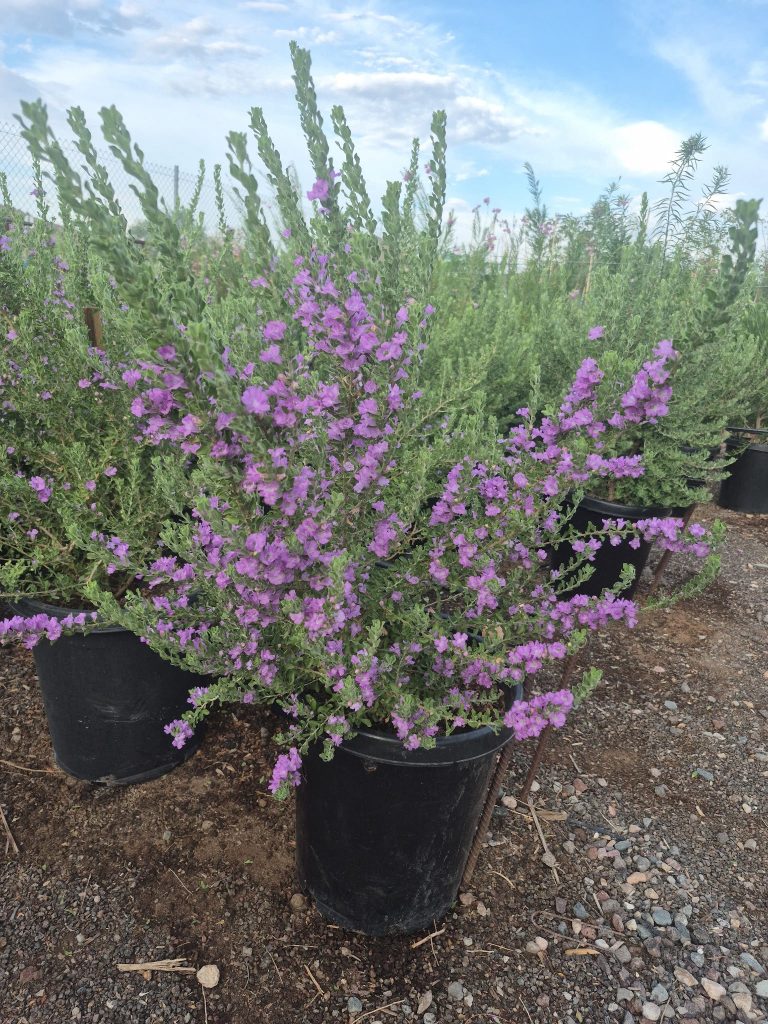
Leucophyllum frutescens 'Heavenly Cloud', commonly known as Heavenly Cloud Sage or Blue Ranger Sage, is one of the most vibrant-flowering Texas Sage varieties for Phoenix Valley landscapes. This compact evergreen shrub bursts with bright blue-purple flowers after summer monsoon rains, creating a stunning display against its silvery-green foliage. Whether you're building a drought-tolerant border in Scottsdale, adding color to a Chandler streetscape, or anchoring a xeriscape bed in Mesa — Heavenly Cloud Sage delivers reliable beauty with zero fuss.
Heavenly Cloud Sage Plant Details
| Attribute | Detail |
|---|---|
| Scientific Name | Leucophyllum frutescens 'Heavenly Cloud' |
| Common Names | Heavenly Cloud Sage, Blue Ranger Sage, Texas Sage |
| Mature Height | 4–5 feet |
| Mature Width | 4–5 feet |
| Growth Rate | Moderate — 1–2 feet per year in Phoenix |
| Sun | Full sun (6+ hrs). Handles reflected heat from walls and pavement. |
| Water | Very low once established. Highly drought-tolerant — overwatering causes problems. |
| USDA Zones | 8–11 (Phoenix is Zone 9b–10a) |
| Soil | Well-draining required. Thrives in Arizona caliche and rocky desert soils. |
| Foliage | Evergreen — silvery-green leaves year-round |
| Bloom Color | Bright blue to blue-purple, triggered by humidity and monsoon rains |
Heavenly Cloud Sage Uses in Phoenix Landscapes
Drought-Tolerant Foundation Planting
Heavenly Cloud Sage is a top choice for foundation beds along homes, commercial buildings, and HOA common areas throughout Phoenix. Its rounded, compact form stays tidy with minimal pruning. Plant 4–5 feet apart for a continuous border that erupts with blue blooms after every summer rain.
Xeriscape Color Accent
In water-wise landscapes across Gilbert, Tempe, and Peoria, Heavenly Cloud Sage provides the color punch that many desert gardens lack. The silvery foliage looks beautiful year-round, and the monsoon blooms are a showstopper. Pair with Yellow Bells, Red Bird of Paradise, or Gold Mound Lantana for a full-spectrum desert garden.
Low Privacy Hedge
Plant Heavenly Cloud Sage 3–4 feet apart to form a dense, informal hedge at 4–5 feet tall. It screens patios and property lines without needing supplemental irrigation once established. For a 20-foot hedge run, you'll need about 5–6 plants.
Best Time to Plant Heavenly Cloud Sage in Phoenix
Fall (October–November) is ideal for planting Heavenly Cloud Sage. Warm soil promotes rapid root establishment while cooler air reduces transplant stress. Your shrub will be deeply rooted and ready to bloom by its first monsoon season. Spring (February–April) is the second-best window. Avoid summer planting if possible, and never plant during active monsoon storms.
How to Plant Heavenly Cloud Sage
- Dig wide, not deep — 2–3x the root ball width, same depth as the container.
- Check for caliche — break through any hardpan layer for drainage. Texas Sage cannot tolerate standing water.
- Backfill with native soil only — do not amend heavily. Rich soil causes leggy, weak growth.
- Spacing — 3–4 feet apart for a hedge; 5–6 feet for individual specimens.
- Water basin — build a 3–4 inch soil ring to direct water to roots during establishment only.
- Mulch — 2–3 inches of gravel or decomposed granite. Avoid bark mulch that retains too much moisture.
Watering Heavenly Cloud Sage in Phoenix
First Year Watering Schedule
Weeks 1–2: Every 2–3 days, deep and slow. Month 1–2: Every 5–7 days. Month 3–6: Every 10–14 days. After Year 1: Little to no supplemental water needed. Natural rainfall and monsoons are sufficient for established plants.
Drip Irrigation
Place one 1-GPH emitter 12–18 inches from the trunk. Reduce frequency as the plant establishes. Overwatering Texas Sage leads to root rot and reduces flowering — when in doubt, water less.
How fast does Heavenly Cloud Sage grow in Phoenix?
Moderate growth at 1–2 feet per year. It reaches its full 4–5 foot size within 2–3 years in full sun with proper drainage.
Why isn't my Texas Sage blooming?
Texas Sage blooms are triggered by humidity, not irrigation. After monsoon rains or humid weather, your Heavenly Cloud Sage should burst into bloom within days. Overwatering can actually suppress flowering.
Is Heavenly Cloud Sage the same as Texas Sage?
Yes — Heavenly Cloud is a cultivar of Leucophyllum frutescens (Texas Sage). It is selected for its particularly bright blue flowers and compact growth habit compared to the standard species.
Does Heavenly Cloud Sage need pruning?
Minimal pruning needed. Light shaping in late winter keeps it compact. Never shear into a formal shape — let it maintain its natural rounded form for the best appearance and bloom production.
You May Also Like
Green Cloud Sage — Another Texas Sage variety with green foliage and lavender-purple blooms.
Chihuahuan Sage — Compact, silvery sage with purple flowers, great for smaller spaces.
Yellow Bells — Bright yellow trumpet flowers that pair beautifully with blue-blooming sages.
Gold Mound Lantana — Low-growing golden groundcover that complements Heavenly Cloud's silver foliage.
How Many Heavenly Cloud Sage Do I Need?
Heavenly Cloud Sage matures around 4 to 5 feet wide, so space plants about 4 feet apart center-to-center for a solid informal hedge or mass, and 5 feet apart for distinct rounded specimens. Use this guide for a continuous low screen:
| Hedge Run Length | Plants Needed (4 ft spacing) |
|---|---|
| 10 ft | 3 plants |
| 20 ft | 5 plants |
| 30 ft | 8 plants |
| 40 ft | 10 plants |
Heavenly Cloud Sage Season-by-Season in Phoenix
- Spring (Feb–Apr): Silver foliage flushes with new growth and scattered blue blooms appear on warm, humid days. A strong second planting window before summer heat arrives.
- Summer (May–Sep): Peak performance. Thrives in full sun and reflected heat off walls and pavement, and erupts into bright blue-purple flower flushes within days of monsoon rains and humidity spikes (Jul–Sep). No afternoon shade needed.
- Fall (Oct–Nov): Prime planting season and another round of bloom flushes as humid spells continue. Roots establish fast in still-warm soil.
- Winter (Dec–Jan): Holds its silvery evergreen structure through Valley winters. Cold-hardy to roughly 5°F, so Phoenix frosts do not faze it. Light shaping in late winter keeps the form tidy.
At a Glance
✔ Heat-Loving (Reflected-Heat Tolerant) ✔ Drought-Tolerant ✔ Pool-Friendly (Low-Litter) ✔ Evergreen ✔ Low-Maintenance ✔ Pollinator-Friendly ✔ Deer & Rabbit-Resistant ✔ Cold-Hardy to 5°F
Plant It With
- Green Cloud Sage: a green-leaved Texas Sage cousin that alternates bloom flushes for layered desert color.
- Chihuahuan Sage: a finer, more compact silvery sage for the front of the same bed.
- Arizona Yellow Bells: bright yellow trumpets that contrast beautifully with the blue blooms.
- Red Yucca: an architectural accent whose coral spikes feed hummingbirds alongside the sage.
Is Heavenly Cloud Sage Right for Your Yard?
Heavenly Cloud Sage thrives in full sun and reflected heat, needs sharp drainage (break through caliche and skip rich amendments), and asks for very little water once established, making it ideal for low-water borders, hedges, and HOA beds across the Valley. It is not a fit if your bed stays wet or shaded: soggy roots and deep shade cause root rot and stop the blooms.
Customer Reviews
Nice addition to our backyard.
Share