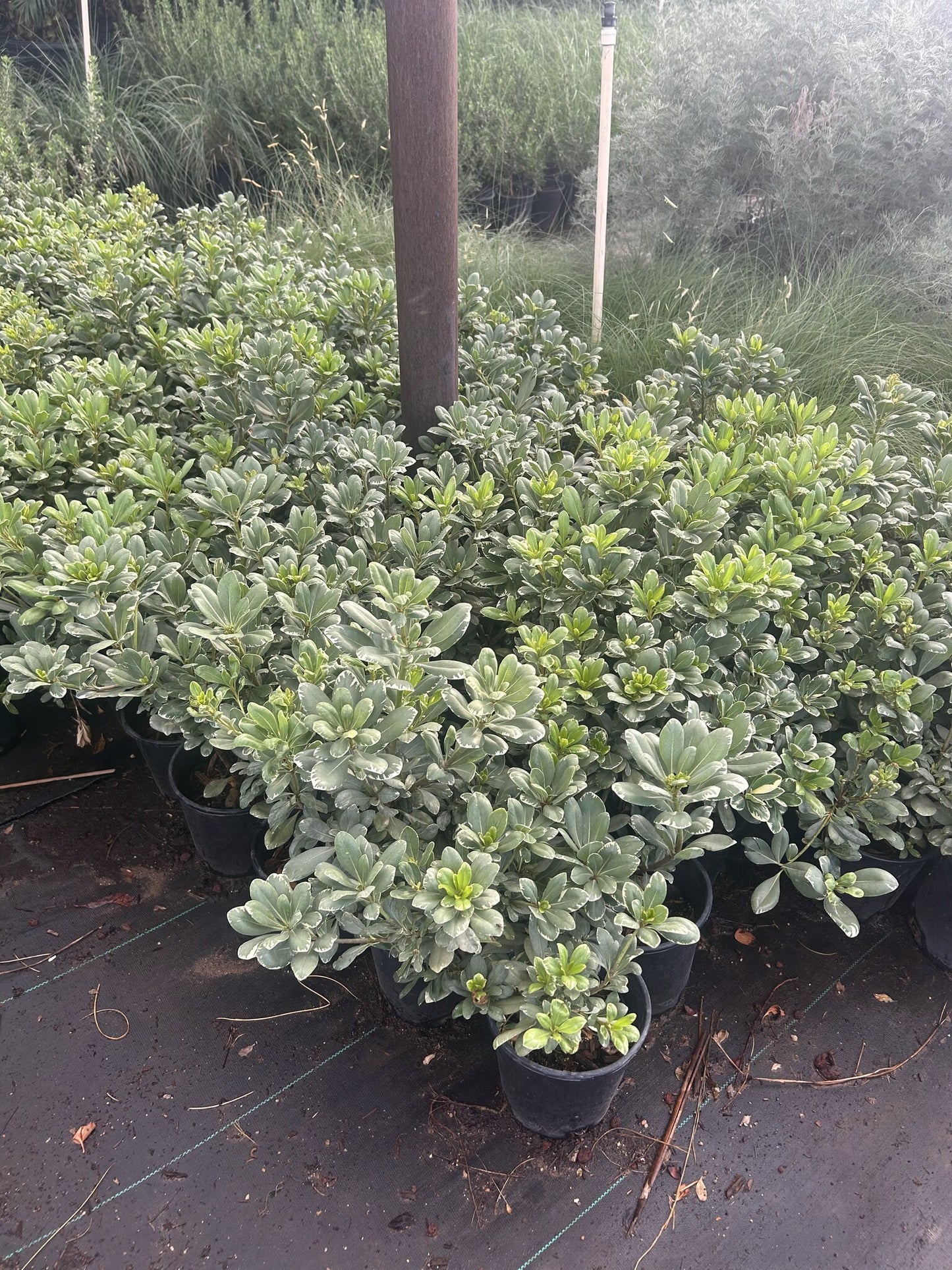


Variegated Pittosporum
Variegated Pittosporum
Couldn't load pickup availability
Phoenix's Best Variegated Privacy Shrub — Variegated Pittosporum
Variegated Pittosporum (Pittosporum tobira 'Variegata') brings bright, luminous foliage and classic evergreen structure to Phoenix landscapes. Its creamy white and gray-green variegated leaves catch light beautifully — creating a shrub that looks polished and intentional in any setting. Dense, compact, and remarkably heat-tolerant for a variegated plant, it forms an attractive privacy screen or foundation shrub with minimal care. Whether you're brightening a shaded corner in Scottsdale, creating a refined border hedge in Chandler, or adding a light-reflecting accent in Mesa — Variegated Pittosporum delivers year-round beauty with little fuss.
Variegated Pittosporum Plant Details
| Attribute | Detail |
|---|---|
| Scientific Name | Pittosporum tobira 'Variegata' |
| Common Names | Variegated Pittosporum, Variegated Mock Orange, Japanese Pittosporum |
| Mature Height | 6–10 feet (easily maintained shorter) |
| Mature Width | 6–10 feet |
| Growth Rate | Moderate — 1–2 feet per year in Phoenix |
| Sun | Full sun to partial shade. Afternoon shade beneficial in peak summer. |
| Water | Low to moderate once established. |
| USDA Zones | 8–11 (Phoenix is Zone 9b–10a) |
| Soil | Well-draining. Adapts to Arizona caliche soils with amendment. |
| Foliage | Evergreen — creamy white and gray-green variegated leaves year-round |
| Bloom | Small white fragrant flowers in spring |
Variegated Pittosporum Uses in Phoenix Landscapes
Privacy Screening & Foundation Planting
Variegated Pittosporum forms a dense, rounded shrub that works beautifully as a medium-height privacy screen. Its tight branching structure fills in to create a solid visual barrier at 6–10 feet. Planted along fences, property lines, or building foundations in Scottsdale, Tempe, and Gilbert, it provides year-round screening with the added bonus of fragrant spring blooms. Spacing guide: plant 5–6 feet apart for a privacy hedge; 6–8 feet apart for a looser informal screen.
Bright Border & Accent Shrub
The luminous cream-and-gray-green variegated foliage brightens darker landscape areas and creates a striking contrast against dark block walls, deep green hedges, and terracotta hardscape. Use as a repeating accent plant along a mixed shrub border in Mesa or Chandler — its consistent color provides visual rhythm without the seasonal variability of flowering plants.
Shaded & Semi-Shaded Areas
Variegated Pittosporum handles partial shade better than most privacy shrubs — making it one of the best choices for north-facing walls, shaded courtyards, and areas beneath patio covers where direct sun is limited. In full shade, growth slows and foliage may lose some contrast; it performs best in bright filtered light or morning sun with afternoon shade in Phoenix summers.
Container & Courtyard Planting
Variegated Pittosporum's refined form and bright foliage make it excellent for large containers in Phoenix patios, entryways, and pool surrounds. In containers it can be shaped and maintained at a smaller size while providing year-round color and structure.
Best Time to Plant Variegated Pittosporum in Phoenix
Fall (October–November) is ideal — mild temperatures encourage root establishment without heat stress, giving the plant 6–8 months to root before its first Phoenix summer. Spring (February–April) is the second-best window. Avoid summer planting; Variegated Pittosporum appreciates moderate temperatures during establishment and can scorch in extreme summer heat if planted without adequate irrigation.
How to Plant Variegated Pittosporum
- Dig wide, not deep — 2–3x the root ball width, same depth as the container.
- Check for caliche — break through hardpan and amend soil with 20–30% organic compost.
- Backfill with amended soil — Pittosporum appreciates improved drainage and some organic matter.
- Spacing — 5–6 ft apart for a privacy hedge; 6–8 ft for informal borders.
- Water basin — build a 3–4 inch earthen ring to direct water to the root zone.
- Mulch — 2–3 inches of bark mulch retains moisture and keeps roots cool.
Watering Variegated Pittosporum in Phoenix
First Year Watering Schedule
- Weeks 1–2: Every 1–2 days, deep and slow (20–30 min drip)
- Months 1–2: Every 3–4 days
- Months 3–6: Every 7–10 days (every 5–7 days in peak summer)
- After Year 1: Every 10–14 days in summer; every 3–4 weeks in winter
Drip Irrigation
Place 1–2 GPH emitters 18–24 inches from the base of each plant. Once established, Variegated Pittosporum is moderately drought-tolerant and performs well on a once-weekly deep watering in summer. Consistent soil moisture produces the best foliage color and density.
How fast does Variegated Pittosporum grow in Phoenix?
Moderately — expect 1–2 feet of new growth per year under good conditions. It reaches its mature 6–10 foot height over 4–6 years. For faster coverage, purchase larger gallon sizes from Three Timbers for immediate visual impact.
Can Variegated Pittosporum take full Phoenix sun?
Yes, with adequate irrigation. It performs best in full sun to partial shade. In south- and west-facing full sun exposures, afternoon shade or consistent irrigation is important to prevent leaf scorch. In partially shaded areas, it's one of the most reliable variegated privacy shrubs available.
Does Variegated Pittosporum bloom?
Yes — in spring (March–April), it produces small clusters of creamy white flowers with a sweet, jasmine-like fragrance. While not a primary flowering shrub, the scented blooms are a pleasant seasonal bonus on an already beautiful evergreen privacy plant.
How is Variegated Pittosporum different from Mock Orange Pittosporum?
Mock Orange Pittosporum (Pittosporum tobira) has uniform dark green foliage. The variegated form ('Variegata') has cream-edged leaves that add brightness and visual contrast. Both have the same care requirements and fragrant white spring flowers; the variegated form is chosen for its light-catching foliage effect.
How often should I prune Variegated Pittosporum?
One or two light shape-ups per year — in late winter (February–March) and again in early fall (September) — are sufficient to maintain a tidy form. Avoid heavy pruning; Pittosporum responds best to light, frequent shaping rather than hard cuts.
You May Also Like
- Mock Orange Pittosporum — The classic deep green version of the same species — a refined, uniform-colored companion or alternative to the variegated form.
- Dwarf Pittosporum — A compact, lower-growing Pittosporum for border and edging use in front of taller variegated specimens.
- Variegated Boxwood Beauty — A more compact variegated shrub for lower hedges and borders alongside Variegated Pittosporum.
- Wax Leaf Privet — A fast-growing evergreen for taller background hedging — a great companion for filling height quickly behind Pittosporum plantings.
- Japanese Boxwood — A classic dense green hedge plant for formal borders in front of Variegated Pittosporum privacy screens.
How Many Variegated Pittosporum Do I Need?
Variegated Pittosporum fills 6 to 10 feet wide, so space plants about 6 feet on center for a solid privacy hedge or wider for an informal screen. Use this guide:
| Hedge Length | Plants at 6 ft Spacing |
|---|---|
| 12 ft | 2 plants |
| 24 ft | 4 plants |
| 30 ft | 6 plants |
| 42 ft | 8 plants |
As a bright accent or container specimen, give it 6 or more feet of clearance so the rounded form fills out evenly.
Variegated Pittosporum Season-by-Season in Phoenix
- Spring (Feb-Apr): Clusters of sweet, jasmine-scented white flowers open in March and April. Fresh variegated growth flushes. Good secondary planting window.
- Summer (May-Sep): Holds up to heat best with morning sun and afternoon shade plus steady water. On a hot west wall the cream leaves can scorch, so keep the drip consistent and avoid bare reflected heat.
- Fall (Oct-Nov): Prime planting season. Mild air and warm soil set up strong root growth before winter.
- Winter (Dec-Jan): Evergreen and cold-hardy through Valley winters. The bright foliage carries the bed when flowering plants rest; no frost protection needed in Phoenix.
At a Glance
✔ Evergreen ✔ Pollinator-Friendly ✔ Drought-Tolerant ✔ Pool-Friendly (Low-Litter) ✔ Low-Maintenance ✔ Cold-Hardy to 15°F
Plant It With
- Mock Orange Pittosporum: the solid deep-green form for a calm backdrop to the variegation.
- Dwarf Pittosporum: a low matching front-of-border edge below the taller screen.
- Wax Leaf Privet: a fast evergreen to fill height quickly behind the planting.
- Japanese Boxwood: a tidy formal green hedge to frame the bright foliage.
Is Variegated Pittosporum Right for Your Yard?
Variegated Pittosporum is at its best in bright filtered light or morning sun with afternoon shade, in well-draining soil amended for drainage, with steady moderate water, as a privacy screen, bright border, or container accent. Not a fit for raw west-facing reflected heat with no irrigation, where the cream foliage tends to scorch.
Customer Reviews
Share