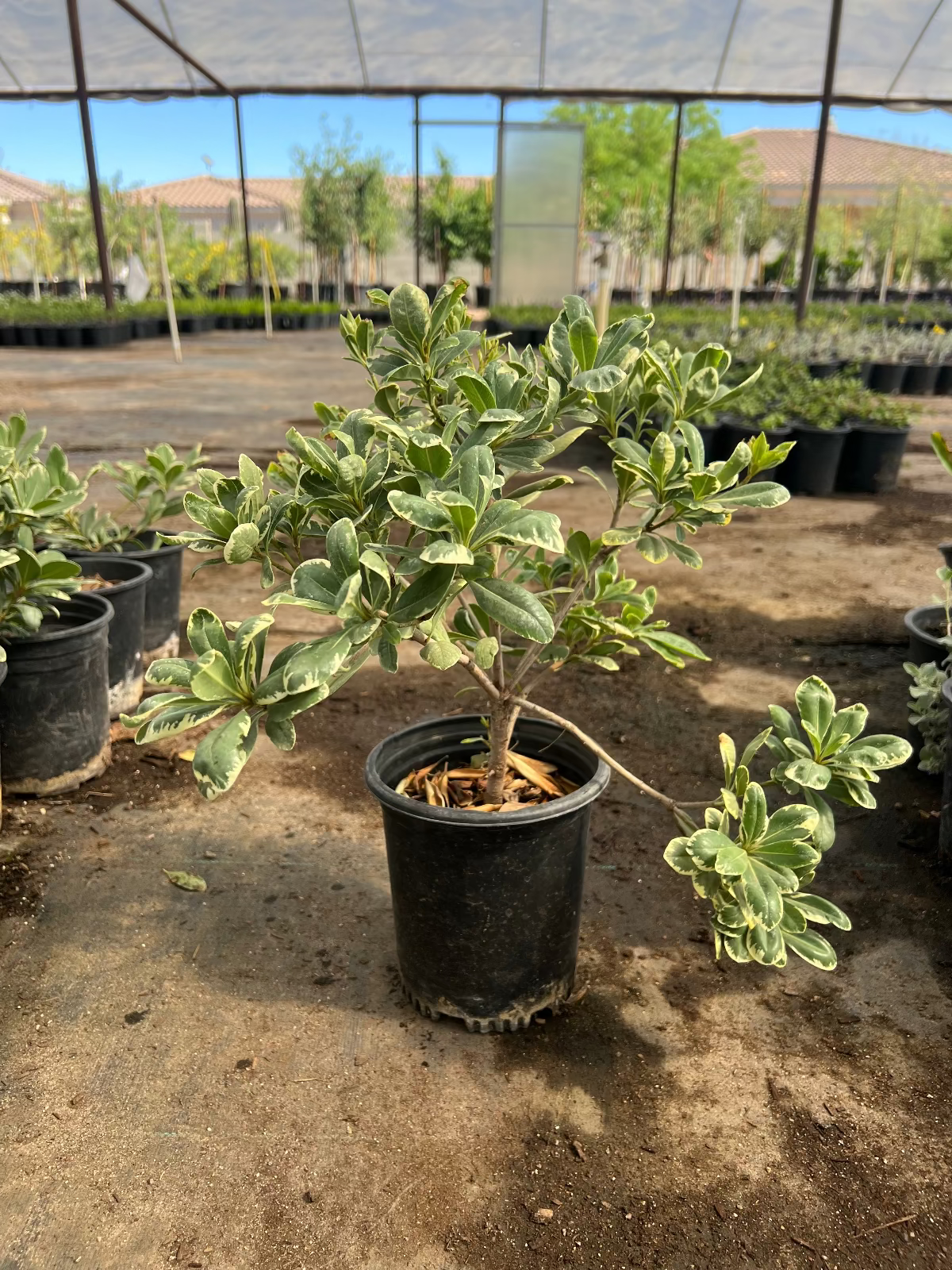


Mock Orange Pittosporum
Mock Orange Pittosporum
Couldn't load pickup availability
Phoenix's Most Fragrant Evergreen Privacy Shrub — Mock Orange Pittosporum
Mock Orange Pittosporum (Pittosporum tobira) is Phoenix's go-to fragrant evergreen shrub — beloved for its glossy dark green foliage, dense branching structure, and intoxicating sweet orange blossom scent every spring. One of the most reliable medium-height privacy shrubs in the Valley, it grows steadily to 6–10 feet while remaining easy to shape and maintain. Whether you're creating a lush privacy screen in Scottsdale, edging a foundation in Chandler, or framing an entryway in Gilbert — Mock Orange Pittosporum delivers year-round beauty and spring fragrance that makes neighbors stop and ask what's blooming.
Mock Orange Pittosporum Plant Details
| Attribute | Detail |
|---|---|
| Scientific Name | Pittosporum tobira |
| Common Names | Mock Orange, Japanese Pittosporum, Tobira |
| Mature Height | 6–10 feet (easily maintained shorter) |
| Mature Width | 6–10 feet |
| Growth Rate | Moderate — 1–2 feet per year in Phoenix |
| Sun | Full sun to partial shade. Adapts well to most exposures. |
| Water | Low to moderate once established. |
| USDA Zones | 8–11 (Phoenix is Zone 9b–10a) |
| Soil | Well-draining. Adapts to Arizona caliche soils with amendment. |
| Foliage | Evergreen — glossy dark green leaves year-round |
| Bloom | Fragrant white flowers (orange blossom scent), spring |
Mock Orange Pittosporum Uses in Phoenix Landscapes
Privacy Screening & Foundation Planting
Mock Orange Pittosporum is one of the most popular privacy shrubs in Phoenix for good reason — it grows steadily, stays dense without aggressive pruning, and looks polished in any landscape style. Its glossy dark green foliage creates a clean, formal backdrop along fences, walls, and property lines. Planting density guide: 20 ft fence — 3–4 plants spaced 5–6 ft apart; 40 ft fence — 7–8 plants.
Fragrant Garden & Sensory Border
When Mock Orange blooms in spring (March–April), the sweet fragrance is unmistakable — similar to orange blossoms or jasmine. Plant near patios, entryways, windows, and outdoor seating areas in Tempe, Mesa, and Peoria to fill the spring air with natural fragrance. Few shrubs make as strong a sensory impact at this size.
Foundation & Building Screen
Mock Orange's dense, rounded form makes it ideal for foundation plantings along homes, offices, and walls. It softens hard architectural edges with lush greenery while providing practical screening for utility areas, HVAC units, and service entrances. Plant 4–5 feet from the foundation to allow for mature spread.
Formal Hedge & Low-Maintenance Border
With minimal pruning, Mock Orange Pittosporum maintains a tidy, rounded form that works beautifully as a formal hedge. It responds well to shaping and can be maintained at almost any height from 3 to 10 feet. For a formal hedge look, prune once in early spring after flowering and once in early fall to shape.
Best Time to Plant Mock Orange Pittosporum in Phoenix
Fall (October–November) is ideal — mild temperatures allow deep root establishment before summer, giving plants 6–8 months to settle in before Phoenix heat arrives. Spring (February–April) is the second-best option. Avoid summer planting; while Mock Orange is tougher than many shrubs, it establishes much better in moderate temperatures with adequate water.
How to Plant Mock Orange Pittosporum
- Dig wide, not deep — 2–3x the root ball width, same depth as the container.
- Check for caliche — break through hardpan and amend with 20–30% organic compost for best results.
- Backfill with amended soil — Pittosporum performs better with improved drainage and some organic matter.
- Spacing — 5–6 ft apart for a privacy hedge; 6–8 ft for informal screens.
- Water basin — build a 3–4 inch earthen ring to direct water to roots.
- Mulch — 2–3 inches of bark mulch retains moisture and keeps roots cool in Phoenix summer heat.
Watering Mock Orange Pittosporum in Phoenix
First Year Watering Schedule
- Weeks 1–2: Every 1–2 days, deep and slow (20–30 min drip)
- Months 1–2: Every 3–4 days
- Months 3–6: Every 7–10 days (every 5–7 days in peak summer)
- After Year 1: Every 10–14 days in summer; every 3–4 weeks in winter
Drip Irrigation
Place 1–2 GPH emitters 18–24 inches from the base of each plant. Once established, Mock Orange is moderately drought-tolerant and handles deep weekly watering in summer well. Consistent soil moisture produces the best foliage density and spring bloom performance.
How fast does Mock Orange Pittosporum grow in Phoenix?
Moderately — expect 1–2 feet of growth per year under good irrigation. It reaches its mature height of 6–10 feet over 4–6 years. Larger gallon sizes from Three Timbers provide immediate privacy impact while the plants continue filling out.
Can Mock Orange Pittosporum handle Phoenix summer heat?
Yes, especially when established. In full sun Phoenix exposures, consistent summer irrigation is important during the first 1–2 years. Once established, it handles Valley heat very well and rarely shows heat stress with adequate watering.
Does Mock Orange Pittosporum really smell like oranges?
Yes — it's one of the most distinctly fragrant shrubs in the Phoenix landscape. In spring (March–April), the creamy white blooms release a powerful sweet fragrance almost identical to orange blossoms. Near patios and entryways, the scent is noticeable from several feet away.
How often should I prune Mock Orange Pittosporum?
Once or twice per year is sufficient. Prune lightly after the spring bloom cycle (May) to shape and encourage new growth. A second light trim in early fall (September) keeps it tidy through winter. Avoid heavy pruning — Mock Orange responds best to gentle, frequent shaping.
How is Mock Orange different from Variegated Pittosporum?
Mock Orange Pittosporum has uniform glossy dark green foliage. Variegated Pittosporum has cream-edged leaves that add brightness. Both have the same fragrant spring blooms and care requirements. Mock Orange is the classic choice for formal hedging; Variegated is chosen for color and visual contrast.
You May Also Like
- Variegated Pittosporum — The cream-and-green variegated form of the same species — identical care and fragrance with bright, light-catching foliage.
- Dwarf Pittosporum — A compact, lower-growing Pittosporum for border and edging use in front of Mock Orange privacy screens.
- Wax Leaf Privet — A faster-growing evergreen alternative for taller privacy hedges when Mock Orange's moderate pace is too slow.
- Japanese Boxwood — A classic dense evergreen hedge plant that pairs beautifully with Mock Orange in formal landscape designs.
- Roman Myrtle — A fragrant, compact evergreen shrub that makes an excellent low companion hedge beneath Mock Orange privacy screens.
How Many Mock Orange Pittosporum Do I Need?
With a mature width of 6 to 10 feet, space plants about 5.5 feet on center for a dense privacy hedge, or 6 to 8 feet for a looser informal screen. Use the table below to estimate plant counts at hedge spacing.
| Hedge Run Length | Plants Needed (5.5 ft spacing) |
|---|---|
| 20 ft | 4 plants |
| 30 ft | 6 plants |
| 40 ft | 8 plants |
| 60 ft | 11 plants |
| 80 ft | 15 plants |
For foundation planting, set each shrub 4 to 5 feet off the wall so the mature canopy has room without crowding the house. As a single rounded specimen, give it a 6 to 8 foot clear footprint.
Mock Orange Pittosporum Season-by-Season in Phoenix
- Spring (Feb–Apr): Creamy white flowers open in March and April, filling the air with sweet orange-blossom fragrance. Shape lightly right after bloom and enjoy a flush of glossy new growth.
- Summer (May–Sep): Holds dense green foliage through Valley heat with steady deep watering. Young plants in full reflected-heat exposures benefit from consistent summer irrigation; established plants take the heat well. Monsoon humidity is generally welcome as long as soil drains.
- Fall (Oct–Nov): Prime planting season. Cooling temperatures and warm soil let new plants root in fast before winter. A light second trim keeps the form tidy.
- Winter (Dec–Jan): Stays fully evergreen and structural through the cool season. Cold-hardy to about 15°F, so it shrugs off normal Valley frost with little to no damage.
At a Glance
✔ Evergreen ✔ Drought-Tolerant ✔ Heat-Loving (Reflected-Heat Tolerant) ✔ Pool-Friendly (Low-Litter) ✔ Pollinator-Friendly ✔ Low-Maintenance ✔ Cold-Hardy to 15°F
Plant It With
- Dwarf Pittosporum: the compact cousin, perfect as a low border in front of a Mock Orange screen.
- Japanese Boxwood: a classic dense evergreen for formal hedging that pairs cleanly with Mock Orange.
- Dwarf Myrtle: a fragrant low evergreen hedge to layer beneath taller Mock Orange plantings.
- Green Euonymus: another glossy evergreen that reinforces a polished, formal green backdrop.
Is Mock Orange Pittosporum Right for Your Yard?
Mock Orange Pittosporum is a strong fit for full sun to partial shade where you want a dense, glossy, fragrant evergreen screen in well-drained or amended caliche soil. Give it room for a 6 to 10 foot spread and it forms a polished privacy wall with spring fragrance and minimal fuss. It is not the best choice for a tight xeric, water-off bed, since it likes amended soil and deep regular watering more than ultra-low-water desert natives do.
Share