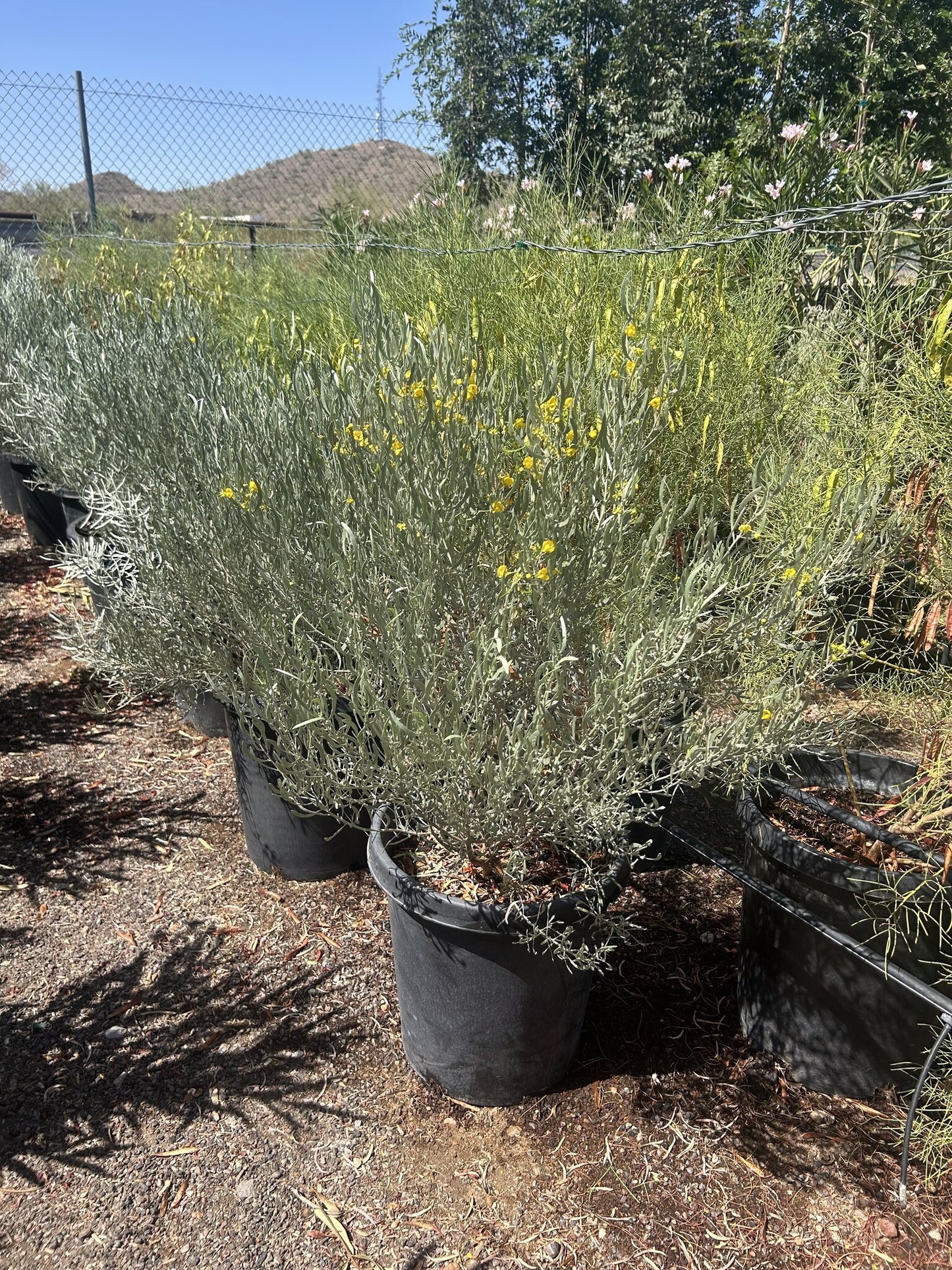


Silvery Cassia
Silvery Cassia
Couldn't load pickup availability
Phoenix's Most Striking Silver Desert Shrub — Silvery Cassia
Silvery Cassia (Cassia phyllodinea) is one of the most visually dramatic low-water shrubs available for Phoenix Valley landscapes. Its stunning silvery-blue foliage and brilliant yellow flower clusters create an eye-catching combination that thrives in full sun and extreme desert heat. Growing 4–6 feet tall and wide, it's a standout choice for homeowners in Scottsdale designing a bold xeriscape, in Chandler creating a low-maintenance focal point, or in Tempe and Mesa adding year-round silvery structure to their desert gardens.
Silvery Cassia Plant Details
| Attribute | Detail |
|---|---|
| Scientific Name | Cassia phyllodinea |
| Common Names | Silvery Cassia, Silver Cassia, Sickle-Leaf Cassia |
| Mature Height | 4–6 feet |
| Mature Width | 4–6 feet |
| Growth Rate | Fast — 1–2+ feet per year in Phoenix's warm climate |
| Sun | Full sun (6+ hrs). Thrives in reflected heat from walls and pavement. |
| Water | Very low once established. Highly drought-tolerant after first growing season. |
| USDA Zones | 9–11 (Phoenix is Zone 9b–10a — ideal) |
| Soil | Well-draining. Adapts well to Arizona caliche soils with proper drainage. |
| Foliage | Evergreen — striking silver-blue phyllodes (flattened leaf stalks) year-round |
| Flower Color | Bright yellow clusters; blooms winter through spring |
| Wildlife Value | Attracts native bees and butterflies; deer-resistant |
Silvery Cassia Uses in Phoenix Landscapes
Bold Focal Point and Specimen Plant
With its striking silver-blue foliage and brilliant yellow blooms, Silvery Cassia commands attention as a standalone specimen plant in landscape beds. Its naturally mounding, rounded form doesn't need pruning to look polished. Place it as a centerpiece in a desert rock garden surrounded by contrasting textures like Desert Spoon, Agave, or Mexican Feather Grass for a professional-quality design.
Low-Water Privacy Screening
At 4–6 feet tall, Silvery Cassia can function as a mid-height privacy screen or border shrub in Phoenix yards. Plant 4–5 feet apart for a continuous screen. For a 20-foot border, use 4–5 plants. Pair with Green Hopseed Bush for a taller backdrop, or with Desert Ruellia for a lower colorful foreground.
Modern Xeriscape and Rock Garden Design
Silvery Cassia is perfectly suited for modern xeriscape designs that prioritize dramatic texture over water use. The silver-blue foliage creates a cool visual contrast against warm desert rock, decomposed granite, and terracotta-toned walls typical of Phoenix Valley homes. Plant alongside Purple Three Awn or Nashville Grass for a stunning multi-textural composition.
Winter Color in the Phoenix Landscape
Unlike many desert plants that bloom in summer, Silvery Cassia puts on its best flower show in winter and early spring — brightening up Phoenix yards when most other plants are dormant. The bright yellow blooms against silver foliage are particularly striking from December through March, making it an excellent choice for winter landscape interest.
Best Time to Plant Silvery Cassia in Phoenix
Fall (October–November) is the ideal planting window. Warm soil temperatures promote root establishment while cooler air reduces transplant stress. Plants get 6–8 months to root in before their first Phoenix summer. Spring (February–April) also works well. Avoid planting in peak summer (June–August) if possible — Silvery Cassia establishes most reliably when planted during cooler months.
How to Plant Silvery Cassia
- Dig wide, not deep — make the hole 2–3 times the root ball width, same depth as the root ball.
- Check for caliche — break through any hardpan caliche layer to ensure proper drainage.
- Backfill with native soil — Silvery Cassia prefers lean, well-draining soil; avoid heavy organic amendments.
- Spacing — plant 4–5 feet apart for screens; 6 feet for individual specimens.
- Water basin — build a 3–4 inch raised soil ring to direct water to root zone.
- Mulch — apply 2–3 inches of gravel or bark mulch to retain moisture and regulate soil temperature.
Watering Silvery Cassia in Phoenix
First Year Watering Schedule
Weeks 1–2: Water every 1–2 days, deep and slow (20–30 minutes). Month 1–2: Reduce to every 3–4 days. Month 3–6: Water every 7–10 days (every 5–7 days in peak summer heat). After Year 1: Silvery Cassia is highly drought-tolerant — water every 3–4 weeks in summer, every 4–6 weeks in winter. Established plants often survive on natural Phoenix rainfall alone.
Drip Irrigation
Place 1–2 GPH emitters 18–24 inches from the base of the plant. Avoid overwatering — Silvery Cassia is prone to root rot in waterlogged soils. As the plant matures, move emitters outward toward the drip line for most efficient water delivery.
How fast does Silvery Cassia grow in Phoenix?
Silvery Cassia is a fast grower — typically adding 1–2+ feet per year in Phoenix's warm climate. In optimal full-sun conditions, plants can reach their mature 4–6 foot height within 2–3 years of planting.
Is Silvery Cassia evergreen in Phoenix?
Yes — Silvery Cassia is fully evergreen in Phoenix's climate, retaining its distinctive silver-blue foliage year-round. This makes it an excellent choice for year-round landscape structure and privacy.
Does Silvery Cassia need pruning?
Minimal pruning is needed. Silvery Cassia naturally maintains a tidy, rounded mounding form. Light shaping after the bloom period can encourage denser growth, but it looks attractive even unpruned.
Can Silvery Cassia handle Phoenix summer heat?
Absolutely — Silvery Cassia is one of Phoenix's most heat-tolerant shrubs. It thrives in full sun, reflected heat from walls, and triple-digit temperatures without wilting or dropping leaves.
You May Also Like
Desert Cassia — A closely related species with bright yellow blooms and a similar heat-tolerant profile, great for companion planting.
Outback Cassia — Another drought-tolerant Cassia variety with bold yellow flowers suited to Phoenix desert landscapes.
Texas Sage (Leucophyllum) — A purple-flowering silver-leaf shrub that pairs beautifully with Silvery Cassia's yellow blooms for a complementary color palette.
Desert Spoon (Dasylirion wheeleri) — A structural accent with silver-gray foliage that creates a cohesive silver-toned desert design alongside Silvery Cassia.
Purple Three Awn — A fine-textured native grass whose burgundy tones contrast dramatically with Silvery Cassia's silver foliage.
How Many Silvery Cassia Do I Need?
At 4 to 6 feet wide, space plants about 5 feet on center for a continuous mid-height screen, or 6 feet apart if you want each rounded silver mound to stand on its own. As a focal specimen, a single plant or an odd-numbered group of 3 spaced 6 feet apart reads best in a rock garden.
| Screen Length | Plants Needed (5 ft spacing) |
|---|---|
| 10 ft | 2 plants |
| 20 ft | 4 plants |
| 30 ft | 6 plants |
| 50 ft | 10 plants |
Silvery Cassia Season-by-Season in Phoenix
- Spring (Feb to Apr): Tail end of the main bloom, with bright yellow flowers fading into a strong flush of silver-blue growth. A solid second planting window before summer.
- Summer (May to Sep): Thrives in extreme and reflected heat with no afternoon shade needed. Foliage holds its silver color through triple-digit days; monsoon storms give it a free deep soak.
- Fall (Oct to Nov): Prime planting season. Cooler air and warm soil let new plants root in, and the first yellow buds often begin to set late in the season.
- Winter (Dec to Jan): Peak flower show, covered in yellow clusters when most desert plants are quiet. Stays evergreen and hardy to about 25°F, with only light tip damage possible in a hard Valley frost.
At a Glance
✔ Heat-Loving (Reflected-Heat Tolerant) ✔ Drought-Tolerant ✔ Evergreen ✔ Pollinator-Friendly ✔ Low-Maintenance ✔ Deer & Rabbit-Resistant ✔ Cold-Hardy to 25°F
Plant It With
- Desert Cassia: a closely related yellow-blooming cassia for an extended cool-season flower show.
- Outback Cassia: another tough yellow-flowering cassia that layers different bloom timing into the bed.
- Texas Sage: purple-flowering silver-leaf shrub that complements the yellow blooms and silver foliage.
- Desert Spoon: architectural silver-gray rosette that ties together a cohesive silver-toned desert design.
Is Silvery Cassia Right for Your Yard?
Silvery Cassia is a strong choice for full-sun, low-water beds with sharp drainage, including hot reflected-heat exposures against walls and pavement. It loves caliche soil kept on the lean, dry side and rewards you with winter color when little else blooms. It is not a fit for soggy or heavily shaded beds, or right over a pool deck, since it drops seed pods that add litter.
Customer Reviews
Share