

Outback Cassia
Outback Cassia
Couldn't load pickup availability
Phoenix's Best Year-Round Yellow Blooming Shrub — Outback Cassia
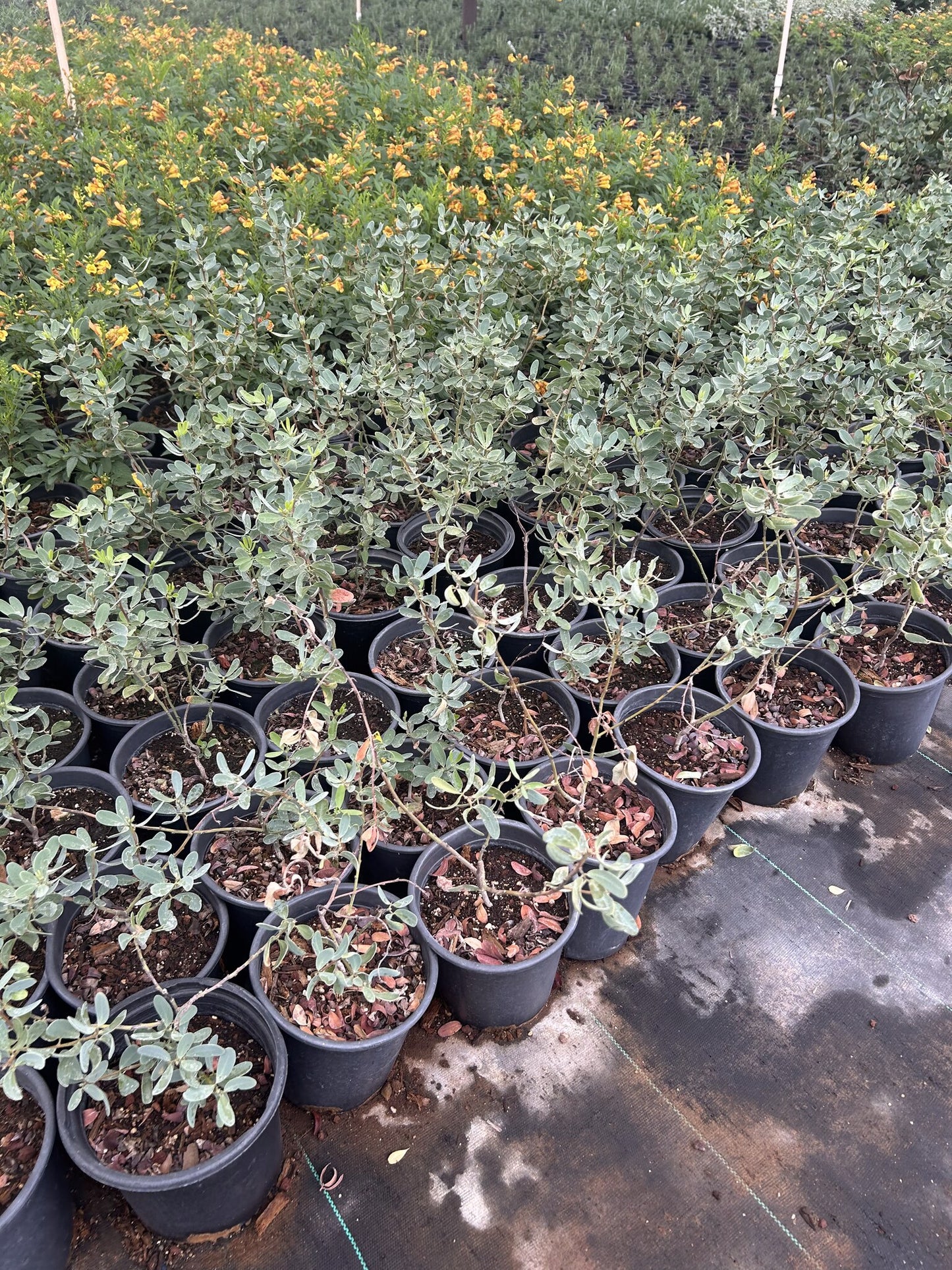
Outback Cassia (Cassia oligophylla) is one of Phoenix's most reliable long-blooming desert shrubs, producing cheerful bright yellow flower clusters nearly year-round in Arizona's warm climate. Native to Australia, this tough evergreen shrub thrives in full sun and extreme heat, making it perfectly adapted to Phoenix Valley conditions. Growing 4–6 feet tall and wide with a naturally rounded, dense habit, it's a top choice for homeowners in Scottsdale seeking effortless color, in Chandler adding structure to xeriscape beds, or in Mesa and Gilbert creating low-water focal points that never disappoint.
Outback Cassia Plant Details
| Attribute | Detail |
|---|---|
| Scientific Name | Cassia oligophylla |
| Common Names | Outback Cassia, Few-Leafed Cassia, Australian Cassia |
| Mature Height | 4–6 feet |
| Mature Width | 4–6 feet |
| Growth Rate | Moderate to fast — 1–2 feet per year in Phoenix's warm climate |
| Sun | Full sun (6+ hrs). Handles reflected heat from walls and pavement. |
| Water | Very low once established. One of Phoenix's most drought-tolerant flowering shrubs. |
| USDA Zones | 9–11 (Phoenix is Zone 9b–10a — ideal) |
| Soil | Well-draining. Adapts to Arizona caliche soils with proper drainage. |
| Foliage | Evergreen — stays green and full year-round |
| Flower Color | Bright yellow clusters; blooms nearly year-round in Phoenix |
| Origin | Native to Australia; highly adapted to dry, hot desert climates |
| Wildlife Value | Attracts native bees and butterflies; deer-resistant |
Outback Cassia Uses in Phoenix Landscapes
Year-Round Color Focal Point
Unlike many desert plants with a single brief bloom season, Outback Cassia produces its cheerful yellow flowers nearly year-round in Phoenix's warm climate. This makes it an invaluable anchor plant in landscape beds where consistent color is the goal. Plant as a specimen in a decomposed granite bed surrounded by contrasting textures like Desert Spoon or Agave for a professional-quality focal point that never goes dull.
Low-Water Privacy and Border Shrub
At 4–6 feet, Outback Cassia works beautifully as a mid-height border shrub or privacy screen. Its dense, rounded habit fills in naturally without aggressive pruning. For a 20-foot property border, plant 4–5 plants spaced 5 feet apart. Pair with Silvery Cassia or Desert Cassia for a complementary all-cassia border with varied foliage textures and continuous yellow blooms.
Modern Xeriscape Design
Outback Cassia's clean, mounding form and bright yellow blooms make it a standout in modern xeriscape designs. The cheerful yellow color contrasts beautifully against gravel, decomposed granite, and desert boulders — creating a vibrant, low-maintenance landscape that honors Phoenix's desert aesthetic without sacrificing color or texture.
Mass Planting for HOA-Approved Landscapes
Outback Cassia's consistent size, tidy habit, and low water requirements make it a favorite for HOA-approved xeriscape designs in the Phoenix Valley. Plant in groups of 3–5 for bold color impact in any landscape zone. Space 5–6 feet apart for individual form, or 4 feet apart for a continuous mass of yellow blooms.
Best Time to Plant Outback Cassia in Phoenix
Fall (October–November) is the ideal planting window. Warm soil temperatures support root establishment while cooler air temperatures reduce transplant stress — plants get 6–8 months of root development before facing their first Phoenix summer. Spring (February–April) is the second-best window. Avoid summer planting if possible; if planting in summer, provide extra irrigation and monitor closely during the first 4–6 weeks.
How to Plant Outback Cassia
- Dig wide, not deep — excavate a hole 2–3 times the root ball width, same depth as the root ball.
- Check for caliche — break through any hardpan caliche layer to ensure proper drainage beneath the root zone.
- Backfill with native soil — lean native soil is preferred; avoid heavy organic amendments that retain excess moisture.
- Spacing — plant 5–6 feet apart for borders; 6–8 feet for individual specimens.
- Water basin — build a 3–4 inch raised soil ring to direct water to the root zone.
- Mulch — apply 2–3 inches of gravel or bark mulch to retain soil moisture and regulate temperature.
Watering Outback Cassia in Phoenix
First Year Watering Schedule
Weeks 1–2: Water every 1–2 days, deep and slow (20–30 minutes). Month 1–2: Reduce to every 3–4 days. Month 3–6: Water every 7–10 days (every 5–7 days in peak summer heat). After Year 1: Outback Cassia is highly drought-tolerant — water every 3–4 weeks in summer; every 4–6 weeks in winter. Established plants often survive on natural Phoenix rainfall alone in normal years.
Drip Irrigation
Place 1–2 GPH emitters 18–24 inches from the base of the plant. Outback Cassia is intolerant of overwatering and waterlogged soils — always allow soil to dry between deep irrigation cycles. Move emitters outward toward the drip line as the plant matures for the most efficient water delivery.
How long does Outback Cassia bloom in Phoenix?
Outback Cassia is one of Phoenix's longest-blooming shrubs — producing yellow flowers nearly year-round in the Phoenix Valley's warm climate, with peak bloom periods in spring and fall. Even in winter, mild Phoenix temperatures allow for continued intermittent blooming.
Does Outback Cassia need pruning?
Minimal pruning is needed. Outback Cassia naturally maintains a tidy, rounded mounding form. Light shaping after peak bloom periods encourages denser new growth, but it looks attractive even without regular pruning.
Is Outback Cassia the same as Desert Cassia or Silvery Cassia?
No — these are distinct species. Outback Cassia (Cassia oligophylla) is native to Australia. Desert Cassia is typically Senna covesii (a native Arizona species), and Silvery Cassia is Cassia phyllodinea. All produce yellow flowers but have different foliage, size, and growth habits.
Can Outback Cassia handle Phoenix summer heat and reflected heat?
Yes — Outback Cassia is one of the toughest yellow-flowering shrubs for Phoenix's climate, thriving in full sun, reflected heat from walls and pavement, and triple-digit temperatures without wilting or dropping leaves.
You May Also Like
Silvery Cassia — A related Cassia with striking silver-blue foliage and bright yellow blooms, ideal for a complementary silver-and-yellow design palette.
Desert Cassia — A native Arizona Cassia with a more compact form and similar cheerful yellow blooms for smaller spaces.
Texas Sage (Leucophyllum) — A purple-flowering silver-leaf shrub that pairs beautifully with Outback Cassia for a bold yellow-purple color contrast.
Desert Bird of Paradise — A tall, dramatic yellow-blooming native shrub for large landscape areas needing maximum color impact.
Green Desert Spoon — A bold structural accent that provides textural contrast alongside Outback Cassia's soft, rounded mounding form.
How Many Outback Cassia Do I Need?
With a mature width of 4 to 6 feet, space plants about 5 feet on center for a continuous border or low screen, or 4 feet apart for a dense mass of yellow. Use the table below to estimate plant counts by run length.
| Border Run Length | Plants Needed (5 ft spacing) |
|---|---|
| 10 ft | 2 plants |
| 20 ft | 4 plants |
| 30 ft | 6 plants |
| 40 ft | 8 plants |
| 50 ft | 10 plants |
As a single year-round color focal point, give each plant a 5 to 6 foot clear footprint. For bold impact in a granite bed, group 3 to 5 plants spaced 4 to 5 feet apart.
Outback Cassia Season-by-Season in Phoenix
- Spring (Feb–Apr): One of the two peak bloom periods, with heavy clusters of bright yellow flowers and a flush of new growth. Prime second planting window and the best time for a light shaping.
- Summer (May–Sep): Thrives in triple-digit and reflected heat off walls and pavement without wilting. Blooms ease in the most extreme heat, then often pick back up with monsoon moisture (Jul–Sep).
- Fall (Oct–Nov): Prime planting season and the second strong bloom peak as temperatures cool. Roots establish fast in warm fall soil.
- Winter (Dec–Jan): Stays evergreen and often keeps blooming intermittently through mild Valley winters. Hardy to roughly 25°F; a hard freeze can nip the tips, but plants recover quickly in spring. Cover young plants on the coldest nights.
At a Glance
✔ Pollinator-Friendly ✔ Heat-Loving (Reflected-Heat Tolerant) ✔ Drought-Tolerant ✔ Evergreen ✔ Low-Maintenance ✔ Deer & Rabbit-Resistant ✔ Cold-Hardy to 25°F
Plant It With
- Desert Cassia: a native Arizona cassia with similar yellow blooms for an all-cassia border with varied texture.
- Texas Sage: silver foliage and purple flowers for a bold yellow-and-purple color contrast.
- Desert Bird of Paradise: a taller yellow bloomer to layer behind Outback Cassia for maximum color.
- Green Desert Spoon: a spiky structural accent that contrasts the soft rounded cassia form.
Is Outback Cassia Right for Your Yard?
Outback Cassia is an excellent fit for a full-sun, low-water bed in well-drained or caliche soil where you want near year-round yellow color with very little upkeep, including hot reflected-heat spots along walls and driveways. It rewards lean soil and infrequent deep watering. It is not the best choice for a shaded spot or a bed that stays wet, since it resents overwatering and blooms and grows best in bright sun with sharp drainage.
Customer Reviews
Share