

Cooperi Mesquite
Cooperi Mesquite
Couldn't load pickup availability
Phoenix's Top Compact Desert Shade Tree — Cooperi Mesquite
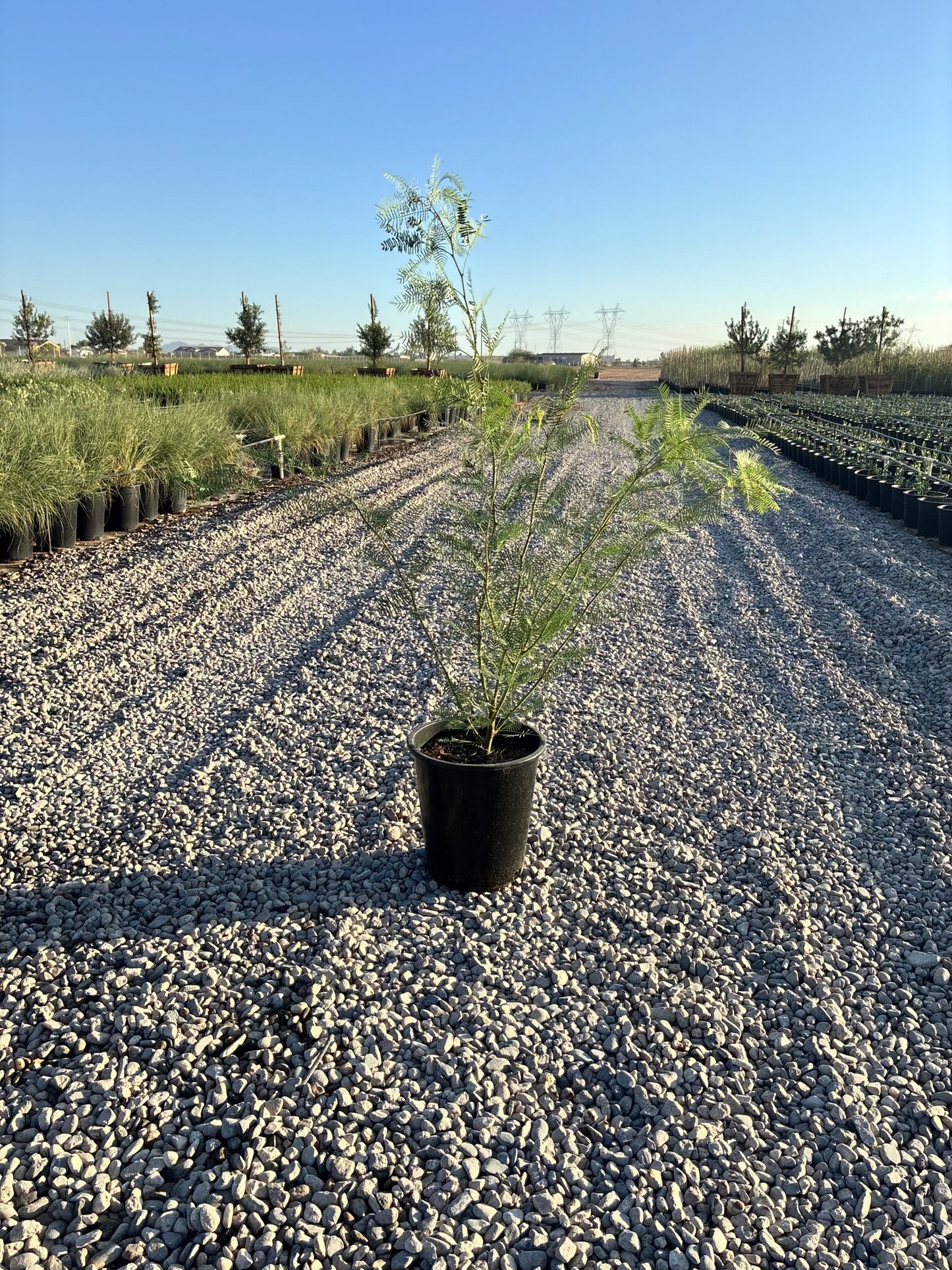
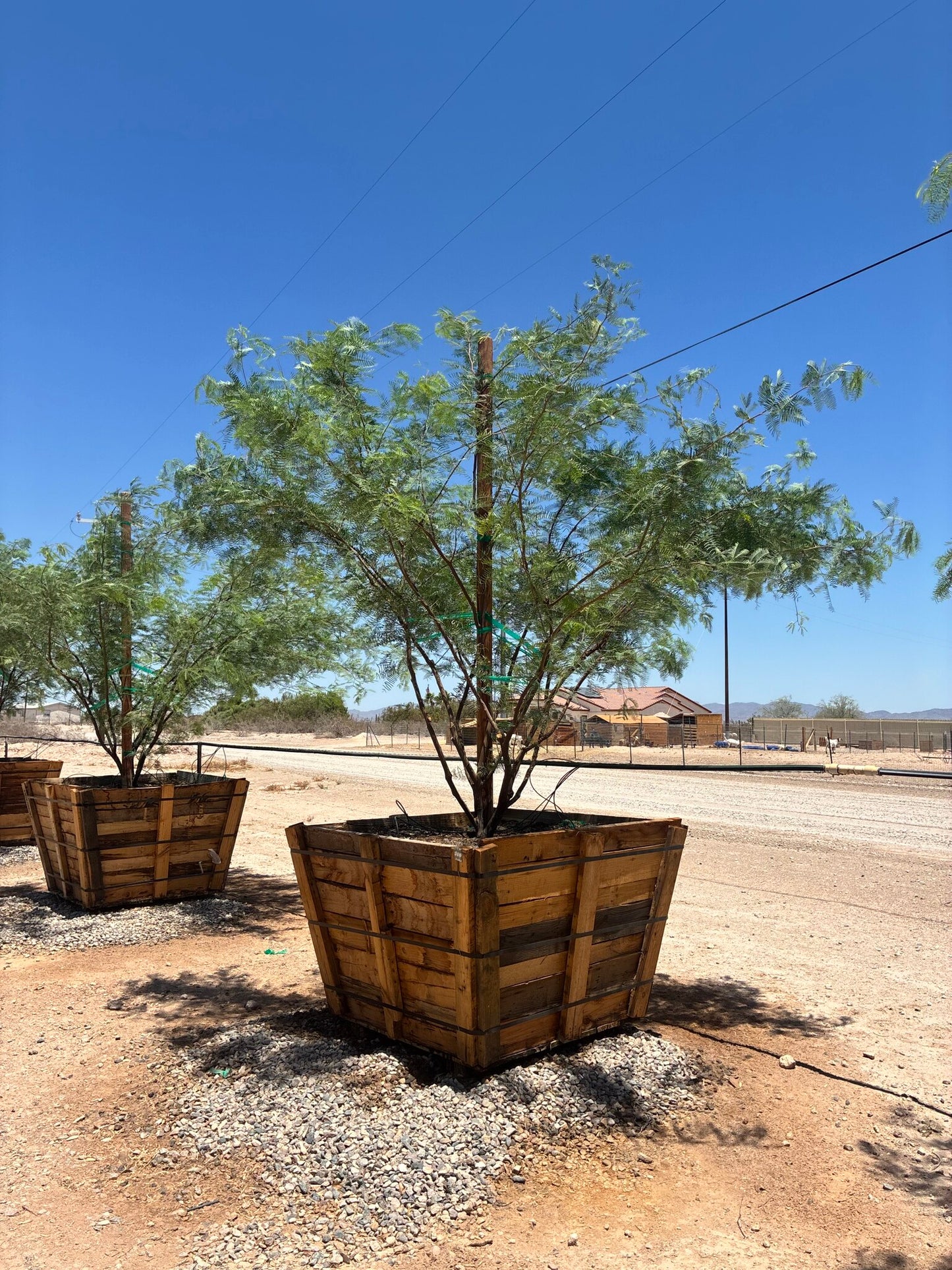
Cooperi Mesquite (Prosopis 'Cooperi') is a highly regarded hybrid mesquite cultivar prized throughout the Phoenix Valley for its refined, compact growth habit, symmetrical canopy, and exceptional adaptability to desert conditions. Unlike the sprawling wild mesquite, the Cooperi develops a well-structured form that suits residential and commercial landscapes — fast-growing, drought-tolerant, and naturally beautiful. Whether you're planting in Scottsdale, Mesa, Chandler, or Glendale, Cooperi Mesquite is a versatile desert shade tree that delivers season after season.
Cooperi Mesquite Plant Details
| Attribute | Detail |
|---|---|
| Scientific Name | Prosopis 'Cooperi' |
| Common Names | Cooperi Mesquite, Cooper's Mesquite |
| Mature Height | 20–30 feet |
| Mature Width | 20–30 feet |
| Growth Rate | Fast — 3–5 feet per year in Phoenix with establishment watering |
| Sun | Full sun (6+ hrs). Thrives in reflected heat from walls and pavement. |
| Water | Very low once established. Highly drought-tolerant. |
| USDA Zones | 9–11 (Phoenix is Zone 9b–10a) |
| Soil | Well-draining. Adapts well to Arizona's alkaline and caliche soils. |
| Foliage | Deciduous — drops leaves in winter, leafs out in early spring |
| Bloom | Fragrant yellowish-white catkins in spring, February–April |
| Canopy Form | Compact, symmetrical — more refined than standard native mesquites |
Cooperi Mesquite Uses in Phoenix Landscapes
Compact Shade Tree for Mid-Size Yards
The Cooperi Mesquite's 20–30 foot mature size makes it an ideal choice for mid-size yards across the Phoenix Valley where a full-sized shade tree is desired but space is a consideration. Its well-proportioned canopy delivers meaningful afternoon shade without overwhelming smaller lots in Chandler, Gilbert, or Tempe neighborhoods. Plant on the west or southwest side of the home to maximize cooling benefits during Phoenix's intense summer afternoons.
Streetscape and HOA-Approved Desert Tree
Cooperi Mesquite's tidy, predictable growth habit and naturally attractive form make it a popular choice for HOA landscapes, streetside planting, and commercial developments across Scottsdale and the East Valley. Its relatively contained canopy spread is easier to manage than the sprawling native mesquites, and it requires far less pruning to maintain a clean appearance. Space plants 20–25 feet apart for a canopy-covered walkway or drive line.
Drought-Tolerant Xeriscape Anchor
Once established, the Cooperi Mesquite requires almost no supplemental irrigation — making it one of the most water-efficient shade trees available for Phoenix xeriscape designs. Pair it with Red Bird of Paradise, Desert Spoon, Agave, and Texas Sage for a full, resort-quality low-water landscape that thrives in the Phoenix Valley without ongoing irrigation expense. Its deep taproot actively seeks subsurface moisture, reducing dependence on surface watering over time.
Pool-Friendly Patio Shade
Cooperi Mesquite's fine, compound leaflets make it a popular choice for pool and patio shade in Phoenix-area homes. The tiny leaflets sink quickly and are far less problematic for pool filtration than large-leafed shade trees. Plant 15–20 feet from the pool edge to keep root systems clear of the pool shell while still delivering overhead shade to the lounge and entertainment areas in Peoria, Tempe, or Mesa.
Best Time to Plant Cooperi Mesquite in Phoenix
Fall planting (October–November) is the ideal window for the Phoenix Valley. Warm soil encourages root development while cooler air temperatures reduce transplant stress — giving the tree 6–8 months of root establishment before its first Phoenix summer. Spring planting (February–April) is the second-best option. Avoid summer planting when possible, as newly planted trees require intensive irrigation management during triple-digit heat.
How to Plant Cooperi Mesquite
- Dig wide, not deep — excavate a hole 2–3x the root ball width at the same depth. Cooperi develops a wide lateral root system that benefits from a broad planting area.
- Check for caliche — probe the bottom of the hole for hard caliche layers. Break through any hardpan to allow drainage and taproot growth.
- Backfill with native soil — use the excavated desert soil. An optional 20% compost amendment is fine.
- Spacing — plant 20–25 feet from structures and other large trees; 15–20 feet from pools.
- Build a water basin — create a 3–4 inch earthen ring around the drip line to direct irrigation water to the root zone.
- Mulch — apply 2–3 inches of bark mulch or decomposed granite to conserve moisture and moderate root zone temperature.
Watering Cooperi Mesquite in Phoenix
First Year Watering Schedule
Consistent deep watering during establishment helps roots develop quickly. Water slowly and deeply — 20–30 minutes per session — to promote downward root growth.
- Weeks 1–2: Every 1–2 days
- Months 1–2: Every 3–4 days
- Months 3–6: Every 7–10 days (every 5–7 days in peak summer heat)
- After Year 1: Every 10–14 days in summer; every 3–4 weeks in winter
Drip Irrigation
Place emitters 18–24 inches from the trunk, at the canopy drip line. Use 1–2 GPH emitters running 60–90 minutes per session during the first growing season. Once established, Cooperi Mesquite becomes highly drought-tolerant and requires minimal supplemental water throughout the Phoenix Valley.
How fast does Cooperi Mesquite grow in Phoenix?
Cooperi Mesquite is a fast grower — expect 3–5 feet of new growth per year during the establishment phase. With proper irrigation and fall planting, trees can reach 10–15 feet within 2–3 seasons.
Is Cooperi Mesquite drought tolerant?
Yes — highly so. Like all mesquites, the Cooperi variety is deeply adapted to desert conditions and requires very little supplemental water once its root system is established, typically after year 2.
What's the difference between Cooperi and Leslie Roy Mesquite?
The Cooperi Mesquite is generally a bit more compact (20–30 feet) compared to Leslie Roy (25–35 feet). Both are refined hybrid cultivars with better growth habits than wild mesquites, but Leslie Roy tends to develop the largest and most symmetrical canopy of the two. Cooperi is often the preference for slightly tighter spaces or where a proportionally smaller tree is desired.
Does Cooperi have thorns?
Cooperi Mesquite may have some thorns, though fewer and less aggressive than wild native mesquites. If a completely thornless option is required, consider the Thornless Texas Honey Mesquite or Chilean Fuente Mesquite.
Is it a good tree for near a pool?
Yes — the Cooperi's fine compound leaflets are among the least intrusive of any shade tree for pool settings. Keep the trunk 15–20 feet from the pool edge.
You May Also Like
- Leslie Roy Mesquite — A larger-canopy hybrid mesquite cultivar, ideal when maximum shade coverage is the priority in Scottsdale or Paradise Valley.
- Chilean Fuente Mesquite — A premium thornless mesquite hybrid with an elegant weeping canopy and very fast growth.
- Thornless Texas Honey Mesquite — A completely thornless mesquite variety ideal for family yards and pool areas.
- Desert Museum Palo Verde — Phoenix's top flowering desert tree, great for adding brilliant yellow spring color alongside mesquite.
- Foothill Palo Verde — Arizona's toughest native tree with photosynthetic green bark and ultra-low-water requirements.
How Many Cooperi Mesquite Do I Need?
Cooperi is a compact 20 to 30 foot shade tree, planted singly as a specimen or spaced out for a shade line. Use this guide to estimate counts:
| Goal | Spacing | Trees needed |
|---|---|---|
| Single mid-size-yard or patio shade tree | n/a | 1, set on the west or southwest side |
| Matched pair flanking a drive or entry | 22 ft apart | 2 |
| Canopy walkway or drive line, 60 ft | 20 to 25 ft on center | 3 |
| Canopy walkway or drive line, 100 ft | 20 to 25 ft on center | 4 to 5 |
Give each tree 20 to 25 feet of clearance from walls and other canopies, and keep the trunk 15 to 20 feet off a pool shell.
Cooperi Mesquite Season-by-Season in Phoenix
- Spring (Feb–Apr): Leafs out early and pushes fragrant yellowish catkins that draw bees. Strong second planting window.
- Summer (May–Sep): Peak shade season. Thrives in triple-digit heat and reflected heat off walls and pavement, and flushes growth with monsoon rain (Jul–Sep). Stake young trees, since fast monsoon growth can outpace root anchorage.
- Fall (Oct–Nov): Best planting season in the Valley. Canopy holds green and full into late fall.
- Winter (Dec–Jan): Drops its leaves and shows a tidy, symmetrical branch structure. Hardy to about 15°F, so established trees handle normal Valley frost; protect only newly planted ones in a hard freeze.
At a Glance
✔ Pollinator-Friendly ✔ Heat-Loving (Reflected-Heat Tolerant) ✔ Drought-Tolerant ✔ Low-Maintenance ✔ Shade-Providing ✔ Cold-Hardy to 15°F
Plant It With
- Leslie Roy Mesquite: a larger-canopy hybrid mesquite for spots that can take maximum shade coverage.
- Chilean Fuente Mesquite: a premium near-thornless weeping mesquite for a refined matched planting.
- Desert Museum Palo Verde: thornless yellow-flowering desert tree for bright spring color beside the mesquite.
- Foothill Palo Verde: ultra-low-water Arizona native with green bark for a true desert layer.
Is Cooperi Mesquite Right for Your Yard?
Cooperi thrives in full sun and reflected heat, in well-drained alkaline or caliche soil, and suits mid-size lots that cannot take a full 35-foot canopy. It is fast, very water-thrifty once established, and frost-hardy to about 15°F. The fine leaflets are genuinely low-litter for a shade tree, but it can carry variable thorns, so for a truly thornless pool or play-area tree choose the Chilean Fuente or a thornless mesquite instead. Not a fit if: you want an evergreen, since it drops its leaves in winter. Stake young trees and thin the canopy periodically to limit monsoon wind-throw.
Customer Reviews
Love it. Excited to watch it grow.
Share