

Desert Museum Palo Verde
Desert Museum Palo Verde
Couldn't load pickup availability
The Best Thornless Palo Verde for Phoenix — Desert Museum
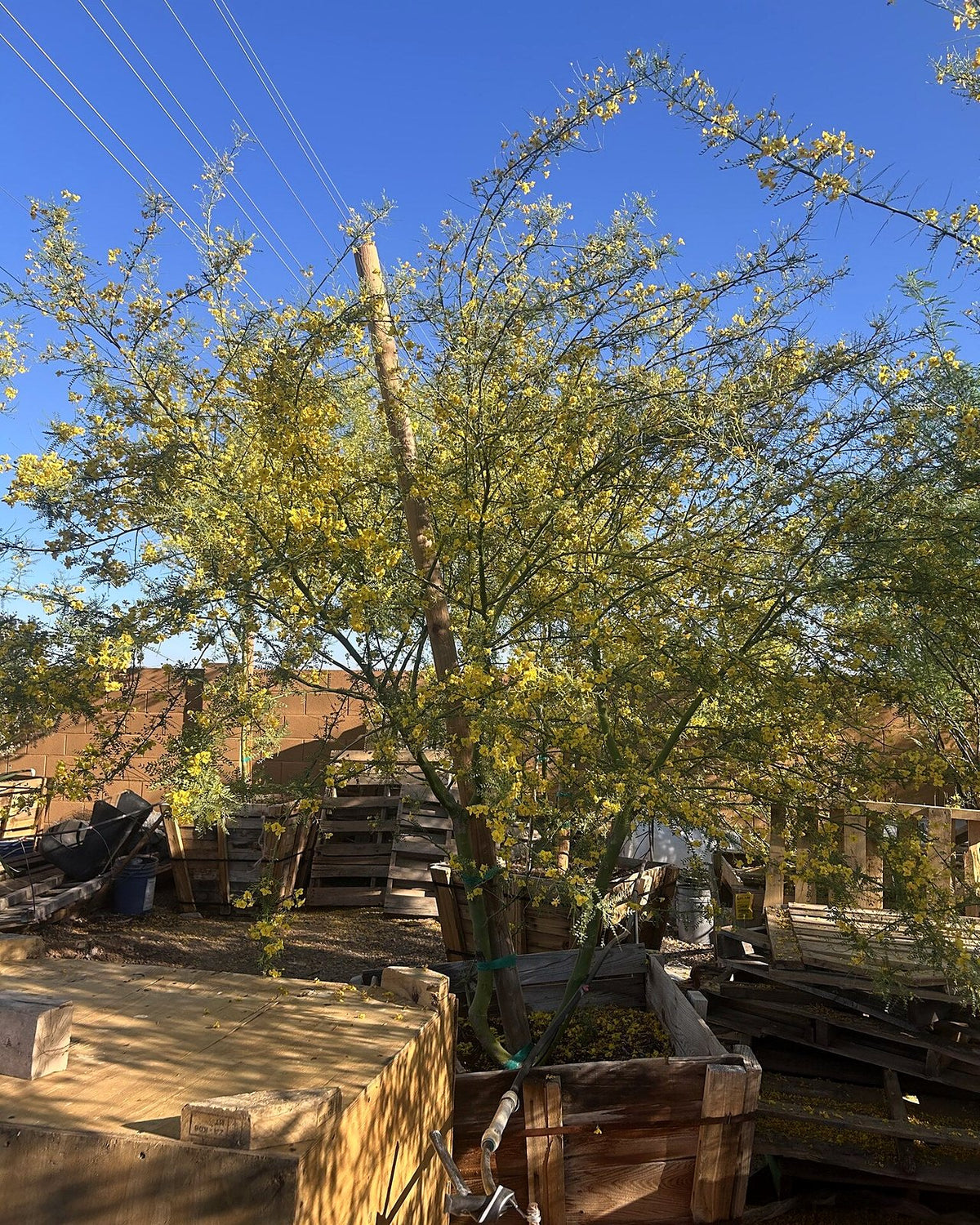
Desert Museum Palo Verde (Parkinsonia × 'Desert Museum') is the most sought-after ornamental tree in Phoenix and Scottsdale landscapes. Developed at the Arizona-Sonora Desert Museum in Tucson, this thornless hybrid — a cross between Blue Palo Verde, Foothill Palo Verde, and Palo Brea — combines the best traits of its parent species into one exceptional desert tree. It delivers the breathtaking golden-yellow spring bloom display of Blue Palo Verde, the graceful blue-green bark of Palo Brea, and the compact form of Foothill Palo Verde — all without a single thorn. For Phoenix homeowners who want an iconic Sonoran Desert tree that won't scratch children or snag clothing, Desert Museum Palo Verde is the definitive choice.
Desert Museum Palo Verde Plant Details
| Attribute | Detail |
|---|---|
| Scientific Name | Parkinsonia × 'Desert Museum' |
| Common Names | Desert Museum Palo Verde, Museum Palo Verde, Thornless Palo Verde |
| Mature Height | 20–30 feet |
| Mature Width | 20–30 feet |
| Growth Rate | Fast — 3–5 feet per year with regular irrigation in Phoenix |
| Sun | Full sun (6+ hrs). Thrives in Phoenix's intense desert heat and reflected light. |
| Water | Very low to low once established. Highly drought-tolerant after 2 years. |
| USDA Zones | 9–11 (Phoenix is Zone 9b–10a) |
| Soil | Well-draining native desert soil. Adaptable to Arizona caliche and alkaline conditions. |
| Foliage | Semi-deciduous — may drop small leaves briefly in cold winters; green bark performs photosynthesis year-round |
| Bloom | Brilliant golden-yellow flowers in spring (March–May); often re-blooms after summer monsoon rains |
| Thorns | None — thornless hybrid |
| Bark | Distinctive blue-green photosynthetic bark year-round |
| Origin | Developed at the Arizona-Sonora Desert Museum, Tucson, AZ |
Desert Museum Palo Verde Uses in Phoenix Landscapes
Showcase Specimen & Focal Point
Nothing stops neighborhood traffic in Phoenix like a Desert Museum Palo Verde in full spring bloom. Its brilliant golden-yellow flowers absolutely blanket the entire canopy from late March through May — creating one of the most dramatic seasonal displays of any tree in the Sonoran Desert. Plant as a front-yard focal point in Scottsdale, Paradise Valley, or Arcadia where it will become the defining visual element of your landscape. The blue-green photosynthetic bark keeps the tree visually interesting even when not in bloom.
Pool Area & Patio Tree
Desert Museum Palo Verde's thornless nature makes it uniquely suitable for pool areas and high-traffic patios — a significant advantage over native Palo Verdes which have sharp thorns. Its filtered, dappled shade provides comfortable shade without blocking every breeze. Plant 8–12 feet from pool edges for canopy shade that reaches over the water. Minimal leaf litter during the growing season makes pool maintenance manageable.
Water-Wise & Desert Xeriscape Garden
As a Sonoran Desert hybrid, Desert Museum Palo Verde is perfectly suited for xeriscape and water-wise garden designs. Once established, it survives on Phoenix's natural rainfall alone — making it one of the most water-efficient ornamental trees available. Pair with Desert Spoon, Agave, Mexican Feather Grass, and Brittlebush for a stunning zero-supplemental-water desert garden that blooms brilliantly every spring.
Driveway & Street Tree
Desert Museum Palo Verde's upright, multi-stemmed structure and rounded canopy make it an excellent driveway and street tree for Phoenix. Planted 15–20 feet apart, a row of Desert Museum Palo Verdes creates a signature Phoenix streetscape. The thornless characteristic is especially important for street tree use where pedestrians and cyclists pass close to branches. Widely used as a street tree throughout Scottsdale and the East Valley.
Best Time to Plant Desert Museum Palo Verde in Phoenix
Fall planting (October through November) is ideal for Desert Museum Palo Verde in Phoenix. The warm soil encourages rapid root establishment while cooler air temperatures reduce transplant stress. This gives the tree a full growing season to establish before its first Phoenix summer. Spring planting (February through April) is the second-best window, timed to take advantage of natural warming and the tree's active growth cycle. Avoid summer planting if possible — though Desert Museum Palo Verde is highly heat-tolerant, transplant shock risk is elevated during sustained 110°F heat.
How to Plant Desert Museum Palo Verde
- Dig wide, not deep — Excavate a hole 2–3 times the width of the root ball, matching the root ball depth exactly. Do not plant too deep.
- Check for caliche — Break through any hardpan caliche layer beneath the hole with a breaker bar or mattock to ensure adequate drainage.
- Native soil backfill — Desert Museum Palo Verde thrives in unamended native soil. Avoid high-organic mixes that retain too much moisture.
- Spacing — 15–20 feet from structures, walls, and other large trees to allow full canopy development.
- Water basin — Build a 3–4 inch earthen berm ring 18–24 inches from the trunk to direct water to the root zone.
- Mulch — Apply 2–3 inches of bark or decomposed granite mulch over the root zone to conserve moisture.
Watering Desert Museum Palo Verde in Phoenix
First Year Watering Schedule
Deep, infrequent watering during the establishment period builds drought tolerance:
- Weeks 1–2: Every 1–2 days, deep and slow (20–30 minutes per session)
- Months 1–2: Every 3–4 days
- Months 3–6: Every 7–10 days (every 5 days during triple-digit summer heat)
- After Year 1: Every 10–14 days in summer; every 3–4 weeks in winter — or eliminate supplemental irrigation entirely after Year 2
Drip Irrigation
Use 1–2 GPH emitters placed 18–24 inches from the trunk. Once established, Desert Museum Palo Verde is extremely drought tolerant and can survive on Phoenix's natural rainfall. Many homeowners eliminate supplemental irrigation after Year 2 with excellent results.
Is Desert Museum Palo Verde truly thornless?
Yes — Desert Museum is a thornless hybrid. Unlike native Blue Palo Verde and Foothill Palo Verde, which have sharp thorns on branches and trunk, Desert Museum Palo Verde has no thorns, making it safe for pool areas, children's play areas, and high-traffic patios.
How fast does Desert Museum Palo Verde grow?
Desert Museum Palo Verde is one of Phoenix's fastest-growing ornamental trees, adding 3–5 feet per year with regular irrigation. A 15-gallon tree can reach 15–20 feet in 4–5 years under Phoenix growing conditions.
When does Desert Museum Palo Verde bloom in Phoenix?
Desert Museum Palo Verde blooms brilliantly from late March through May in Phoenix. It often re-blooms with a secondary flush of flowers following the summer monsoon rains in July and August. The spring bloom can last 4–6 weeks.
What's the difference between Desert Museum and Blue Palo Verde?
Desert Museum Palo Verde is thornless and produces a slightly denser canopy than Blue Palo Verde, which has thorns. Both produce brilliant yellow spring blooms and blue-green bark, but Desert Museum's hybrid vigor makes it faster-growing and its thornless character makes it safer for residential landscapes.
Can I plant Desert Museum Palo Verde near my pool?
Yes — Desert Museum Palo Verde is one of the best pool-area trees for Phoenix. Its thornless nature, filtered canopy shade, and relatively non-invasive root system make it a safe and beautiful choice. Plant 8–12 feet from pool edges and 15 feet from underground plumbing.
You May Also Like
- Blue Palo Verde — Arizona's state tree; wild-type palo verde with thorns and brilliant yellow spring bloom; slightly larger than Desert Museum.
- Foothill Palo Verde — Native palo verde with pale yellow spring blooms; very compact and extremely drought tolerant.
- Palo Brea — Sonoran native with striking blue-green bark and golden blooms; excellent companion to Desert Museum Palo Verde.
- Sonoran Emerald Palo Verde — Another thornless palo verde hybrid with emerald-green bark; compact form for smaller spaces.
- Mulga Acacia — Ultra drought-tolerant silver-foliage Australian native; excellent water-wise companion to Desert Museum in xeriscape gardens.
How Many Desert Museum Palo Verde Do I Need?
Desert Museum Palo Verde is a wide-canopy specimen tree (mature spread 20 to 30 feet). Plant a single tree as a front-yard focal point, or use it in odd-numbered groves of 3 to 5 for a naturalized desert look, spacing trees 18 to 20 feet on center so each canopy can develop its full rounded form. For a driveway or street row, the table below estimates tree counts at 18-foot on-center spacing.
| Row length | Trees needed (18 ft on center) |
|---|---|
| 36 ft | 2 trees |
| 54 ft | 3 trees |
| 90 ft | 5 trees |
| 144 ft | 8 trees |
Keep at least 15 feet between the trunk and walls, foundations, and pool plumbing to allow for root spread and canopy reach.
Desert Museum Palo Verde Season-by-Season in Phoenix
- Spring (Feb to Apr): The headline season. New leaf flush followed by a heavy golden-yellow bloom from late March through May that blankets the entire canopy. Excellent secondary planting window once nights warm.
- Summer (May to Sep): Handles Phoenix reflected heat and triple-digit days with ease. The monsoon (July to September) often triggers a lighter second bloom flush. Green bark keeps the tree photosynthesizing through the heat.
- Fall (Oct to Nov): Prime planting season in the Valley. Growth slows as nights cool, letting roots establish before winter.
- Winter (Dec to Jan): Semi-deciduous, so it may shed a portion of its small leaves briefly in a cold snap. Hardy to about 15°F; mature trees shrug off normal Valley frost, though young trees can show minor tip damage in a hard freeze.
At a Glance
✔ Pollinator-Friendly ✔ Heat-Loving (Reflected-Heat Tolerant) ✔ Drought-Tolerant ✔ Pool-Friendly (Low-Litter) ✔ Low-Maintenance ✔ Shade-Providing ✔ Cold-Hardy to 15°F
Plant It With
- Blue Palo Verde: Arizona's thorned state tree; pair for a mixed palo verde grove with staggered bloom.
- Foothill Palo Verde: compact native palo verde that echoes the green bark in a smaller footprint.
- Desert Willow: a flowering native companion that blooms through summer when the palo verde rests.
- Desert Spoon: a sculptural evergreen understory accent beneath the filtered canopy.
Is Desert Museum Palo Verde Right for Your Yard?
This is the right tree if you want a fast-growing, thornless shade and specimen tree for full sun and reflected heat, with excellent drought tolerance once established and clean enough habits for a pool area. It thrives in well-drained native or caliche soil and needs room to spread 20 to 30 feet. It is not a fit if you have a very small courtyard with no room for the canopy, or if you want a fully evergreen tree, since it can briefly thin out in a cold winter.
Customer Reviews
Great specimen
Wonderful specimen and the delivery was effortless.
The tree is flourishing in its new home.
Thank you Three Timbers!!
Share