

Foothill Palo Verde
Foothill Palo Verde
Couldn't load pickup availability
Arizona's Toughest Native Desert Tree — Foothill Palo Verde
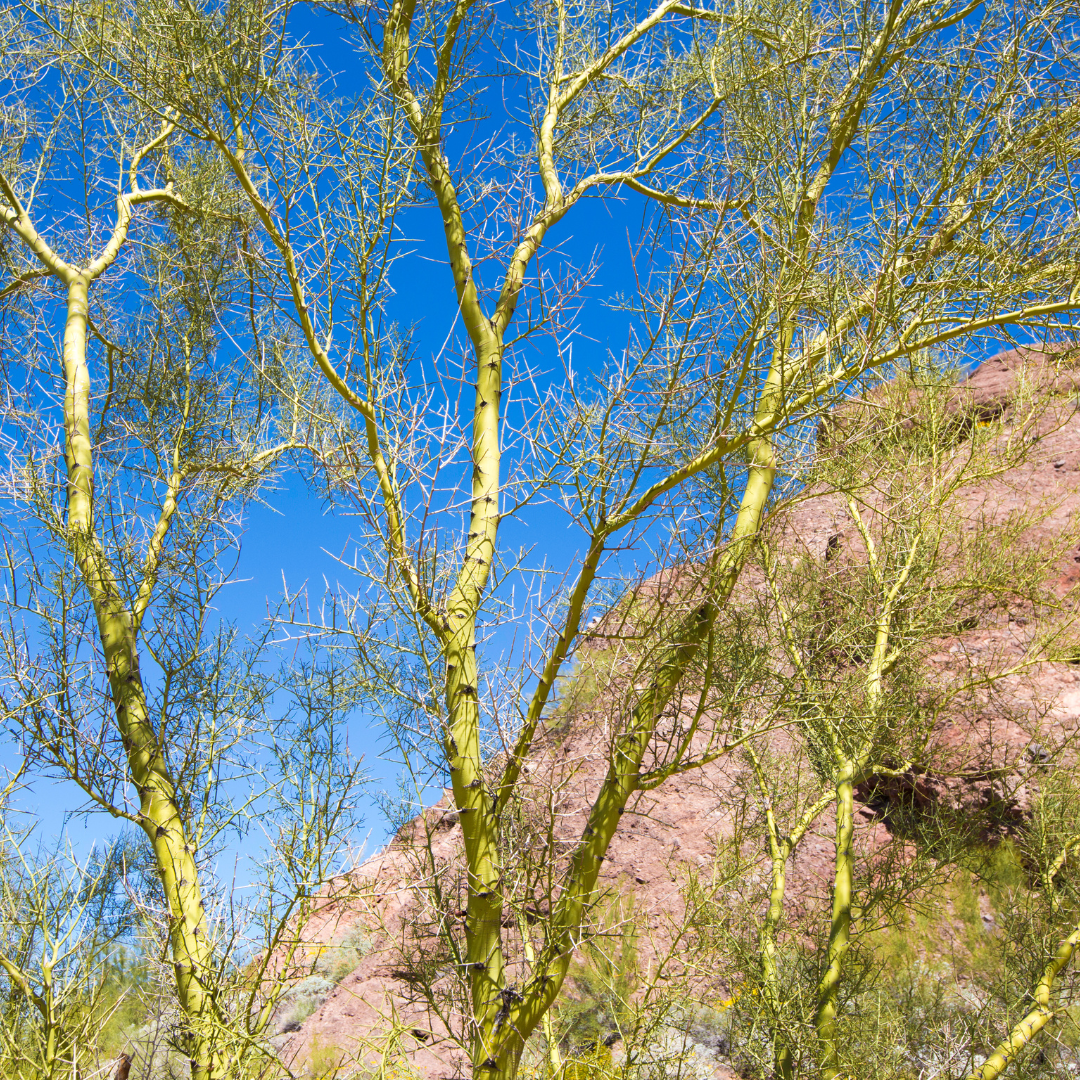
The Foothill Palo Verde (Parkinsonia microphylla) is Arizona's toughest native desert tree, built to thrive in the harshest conditions the Sonoran Desert can deliver. Recognized by its stunning chartreuse-yellow bark that photosynthesizes even when leafless, this iconic native lights up any desert landscape with brilliant yellow blooms each spring. Drought-tolerant to the extreme and requiring almost no supplemental water once established, the Foothill Palo Verde is the ultimate low-maintenance native tree for homeowners in Phoenix, Scottsdale, Chandler, Mesa, Tempe, and the entire Valley.
Foothill Palo Verde Plant Details
| Attribute | Detail |
|---|---|
| Scientific Name | Parkinsonia microphylla |
| Common Names | Foothill Palo Verde, Yellow Palo Verde, Little-Leaf Palo Verde |
| Mature Height | 15–20 feet |
| Mature Width | 15–20 feet |
| Growth Rate | Moderate — 1–2 feet per year in Phoenix |
| Sun | Full sun (6+ hrs). Thrives in reflected heat from walls and boulders. |
| Water | Very low once established. Survives on rainfall alone in Phoenix. |
| USDA Zones | 9–11 (Phoenix is Zone 9b–10a) |
| Soil | Well-draining. Adapts naturally to rocky Arizona caliche soils. |
| Foliage | Semi-deciduous — drops small leaflets during drought and cold; bark stays green year-round |
| Bark Color | Distinctive chartreuse yellow-green — photosynthetic even without leaves |
| Bloom | Bright yellow flowers, spring (March–May) |
| Native Status | Native to the Sonoran Desert (Arizona, California, Baja California, Sonora) |
Foothill Palo Verde Uses in Phoenix Landscapes
Native & Naturalized Desert Gardens
The Foothill Palo Verde is the cornerstone of any authentic Sonoran Desert garden in Phoenix. It provides the vertical structure and dappled shade that desert perennials like Brittlebush, Penstemon, and Desert Marigold need to thrive beneath. Plant in groupings of 2–3 trees spaced 15–20 feet apart to recreate the natural desert wash aesthetic. Pair with Saguaro cactus, Desert Spoon, and Agave americana for a fully native planting that requires virtually no supplemental irrigation after establishment.
Small Yard Shade & Patio Tree
With a mature height and spread of 15–20 feet, the Foothill Palo Verde is perfectly sized for smaller yards in Scottsdale and Tempe where a full-sized mesquite would overwhelm the space. Its open, airy canopy provides light, dappled shade without creating the dense darkness that blocks solar panels or outdoor lighting. Plant 10–12 feet from a patio edge for gentle afternoon shade without root intrusion concerns. Pairs beautifully with Desert Museum Palo Verde and Willow Acacia in mixed shade gardens.
Wildlife & Pollinator Habitat
Few trees rival the Foothill Palo Verde for wildlife value in Phoenix landscapes. The yellow spring blooms attract native bees, butterflies, and hummingbirds in abundance. Seed pods feed quail, doves, and small mammals. The thorny structure provides protected nesting habitat for cactus wrens and curve-billed thrashers. If you're creating a certified wildlife garden in Gilbert, Mesa, or Peoria, a Foothill Palo Verde is an essential anchor plant that supports the full desert food chain.
Rock Garden & Slope Planting
The Foothill Palo Verde is nature's choice for rocky slopes, decomposed granite gardens, and hillside plantings across Phoenix. It grows naturally in the rocky foothills of South Mountain and the McDowell Mountains — exactly the tough, well-draining conditions it loves. Its root system stabilizes slopes and caliche hillsides effectively. Pair with native grasses, Desert Marigold, and Brittlebush for a low-water slope planting that looks natural year-round.
Best Time to Plant Foothill Palo Verde in Phoenix
Fall planting (October–November) is ideal for Foothill Palo Verde in Phoenix. Cool air temperatures reduce transplant stress dramatically while warm soil encourages immediate root development. A fall-planted tree gets 6–8 months of root establishment before its first summer — the difference between thriving and struggling in Phoenix's extreme June-July heat.
Spring planting (February–April) is the second-best window. Avoid summer planting whenever possible; while the Foothill Palo Verde is extremely heat-tolerant, newly transplanted trees still benefit from cooler establishment conditions.
How to Plant Foothill Palo Verde
- Dig wide, not deep — excavate a hole 2–3x the width of the root ball but only as deep as the root ball. Never plant too deep.
- Check for caliche — probe the hole bottom for hardpan caliche. The Foothill Palo Verde naturally grows in rocky, fast-draining soil; break through any caliche layer with a rebar rod to ensure drainage.
- Use native soil — backfill with the native rocky or sandy soil you removed. Avoid heavy organic amendments; this tree prefers lean soil.
- Spacing — plant 12–15 feet apart for a naturalized grove effect; 15–20 feet apart as standalone specimens.
- Build a water basin — create a 3–4 inch berm 18–24 inches from the trunk to direct irrigation to the root zone.
- Mulch lightly — 1–2 inches of decomposed granite or gravel mulch is ideal; this tree prefers rocky surfaces that mimic its natural habitat.
Watering Foothill Palo Verde in Phoenix
First Year Watering Schedule
- Weeks 1–2: Water every 1–2 days, deep and slow (20–30 minutes per session)
- Month 1–2: Reduce to every 3–5 days
- Month 3–6: Transition to every 7–14 days (every 7–10 days in peak summer heat)
- After Year 1: Every 2–4 weeks in summer; once per month or less in winter. After 2 years, many trees thrive on rainfall alone in Phoenix.
Drip Irrigation
Place drip emitters 18–24 inches from the trunk to encourage outward root growth. Use 1–2 GPH emitters per tree, running 30–45 minutes per session. The Foothill Palo Verde is one of the most water-efficient trees available for Phoenix — mature trees in established desert landscapes typically require no supplemental irrigation at all.
How fast does Foothill Palo Verde grow in Phoenix?
Foothill Palo Verde grows moderately at 1–2 feet per year in Phoenix — slower than Blue Palo Verde but producing a denser, more rounded canopy over time. Patience pays off: a 5-year-old Foothill Palo Verde is a striking, self-sufficient specimen that needs almost no care.
Is Foothill Palo Verde the same as Blue Palo Verde?
No — Foothill Palo Verde (Parkinsonia microphylla) and Blue Palo Verde (Parkinsonia florida) are two distinct native species. Foothill Palo Verde has a more rounded, denser form and distinctly yellow-green bark. Blue Palo Verde is the Arizona state tree with a more open canopy and bluish-green stems. Both are excellent desert trees; many Phoenix landscapes include both species for variety.
Does the Foothill Palo Verde have thorns?
Yes — the Foothill Palo Verde has short, stiff spines at the branch tips. This is typical of wild-collected or seed-grown specimens. The spines provide excellent wildlife habitat value. If you prefer a thornless option, consider the Desert Museum Palo Verde hybrid, which combines Palo Verde species into a nearly thornless cultivar.
Can I plant Foothill Palo Verde near a pool?
The Foothill Palo Verde produces small seed pods and tiny leaflets that can create minor maintenance around pools. We recommend planting at least 15 feet from pool edges and filtering for seed pod drop during the fall. For a cleaner pool-adjacent option, the Desert Museum Palo Verde is a better choice.
What sizes does Three Timbers carry for Foothill Palo Verde?
Three Timbers carries Foothill Palo Verde in 3/5 gallon, 10/15 gallon, 24"/25 gallon, 36" box, and 48" box sizes — from starter plants to mature specimens ready for immediate landscape impact.
You May Also Like
- Desert Museum Palo Verde — The thornless hybrid Palo Verde with larger yellow blooms, perfect for pool-adjacent planting and high-visibility areas in Scottsdale and Phoenix.
- Blue Palo Verde — Arizona's state tree; more open canopy and longer bloom period, great companion for Foothill Palo Verde in native desert gardens.
- Palo Brea — A sister species from Mexico with brilliant lime-green bark and orange-yellow blooms; exceptional specimen tree for modern desert designs.
- Smoothie Cascalote — A striking thornless flowering tree with showy yellow blooms and fine texture that pairs beautifully with Palo Verde in mixed desert plantings.
- Sweet Acacia — A fragrant native acacia with golden puffball blooms and wildlife value; excellent companion in naturalized desert garden designs.
How Many Foothill Palo Verde Do I Need?
Foothill Palo Verde is a compact native desert tree (15 to 20 ft wide), planted as a specimen or in a natural grove rather than a hedge. Set one as a focal point in a rock garden, or plant in odd-numbered groups of 3 to 5 spaced 12 to 15 ft apart to recreate a desert-wash look.
| Effect | Spacing and count |
|---|---|
| Single patio or focal specimen | 1 tree, 10 to 12 ft from the patio edge |
| Naturalized desert grove | 3 trees at 14 ft apart |
| Standalone in open desert garden | 1 tree every 15 to 20 ft |
Foothill Palo Verde Season-by-Season in Phoenix
- Spring (Mar to May): Bright yellow bloom blankets the canopy and draws native bees, butterflies, and hummingbirds. Second-best planting window.
- Summer (May to Sep): Light dappled shade through the worst heat, fully at home in reflected sun off boulders and walls. Seed pods feed quail and doves. Needs almost no water once established.
- Fall (Oct to Nov): Prime planting season. The green photosynthetic bark keeps the tree looking alive as growth slows.
- Winter (Dec to Jan): Semi-deciduous; it sheds small leaflets in cold or drought, but the chartreuse bark holds year-round color. Hardy through Valley winters down to about 15°F.
At a Glance
✔ Arizona Native ✔ Pollinator-Friendly ✔ Hummingbird-Friendly ✔ Heat-Loving (Reflected-Heat Tolerant) ✔ Drought-Tolerant ✔ Shade-Providing ✔ Low-Maintenance ✔ Cold-Hardy to 15°F
Plant It With
- Desert Museum Palo Verde: thornless hybrid cousin with larger blooms for the pool-adjacent end of the garden.
- Blue Palo Verde: Arizona's state tree, a more open-canopy companion in a native grove.
- Foothill Palo Brea CCF: a sister Parkinsonia with refined form and a long yellow bloom.
- Sweet Acacia: fragrant golden puffball blooms and strong wildlife value beside the palo verde.
Is Foothill Palo Verde Right for Your Yard?
Foothill Palo Verde thrives in full Phoenix sun and reflected heat, in lean rocky or caliche soil, and survives on rainfall once established: ideal for native gardens, slopes, and small yards where a mesquite would be too big. Give it 15 ft of clearance. Not a fit right beside a pool, since its branch-tip thorns and seed-pod drop mean more cleanup; choose the thornless Desert Museum there instead.
Share