

Leslie Roy Mesquite
Leslie Roy Mesquite
Couldn't load pickup availability
Phoenix's Premier Large-Canopy Shade Tree — Leslie Roy Mesquite
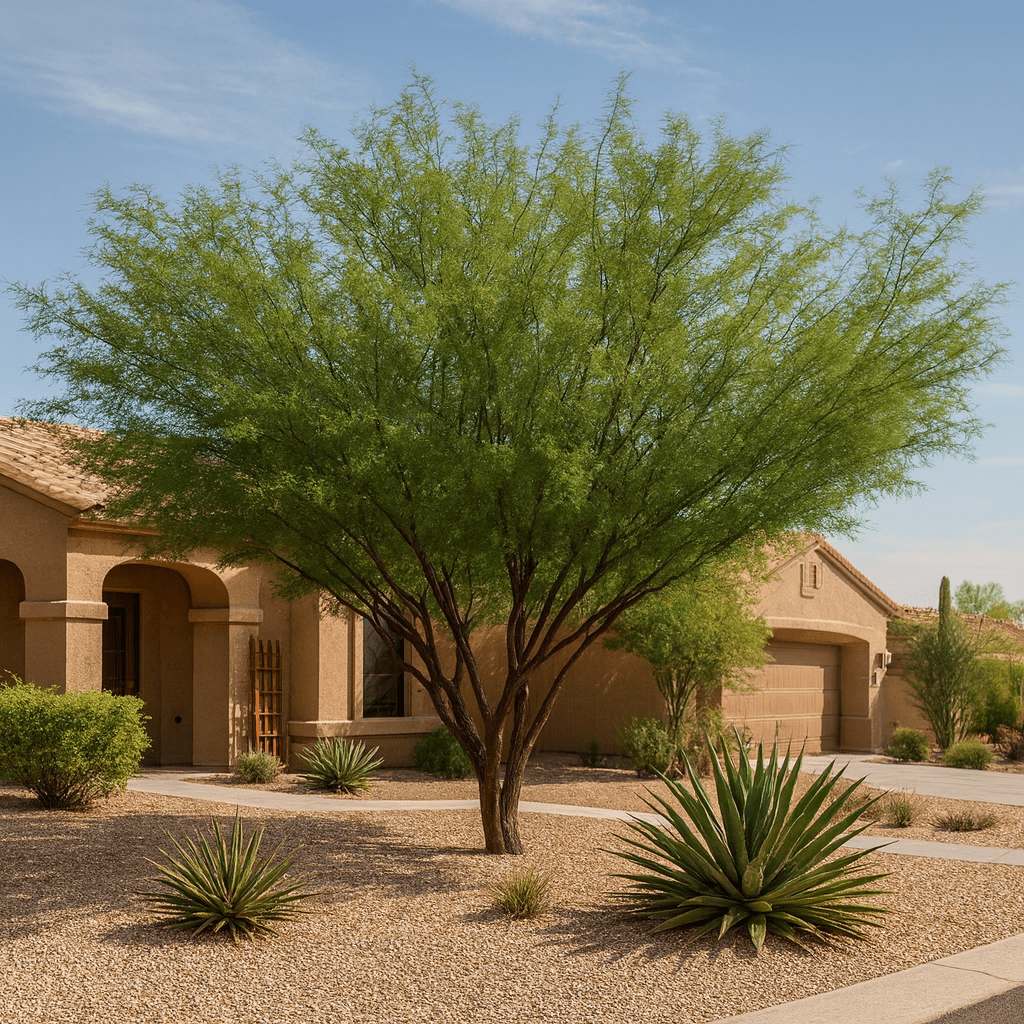
Leslie Roy Mesquite (Prosopis 'Leslie Roy') is one of the most popular and highly regarded shade trees in the Phoenix Valley, prized for its exceptionally large, symmetrical canopy, fast growth, and relatively few thorns compared to native mesquites. A superior hybrid cultivar, Leslie Roy combines the toughness and drought tolerance of the desert mesquite with refined growth habits that suit upscale residential landscaping. Whether you're planting in Scottsdale, Paradise Valley, Chandler, or Gilbert, Leslie Roy Mesquite is the gold standard for premium desert shade.
Leslie Roy Mesquite Plant Details
| Attribute | Detail |
|---|---|
| Scientific Name | Prosopis 'Leslie Roy' |
| Common Names | Leslie Roy Mesquite, Leslie Roy Desert Tree |
| Mature Height | 25–35 feet |
| Mature Width | 25–35 feet |
| Growth Rate | Fast — 4–6 feet per year in Phoenix with establishment watering |
| Sun | Full sun (6+ hrs). Handles intense reflected heat from walls and hardscape. |
| Water | Very low once established. Highly drought-tolerant. |
| USDA Zones | 9–11 (Phoenix is Zone 9b–10a) |
| Soil | Well-draining. Adapts to Arizona's alkaline and caliche soils. |
| Foliage | Deciduous — drops leaves in winter, leafs out vigorously in early spring |
| Bloom | Fragrant yellowish-white catkins in spring, February–April |
| Thorns | Semi-thornless — fewer and smaller thorns than wild mesquites |
| Canopy | Wide, symmetrical umbrella shape — one of the largest canopies of any desert mesquite |
Leslie Roy Mesquite Uses in Phoenix Landscapes
Premium Backyard Shade Tree
Leslie Roy Mesquite's defining characteristic is its large, symmetrical canopy — which can spread 25–35 feet at maturity — delivering some of the best dappled afternoon shade of any desert-adapted tree available in Phoenix. Its semi-thornless nature makes it safer than wild mesquites for areas where people and pets spend time. Plant it on the west or southwest side of your home in Scottsdale or Paradise Valley for maximum summer shade benefit and potential cooling cost reduction.
Streetscape and Property-Line Tree
The Leslie Roy's refined growth habit and exceptional canopy spread make it a top choice for streetscape planting, large property plantings, and statement trees in high-end Gilbert and Chandler neighborhoods. Its fast growth — up to 4–6 feet per year — means it delivers meaningful shade within just a few seasons. For a defined shaded canopy line, plant 25–30 feet apart to allow full canopy development at maturity.
Pool-Friendly Shade Companion
Leslie Roy Mesquite performs well near pools due to its fine compound leaflets that sink quickly and are far less intrusive than large-leafed trees. Its filtered, open canopy allows sunlight to reach the pool while blocking intense summer afternoon heat. Plant 15–20 feet from the pool edge to keep the root system well clear of the pool shell while still providing substantial overhead shade for lounge areas.
Xeriscape Anchor in Upscale Desert Landscapes
Few trees command a landscape the way a mature Leslie Roy does. Its sculpted, wide-spreading form works beautifully as the central anchor of a xeriscape design, surrounded by complementary desert plants like Desert Spoon, Red Bird of Paradise, Texas Sage, and Agave. In Peoria, Mesa, or Tempe neighborhoods with low-water HOA requirements, Leslie Roy delivers a resort-style look on near-zero irrigation once established.
Best Time to Plant Leslie Roy Mesquite in Phoenix
Fall planting (October–November) is ideal in the Phoenix Valley. Warm soil encourages rapid root development while cooler air reduces transplant stress, giving the tree 6–8 months to establish before its first summer. Spring planting (February–April) is the second-best window. Avoid summer planting where possible — newly planted trees in summer require intensive irrigation management and face maximum heat stress.
How to Plant Leslie Roy Mesquite
- Dig wide, not deep — excavate 2–3x the root ball width at the same depth. The Leslie Roy develops an extensive lateral root system.
- Check for caliche — probe the hole bottom for hardpan. Break through any caliche layer to allow drainage and taproot penetration.
- Backfill with native soil — use the excavated desert soil with an optional 20% compost amendment. Avoid over-amending.
- Spacing — plant 25–30 feet from structures and other large trees; 15–20 feet from pools.
- Build a water basin — create a 3–4 inch earthen berm around the drip line to direct water to the roots.
- Mulch — apply 2–3 inches of bark mulch or decomposed granite to retain soil moisture and moderate root zone temperature.
Watering Leslie Roy Mesquite in Phoenix
First Year Watering Schedule
Leslie Roy Mesquite establishes quickly with consistent deep watering. Water slowly and deeply — 20–30 minutes per session — to encourage the extensive root system to develop.
- Weeks 1–2: Every 1–2 days
- Months 1–2: Every 3–4 days
- Months 3–6: Every 7–10 days (every 5–7 days in peak summer heat)
- After Year 1: Every 10–14 days in summer; every 3–4 weeks in winter
Drip Irrigation
Place emitters 18–24 inches from the trunk, at the canopy drip line. Use 1–2 GPH emitters running 60–90 minutes per session during the first growing season. Leslie Roy Mesquite becomes highly drought-tolerant after year 2 and requires minimal supplemental water in most Phoenix Valley soils.
How fast does Leslie Roy Mesquite grow in Phoenix?
Leslie Roy is one of the fastest-growing mesquite cultivars available — expect 4–6 feet of vertical growth per year during peak establishment. Trees can reach 15–20 feet in height within 3–4 seasons with proper irrigation.
Is Leslie Roy Mesquite drought tolerant?
Yes — extremely. Like all mesquites, Leslie Roy is highly adapted to desert conditions and becomes exceptionally drought-tolerant once its root system is established, typically after year 2.
What's special about Leslie Roy compared to other mesquites?
Leslie Roy is prized for its exceptionally large, symmetrical canopy — often considered the best canopy spread-to-height ratio of any mesquite cultivar. It also has fewer thorns than wild mesquites and a more refined, predictable growth habit, making it the premium choice for high-end residential landscapes in Scottsdale and Paradise Valley.
Can it handle Phoenix's extreme summer heat?
Absolutely. Mesquite trees evolved in the Sonoran Desert and are perfectly adapted to Phoenix's triple-digit summers, extreme aridity, and alkaline soils. Leslie Roy thrives in conditions that would stress most other shade trees.
Does it work near a pool?
Yes — the Leslie Roy's fine compound leaflets are much less of a pool maintenance issue than large-leafed trees. Keep the trunk 15–20 feet from the pool edge for best results.
You May Also Like
- Chilean Fuente Mesquite — A fast-growing, thornless hybrid mesquite with a graceful weeping canopy, great for premium Scottsdale landscapes.
- Thornless Texas Honey Mesquite — A completely thornless mesquite variety ideal for family yards, patios, and pool areas.
- Cooperi Mesquite — Another top-rated hybrid mesquite cultivar, known for its full canopy and exceptional heat tolerance.
- Desert Museum Palo Verde — The Valley's most popular flowering desert tree with brilliant yellow spring blooms and similar drought tolerance.
- Foothill Palo Verde — Arizona's toughest native tree, perfect for ultra-low-water xeriscape designs in Phoenix Valley neighborhoods.
How Many Leslie Roy Mesquite Do I Need?
Leslie Roy is a large-canopy specimen, so most yards need just one as a central shade anchor. Give it 25 to 30 feet of clearance from structures, walls, and other big trees so the umbrella canopy can spread fully, and keep the trunk 15 to 20 feet back from a pool shell. For a shaded canopy line along a driveway or property line, space trees about 28 feet on center so the crowns meet without crowding.
| Canopy Row Length | Trees Needed (28 ft spacing) |
|---|---|
| 28 ft | 2 |
| 56 ft | 3 |
| 84 ft | 4 |
| 112 ft | 5 |
Leslie Roy Mesquite Season-by-Season in Phoenix
- Spring (Feb–Apr): Vigorous leaf-out after winter dormancy, followed by fragrant yellowish-white catkins that draw bees and other pollinators. Strong growth flush and a good second planting window once nights warm.
- Summer (May–Sep): Peak performer. The wide canopy delivers dense dappled shade through extreme heat and reflected heat off walls and pavement. Monsoon storms (Jul–Sep) push fast growth, but the open form lets wind pass through; stake and prune young trees for a strong structure.
- Fall (Oct–Nov): Prime planting season as soil stays warm and air cools. Growth continues until the first cold nights.
- Winter (Dec–Jan): Drops its leaves and goes dormant, letting winter sun through to warm patios and pools. Hardy to roughly 15°F, so it handles normal Valley frost without trouble and leafs back out in spring.
At a Glance
✔ Pollinator-Friendly ✔ Heat-Loving (Reflected-Heat Tolerant) ✔ Drought-Tolerant ✔ Shade-Providing ✔ Low-Maintenance ✔ Cold-Hardy to 15°F
Plant It With
- Cooperi Mesquite: Another full-canopy hybrid mesquite for matching shade trees across a larger property.
- Desert Museum Palo Verde: Thornless flowering desert tree that adds brilliant yellow spring color beside the mesquite shade.
- Foothill Palo Verde: Tough Arizona native for an ultra-low-water companion in the same xeriscape.
- Desert Spoon: Sculptural understory accent that reads well beneath the open mesquite canopy.
Is Leslie Roy Mesquite Right for Your Yard?
It is an excellent fit for a large, sunny yard that needs a fast, drought-tough shade anchor, thriving in full sun, reflected heat, and alkaline caliche soil once the planting hole drains. It is not the right choice for a small lot or a tight space near foundations, since the canopy and lateral roots both spread 25 to 35 feet, and it drops leaves, catkins, and seed pods, so plan on some seasonal cleanup if you place it over a patio or pool.
Customer Reviews
Share