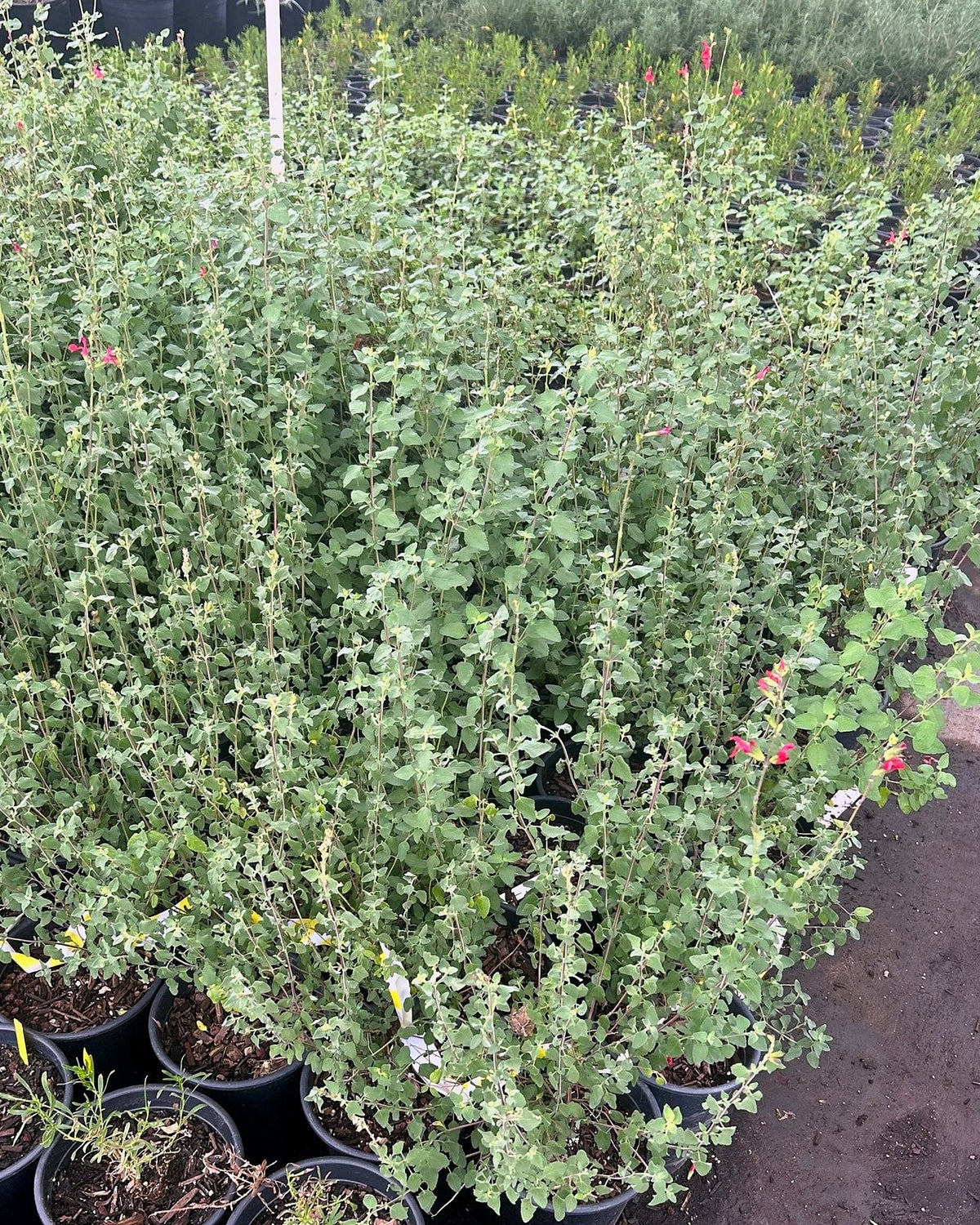

Autumn Sage - Hot Lips
Autumn Sage - Hot Lips
Couldn't load pickup availability
Phoenix's Most Unique Bicolor Salvia — Autumn Sage Hot Lips
Autumn Sage 'Hot Lips' (Salvia microphylla, a close cousin of Salvia greggii) is the most distinctive and conversation-starting variety of Autumn Sage available for Phoenix Valley landscapes. Its signature red-and-white bicolor flowers shift in color with temperature changes — producing bold red-and-white blooms in cooler weather and sometimes going all-red or all-white in peak summer heat — making every season a new visual experience. Compact, aromatic, and incredibly tough, it thrives in full sun or partial shade across Scottsdale, Chandler, Mesa, and Gilbert with minimal care.
Autumn Sage Hot Lips Plant Details
| Attribute | Detail |
|---|---|
| Scientific Name | Salvia microphylla 'Hot Lips' |
| Common Names | Autumn Sage Hot Lips, Hot Lips Salvia, Bicolor Autumn Sage |
| Mature Height | 2–3 feet |
| Mature Width | 2–3 feet |
| Growth Rate | Moderate — 1–2 feet per year in Phoenix |
| Sun | Full sun to partial shade (6+ hrs ideal). Handles reflected heat well. |
| Water | Low once established. Drought-tolerant after first season. |
| USDA Zones | 7–11 (Phoenix is Zone 9b–10a) |
| Soil | Well-draining. Adapts to Arizona caliche soils with proper drainage. |
| Foliage | Semi-evergreen — aromatic, small dark green leaves year-round |
| Bloom Color | Bicolor red and white; shifts to all-red or all-white with temperature changes |
| Bloom Season | Spring through fall with peak flushes; sporadic blooms in mild Phoenix winters |
Autumn Sage Hot Lips Uses in Phoenix Landscapes
Unique Color Accent in Desert Gardens
Hot Lips is the rare plant that generates genuine compliments from neighbors and passersby. The striking bicolor red-and-white flowers stand out dramatically against desert gravel, native boulders, and the neutral tones typical of Phoenix landscaping. Use it as a focal point specimen at a corner, entryway, or along a garden path in Scottsdale or Chandler where its unusual coloration can be fully appreciated. Plant 3 feet apart for a bold statement border, or in groups of 3 for a high-impact color cluster.
Pollinator & Hummingbird Gardens
Like its Salvia greggii cousins, Hot Lips is a powerful hummingbird and butterfly magnet throughout its long bloom season. The tubular bicolor flowers are irresistible to hummingbirds, which visit repeatedly throughout the day. In Phoenix and Peoria gardens, pairing Hot Lips with Chuparosa, Desert Ruellia, and other nectar-rich natives creates a multi-season wildlife habitat that supports the local pollinator population.
Low-Water Mixed Borders
Hot Lips' compact 2–3 foot mound makes it an ideal mid-border plant in low-water landscape designs across the Phoenix Valley. Its bicolor flowers pair beautifully with silver and blue-toned plants like Desert Spoon, Blue Nolina, and Mealy-Cup Sage, creating sophisticated color combinations that look intentional and professionally designed. Space plants 2–3 feet apart for a full border effect.
Container Planting for Patios
Autumn Sage Hot Lips performs exceptionally well in large containers on Phoenix patios, covered entries, and outdoor living spaces. The unusual flower color makes it a natural conversation piece on a patio or pool deck. Use a well-draining potting mix in a large (15+ gallon) container, and position where it receives morning sun and some afternoon shade for best performance during peak Phoenix summer heat.
Best Time to Plant Autumn Sage Hot Lips in Phoenix
Fall (October–November) is the ideal window for planting Hot Lips in the Phoenix area. The cooler air temperatures dramatically reduce transplant stress, and the plant has the full fall and winter season to establish a deep root system before facing its first Phoenix summer. Spring planting (February–April) is also an excellent option — you can often enjoy a full bloom display shortly after planting. Avoid peak summer planting (June–August) when possible; if necessary, provide afternoon shade and extra irrigation frequency through the first summer.
How to Plant Autumn Sage Hot Lips
- Dig wide, not deep — Excavate a hole 2–3x the width of the root ball and the same depth. Keep the crown at or slightly above grade to prevent crown rot.
- Check for caliche — Break through any hardpan caliche layer beneath the planting hole to ensure excellent drainage. Salvia microphylla is sensitive to poorly draining soils.
- Backfill with native soil — Use excavated soil with up to 20% compost blended in. Avoid heavy clay-based amendments that retain moisture.
- Spacing — Space 2–3 feet apart for borders and mass plantings; 3 feet for individual specimen plants.
- Build a water basin — Form a 3–4 inch earthen berm around the plant to direct irrigation water into the root zone during establishment.
- Mulch — Apply 2–3 inches of decomposed granite or gravel mulch around the base to conserve moisture and moderate soil temperature.
Watering Autumn Sage Hot Lips in Phoenix
First Year Watering Schedule
- Weeks 1–2: Water every 1–2 days, deep and slow (20–30 minutes) to thoroughly saturate the root ball and surrounding soil.
- Months 1–2: Reduce to every 3–4 days as the root system begins expanding.
- Months 3–6: Water every 7–10 days (every 5–7 days during peak Phoenix summer).
- After Year 1: Very drought-tolerant once established. Water every 10–14 days in summer; every 3–4 weeks in winter, or rely on natural Phoenix rainfall.
Drip Irrigation
Place drip emitters 12–18 inches from the plant base. Use 1 GPH emitters for 5 gallon plants. Once established, Hot Lips thrives on minimal supplemental irrigation — and reducing water slightly after establishment actually promotes more prolific blooming cycles.
Why do the flowers on my Hot Lips Salvia change color?
This is completely normal and one of Hot Lips' most fascinating characteristics. The bicolor red-and-white pattern is most vivid in cool weather (fall and spring). In hot summer temperatures, the flowers may shift to predominantly red or occasionally all-white. As temperatures cool again in fall, the signature bicolor pattern returns reliably.
How fast does Hot Lips Salvia grow in Phoenix?
Hot Lips grows at a moderate rate in Phoenix, typically adding 1–2 feet per year and reaching its mature 2–3 foot size within 1–2 seasons. The warm Phoenix climate and long growing season support steady growth, and blooming typically begins shortly after planting in spring or fall.
Is Autumn Sage Hot Lips drought-tolerant in Phoenix?
Yes — like its Salvia greggii cousins, Hot Lips is highly drought-tolerant once established after its first season. Mature plants in Phoenix can survive on natural rainfall alone during cooler months. During summer, supplemental irrigation every 1–2 weeks keeps the plant looking its best and encourages continued blooming.
Can I plant Hot Lips near my pool?
Yes, Autumn Sage Hot Lips is a great poolside plant. It produces no messy fruit or seed pods, and its small aromatic leaves don't create significant debris in pools. Its compact size makes it easy to manage near pool edges, and the hummingbirds it attracts add to the enjoyment of the outdoor living space.
You May Also Like
- Autumn Sage - Hot Pink — The bold solid-pink variety of Salvia greggii, perfect for pairing with Hot Lips for a vivid color combination in the same border.
- Autumn Sage - Furman's Red — The classic deep red variety that pairs beautifully with Hot Lips' bicolor flowers in mixed salvia plantings.
- Mealy-Cup Sage — A blue-purple salvia that creates a striking cool-warm color contrast when planted alongside Hot Lips.
- Chuparosa — Another top hummingbird plant for Phoenix that extends the wildlife feeding season alongside Autumn Sage.
- Desert Ruellia — A tough spreading native with purple flowers that fills in beautifully around the base of Autumn Sage plantings.
How Many Autumn Sage Hot Lips Do I Need?
At a mature 2 to 3 feet wide, Hot Lips is spaced about 2.5 feet apart for a full border or mass planting. Use this table to estimate plant counts to fill an area:
| Area to Fill | Plants Needed (2.5 ft spacing) |
|---|---|
| 50 sq ft | 8 plants |
| 100 sq ft | 16 plants |
| 150 sq ft | 24 plants |
| 200 sq ft | 32 plants |
For a single-row border, figure one plant about every 2.5 feet of run.
Autumn Sage Hot Lips Season-by-Season in Phoenix
- Spring (Feb to Apr): Heavy flush of crisp bicolor red-and-white flowers as the weather is cool. Prime bloom and a strong second planting window.
- Summer (May to Sep): Keeps blooming through the heat, though flowers often shift to mostly red or white in the hottest stretch. Tolerates reflected heat; a little afternoon shade and water every 1 to 2 weeks keeps it looking fresh. Light shearing after a flush brings on more bloom.
- Fall (Oct to Nov): The signature bicolor pattern returns reliably as nights cool, with another strong flush. Prime planting season in the Valley.
- Winter (Dec to Jan): Stays semi-evergreen and aromatic, with sporadic blooms in mild Valley winters. Cold-hardy well below freezing, so no frost cover is needed. Shear lightly in late winter to reshape.
At a Glance
✔ Pollinator-Friendly ✔ Hummingbird-Friendly ✔ Heat-Loving (Reflected-Heat Tolerant) ✔ Drought-Tolerant ✔ Pool-Friendly (Low-Litter) ✔ Low-Maintenance ✔ Deer & Rabbit-Resistant ✔ Cold-Hardy to 10°F
Plant It With
- Autumn Sage - Hot Pink: a solid hot-pink Salvia greggii that pops next to the bicolor flowers in the same border.
- Autumn Sage Red (Furman's Red): the deep-red classic that blends seamlessly in a mixed salvia planting.
- Red Yucca: another top hummingbird plant that extends the nectar season with coral spikes.
- Desert Spoon: a silver, architectural anchor that sets off the salvia's warm flower color.
Is Autumn Sage Hot Lips Right for Your Yard?
Hot Lips is a fit for full sun to light afternoon shade, well-draining soil (it dislikes soggy roots, so break through caliche and skip heavy clay amendments), and a low-water border, pool surround, or pollinator garden where you want long, hummingbird-friendly color in a tidy 2 to 3 foot mound. It is not the right pick for a deep-shade spot or a poorly draining low area where water collects: this salvia is prone to crown rot in standing water.
Customer Reviews
Share