

Autumn Sage Red
Autumn Sage Red
Couldn't load pickup availability
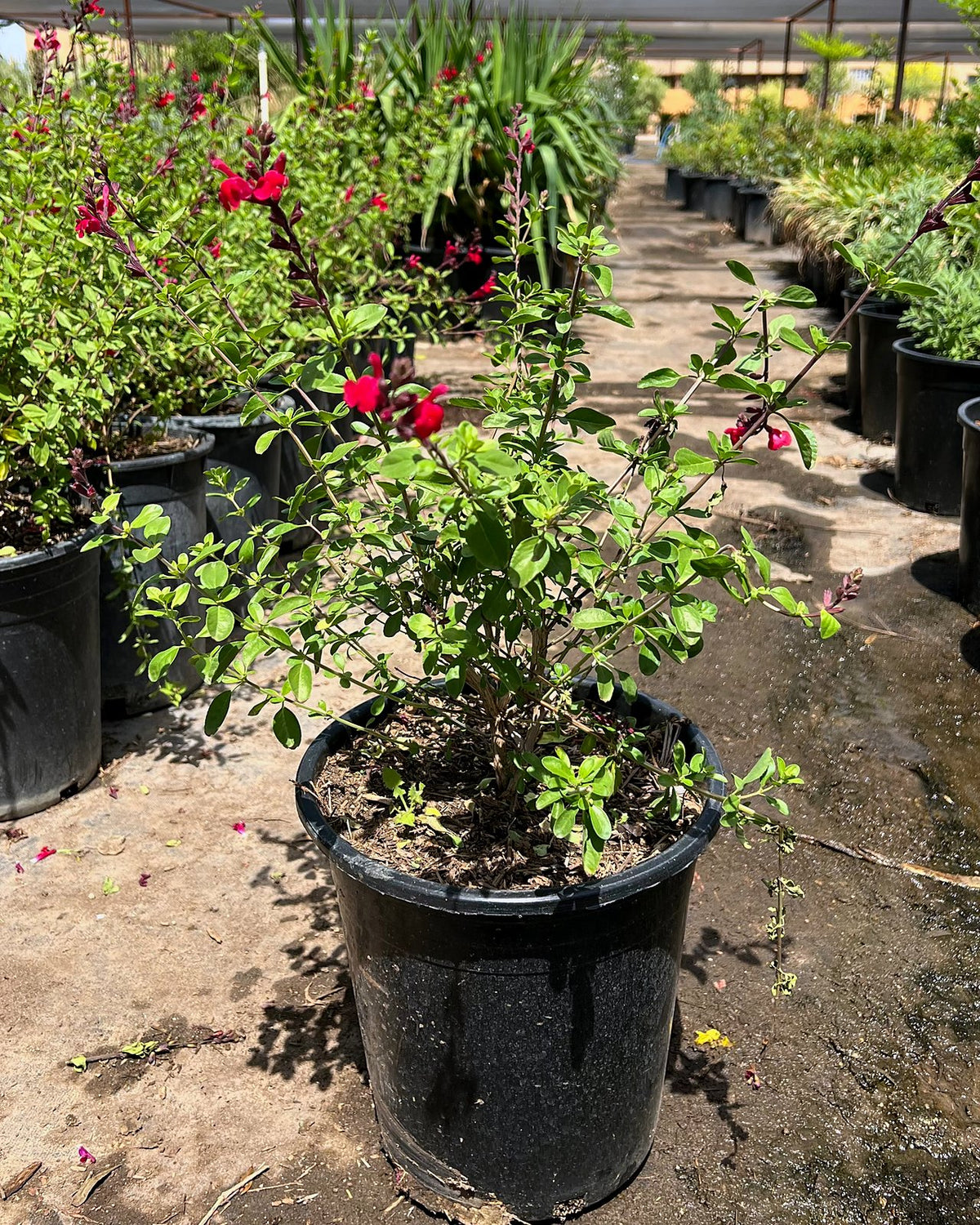
Autumn Sage Furman's Red — Non-Stop Crimson Blooms for Phoenix Desert Gardens
Autumn Sage 'Furman's Red' (Salvia greggii 'Furman's Red') delivers some of the most intense, long-lasting crimson flowers of any shrub available for Phoenix, Tempe, and Scottsdale landscapes. This heat-loving native salvia blooms from late winter through frost — re-blooming after every monsoon rain — and thrives in the same caliche-heavy, alkaline soils found throughout Maricopa County. Reliably hardy in USDA Zones 9b–10a, it's the go-to choice for gardeners wanting vivid color with minimal irrigation.
Plant Details
| Attribute | Detail |
|---|---|
| Scientific Name | Salvia greggii 'Furman's Red' |
| Common Names | Autumn Sage, Furman's Red Salvia, Cherry Sage |
| Plant Type | Evergreen perennial shrub |
| Mature Size | 2–3 ft tall, 2–3 ft wide |
| Growth Rate | Moderate to fast |
| Hardiness Zones | USDA 7–10a (very heat- and cold-tolerant) |
| Sun Exposure | Full sun; tolerates partial shade |
| Soil Tolerance | Sandy, rocky, caliche — excellent drainage required |
| Water Needs | Low — drought-tolerant once established |
| Bloom Season | Late winter through frost; heaviest spring and fall |
| Flower Color | Vibrant crimson-red |
| Wildlife Value | Hummingbird magnet; attracts butterflies and bees |
Why Autumn Sage Furman's Red Belongs in Your Phoenix Landscape
The Longest Bloom Season of Any Phoenix Shrub
Few plants in the Sonoran Desert rival Autumn Sage 'Furman's Red' for sheer bloom duration. In the Phoenix Valley, it begins flowering as early as February and continues blooming through November — pausing briefly during peak summer heat, then rebounding explosively after monsoon rains in Chandler, Gilbert, and Mesa. The striking crimson-red flowers are irresistible to hummingbirds and butterflies, making this an essential plant for pollinator-friendly desert gardens.
Perfectly Adapted to Phoenix Conditions
Salvia greggii 'Furman's Red' comes from a species native to the Chihuahuan Desert of west Texas and northern Mexico, a hot, dry climate much like greater Phoenix's Sonoran Desert. It handles full sun, reflected heat from walls and pavement, rocky caliche soils, and the alkaline pH typical of Maricopa County with ease. Once established (6–12 months), it requires minimal supplemental irrigation and will thrive in xeriscape designs alongside desert perennials like Desert Marigold, Blackfoot Daisy, and Chuparosa.
Low Maintenance, High Impact
Autumn Sage is one of the easiest-care flowering shrubs for the Phoenix Valley. Light trimming after each bloom flush encourages fresh growth and continuous flowering. No specialized fertilizer is needed — the native soils of Peoria, Surprise, and Goodyear provide all the nutrients it requires. Simply plant it, establish it through the first summer, and enjoy years of brilliant color.
Planting Density & Spacing Guide
For a lush mass planting, space Autumn Sage 'Furman's Red' 2–2.5 ft apart on center. As a border plant, single specimens spaced 2.5–3 ft apart create a full, continuous hedge effect. Pair with golden-flowering perennials like Desert Marigold or Yellow Columbine for striking color contrast. It also works beautifully planted against dark walls or decomposed granite backgrounds where the crimson flowers pop visually.
Best Time to Plant in Phoenix
The ideal planting windows in Phoenix are fall (September–November) and early spring (February–March). Fall planting allows roots to establish through the mild winter months before the heat of summer. Spring planting in Glendale, Avondale, or Litchfield Park works well as long as supplemental irrigation is maintained through the first summer. Avoid planting during peak summer heat (June–August) unless prepared to water daily through establishment.
How to Plant Autumn Sage Furman's Red
- Choose a location with full sun or morning sun / afternoon shade — both work well in Phoenix's intense heat.
- Dig a hole 2× the width of the container but no deeper than the root ball height.
- Break through any caliche layer with a tile spade to ensure adequate drainage depth.
- Backfill with native soil — no heavy amendment needed; avoid peat or excessive organic matter.
- Plant so the crown sits at or slightly above grade.
- Water deeply at planting, then build a shallow watering basin around the root zone.
- Apply 2–3 inches of decomposed granite mulch to conserve moisture and suppress weeds.
- Follow the watering schedule below through the first growing season.
Watering Schedule for Phoenix
Drip Irrigation Guidelines
During establishment (first 6–12 months), water Autumn Sage with a 1 GPH emitter placed 8–10 inches from the base. Run 2× per week during summer heat and 1× per week in spring and fall. Once established, reduce to once every 1–2 weeks in summer and every 2–3 weeks in winter. Autumn Sage is notably drought-tolerant but rewards occasional deep watering during dry spring periods with heavier bloom flushes. Avoid frequent shallow watering, which encourages weak root systems.
Frequently Asked Questions
How big does Autumn Sage Furman's Red get in Phoenix?
Expect 2–3 feet tall and wide at maturity. It can be kept compact with light pruning after each bloom flush, or allowed to develop a fuller, more rounded habit over time.
Does Autumn Sage attract hummingbirds?
Yes — Salvia greggii is one of the top hummingbird plants for the Southwest. Expect Anna's Hummingbirds and Costa's Hummingbirds to visit regularly throughout the blooming season in Phoenix.
Is Autumn Sage Furman's Red deer resistant?
Yes. The aromatic foliage of Salvia greggii is generally unappealing to deer, making it suitable for properties near desert preserves in Scottsdale, Cave Creek, and Fountain Hills.
How do I prune Autumn Sage in Phoenix?
After each major bloom flush, cut stems back by one-third to encourage fresh growth and a new wave of flowers. A light hard pruning in late winter (February) before new growth emerges keeps the plant tidy and productive. Always leave some green foliage — never cut back to bare wood.
Can Autumn Sage Furman's Red grow in partial shade?
Yes. While it blooms most prolifically in full sun, it adapts to morning sun / afternoon shade conditions — ideal for east-facing walls and patios throughout the Phoenix Valley.
You May Also Like
Customers who love Autumn Sage 'Furman's Red' frequently pair it with Chuparosa (Justicia californica), Desert Marigold (Baileya multiradiata), Blackfoot Daisy (Melampodium leucanthum), and Yellow Bells (Tecoma stans) to create a multi-season, hummingbird-friendly desert garden throughout Phoenix, Scottsdale, and the East Valley.
How Many Autumn Sage Furman's Red Do I Need?
Furman's Red matures to 2 to 3 feet wide. Space plants 2.5 feet apart on center for a continuous mass or low informal hedge (up to 3 feet apart for a looser, more individual look). Use this guide for a single row:
| Border / Row Length | Plants Needed (2.5 ft spacing) |
|---|---|
| 10 ft | 5 plants |
| 20 ft | 9 plants |
| 30 ft | 13 plants |
| 40 ft | 17 plants |
In a pollinator bed, group in odd numbers of 3 or 5 at 2.5 feet apart so the crimson reads as one bold drift.
Autumn Sage Furman's Red Season-by-Season in Phoenix
- Spring (Feb to Apr): Heavy crimson bloom flush and a top spring planting window. Hummingbirds work the flowers daily. Shear lightly after the first flush to keep it dense.
- Summer (May to Sep): Takes full sun and reflected heat in stride. Flowering eases during the hottest weeks, then rebounds after monsoon storms. Established plants need only a deep soak every 1 to 2 weeks.
- Fall (Oct to Nov): Prime planting season and a second strong bloom as the heat breaks. Best time to add or mass-plant.
- Winter (Dec to Jan): Evergreen and cold-hardy well below Phoenix lows (roughly to 10°F), so no frost protection is needed. A hard cutback in late February resets it for spring.
At a Glance
✔ Hummingbird-Friendly ✔ Pollinator-Friendly ✔ Heat-Loving (Reflected-Heat Tolerant) ✔ Drought-Tolerant ✔ Low-Maintenance ✔ Deer & Rabbit-Resistant ✔ Cold-Hardy to 10°F
Plant It With
- Autumn Sage Hot Lips: bicolor red-and-white salvia with matching care for a layered pollinator border.
- Autumn Sage Hot Pink: bright pink form that contrasts beautifully with the deep crimson.
- Red Yucca: arching coral bloom spikes add vertical structure and feed the same hummingbirds.
- Brittlebush: native silver-leaved shrub with golden daisies that sets off the red and shares the low water needs.
Is Autumn Sage Furman's Red Right for Your Yard?
Furman's Red is a fit for full-sun and reflected-heat spots with well-draining soil (break through caliche at planting), giving you the longest bloom season of nearly any desert shrub on very little water. It shines in borders, foundation beds, and hummingbird xeriscapes across the Valley. Skip it for deep shade or heavy, poorly drained soil that stays wet, where it grows weak and blooms sparsely.
Customer Reviews
Share