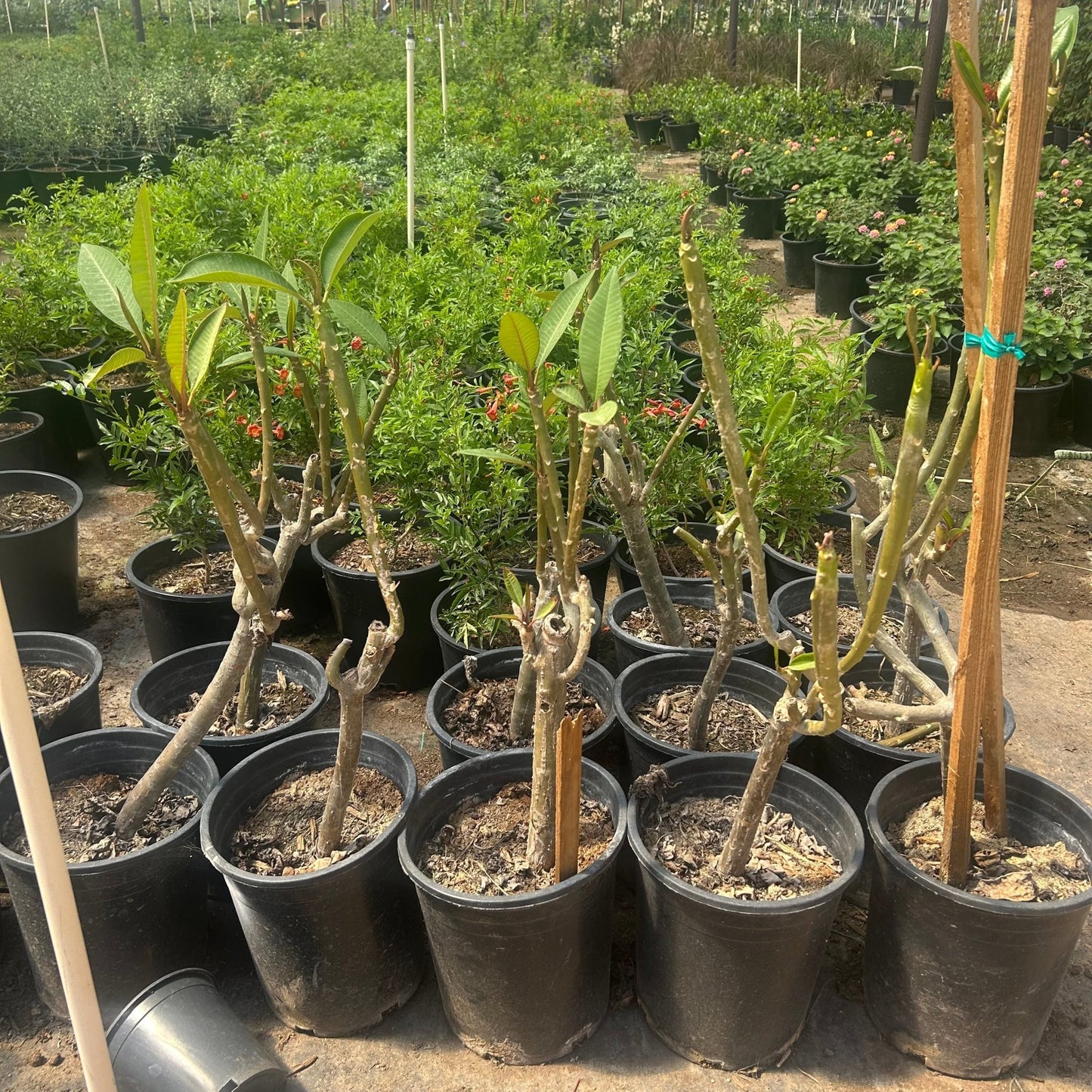

Plumeria
Plumeria
Couldn't load pickup availability
Arizona's Most Exotic Flowering Tree — Plumeria (Frangipani) for Phoenix Gardens
Plumeria (Plumeria spp.), known worldwide as Frangipani, is the ultimate tropical statement plant for Phoenix landscapes. Famous for its intensely fragrant clusters of waxy flowers in white, yellow, pink, red, and multi-colored varieties, Plumeria brings a true Hawaiian paradise feel to desert gardens. Despite its exotic appearance, this deciduous flowering tree is surprisingly heat-tough — going dormant in Phoenix winters and bursting back with stunning blooms every summer. Whether you're creating a tropical focal point in Scottsdale, adding poolside drama in Chandler, or planting a fragrant centerpiece in your Mesa backyard — Plumeria delivers jaw-dropping beauty season after season.
Plumeria Plant Details
| Attribute | Detail |
|---|---|
| Scientific Name | Plumeria spp. |
| Common Names | Plumeria, Frangipani, Lei Flower, Temple Tree |
| Mature Height | 8–20 feet (varies by variety and age) |
| Mature Width | 8–12 feet |
| Growth Rate | Moderate — 1–2 feet per year in Phoenix |
| Sun | Full sun (6+ hours). Thrives in Phoenix's intense summer sun. |
| Water | Low once established. Highly drought-tolerant during dormancy. |
| USDA Zones | 10–12 (Phoenix Zone 9b–10a — protect from frost in winter) |
| Soil | Well-draining. Sensitive to overwatering. Adapts to Arizona soils with excellent drainage. |
| Foliage | Deciduous — drops leaves in winter; leafs out and blooms in late spring |
| Bloom Color | White, yellow, pink, red, or multi-colored (varies by variety) |
| Bloom Season | Late spring through fall (May–October in Phoenix) |
| Fragrance | Intense tropical fragrance — sweet, honeyed, and floral |
Plumeria Uses in Phoenix Landscapes
Specimen Focal Point
Plumeria's sculptural branching structure and spectacular blooms make it a natural focal point in Phoenix landscapes year-round. Even in winter dormancy, the twisted, bare branches have an architectural quality that adds interest to the garden. In summer, the bursts of fragrant flowers are truly show-stopping. Plant as a standalone specimen in a lawn area, courtyard, or center of a circular drive in Scottsdale, Paradise Valley, or Fountain Hills for maximum impact.
Poolside Tropical Planting
Plumeria is one of the most popular poolside trees in Phoenix thanks to its clean, leathery foliage (minimal mess), stunning blooms, and intoxicating fragrance that perfumes outdoor spaces all summer long. Its non-invasive root system makes it safe near pool decks and spa surrounds. Plant 8–10 feet from the pool edge to give the canopy room to spread while keeping the pool area clean. Pair with Bird of Paradise and Giant White Bird of Paradise for a full tropical resort experience in Chandler, Peoria, and Glendale.
Fragrant Patio and Courtyard Tree
A single Plumeria near a patio or outdoor seating area in Tempe or Gilbert will perfume your entire outdoor living space on warm summer evenings. The fragrance intensifies after sunset, making it perfect for outdoor dining areas and entryways. The compact canopy (8–12 feet wide) fits comfortably in enclosed courtyard gardens where larger trees would overwhelm the space.
Container Planting and Frost Protection
In Phoenix's Zone 9b areas that occasionally see frost, Plumeria can be grown in large containers (25+ gallons) and moved to a covered area during rare cold snaps. Container-grown Plumerias thrive on patios and balconies, providing the full tropical impact without worrying about ground frost. A large ceramic or terracotta pot with excellent drainage is ideal — the heat absorbed by the container actually benefits the roots during Phoenix winters.
Best Time to Plant Plumeria in Phoenix
Spring (March–May) is the ideal time to plant Plumeria in Phoenix — once nighttime temperatures are consistently above 50°F and the plant has broken dormancy. Planting in active growth allows roots to establish during the long, warm growing season. Fall planting is not recommended as the plant will soon go dormant and won't establish well before winter. If you plant in spring, expect your first blooms within the same season on established 10+ gallon plants. Summer planting is fine — just water more frequently in the first 4–6 weeks.
How to Plant Plumeria
- Choose a full-sun location — Plumeria needs 6+ hours of direct sun daily to bloom well. South or west-facing locations in Phoenix are ideal.
- Dig wide, not deep — excavate 2–3x the root ball width at the same depth. Never plant deeper than the soil line in the pot.
- Drainage is critical — check for caliche and break through any hardpan. Plumeria is extremely sensitive to root rot from standing water.
- Amend sparingly — backfill with native soil and a 20% blend of coarse sand or perlite to improve drainage in Phoenix's dense caliche soils.
- Space generously — 10–15 feet from other large plants and structures to allow full canopy development.
- Water basin and mulch — build a 3–4 inch watering berm; apply 2–3 inches of gravel or bark mulch to retain moisture without waterlogging roots.
Watering Plumeria in Phoenix
First Year Watering Schedule
Plumeria is more drought-tolerant than most tropical plants but needs consistent moisture to establish. Overwatering is the #1 killer — always let the soil dry out between waterings:
- Weeks 1–2: Every 2–3 days, deep and slow (let water soak in fully)
- Month 1–2: Every 4–5 days (check soil — water only when top 2 inches are dry)
- Month 3–6: Every 7–10 days during active growth; reduce in fall as dormancy approaches
- Winter dormancy: Stop watering entirely or water once a month at most — Plumeria needs a dry rest period
- Summer Year 2+: Every 10–14 days; rely on rainfall in monsoon season
Drip Irrigation
Use 1–2 GPH emitters placed 18–24 inches from the trunk. A timer that runs deeply and infrequently (rather than short daily cycles) is ideal for Plumeria. During monsoon season (July–September), reduce or stop irrigation as rainfall is usually sufficient. Never allow Plumeria to sit in standing water — well-draining soil and infrequent deep watering is the key to success.
When does Plumeria bloom in Phoenix?
Plumeria typically blooms from late April or May through October in the Phoenix Valley. The first flowers appear as the plant fully leafs out in spring. Peak bloom is usually June through September, coinciding with Phoenix's warmest and longest days. Established plants with full sun exposure produce the most abundant blooms.
Does Plumeria lose its leaves in Phoenix?
Yes — Plumeria is deciduous and loses all its leaves in Phoenix's mild winters, usually from November through March. This is completely normal and doesn't indicate a problem. The bare branches will leaf out again in spring, followed by blooms. During dormancy, stop watering almost entirely — the plant is resting.
Is Plumeria cold-hardy enough for Phoenix?
Phoenix's Zone 9b–10a climate is on the edge of Plumeria's cold tolerance. Most years, established Plumerias in the ground handle Phoenix winters without damage. On rare nights when temperatures drop below 32°F, young plants and container specimens should be protected with frost cloth or moved indoors. In most Phoenix years, ground-planted Plumerias establish without any frost protection needed.
Is Plumeria pet-friendly?
Plumeria has mild toxicity — it can cause GI upset if leaves or sap are ingested by pets, though serious toxicity is rare. The sticky white sap can also irritate skin. Exercise caution with pets that chew plants, and keep cut branches away from dogs and cats. Three Timbers recommends consulting your vet if you have pets that are heavy plant-chewers.
How big does Plumeria get in Phoenix?
In Phoenix, Plumeria typically reaches 8–15 feet tall over 5–10 years, growing 1–2 feet per year during the warm season. Larger 25-gallon specimens planted in the ground can eventually reach 15–20 feet with age, though they remain quite manageable for most residential landscapes. Phoenix's long, warm summers accelerate growth compared to cooler climates.
You May Also Like
Tropical Bird of Paradise — Another stunning tropical statement plant for Phoenix, with brilliant orange and blue blooms that complement Plumeria plantings.
Giant White Bird of Paradise — A dramatic large-leaved tropical that creates an impressive backdrop behind Plumeria in poolside or courtyard plantings.
Canna Lily — A bold, colorful tropical perennial that pairs beautifully with Plumeria in summer-blooming Phoenix garden beds.
Bougainvillea — A fast-growing tropical vine with vivid color that complements Plumeria's soft fragrance in Phoenix's full-sun landscapes.
Lantana — A low-water, colorful flowering perennial that works beautifully as ground-level color beneath Plumeria trees in Phoenix gardens.
How Many Plumeria Do I Need?
Plumeria is a sculptural specimen, not a hedge plant. One tree makes a striking focal point in a courtyard, lawn island, or near a patio where its evening fragrance can be enjoyed. For a tropical grouping, plant in odd numbers (3 or 5) spaced 10 to 12 ft apart so each canopy and branching form stands clear. Keep it 8 to 10 ft back from pool edges and walls to give the 8 to 12 ft canopy room while keeping litter off the deck. Different bloom colors grouped together create a vivid summer display.
Plumeria Season-by-Season in Phoenix
- Spring (Feb-Apr): Breaks dormancy and leafs out as nights warm above 50°F. This is the prime planting window, and the first blooms begin to open on established trees by late spring.
- Summer (May-Sep): Peak bloom and fragrance. Loves full Phoenix sun and reflected heat, perfuming the yard on warm evenings. Ease back on water during monsoon humidity (Jul-Sep) since soggy roots cause rot.
- Fall (Oct-Nov): Bloom winds down and the tree begins dropping leaves as it heads toward dormancy. Taper off irrigation.
- Winter (Dec-Jan): Fully deciduous and resting; bare architectural branches. Frost-tender below 32°F, so cover young or container plants on hard frost nights and keep the soil nearly dry through the dormant rest.
At a Glance
✔ Heat-Loving (Reflected-Heat Tolerant) ✔ Drought-Tolerant ✔ Pool-Friendly (Low-Litter) ✔ Low-Maintenance
Plant It With
- Tropical Bird of Paradise: brilliant orange and blue blooms for a resort-style pairing.
- Giant Tropical Bird of Paradise: a large-leaved tropical backdrop behind the Plumeria canopy.
- Barbara Karst Bougainvillea: vivid color that complements Plumeria's soft fragrance in full sun.
- Florida Sunset Hibiscus: tropical bloom at eye level beneath the tree.
Is Plumeria Right for Your Yard?
It thrives in a hot, full-sun spot with sharp drainage where you can give it a dry winter rest, and rewards you with show-stopping fragrant bloom all summer plus clean, pool-safe litter. It is ideal as a tropical focal point or poolside specimen. Not a fit if you want year-round foliage or a plant for a cold frost pocket: it goes fully bare in winter, is frost-tender below 32°F, and its sap is mildly toxic and can irritate skin, so site it away from heavy pet-chewers.
Customer Reviews
Share