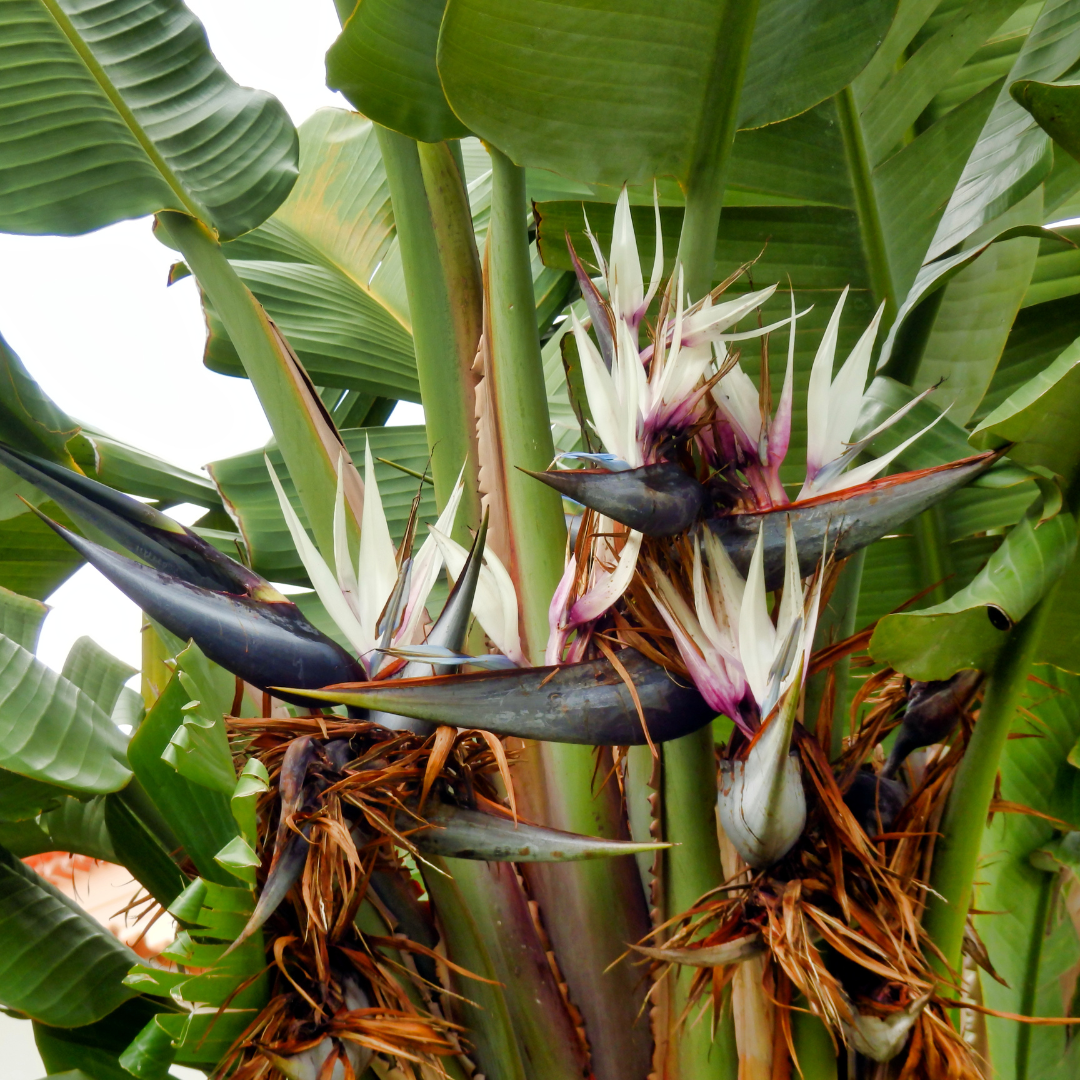


Giant Tropical Bird of Paradise
Giant Tropical Bird of Paradise
Couldn't load pickup availability
Phoenix's Most Dramatic Tropical Statement — Giant Bird of Paradise Tree
Giant Tropical Bird of Paradise (Strelitzia nicolai) is the most architecturally striking tropical accent plant available in Phoenix — a towering multi-stemmed beauty with enormous paddle-shaped leaves that creates instant resort-style drama in any landscape. Unlike the smaller orange Bird of Paradise, this giant species grows into a true tree-form specimen with a woody trunk, reaching 20–30 feet at maturity. It thrives in the intense Phoenix sun, tolerates reflected heat from walls and pavers, and delivers year-round tropical grandeur with minimal maintenance. Whether you're creating a resort-style focal point in a Scottsdale backyard, framing a pool in Chandler, anchoring a modern desert design in Mesa, or adding bold tropical scale to a Gilbert courtyard — Giant Bird of Paradise delivers unmatched presence.
Giant Tropical Bird of Paradise Plant Details
| Attribute | Detail |
|---|---|
| Scientific Name | Strelitzia nicolai |
| Common Names | Giant Bird of Paradise, Giant White Bird of Paradise, White Bird of Paradise, Natal Wild Banana |
| Mature Height | 20–30 feet |
| Mature Width | 10–15 feet |
| Growth Rate | Moderate — 2–3 feet per year in Phoenix |
| Sun | Full sun to partial shade. Handles reflected heat from walls and pavers. |
| Water | Low to moderate once established. Drought-tolerant after year 2. |
| USDA Zones | 9–11 (Phoenix is Zone 9b–10a) |
| Soil | Well-draining. Adapts to Arizona caliche soils. |
| Foliage | Evergreen — large paddle-shaped leaves year-round |
| Bloom | White and dark blue/purple flowers on mature plants (5+ years) |
Giant Tropical Bird of Paradise Uses in Phoenix Landscapes
Resort-Style Focal Point & Specimen Planting
Nothing transforms a Phoenix backyard into a resort-style oasis like a mature Giant Bird of Paradise. Its enormous banana-like leaves and multi-trunk form create instant architectural drama as a standalone specimen. Plant it where it can be seen from multiple angles — as a backdrop to a water feature, anchoring a courtyard corner, or rising behind a pool deck in Scottsdale or Tempe. Allow 15 feet of clearance from structures for its mature spread, and 20+ feet from pools and walkways. One well-placed specimen becomes the defining feature of an entire landscape design.
Pool Surround & Tropical Paradise Design
Giant Bird of Paradise is one of Phoenix's most popular poolside plants — its dramatic leaves create a resort canopy without dropping messy seed pods into the water. It's a true pool-friendly tropical that pairs beautifully with Mexican Fan Palms, Lantana, and desert succulents for a layered tropical resort look popular in Peoria and Gilbert. Plant 8–10 feet from the pool edge in a well-draining bed, and allow it to grow into a multi-trunk clump over time. The white and blue flowers (once the plant matures at 5+ years) add another dramatic seasonal element.
Privacy Screening & Tropical Background
Planted 6–8 feet apart in a row, Giant Bird of Paradise creates an impactful and fast-growing tropical privacy screen for Phoenix properties. Within 3–5 years, a row of these plants will provide 10–15 feet of visual screening — blocking neighbors, walls, or utility equipment behind a curtain of lush tropical foliage. This approach works exceptionally well in Chandler and Mesa where block walls can be transformed with a bold living backdrop. For a 20 ft fence line: 3 plants; for a 40 ft fence: 5–6 plants.
Modern Desert & Contemporary Landscape Design
Giant Bird of Paradise's clean, architectural form makes it a top pick for modern desert and contemporary Phoenix landscape designs. Its structural leaves and vertical growth habit complement desert minimalism — paired with concrete hardscape, gravel, and low-profile succulents like Blue Glow Agave or Soft-leaf Yucca. This contrast of tropical lushness with desert materials creates the signature "desert modern" aesthetic popular across Scottsdale's luxury residential market.
Best Time to Plant Giant Tropical Bird of Paradise in Phoenix
Fall (October–November) is the ideal planting window — cooler temperatures reduce transplant stress while warm soil gives roots 5–6 months of establishment before the first Phoenix summer. Spring (March–April) is a solid second option, giving plants a full growing season ahead. Avoid planting in peak summer (July–August) as extreme heat combined with transplant stress can cause severe leaf scorch. If summer planting is necessary, provide afternoon shade cloth for the first 30 days and water every other day.
How to Plant Giant Tropical Bird of Paradise
- Dig wide, not deep — excavate a hole 2–3x the width of the root ball at the same depth as the container. Giant Bird of Paradise has a wide-spreading root system that needs lateral room.
- Check for caliche — break through any caliche hardpan layer to ensure water can drain below the root zone and prevent waterlogging.
- Backfill with native soil — amend lightly with 10–20% organic compost. Avoid heavy mixes that retain too much moisture, which can cause root rot.
- Spacing — 8–10 ft apart for screening; 15 ft apart for specimens to reach full spread.
- Build a deep water basin — create a 4–6 inch raised ring of soil around the drip line to contain irrigation water and direct it deep into the root zone.
- Mulch generously — apply 3–4 inches of bark or decomposed granite to retain moisture, moderate soil temperature, and suppress weeds during establishment.
Watering Giant Tropical Bird of Paradise in Phoenix
First Year Watering Schedule
Weeks 1–2: Water every 1–2 days, deep and slow (30–40 minutes per session). Months 1–2: Every 3–4 days. Months 3–6: Every 7–10 days (every 5–7 days in peak summer). After Year 1: Every 14 days in summer; every 3–4 weeks in winter. After Year 2: Highly drought-tolerant — every 3 weeks in summer; monthly or less in winter. Consistent deep watering encourages deep root growth, which dramatically improves heat and drought tolerance.
Drip Irrigation for Giant Bird of Paradise
Use 2–4 GPH drip emitters placed 18–24 inches from the main trunk, spaced evenly around the plant. As the plant grows and spreads, move emitters outward toward the expanding drip line. Run irrigation in early morning for maximum absorption. Established plants need significantly less water — reduce frequency as the plant matures past year 2.
How fast does Giant Bird of Paradise grow in Phoenix?
In Phoenix's warm climate, expect 2–3 feet of growth per year under good conditions. A 15-gallon plant can reach 8–10 feet within 3–4 years and achieve its mature height of 20–30 feet within 10–15 years. Consistent summer watering during the first two years dramatically accelerates establishment.
Is Giant Bird of Paradise the same as the regular Bird of Paradise?
No — they are different species. The regular (orange) Bird of Paradise is Strelitzia reginae, a compact shrub that grows 4–5 feet tall with vivid orange and blue flowers. Giant Bird of Paradise (Strelitzia nicolai) is a true tree-form species that grows 20–30 feet, produces white and blue flowers, and develops a distinctive woody trunk. Both thrive in Phoenix, but Giant Bird of Paradise is used for large-scale tropical drama and screening.
Does Giant Bird of Paradise bloom in Phoenix?
Yes — but patience is required. Plants typically begin flowering after 5–7 years when they reach sufficient maturity. The white and dark blue/purple flowers emerge from boat-shaped bracts and appear intermittently in spring and summer. Even without flowers, the plant's architectural presence and lush foliage make it one of Phoenix's most dramatic landscape specimens.
Is it cold-hardy in Phoenix?
Giant Bird of Paradise is rated for USDA Zones 9–11, and Phoenix (Zone 9b–10a) is within its comfortable range. It can handle brief dips to the upper 20s°F without permanent damage. Leaves may brown at the tips during an unusually cold Phoenix winter, but the plant recovers quickly once temperatures warm in February. Established plants over 3 years old are significantly more cold-tolerant than newly planted specimens.
How much clearance does Giant Bird of Paradise need?
Plan for at least 10–12 feet of horizontal clearance from structures, walls, or other plants to accommodate mature width. Keep it 15–20 feet from pools, foundations, and underground utilities — its root system can become substantial as the plant matures. The further from structures, the better for long-term health and low-maintenance performance.
You May Also Like
Yellow Hibiscus — A tropical accent shrub with large yellow blooms that pairs beautifully with Giant Bird of Paradise in Phoenix tropical landscape designs.
Florida Sunset Hibiscus — A multi-color tropical hibiscus with bold orange, red, and yellow blooms that creates a stunning companion planting with Giant Bird of Paradise.
Torch Glow Bougainvillea — A compact magenta bougainvillea for foreground planting that provides year-round color contrast against Giant Bird of Paradise's lush green leaves.
Lantana — A heat-loving, drought-tolerant ground cover that fills in around the base of Giant Bird of Paradise with season-long color in Phoenix landscapes.
Texas Sage (Leucophyllum frutescens) — A silvery desert shrub with purple blooms that creates a striking contrast with the lush tropical foliage of Giant Bird of Paradise.
How Many Giant Bird of Paradise Do I Need?
This is a large architectural specimen, so plant it for presence rather than crowding. As a focal point, a single clump anchors a courtyard corner, pool backdrop, or entry. For grouped drama, plant in odd-numbered groups of 3 spaced 8 to 10 feet apart so each multi-trunk clump can open to its full 10 to 15 foot width. For a fast tropical screen, set plants 7 feet on center so the clumps knit into a continuous wall of foliage within 3 to 5 years.
| Screen run length | Plants needed (about 7 ft on center) |
|---|---|
| 14 ft | 3 plants |
| 21 ft | 4 plants |
| 28 ft | 5 plants |
| 35 ft | 6 plants |
Giant Bird of Paradise Season-by-Season in Phoenix
- Spring (Feb to Apr): Strong new leaf flush as temperatures climb, and the best second planting window of the year. Mature plants begin pushing their white-and-blue boat-shaped bracts.
- Summer (May to Sep): Thrives in full Phoenix heat and reflected heat off walls and pavers. Monsoon winds (Jul to Sep) often split or shred the big paddle leaves, which is cosmetic and normal. Keep a deep soak every 10 to 14 days in peak heat for the lushest foliage.
- Fall (Oct to Nov): Prime planting season. Warm soil and mild air give roots months to establish before winter, and growth continues well into the fall.
- Winter (Dec to Jan): Holds its evergreen structure. Be honest about frost: leaf tips and edges can brown in the upper 20s F. Cover young plants on hard frost nights below about 28 F. Established plants over 3 years old shrug off brief cold and recover by February.
At a Glance
✔ Heat-Loving (Reflected-Heat Tolerant) ✔ Drought-Tolerant ✔ Evergreen ✔ Low-Maintenance ✔ Shade-Providing
Plant It With
- Florida Sunset Hibiscus: tropical mid-height color that echoes the resort look.
- Torch Glow Bougainvillea: compact magenta mound for the foreground.
- Texas Sage: silvery desert contrast against the lush green paddles.
- Gold Mound Lantana: low, heat-loving color to fill in around the base.
Is Giant Bird of Paradise Right for Your Yard?
It thrives in full sun to part shade, takes reflected heat, and wants well-drained soil with the caliche broken through, plus room to reach 20 to 30 feet tall and 10 to 15 feet wide. Not a fit if you only have a small patio bed, a low overhang or eave, or a low spot that regularly drops into the mid-20s F without any frost protection.
Customer Reviews
Ben and Bobby were on top of the plants I wanted and gave me options for other plants that may work. If there was something my wife wanted they went out of there way to try and accommodate, service of champions!
Share