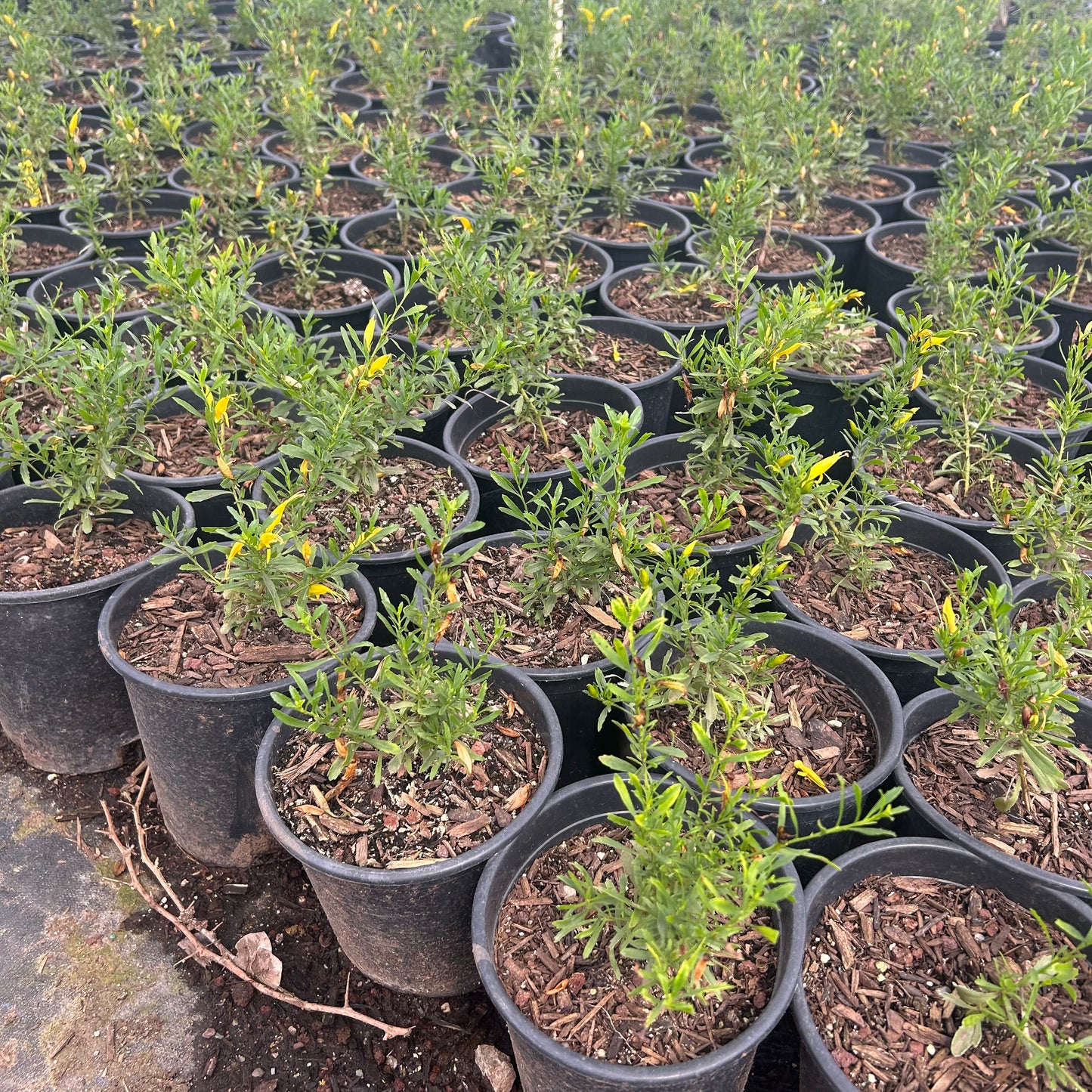


Outback Sunrise' Emu Bush
Outback Sunrise' Emu Bush
Couldn't load pickup availability
The Best Low-Growing Yellow Groundcover for Phoenix Desert Landscapes
'Outback Sunrise' Emu Bush (Eremophila prostrata) is a tough Australian native that delivers bright yellow flowers on a low, spreading mat of evergreen foliage — all with virtually zero water once established. Growing just 1–2 feet tall and spreading 4–6 feet wide, this groundcover shrub is built for Phoenix heat and perfect for covering large areas with color. Whether you're replacing thirsty turf in Scottsdale, filling a slope in Mesa, or edging a xeriscape bed in Chandler — Outback Sunrise gives you year-round coverage and seasonal blooms without the maintenance.
Outback Sunrise Emu Bush Plant Details
| Attribute | Detail |
|---|---|
| Scientific Name | Eremophila prostrata 'Outback Sunrise' |
| Common Names | Outback Sunrise Emu Bush, Prostrate Emu Bush |
| Mature Height | 1–2 feet |
| Mature Width | 4–6 feet |
| Growth Rate | Moderate — fills in within 1–2 seasons in Phoenix |
| Sun | Full sun (6+ hrs). Handles reflected heat from walls. |
| Water | Very low once established. Extremely drought-tolerant. |
| USDA Zones | 9–11 (Phoenix is Zone 9b–10a) |
| Soil | Well-draining. Adapts to Arizona caliche soils. |
| Foliage | Evergreen — stays green year-round |
| Bloom Color | Bright yellow |
Outback Sunrise Emu Bush Uses in Phoenix Landscapes
Drought-Tolerant Groundcover
Outback Sunrise is one of the best low-water groundcovers for large areas in Phoenix. Plant 3–4 feet apart and it will fill in to form a dense, flowering mat. It's an excellent turf replacement for homeowners looking to cut water bills in Gilbert, Tempe, and Peoria without sacrificing visual appeal.
Slope & Erosion Control
The spreading, low growth habit makes Outback Sunrise ideal for stabilizing slopes and hillsides. Its dense root system holds soil in place while the evergreen foliage provides year-round coverage. Combine with decomposed granite for a clean, modern desert slope treatment.
Border & Edging Plant
Use Outback Sunrise to edge walkways, patios, and garden beds. Its low profile won't block sightlines, and the bright yellow blooms add seasonal color at ground level. It pairs beautifully with taller desert shrubs like Texas Sage and Ruellia for layered contrast.
Best Time to Plant Outback Sunrise Emu Bush in Phoenix
Fall (October–November) is the ideal planting window. Warm soil encourages root development while cooler air reduces transplant stress, giving the plant 6–8 months to establish before summer heat. Spring (February–April) is the second-best option. Avoid summer planting if possible.
How to Plant Outback Sunrise Emu Bush
- Dig wide, not deep — 2–3x the root ball width, same depth as the container.
- Check for caliche — break through any hardpan layer for proper drainage.
- Backfill with native soil — no amendments needed for this tough species.
- Spacing — 3–4 feet apart for groundcover fill; 4–5 feet for individual accent plants.
- Water basin — build a 3–4 inch ring to direct water to roots during establishment.
- Mulch — 2–3 inches of gravel or decomposed granite around the base.
Watering Outback Sunrise Emu Bush in Phoenix
First Year Watering Schedule
Weeks 1–2: Every 2–3 days, deep and slow. Month 1–2: Every 4–5 days. Month 3–6: Every 7–10 days. After Year 1: Every 2–3 weeks in summer; minimal to no supplemental water in winter.
Drip Irrigation
Place one 1 GPH emitter 8–12 inches from the base. Established plants are extremely drought-tolerant — overwatering is a bigger risk than underwatering. Let the soil dry completely between waterings.
How fast does Outback Sunrise Emu Bush spread?
It fills in at a moderate rate, typically reaching its full 4–6 foot spread within 1–2 growing seasons in Phoenix. Plant closer together (3 feet apart) if you want faster coverage.
Does it bloom year-round in Phoenix?
It blooms heaviest in spring and fall, with sporadic flowers through summer and winter. The evergreen foliage looks great year-round even when not in bloom.
Is Outback Sunrise deer and rabbit resistant?
Yes. Eremophila species are generally not palatable to deer or rabbits, making them a reliable choice for landscapes where wildlife browsing is an issue.
Can it handle reflected heat?
Absolutely. This Australian native thrives in full sun and reflected heat — perfect for south- and west-facing exposures alongside walls, driveways, and patios.
You May Also Like
Valentine Emu Bush — Red-flowering Eremophila for dramatic desert color.
Trailing Lantana — Purple or white trailing groundcover that complements yellow Emu Bush.
Angelita Daisy — Low-growing yellow daisy for similar groundcover use.
Damianita — Compact yellow-blooming groundcover for rock gardens and borders.
How Many Outback Sunrise Emu Bush Do I Need?
Outback Sunrise spreads 4 to 6 feet wide on a low mat, so it is priced and planted by area. Space plants about 4 feet apart on center for solid groundcover coverage (roughly 16 square feet per plant), or 3 feet apart if you want the bed to close in faster. Use this as a starting guide:
| Area to cover | Plants needed (4 ft spacing) |
|---|---|
| 100 sq ft | 6 plants |
| 250 sq ft | 16 plants |
| 500 sq ft | 31 plants |
| 1,000 sq ft | 63 plants |
For slopes, plant on the tighter 3 foot spacing so the roots knit together and hold soil before the first monsoon storms.
Outback Sunrise Emu Bush Season-by-Season in Phoenix
- Spring (Feb–Apr): Heaviest yellow bloom flush and a strong push of new growth. Excellent second window to plant and let roots establish before summer.
- Summer (May–Sep): Thrives in full reflected heat against west- and south-facing walls with very little water. Flowering slows but continues sporadically, often picking back up with monsoon humidity (Jul–Sep). Let the soil dry fully between waterings to avoid root rot.
- Fall (Oct–Nov): Prime planting season in the Valley and a second strong bloom. Cooler nights plus warm soil give the fastest establishment.
- Winter (Dec–Jan): Stays evergreen and holds its low green mat through the season. Hardy to roughly 20°F, so it shrugs off normal Phoenix winters; cover only during an unusual hard freeze.
At a Glance
✔ Heat-Loving (Reflected-Heat Tolerant) ✔ Drought-Tolerant ✔ Evergreen ✔ Low-Maintenance ✔ Pollinator-Friendly ✔ Deer & Rabbit-Resistant ✔ Cold-Hardy to 20°F
Plant It With
- Valentine Emu Bush: a taller red-flowering Eremophila that layers winter and spring color above the yellow mat.
- Angelita Daisy: another low yellow bloomer that blends seamlessly for a long groundcover sweep.
- Damianita: a compact yellow-flowering mound for the front of borders and rock gardens.
- Desert Marigold: airy yellow daisies that self-sow through the planting for an effortless desert look.
Is Outback Sunrise Emu Bush Right for Your Yard?
It is an ideal fit for full-sun, low-water areas with fast-draining soil: turf-replacement zones, sunny slopes, parking-strip edges, and beds along hot reflective walls. Break through any caliche layer at planting and water deeply but infrequently. It is not a fit if the spot stays shaded, drains poorly, or gets frequent irrigation, since constant moisture is the one thing that will rot it out.
Customer Reviews
Share