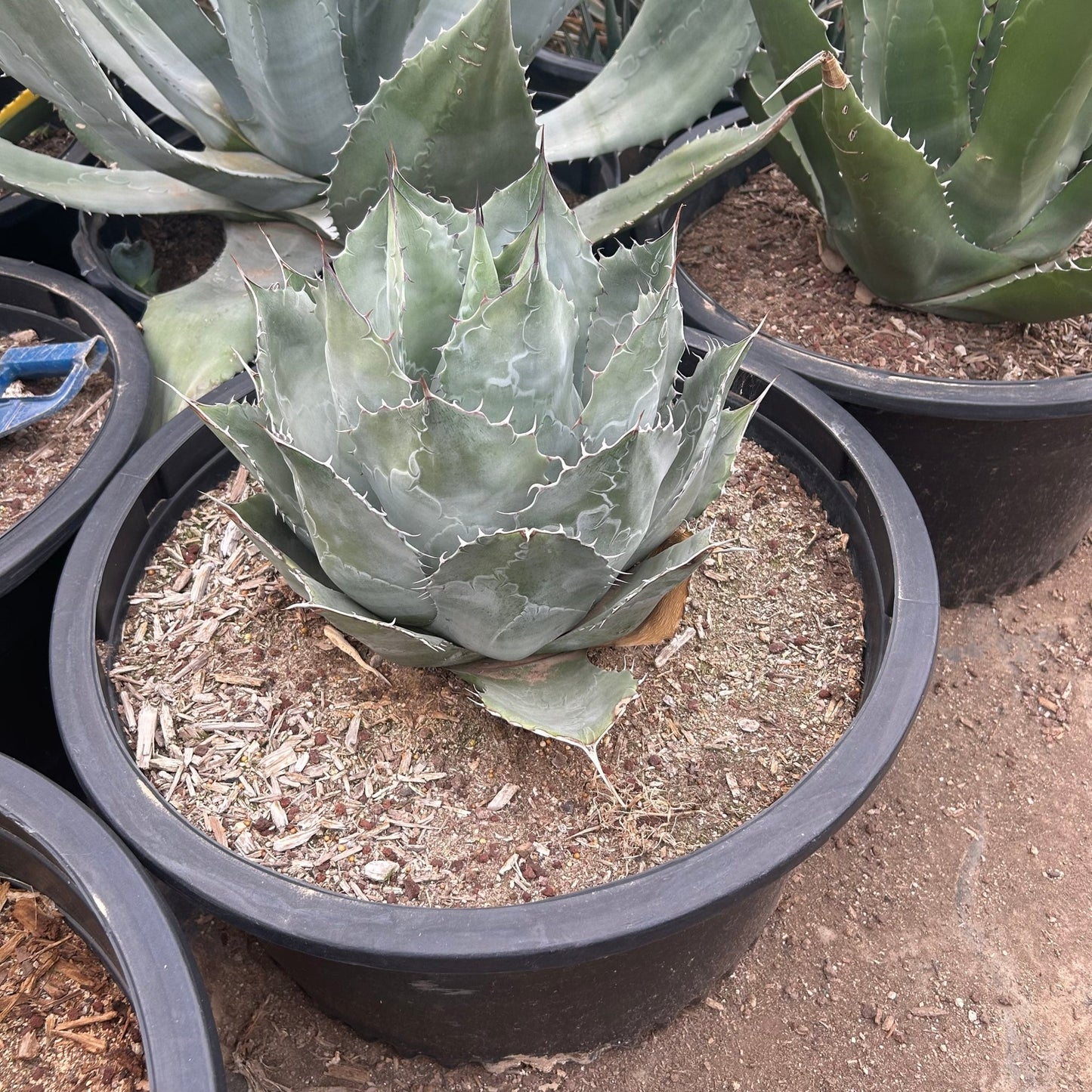


Desert Rose Agave
Desert Rose Agave
Couldn't load pickup availability
A Stunning Compact Agave for Phoenix Desert Gardens
Desert Rose Agave (Agave parasana) is one of the most beautiful small agaves you can grow in the Phoenix Valley. Its tight, symmetrical rosette of blue-green leaves edged with striking reddish-brown teeth creates a living sculpture that looks incredible year-round. Whether you're building a rock garden in Scottsdale, adding a container accent in Chandler, or designing a low-water border in Gilbert — Desert Rose Agave delivers maximum visual impact with virtually zero maintenance.
Desert Rose Agave Plant Details
| Attribute | Detail |
|---|---|
| Scientific Name | Agave parasana |
| Common Names | Desert Rose Agave, Parasana Agave, Butterfly Agave |
| Mature Height | 1–2 feet |
| Mature Width | 2–3 feet |
| Growth Rate | Slow — 2–4 inches per year in Phoenix |
| Sun | Full sun to partial shade. Handles reflected heat from walls. |
| Water | Very low once established. Extremely drought-tolerant. |
| USDA Zones | 8–11 (Phoenix is Zone 9b–10a) |
| Soil | Well-draining. Adapts to Arizona caliche soils with minimal amendment. |
| Foliage | Evergreen — blue-green rosette with reddish-brown marginal teeth |
| Flower | Yellow bloom stalk at maturity (monocarpic — blooms once) |
Desert Rose Agave Uses in Phoenix Landscapes
Rock Garden Centerpiece
Desert Rose Agave's compact, sculptural form makes it the perfect focal point in a rock garden. Plant it among boulders and decomposed granite for a natural desert aesthetic. Its blue-green coloring and red-tipped teeth pop against warm-toned gravel. Pair with Angelita Daisy or trailing Rosemary for contrasting texture.
Container & Patio Accent
This agave's manageable 2–3 foot spread makes it ideal for large pots on patios, pool decks, and courtyards. Use a terra cotta or concrete planter with well-draining cactus mix. In Scottsdale and Paradise Valley, container agaves add instant southwestern elegance to outdoor living spaces.
Low-Water Border & Mass Planting
Line a walkway or driveway with Desert Rose Agave spaced 2.5–3 feet apart for a dramatic, low-maintenance border. The uniform rosettes create a clean, modern look that thrives on neglect. Mix with other small agaves like Artichoke Agave or Parry's Agave for variety in a mass planting.
Best Time to Plant Desert Rose Agave in Phoenix
Fall (October–November) is the ideal planting window — warm soil encourages root growth while cooler air reduces transplant stress. The plant gets 6–8 months of establishment before its first Phoenix summer. Spring (February–April) is the second-best window. Avoid planting in peak summer heat if possible.
How to Plant Desert Rose Agave
- Dig wide, not deep — 2–3x the root ball width, same depth
- Check for caliche — break through any hardpan layer for drainage
- Backfill with native soil — no amendment needed for most Phoenix soils
- Plant at grade — keep the crown at or slightly above soil level to prevent rot
- Water basin — build a 3–4 inch ring to direct water to roots
- Mulch with gravel — 2–3 inches of decomposed granite or rock mulch (avoid organic mulch touching the crown)
Watering Desert Rose Agave in Phoenix
First Year Watering Schedule
Weeks 1–2: Every 2–3 days, deep and slow (15–20 min). Month 1–2: Every 5–7 days. Month 3–6: Every 10–14 days. After Year 1: Every 2–3 weeks in summer; monthly or less in winter.
Drip Irrigation
Place one 1–2 GPH emitter 12 inches from the base. Established Desert Rose Agaves are extremely drought-tolerant and need very little supplemental water. Overwatering is the most common cause of agave death in Phoenix — always err on the dry side.
How fast does Desert Rose Agave grow in Phoenix?
Desert Rose Agave is a slow grower, adding just 2–4 inches per year. It reaches its full 2–3 foot spread over 5–8 years. The slow growth is part of its appeal — it maintains a tight, compact form for years.
Is Desert Rose Agave drought-tolerant?
Extremely. Once established, it can survive on rainfall alone in most Phoenix-area landscapes. It stores water in its thick leaves and is one of the toughest ornamental plants for Arizona's desert climate.
Can Desert Rose Agave handle full Arizona summer sun?
Yes — it thrives in full sun, including reflected heat off walls, concrete, and pavers. It also tolerates partial shade, making it versatile for different landscape positions.
Does Desert Rose Agave have sharp spines?
Yes — the leaves have reddish-brown marginal teeth and a terminal spine. Plant it away from high-traffic walkways and keep children and pets at a safe distance.
You May Also Like
Artichoke Agave — Larger sculptural agave with wide, overlapping leaves for dramatic desert focal points.
Parry's Agave — Compact blue-gray rosette that pairs beautifully with Desert Rose Agave in mass plantings.
Whale's Tongue Agave — Bold, wide-leaved agave for large-scale desert landscape statements.
Coral Aloe — Colorful succulent with coral-orange winter blooms that contrast nicely with agave forms.
How Many Desert Rose Agave Do I Need?
Desert Rose Agave is a compact specimen rosette. Plant single as a rock-garden or container focal point, in odd-numbered clusters, or in a clean low border. At a mature 2 to 3 foot spread it spaces tightly. Keep its reddish marginal teeth and terminal spine back from walkways, patios, and play areas.
| Planting goal | Spacing | What to buy |
|---|---|---|
| Single rock-garden or container focal | 3 ft clearance | 1 plant |
| Sculptural cluster | 2.5–3 ft on center | 3–5 plants in an odd group |
| Low border / mass (per 10 ft) | 2.5–3 ft on center | about 4 plants |
Desert Rose Agave Season-by-Season in Phoenix
- Spring (Feb–Apr): Slow new growth resumes and the reddish teeth color up crisply along fresh blue-green leaves. A solid second planting window.
- Summer (May–Sep): Handles full sun and reflected heat, and also takes light afternoon shade, which keeps the blue-green color softer in peak heat. Monsoon rain (Jul–Sep) is fine with sharp drainage: keep the crown dry and never let water pool.
- Fall (Oct–Nov): The best planting window of the year. Warm soil and mild air settle roots before winter.
- Winter (Dec–Jan): Evergreen and structural. One of the more cold-tolerant compact agaves, hardy to roughly 15°F, so it rides out typical Valley frost. Cover only in a hard, prolonged freeze to protect leaf tips.
At a Glance
✔ Heat-Loving (Reflected-Heat Tolerant) ✔ Drought-Tolerant ✔ Evergreen ✔ Low-Maintenance ✔ Deer & Rabbit-Resistant ✔ Cold-Hardy to 15°F
Plant It With
- Artichoke Agave: a larger overlapping blue-gray rosette that layers scale behind the compact Desert Rose.
- Blue Glow Agave: red-margined blue rosette that picks up the reddish teeth in a curated grouping.
- Red Yucca: grassy clumps and coral bloom spikes that soften the agave forms and draw hummingbirds.
- Desert Spoon: silvery fine texture that contrasts the tight rosette and reads beautifully in xeriscape.
Is Desert Rose Agave Right for Your Yard?
Desert Rose Agave is right for you if you want a tough, sculptural compact rosette for full sun to light shade, with well-draining or caliche soil and 2 to 3 feet of room. It is deer and rabbit resistant, container-friendly, and needs almost no water once established. It is not a fit beside busy walkways or play areas, since the teeth and tip spine need clearance, and it resents soggy, poorly drained ground.
Customer Reviews
Share