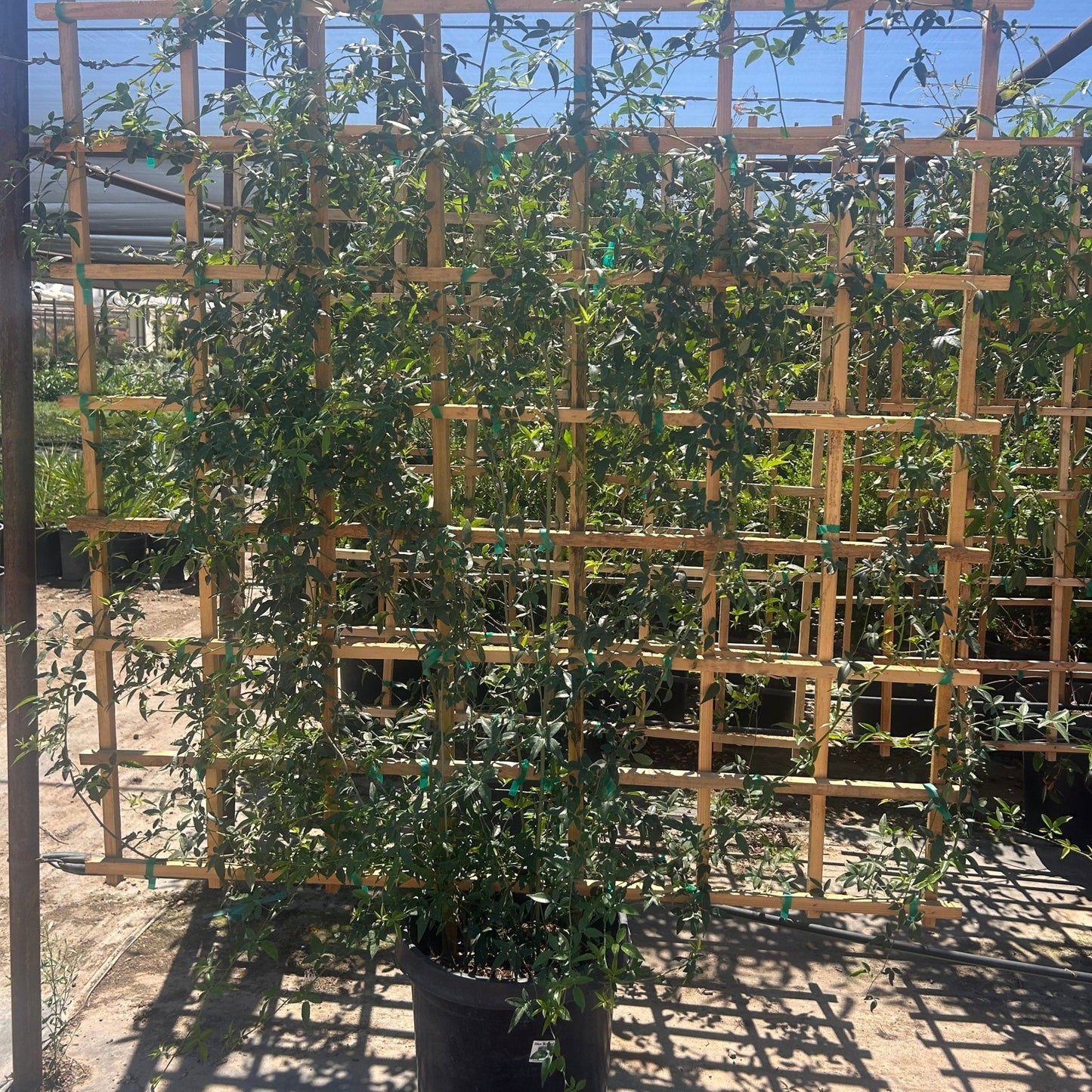

Bower Vine Espalier
Bower Vine Espalier
Couldn't load pickup availability
Phoenix's Most Elegant Espalier Vine — Bower Vine Espalier
Bower Vine Espalier (Pandorea jasminoides, trained as espalier) is one of the most striking and space-efficient plants available for Phoenix Valley walls, fences, and garden structures. Pre-trained to grow flat against a surface, this evergreen climber delivers year-round lush green foliage and cascading clusters of white trumpet-shaped blooms with deep rose-pink throats — all without the sprawl of an untrained vine. Whether you're adding elegance to a courtyard wall in Scottsdale, creating a vertical privacy screen in Chandler, or enhancing a fence line in Mesa — Bower Vine Espalier delivers maximum visual impact in minimal space.
Bower Vine Espalier Plant Details
| Attribute | Detail |
|---|---|
| Scientific Name | Pandorea jasminoides (trained as espalier) |
| Common Names | Bower Vine Espalier, Bower of Beauty Espalier, Pink Bower Vine |
| Trained Height | 10–15 feet (spread depends on support structure) |
| Trained Width | 6–10 feet flat against a wall or fence |
| Growth Rate | Moderate to fast — 3–6 feet per year in Phoenix |
| Sun | Full sun to partial shade. Handles reflected heat from walls. |
| Water | Low to moderate once established. Drought-tolerant. |
| USDA Zones | 9–11 (Phoenix is Zone 9b–10a) |
| Soil | Well-draining. Adapts to Arizona caliche soils. |
| Foliage | Evergreen — stays lush and green year-round |
| Bloom Color | White with deep rose-pink throats, spring through fall |
| Training Style | Pre-trained flat — ideal for walls, fences, and trellises |
Bower Vine Espalier Uses in Phoenix Landscapes
Living Wall and Privacy Screen
Bower Vine Espalier is unmatched for creating a living green wall in Phoenix courtyards, patios, and garden spaces. Trained flat against a surface, it fills in vertically without protruding into walkways or outdoor living areas, making it ideal for narrow side yards, property line fences, and covered patio walls in Scottsdale, Tempe, and Chandler. The dense evergreen foliage provides effective visual privacy, and the recurring blooms add beauty throughout the growing season. Space plants 8–10 feet apart along a fence to create full coverage within 2–3 seasons.
Courtyard and Patio Feature
Few plants in the Phoenix Valley match the elegance of a well-trained Bower Vine Espalier framing a courtyard gate or flowing up a stucco wall. Its refined form, glossy foliage, and soft pink-and-white blooms create a Mediterranean or tropical aesthetic that pairs beautifully with terracotta planters, agave accents, and Spanish-tile features common in Phoenix and Scottsdale architecture. Train along horizontal wires or attach to decorative trellis panels for a polished, structured look.
Low-Space High-Impact Planting
The espalier form solves one of the Phoenix Valley's most common landscaping challenges: creating impact in tight spaces. Because Bower Vine Espalier grows in two dimensions rather than three, it can thrive in narrow planting beds along walls, between structures, and in confined easements where traditional shrubs or trees won't fit. It's an excellent choice for homebuilders, HOA landscapes, and property managers in Peoria, Gilbert, and Glendale looking for a clean, structured plant that delivers year-round visual appeal.
Shade Structure and Pergola Cover
Trained up and over a pergola, arbor, or shade structure, Bower Vine Espalier creates a canopy of dense, evergreen foliage dotted with pink-throated white blooms. Its moderate growth rate makes it manageable — unlike more aggressive vines — and its lush coverage provides meaningful shade for Phoenix patios and outdoor dining areas. Pair with outdoor fans or misters to create a cool, flowering oasis even during summer months.
Best Time to Plant Bower Vine Espalier in Phoenix
Fall (September–November) is the ideal planting window. Warm soil encourages root development while cooler air temperatures reduce transplant stress, giving the vine time to anchor before its first Phoenix summer. Spring (February–April) is a strong second choice. Avoid planting in peak summer (June–August) — the combination of heat stress and transplant shock makes establishment difficult without exceptional care. If you must plant in summer, shade cloth and twice-daily watering for the first two weeks are essential.
How to Plant Bower Vine Espalier
- Prepare the support — install trellis wires, panels, or attachment hardware before planting. The vine can't support itself free-standing.
- Dig wide, not deep — excavate a hole 2–3x wider than the root ball at the same depth, 12–18 inches from the wall base.
- Check for caliche — break through any hardpan layer to ensure deep water penetration. Roots need to go deep for stability.
- Backfill with native soil — a 20% organic amendment mix is fine; don't over-amend with moisture-retaining material.
- Attach stems gently — use soft garden ties or espalier clips to train new growth flat. Avoid crimping stems.
- Mulch around the base — 2–3 inches of decomposed granite or bark mulch keeps roots cool and conserves moisture.
Watering Bower Vine Espalier in Phoenix
First Year Watering Schedule
Weeks 1–2: Water every 1–2 days, deeply (30 minutes per session). Month 1–2: Every 3–4 days. Month 3–6: Every 7–10 days (reduce to 5–7 days in peak summer). After Year 1: Every 10–14 days in summer; every 3–4 weeks in winter. Wall-mounted espaliers can experience more moisture loss due to radiant heat from adjacent surfaces — check soil moisture more frequently in the first season.
Drip Irrigation
Use 1–2 GPH emitters placed 12–18 inches from the plant crown, directed toward the root zone rather than the wall. Wall-mounted plants sometimes need a second emitter positioned on the outer perimeter of the root ball to ensure even moisture distribution. Once established, Bower Vine Espalier handles Phoenix summers with minimal supplemental watering.
How fast does Bower Vine Espalier grow in Phoenix?
Expect 3–6 feet of new growth per year in good conditions. With regular irrigation in the first season and a warm Phoenix climate, you'll see meaningful coverage within 1–2 growing seasons.
Can Bower Vine Espalier handle Phoenix wall heat?
Yes — Pandorea jasminoides is well-adapted to the intense reflected heat common on south- and west-facing walls in Phoenix. Once established, it is one of the most reliable wall vines for hot desert conditions.
Does it need to be tied to the wall?
Yes — unlike true clinging vines, Bower Vine does not self-adhere. It needs to be tied to trellis wires, panels, or attachment clips at regular intervals (every 12–18 inches) to maintain its espalier form.
Will it block my view or overgrow the space?
No — the espalier training keeps it flat and controlled. Annual or semi-annual trimming of outward-growing shoots maintains its two-dimensional form and keeps it tidy against walls and fences.
Is Bower Vine Espalier evergreen in Phoenix?
Yes — in Phoenix's Zone 9b–10a climate, Bower Vine retains its foliage year-round. Cold snaps below 28°F may cause minor leaf damage, but established plants recover quickly once temperatures stabilize.
You May Also Like
Bower Vine — The untrained version of this beautiful climber — fast-growing and perfect for covering pergolas, arbors, and fences with lush green foliage and pink blooms.
Hacienda Creeper — A vigorous, self-clinging climbing vine that covers walls with dense green foliage and spectacular fall color in Phoenix and Scottsdale.
Snail Vine Espalier — A unique, fragrant espalier vine with distinctive shell-shaped purple and white blooms, trained flat for walls and fences in the Phoenix Valley.
Sandpaper Verbena — A drought-tolerant ground cover with vivid purple blooms that pairs beautifully with the base of espalier plantings.
Trailing Rosemary — A fragrant, cascading perennial herb perfect for underplanting beneath espalier vines along walls in Scottsdale, Mesa, and Tempe.
How Many Bower Vine Espalier Do I Need?
Each espalier panel spreads 6 to 10 feet wide flat against a wall or fence. Space plants 8 to 10 feet on center for a continuous living screen. Use this guide for a run of wall or fence:
| Wall / fence length | Plants needed (9 ft spacing) |
|---|---|
| 10 ft | 1-2 plants |
| 20 ft | 2-3 plants |
| 40 ft | 5 plants |
| 60 ft | 7 plants |
For a single courtyard feature or entry frame, one panel stands on its own. Because it grows flat, it fits planting beds as narrow as 18 to 24 inches.
Bower Vine Espalier Season-by-Season in Phoenix
- Spring (Feb-Apr): Strong new growth to train flat, with the first flush of white pink-throated trumpets. A good planting window as soil warms.
- Summer (May-Sep): Holds up to full sun and reflected wall heat, blooming on and off through the season. Monsoon humidity supports steady growth. Give afternoon relief and steady water on the hottest west-facing walls in the first year.
- Fall (Oct-Nov): Prime planting season and a renewed flush of bloom as temperatures ease.
- Winter (Dec-Jan): Stays evergreen and holds its structure. Minor leaf damage possible in cold snaps below about 28°F, with quick recovery once it warms.
At a Glance
✔ Evergreen ✔ Drought-Tolerant ✔ Low-Maintenance ✔ Shade-Providing
Plant It With
- Bower Vine: the untrained climber for pergolas and arbors where you want free sprawl instead of a flat panel.
- Snail Vine Espalier: a fragrant espalier sibling with shell-shaped purple and white blooms for a matching wall set.
- Lilac Vine Espalier: cascading purple blooms on the same space-saving trellis format.
- Cape Honeysuckle Espalier: vivid orange flowers for a bolder espalier panel nearby.
Is Bower Vine Espalier Right for Your Yard?
The espalier is right when you want a flat, controlled living wall or privacy screen in a tight space, with evergreen cover and recurring blooms on full sun to part shade. It needs a wall, fence, or trellis to be tied to, well-draining soil broken through caliche, and steady water its first season. It is not a fit if you want a self-clinging vine that needs no tying or a freestanding shrub, and it can show minor leaf damage in cold snaps below 28°F.
Customer Reviews
Share