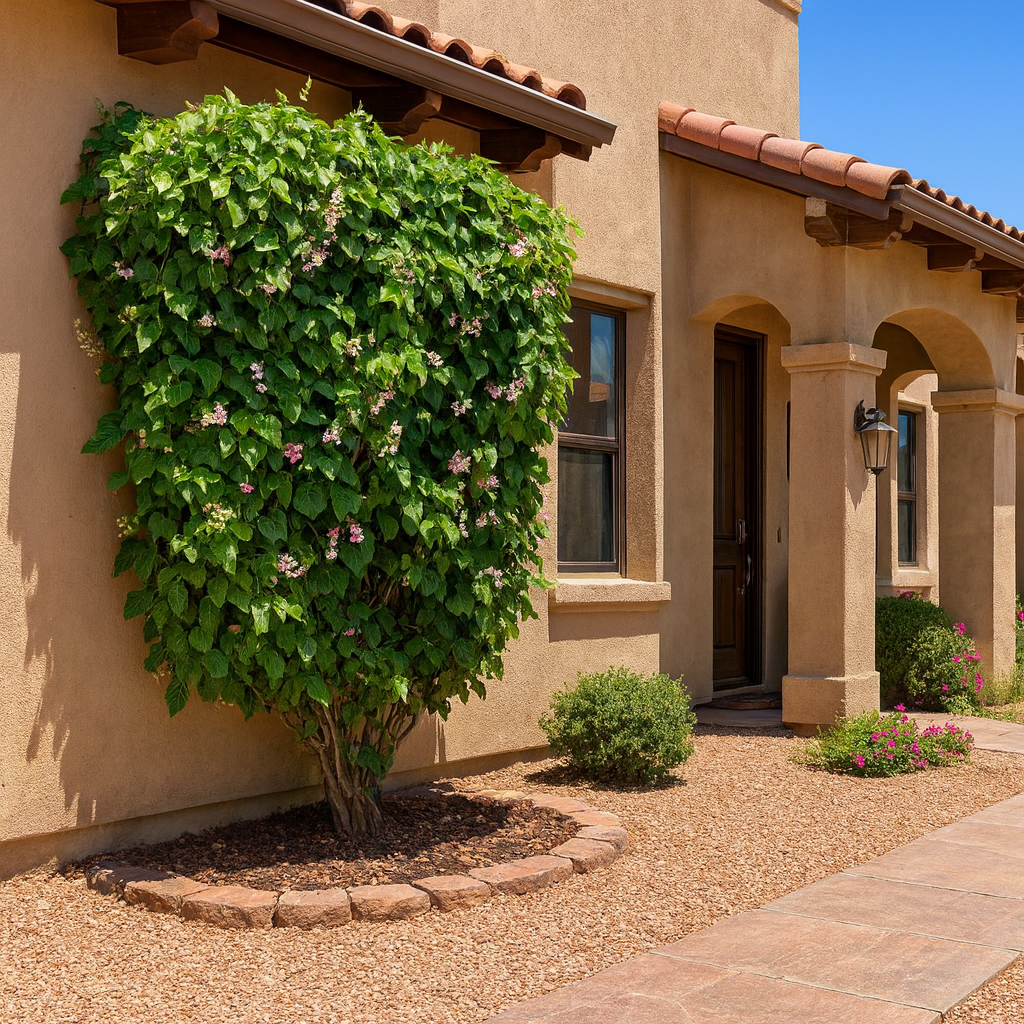

Snail Vine Espalier
Snail Vine Espalier
Couldn't load pickup availability
Phoenix's Most Fragrant Espalier Vine — Snail Vine Espalier
Snail Vine Espalier (Vigna caracalla, trained as espalier) is one of the most spectacular and fragrant wall plants available for Phoenix Valley homes and gardens. Pre-trained to grow flat against a surface, this semi-evergreen climber delivers lush, dense green coverage along fences, courtyard walls, and home exteriors — topped with uniquely coiled, corkscrew-shaped blooms in lavender-purple, pink, and cream that fill the air with an intoxicating sweet fragrance at dusk. Whether you're covering a block wall in Scottsdale, dressing a courtyard fence in Chandler, or adding living color to a home exterior in Gilbert — Snail Vine Espalier brings fragrance and elegance in a space-efficient, pre-trained form.
Snail Vine Espalier Plant Details
| Attribute | Detail |
|---|---|
| Scientific Name | Vigna caracalla |
| Common Names | Snail Vine Espalier, Corkscrew Vine, Snail Flower |
| Mature Height | 10–20 feet (trained size depends on support) |
| Mature Width | 6–12 feet spread |
| Growth Rate | Fast — 6–10 feet per season in Phoenix |
| Sun | Full sun to partial shade. Handles reflected heat from walls. |
| Water | Low to moderate once established. Drought-tolerant when mature. |
| USDA Zones | 9–11 (Phoenix is Zone 9b–10a) |
| Soil | Well-draining. Adapts to Arizona caliche soils. |
| Foliage | Semi-evergreen — may drop leaves in cool winters, returns vigorously in spring |
| Flower Color | Lavender-purple, pink, and cream — spiral corkscrew-shaped blooms |
| Fragrance | Strong, sweet evening fragrance — especially potent at dusk |
Snail Vine Espalier Uses in Phoenix Landscapes
Covering Home Exteriors and Stucco Walls
Snail Vine Espalier is one of the best choices for flat-against-the-wall coverage of Phoenix home exteriors and stucco walls. Its pre-trained, flat growth habit means you get the look of a mature vine installation from day one, without the years of coaxing an untrained plant requires. A single espalier covers 8–12 feet of wall surface within two seasons, making it ideal for the long walls common in Peoria, Glendale, and Mesa neighborhoods.
Courtyard and Privacy Walls
In Phoenix courtyard landscapes, Snail Vine Espalier creates an elegant living wall that combines privacy with fragrance. Train it along a 6–8 foot block wall and you'll create a dense, leafy screen that also perfumes the courtyard air every evening from spring through fall. Plant one espalier every 8 feet for a continuous wall — a 24-foot courtyard wall needs 3 plants. Pair with Desert Spoon or Agave at the base for a layered Southwest aesthetic.
Evening Fragrance for Outdoor Living Spaces
One of Snail Vine Espalier's most prized features is its powerful evening fragrance. Position it on a wall adjacent to a patio, seating area, or pool deck in Scottsdale or Tempe, and the sweet honeyed scent fills the outdoor space at dusk — naturally. The coiled, snail-shell-shaped blooms are also a conversation piece, unlike any other vine available in Phoenix Valley nurseries.
Shade Structures and Pergola Walls
Mount Snail Vine Espalier on a pergola side wall or shade structure column to create a fragrant, living backdrop for outdoor dining. Its flat growth habit makes it easy to maintain within a defined footprint, and the seasonal blooms from late spring through fall provide color exactly when you're using outdoor spaces most in Phoenix. Shade Plants nearby can complement the espalier's vertical effect with ground-level texture.
Best Time to Plant Snail Vine Espalier in Phoenix
Fall (October–November) is the ideal planting window for Snail Vine Espalier in the Phoenix Valley. The cooler air reduces transplant stress while warm soil temperatures support root establishment before summer. A fall-planted espalier gets 6–8 months of root development before facing its first Phoenix summer, resulting in significantly better heat resilience and faster coverage. Spring planting (February–April) is a solid second option, though you'll need more frequent irrigation as temperatures rise. Avoid summer installation if possible — the intense Phoenix heat demands intensive watering to get a newly transplanted espalier established.
How to Plant Snail Vine Espalier
- Dig wide, not deep — dig a hole 2–3 times the width of the root ball but no deeper than the container height.
- Check for caliche — break through any hardpan caliche layer beneath the planting hole to ensure proper drainage and root penetration.
- Backfill with native soil — a light 20% organic amendment is fine; avoid over-amending desert-adapted plants.
- Spacing — plant 8 feet apart for continuous wall coverage; 10–12 feet for individual specimen placement.
- Attach to support — secure main stems to wall anchors, trellis wire, or screws with soft plant ties immediately after planting.
- Mulch — apply 2–3 inches of bark or gravel mulch around the base to retain moisture and regulate root temperature.
Watering Snail Vine Espalier in Phoenix
First Year Watering Schedule
- Weeks 1–2: Every 1–2 days, deep and slow (20–30 minutes)
- Month 1–2: Every 3–4 days
- Month 3–6: Every 7–10 days (every 5–7 days in peak summer heat)
- After Year 1: Every 10–14 days in summer; every 3–4 weeks in winter
Drip Irrigation
Place a 1–2 GPH drip emitter 12–18 inches from the base of the vine. As the plant matures and spreads along the wall, add a second emitter on the opposite side of the root zone. Established Snail Vine Espalier is drought-tolerant and can go 3–4 weeks between waterings outside of peak summer months in Phoenix.
How fast does Snail Vine Espalier cover a wall in Phoenix?
Snail Vine Espalier is a fast grower in Phoenix's warm climate. Because it arrives pre-trained flat, coverage begins immediately. You can expect the vine to extend 4–8 feet of new lateral growth per season in Phoenix — a 10-gallon espalier can cover an 8–10 foot section of wall within its first full growing season.
Is Snail Vine Espalier drought tolerant?
Yes, once established after its first year in the ground, Snail Vine Espalier becomes quite drought tolerant. During Phoenix summers it performs best with a deep watering every 10–14 days. In winter months it requires very little supplemental water, making it a low-maintenance choice for Phoenix Valley landscapes after establishment.
What's the difference between Snail Vine and Snail Vine Espalier?
The plant is the same species (Vigna caracalla), but the Espalier version has been professionally trained to grow flat against a support — giving you an immediately wall-ready plant with a defined, tidy form. Standard Snail Vine is sold in smaller containers and grows freely in all directions, requiring more training to achieve wall coverage. The Espalier is ideal when you want fast, clean coverage of a specific wall section.
Can Snail Vine Espalier handle reflected heat from block walls?
Yes. Snail Vine is a tropical plant that thrives in heat, and the warm microclimate created by a south- or west-facing block wall in Phoenix actually accelerates its growth. Just ensure adequate summer irrigation, as walls can amplify heat stress during peak July–August temperatures.
When does Snail Vine Espalier bloom in Phoenix?
In Phoenix, blooming typically begins in late spring (April–May) and continues through fall (October–November). The corkscrew-shaped flowers shift from cream to lavender-purple as they mature, and evening fragrance is strongest from May through September.
You May Also Like
- Bower Vine Espalier (Pandorea jasminoides) — another pre-trained fragrant flowering vine, perfect for Phoenix courtyard walls and home exteriors.
- Snail Vine (Vigna caracalla) — the standard (non-espalier) version, available in smaller sizes for trellises and fences in Scottsdale and Chandler.
- Hacienda Creeper (Parthenocissus striata) — a vigorous wall-clinging vine for full coverage of block walls in Phoenix Valley landscapes.
- Texas Sage (Leucophyllum frutescens) — a drought-tolerant flowering shrub that pairs beautifully at the base of an espalier in low-water Phoenix gardens.
- Ruellia — low-growing groundcover with purple blooms that complements the vertical form of Snail Vine Espalier with ground-level color.
Share