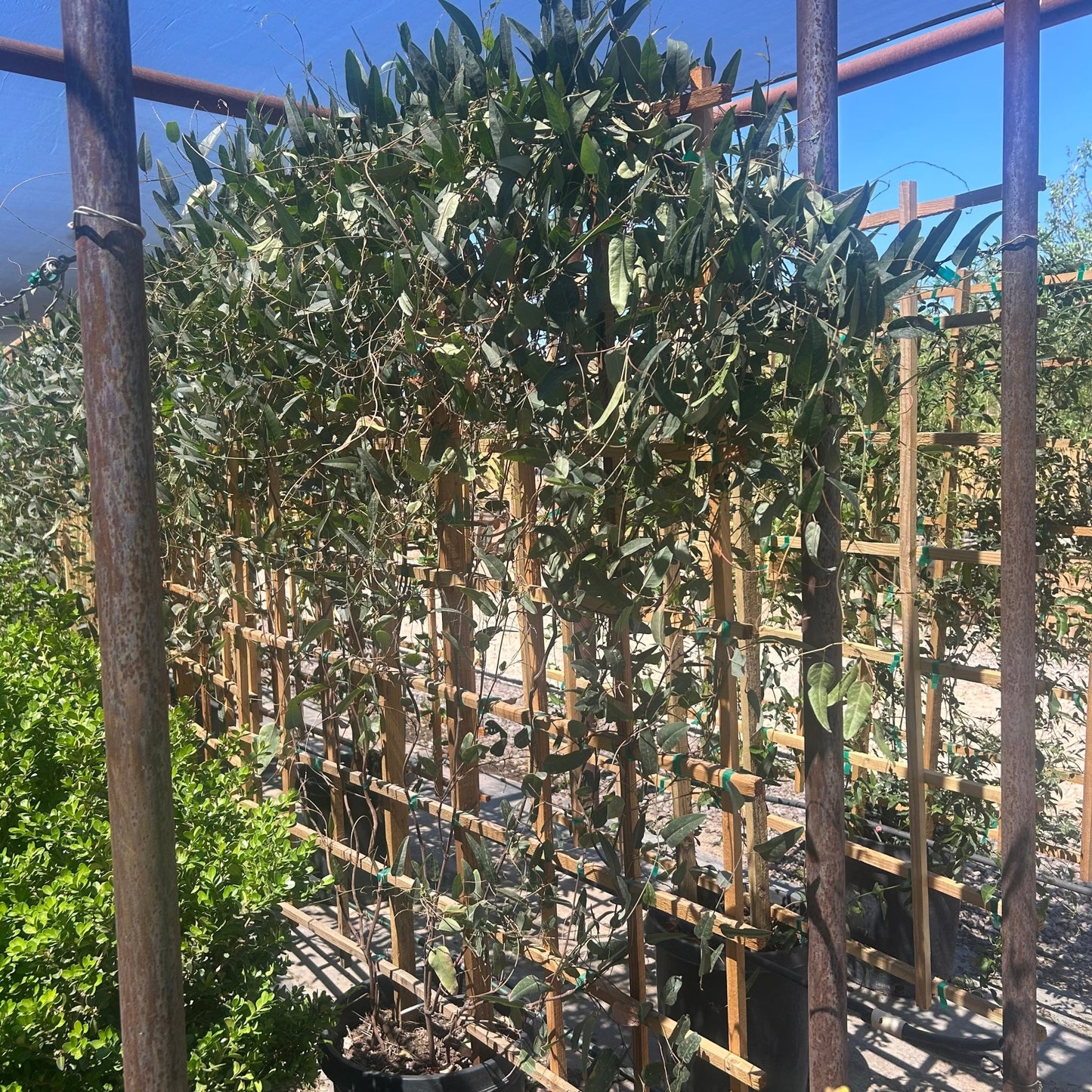

Lilac Vine Espalier
Lilac Vine Espalier
Couldn't load pickup availability
Phoenix's Most Colorful Espalier — Cascading Purple Blooms on a Space-Saving Trellis
Lilac Vine Espalier (Duranta erecta), also known as Sky Flower and Golden Dewdrop, is one of the most vibrant flowering espaliers you can grow in the Phoenix Valley. This fast-growing evergreen produces cascading clusters of violet-blue flowers from spring through fall, followed by ornamental golden berries that attract birds and butterflies. Whether you're adding a pop of color to a Scottsdale courtyard, screening a Mesa pool fence, or brightening a bare wall in Chandler — Lilac Vine Espalier delivers non-stop tropical beauty with minimal fuss.
Lilac Vine Espalier Plant Details
| Attribute | Detail |
|---|---|
| Scientific Name | Duranta erecta |
| Common Names | Lilac Vine, Sky Flower, Golden Dewdrop, Pigeon Berry |
| Mature Height | 8–12 feet (trained as espalier) |
| Mature Width | 6–8 feet (flat on trellis) |
| Growth Rate | Fast — 3–5 feet per year in Phoenix |
| Sun | Full sun to partial shade (6+ hrs ideal). Handles reflected heat from walls. |
| Water | Low to moderate once established. Drought-tolerant after Year 1. |
| USDA Zones | 9–11 (Phoenix is Zone 9b–10a) |
| Soil | Well-draining. Adapts to Arizona caliche soils. |
| Foliage | Evergreen — stays green year-round in Phoenix |
| Bloom Color | Violet-blue with white edges; golden berry clusters follow |
Lilac Vine Espalier Uses in Phoenix Landscapes
Colorful Wall Cover & Vertical Accent
Lilac Vine Espalier is one of the best choices for turning a plain block wall or stucco surface into a living tapestry of purple blooms. Trained flat against a trellis, the cascading flower clusters create a striking vertical accent that works beautifully in modern desert landscapes and Mediterranean-style courtyards across Scottsdale and Paradise Valley.
Pool-Friendly Flowering Screen
The espalier form keeps growth contained and tidy — no branches overhanging the pool. Lilac Vine's light, airy foliage means minimal leaf drop, and the vibrant blooms add resort-style color to any Gilbert or Tempe poolscape. Plant along a pool fence for a living privacy wall that doubles as a butterfly garden.
Wildlife & Pollinator Garden
Few espaliers attract as much wildlife as Lilac Vine. The violet flowers draw hummingbirds and butterflies all season, while the golden berries are a favorite of songbirds. Pair with Cape Honeysuckle Espalier or Star Jasmine Espalier for a year-round pollinator corridor along a Peoria or Glendale property line.
Best Time to Plant Lilac Vine Espalier in Phoenix
Fall (October–November) is the ideal planting window. Warm soil encourages fast root establishment while cooler air reduces transplant stress, giving your Lilac Vine 6–8 months of root growth before its first Phoenix summer. Spring (February–April) is the second-best window. Avoid summer planting if possible — the combination of extreme heat and transplant shock can slow establishment significantly.
How to Plant Lilac Vine Espalier
- Dig wide, not deep — excavate 2–3x the root ball width at the same depth as the container.
- Check for caliche — break through any hardpan layer to ensure proper drainage.
- Backfill with native soil — a light 20% organic blend is fine, but avoid heavy amendments.
- Position the trellis — set the trellis 4–6 inches from the wall to allow airflow behind the plant.
- Water basin — build a 3–4 inch soil ring around the root zone to direct water to the roots.
- Mulch — spread 2–3 inches of bark or gravel mulch to retain moisture and regulate soil temperature.
Watering Lilac Vine Espalier in Phoenix
First Year Watering Schedule
- Weeks 1–2: Every 1–2 days, deep and slow (20–30 minutes per session)
- Months 1–2: Every 3–4 days
- Months 3–6: Every 7–10 days (every 5–7 days during peak summer)
- After Year 1: Every 10–14 days in summer; every 3–4 weeks in winter
Drip Irrigation Tips
Place two 2-GPH emitters 18–24 inches from the trunk on opposite sides. Once established, Lilac Vine is remarkably drought-tolerant and needs very little supplemental water beyond what drip irrigation provides. Increase watering slightly during peak bloom for the best flower production.
How fast does Lilac Vine Espalier grow in Phoenix?
Very fast — expect 3–5 feet of new growth per year in Phoenix's long growing season. With regular training and tying, it fills a 6-foot trellis in one to two seasons.
Is Lilac Vine drought tolerant once established?
Yes. After the first year of regular watering, Lilac Vine is quite drought-tolerant and thrives on deep, infrequent irrigation. It performs well on standard desert drip schedules.
Does Lilac Vine attract hummingbirds?
Absolutely. The violet-blue flower clusters are a magnet for hummingbirds, butterflies, and other pollinators from spring through fall. The golden berries that follow also attract songbirds.
Can Lilac Vine handle Phoenix summer heat?
Yes — it handles full sun and reflected heat from walls and pavement. It may show minor leaf scorch during the hottest weeks but recovers quickly. Afternoon shade in the most extreme exposures can help it look its best year-round.
What's the difference between Lilac Vine and Sky Flower?
They're the same plant — Duranta erecta goes by many common names including Lilac Vine, Sky Flower, Golden Dewdrop, and Pigeon Berry. At Three Timbers, we sell it trained as an espalier for maximum space efficiency and visual impact.
You May Also Like
- Cape Honeysuckle Espalier — Vibrant orange trumpet flowers all year with the same low-water, fast-growing toughness.
- Star Jasmine Espalier — Fragrant white blooms and glossy evergreen foliage for shaded walls and entryways.
- Orange Jubilee Espalier — Bright orange-yellow trumpet blooms on a heat-loving, fast-growing espalier.
- Pink Trumpet Vine Espalier — Showy pink trumpet flowers that thrive in full Phoenix sun.
- Bower Vine Espalier — Delicate pink-white trumpet blooms perfect for a softer, romantic look.
How Many Lilac Vine Espaliers Do I Need?
Trained flat against a wall or fence, each espalier spreads to cover roughly 6 to 8 feet of horizontal run. Space plants about 7 feet apart on center for continuous coverage, or tighter at 6 feet for a faster, fuller wall of color.
| Wall / Fence Run | Plants Needed (7 ft spacing) |
|---|---|
| 7 ft | 1 plant |
| 14 ft | 2 plants |
| 21 ft | 3 plants |
| 28 ft | 4 plants |
| 42 ft | 6 plants |
Lilac Vine Espalier Season-by-Season in Phoenix
- Spring (Feb–Apr): New growth flushes and violet-blue bloom clusters begin, building toward a long flowering season. Tie in new canes to train the espalier and do any shaping now.
- Summer (May–Sep): Peak bloom through the heat, with reflected wall warmth well tolerated. Monsoon humidity (Jul–Sep) often pushes a heavy flush followed by clusters of golden berries. May show minor leaf scorch in the most extreme west exposures but recovers fast.
- Fall (Oct–Nov): Prime planting season and continued bloom plus berry color as temperatures ease.
- Winter (Dec–Jan): Stays green through mild Valley winters but is frost-sensitive: expect leaf and tip dieback below about 28 to 30°F. Cover on hard frost nights, or let it freeze back and prune in early spring, since it resprouts vigorously. Note the golden berries are toxic if eaten, so site it away from areas where small children or pets graze.
At a Glance
✔ Pollinator-Friendly ✔ Hummingbird-Friendly ✔ Heat-Loving (Reflected-Heat Tolerant) ✔ Drought-Tolerant ✔ Pool-Friendly (Low-Litter) ✔ Low-Maintenance
Plant It With
- Cape Honeysuckle Espalier: vibrant orange trumpets that contrast with the violet bloom on a neighboring wall.
- Orange Jubilee Espalier: bright orange-yellow trumpet flowers and the same fast, heat-loving habit.
- Bower Vine Espalier: soft pink-white trumpets for a gentler companion in part shade.
- Barbara Karst Bougainvillea Espalier: bold crimson bracts for a high-contrast, heat-loving espalier wall.
Is Lilac Vine Espalier Right for Your Yard?
It thrives in full sun to light afternoon shade on a warm wall or fence with room to fan out 6 to 8 feet wide, in well-drained soil broken free of caliche, and rewards you with months of violet bloom and golden berries that feed birds and butterflies. It is not the right fit for an unprotected cold pocket, since frost below about 28 to 30°F will knock it back, or for a yard where toxic berries near grazing pets or toddlers are a concern.
Customer Reviews
Share