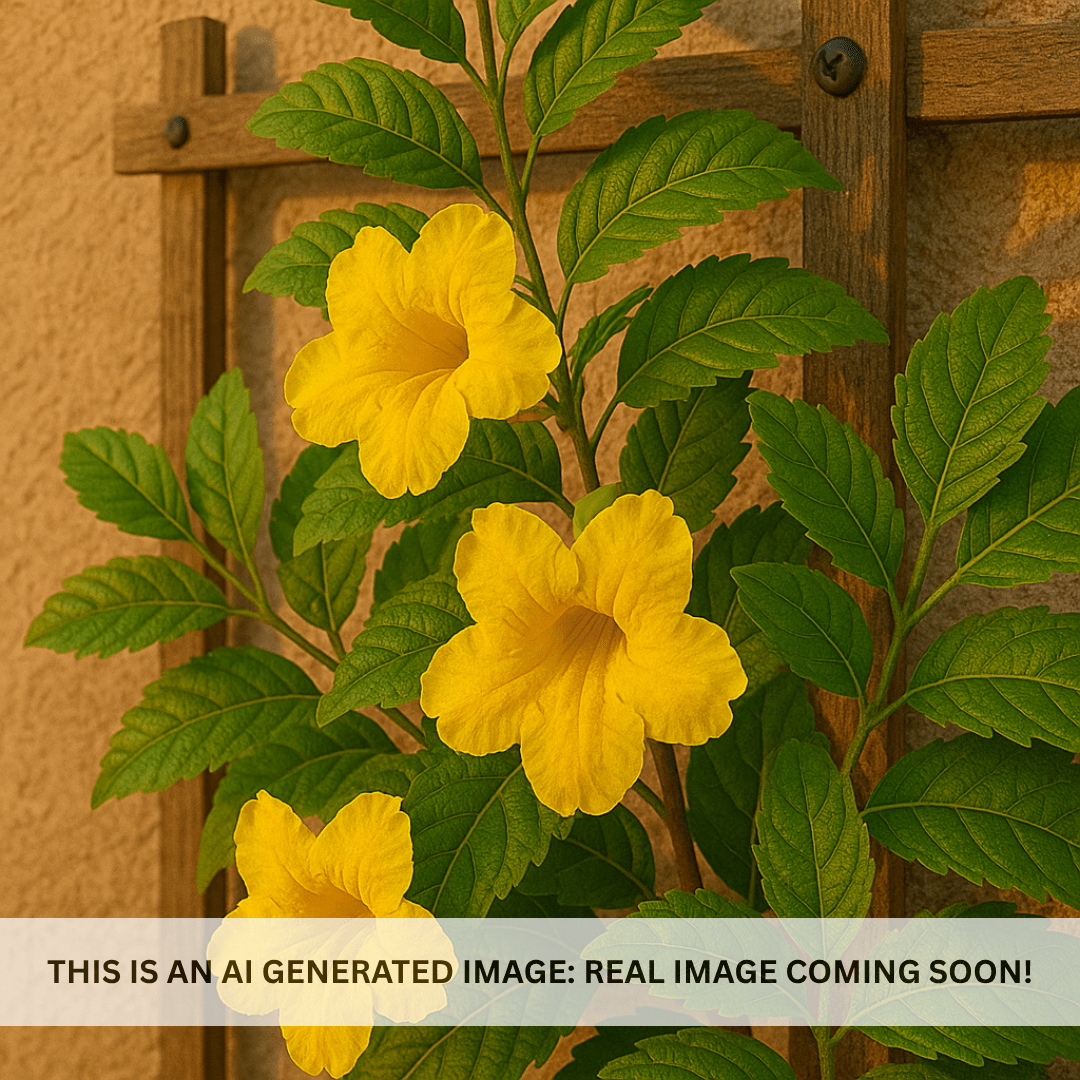


Arizona Yellow Bells (wide leaf) Espalier
Arizona Yellow Bells (wide leaf) Espalier
Couldn't load pickup availability
Arizona Yellow Bells Espalier — Native Desert Color Trained for Walls
Arizona Yellow Bells Wide Leaf Espalier (Tecoma stans var. angustata) is a native Arizona showstopper trained flat on a frame for vibrant wall and fence coverage. Known for its trumpet-shaped, golden-yellow flowers that bloom prolifically from spring through fall, this Arizona native thrives in the extreme heat that wilts other plants. Whether you're adding color to a block wall in Scottsdale, brightening a fence line in Mesa, or creating a pollinator-friendly accent in Gilbert — Arizona Yellow Bells Espalier delivers non-stop desert-adapted color.
Arizona Yellow Bells Espalier — Plant Details
| Attribute | Detail |
|---|---|
| Scientific Name | Tecoma stans var. angustata |
| Common Names | Arizona Yellow Bells, Esperanza, Yellow Trumpetbush |
| Mature Height | 8–12 ft (on wall/trellis) |
| Mature Width | 6–8 ft spread |
| Growth Rate | Fast — 3–5 ft per year in Phoenix |
| Sun | Full sun (6+ hrs). Handles reflected heat from walls. |
| Water | Low once established. Highly drought-tolerant. |
| USDA Zones | 9–11 (Phoenix is Zone 9b–10a) |
| Soil | Well-draining. Adapts to Arizona caliche soils. |
| Foliage | Semi-evergreen — may drop leaves in hard freezes |
| Bloom Color | Bright golden-yellow trumpet flowers |
| Native Status | Arizona native — supports local pollinators |
Arizona Yellow Bells Espalier Uses in Phoenix Landscapes
Wall Color & Pollinator Habitat
Yellow Bells' trumpet-shaped flowers are a magnet for hummingbirds, butterflies, and native bees. Trained as an espalier, it turns blank walls into living pollinator habitats while delivering months of golden-yellow blooms. Perfect for south- and west-facing walls where heat intensifies flowering.
Native Desert Screening
For homeowners who prefer native Arizona plants, Yellow Bells Espalier provides colorful wall coverage without relying on tropical species. It's naturally adapted to Phoenix's soil, heat, and low rainfall — no special amendments or heavy irrigation needed.
HOA-Friendly Desert Landscaping
The wide-leaf variety has a lush, full appearance that satisfies HOA requirements for maintained landscaping while staying true to desert-adapted principles. Use along property walls in Chandler, Tempe, and Peoria for a clean, colorful boundary.
Best Time to Plant Arizona Yellow Bells Espalier in Phoenix
Fall (October–November) is ideal: warm soil promotes root establishment while cooler air reduces stress. Spring (March–April) is the second-best window. As a native, Yellow Bells handles summer planting better than most — but fall gives the best head start before peak heat.
How to Plant Arizona Yellow Bells Espalier
- Position the frame: Set 6–12 inches from the wall for airflow behind the plant.
- Dig wide, not deep: 2–3x root ball width, same depth.
- Check for caliche: Break through hardpan with a digging bar for drainage.
- Backfill with native soil: Yellow Bells prefers unamended desert soil. Skip heavy compost.
- Water basin: Build a 3–4 inch ring to direct water during establishment.
- Mulch: 2–3 inches of gravel mulch. Keep away from the trunk.
Watering Arizona Yellow Bells Espalier in Phoenix
First Year Watering Schedule
- Weeks 1–2: Every 1–2 days, deep and slow (20–30 min)
- Month 1–2: Every 3–4 days
- Month 3–6: Every 7–10 days (5–7 days in peak summer)
- After Year 1: Every 10–14 days summer; every 3–4 weeks winter
Drip Irrigation
Place emitters 18–24 inches from the trunk, 2 GPH minimum. Once established, Yellow Bells is extremely drought-tolerant and may need only occasional deep soaking during the hottest months.
How fast does Arizona Yellow Bells grow in Phoenix?
Fast — 3–5 feet per year. The espalier form directs growth flat against the wall, filling in quickly during warm months. Expect substantial coverage within the first growing season.
Is Arizona Yellow Bells native to Arizona?
Yes — Tecoma stans var. angustata is native to southern Arizona and thrives in the Phoenix Valley's heat, alkaline soil, and low rainfall without special care.
Does Yellow Bells attract hummingbirds?
Absolutely — the trumpet-shaped yellow flowers are one of the top hummingbird attractors in the desert. Butterflies and native bees also frequent the blooms heavily.
Does Yellow Bells freeze back in Phoenix?
It may lose leaves or freeze back to the ground in hard freezes (below 28°F), but recovers quickly in spring. In most Phoenix winters, it stays semi-evergreen with minimal leaf drop.
You May Also Like
- Orange Jubilee Espalier — orange trumpet flowers for a warm-toned wall display
- Cape Honeysuckle Espalier — orange-red tubular blooms for hummingbird gardens
- Shop All Espaliers
How Many Arizona Yellow Bells Espalier Do I Need?
Each espalier panel spreads roughly 6 to 8 feet wide on a wall or fence. Space panels about 6 feet apart (center to center) for continuous color along a run. Use this table to estimate how many panels a wall needs:
| Wall / Fence Length | Espalier Panels (6 ft spacing) |
|---|---|
| 12 ft | 2 panels |
| 24 ft | 4 panels |
| 36 ft | 6 panels |
| 48 ft | 8 panels |
Arizona Yellow Bells Espalier Season-by-Season in Phoenix
- Spring (Feb to Apr): New growth flushes fast and the first golden trumpet flowers open. A strong second planting window once nights warm.
- Summer (May to Sep): Peak bloom. Heat and reflected warmth off a south- or west-facing wall actually intensify flowering, and monsoon rains (Jul to Sep) fuel a surge of new growth. Hummingbirds work the flowers all season.
- Fall (Oct to Nov): Blooming continues into the cool months and this is the prime planting window in the Valley.
- Winter (Dec to Jan): Usually semi-evergreen with minimal leaf drop. In a hard freeze below about 28°F it can lose leaves or die back, then recovers quickly in spring. Cover the frame on the coldest frost nights if you want to protect top growth.
At a Glance
✔ Arizona Native ✔ Pollinator-Friendly ✔ Hummingbird-Friendly ✔ Heat-Loving (Reflected-Heat Tolerant) ✔ Drought-Tolerant ✔ Low-Maintenance
Plant It With
- Orange Jubilee Espalier: warm orange trumpets that pair with the yellow for a sunset-toned wall.
- Cape Honeysuckle Espalier: orange-red tubular blooms that keep hummingbirds coming.
- Lilac Vine Espalier: cool purple flowers for a complementary-color wall panel.
- Red Yucca: a low, hummingbird-friendly accent to anchor the base of the wall.
Is Arizona Yellow Bells Espalier Right for Your Yard?
This espalier is a fit for a sunny wall or fence (south- or west-facing is best), well-draining soil with caliche broken through at planting, and a spot where you want fast, pollinator-friendly color tied flat to a frame. It is not the right pick if you need a year-round evergreen screen with no winter change: in a hard freeze it can drop leaves or die back before bouncing back in spring.
Customer Reviews
Share