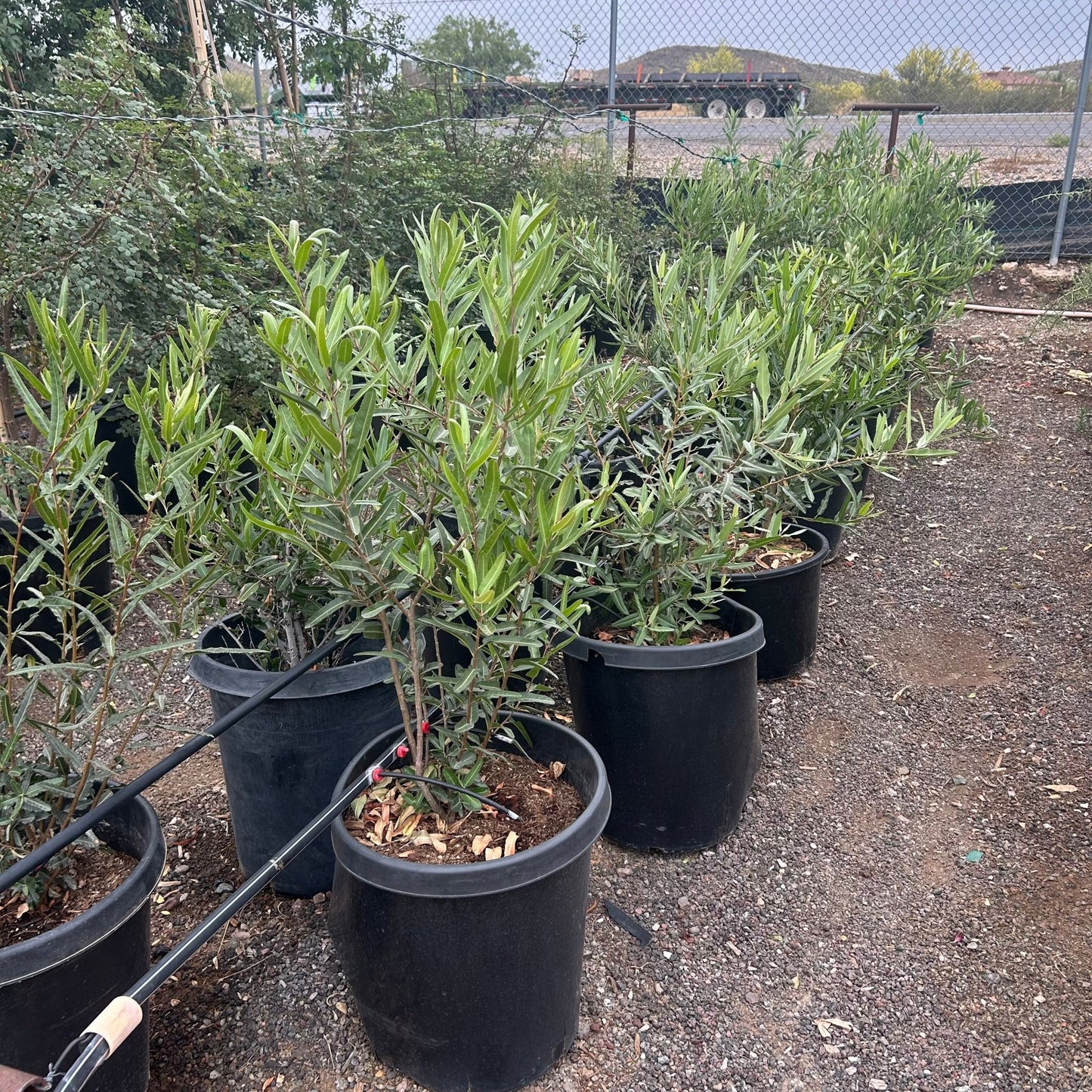

Arizona rosewood
Arizona rosewood
Couldn't load pickup availability
Phoenix's Best Evergreen Privacy Screen — Arizona Rosewood
Arizona Rosewood (Vaquelinia californica) is the most underused — and most impressive — large evergreen shrub available for Phoenix Valley landscapes. With its dense, glossy dark green foliage, clusters of fragrant white flowers in spring, and exceptional drought tolerance, it delivers the year-round privacy and lush appearance that most desert plants simply cannot match. Whether you're creating a tall privacy screen in Scottsdale, planting a windbreak in Chandler, adding an evergreen anchor to a large garden in Gilbert, or shaping a formal screen along a wall in Peoria — Arizona Rosewood is the plant that performs when others fail.
Arizona Rosewood Plant Details
| Attribute | Detail |
|---|---|
| Scientific Name | Vaquelinia californica |
| Common Names | Arizona Rosewood, Western Rosewood |
| Mature Height | 10–20 feet |
| Mature Width | 8–12 feet |
| Growth Rate | Moderate — 1–2 feet per year in Phoenix |
| Sun | Full sun (6+ hrs). Handles intense reflected heat from walls and pavement. |
| Water | Low once established. Highly drought-tolerant after first season. |
| USDA Zones | 8–11 (Phoenix is Zone 9b–10a) |
| Soil | Well-draining. Highly adaptable to Arizona caliche soils once drainage is ensured. |
| Foliage | Evergreen — dense, leathery, dark glossy green leaves year-round |
| Bloom Color | Small clusters of white flowers in spring and early summer |
| Native Status | Native to Arizona, California, and northern Mexico |
Arizona Rosewood Uses in Phoenix Landscapes
Tall Privacy Screens & Windbreaks
Arizona Rosewood is one of the top choices for tall privacy screening in the Phoenix Valley. Its naturally dense, upright form creates an effective visual barrier from 6 feet up to 15–20 feet tall, and its evergreen foliage ensures privacy 365 days a year — unlike deciduous alternatives. For a solid privacy screen, plant 6–8 feet apart; for a faster solid hedge, space 4–5 feet apart. Along a 30 ft fence line, 5–6 plants spaced 6 ft apart creates a full screen within 3–4 years.
Formal Hedges & Screens
Arizona Rosewood responds exceptionally well to shaping and can be trained into formal hedges, sculpted screens, or even small multi-trunk trees in Scottsdale and Paradise Valley estates. Its dense branching and tight leaf structure hold a clean edge after trimming better than most desert shrubs, making it ideal for refined, structured landscape designs. For a formal clipped hedge, shear once or twice yearly in spring and fall.
Naturalized Desert Gardens & Wildlife Habitat
Left to its natural form, Arizona Rosewood develops into a beautiful multi-stem large shrub or small tree with graceful, arching branches and lush evergreen foliage. The spring white flower clusters attract native bees, butterflies, and other pollinators, and the plant provides excellent bird habitat and nesting cover. In naturalized Sonoran Desert gardens across Mesa and Tempe, it anchors large garden compositions beautifully alongside Agave, Desert Spoon, and Ironwood trees.
Specimen Tree & Patio Accent
With some early training and selective pruning to expose the lower trunk structure, Arizona Rosewood can be developed into a stunning small multi-trunk specimen tree for patios, courtyards, and entry gardens. Its dark evergreen canopy provides dappled shade, and the fragrant spring bloom adds seasonal interest. Unlike many desert trees, it maintains its lush appearance even through Phoenix's hottest summers without significant leaf drop.
Best Time to Plant Arizona Rosewood in Phoenix
Fall (October–November) is the optimal planting window for Arizona Rosewood in the Phoenix area. The warm soil temperatures encourage rapid root development while cooler air dramatically reduces transplant stress, giving the plant a full 6–8 months to establish before its first Phoenix summer. Spring planting (February–April) is a strong second choice. Avoid summer planting when possible — while Arizona Rosewood is heat-tough, newly transplanted specimens in peak summer (June–August) require significantly more irrigation attention and are more prone to transplant shock.
How to Plant Arizona Rosewood
- Dig wide, not deep — Excavate a hole 2–3x the width of the root ball and only as deep as the root ball. Arizona Rosewood prefers its root crown at or just slightly above grade.
- Check for caliche — Break through any hardpan caliche layer beneath the planting hole. Good drainage is essential — standing water around the roots will cause problems.
- Backfill with native soil — Use the excavated native soil to backfill. A light 20% compost amendment is acceptable but not required; Arizona Rosewood thrives in lean native conditions.
- Spacing for privacy screens — Plant 6–8 feet apart for a naturalized screen; 4–5 feet apart for a faster-closing formal hedge.
- Build a water basin — Create a 4–6 inch earthen berm around the plant to direct irrigation water to the root zone during the critical establishment period.
- Mulch — Apply 3 inches of decomposed granite or bark mulch around the base (keep 6 inches away from the trunk) to conserve moisture and moderate soil temperature.
Watering Arizona Rosewood in Phoenix
First Year Watering Schedule
- Weeks 1–2: Water every 1–2 days, deep and slow (30–45 minutes) to thoroughly saturate the large root ball and surrounding soil.
- Months 1–2: Reduce to every 3–4 days as roots begin expanding into native soil.
- Months 3–6: Water every 7–10 days (every 5–7 days during peak Phoenix summer heat).
- After Year 1: Established Arizona Rosewood is highly drought-tolerant. Water every 14–21 days in summer; every 3–4 weeks in winter, or less depending on rainfall.
Drip Irrigation
Place drip emitters 18–24 inches from the base of the plant. Use 2 GPH emitters for large specimens. For privacy screen plantings with multiple plants, a single drip line running along the row works well. Once fully established after the first year, Arizona Rosewood is exceptionally low-water and thrives with minimal supplemental irrigation in Phoenix's climate.
How fast does Arizona Rosewood grow into a privacy screen?
Arizona Rosewood grows at a moderate pace of 1–2 feet per year in Phoenix conditions. Planted at 5–6 gallon size and spaced 6 feet apart, you can expect a fairly solid privacy screen within 4–5 years. Planting at larger sizes or spacing more tightly (4–5 feet) will close the screen faster. Regular deep watering during the first two seasons accelerates establishment significantly.
Is Arizona Rosewood truly drought-tolerant?
Yes — Arizona Rosewood is one of the most drought-tolerant large evergreen shrubs available for Phoenix landscapes. Once established after its first season, it thrives on very low supplemental irrigation and is naturally adapted to the same intense heat and periodic drought conditions found across the Sonoran Desert. Its deep root system allows it to access subsurface moisture that shallow-rooted plants cannot reach.
Can Arizona Rosewood be kept smaller with pruning?
Yes. Arizona Rosewood responds very well to pruning and can be maintained at virtually any size from a compact 6-foot hedge to its full 15–20 foot natural height. For hedge maintenance, prune once in spring after flowering and again lightly in early fall. Avoid heavy pruning in peak summer heat. The plant will not become leggy or lose its density with regular trimming.
Does Arizona Rosewood work as a street tree or under power lines?
At its natural mature height of 10–20 feet, Arizona Rosewood is well-suited for planting under utility lines where taller trees would require frequent trimming. It's also an excellent choice for street-side planting in Phoenix where its moderate size, toughness, and evergreen foliage make it far more manageable than large canopy trees.
You May Also Like
- Green Hopseed Bush — A faster-growing privacy hedge option for Phoenix that can be used alongside Arizona Rosewood in layered screen plantings.
- Sugar Bush — Another excellent native evergreen shrub for large screens and naturalized desert gardens.
- Canyon Hackberry — A tough native tree that pairs beautifully with Arizona Rosewood in naturalized desert landscape designs.
- Desert Spoon — A dramatic native accent plant that complements Arizona Rosewood's lush evergreen backdrop with strong architectural form.
- Little Leaf Cordia — A beautiful small flowering tree to plant in front of an Arizona Rosewood screen for layered landscape depth.
How Many Arizona Rosewood Do I Need?
At a mature width of 8 to 12 feet, Arizona Rosewood is spaced about 6 feet apart for a solid evergreen privacy screen (closer, at 4 to 5 feet, for a faster-closing formal hedge). Use this table to estimate plant counts for a screen at 6-foot spacing:
| Run Length | Plants Needed (6 ft spacing) |
|---|---|
| 20 ft | 4 plants |
| 30 ft | 6 plants |
| 50 ft | 9 plants |
| 75 ft | 13 plants |
| 100 ft | 17 plants |
Arizona Rosewood Season-by-Season in Phoenix
- Spring (Feb to Apr): Clusters of fragrant white flowers open as new growth flushes. A strong second planting window once the soil warms.
- Summer (May to Sep): Holds dense, glossy evergreen foliage through extreme heat and reflected heat off walls and pavement without significant leaf drop. Monsoon rains (Jul to Sep) push a flush of new growth; little supplemental water is needed once established.
- Fall (Oct to Nov): Prime planting season in the Valley. Cooler air and warm soil give roots months to establish before the next summer.
- Winter (Dec to Jan): Stays fully evergreen and structural. Cold-hardy well below freezing (to roughly 10°F), so it shrugs off normal Valley frost nights with no cover needed.
At a Glance
✔ Arizona Native ✔ Pollinator-Friendly ✔ Heat-Loving (Reflected-Heat Tolerant) ✔ Drought-Tolerant ✔ Evergreen ✔ Low-Maintenance ✔ Cold-Hardy to 10°F
Plant It With
- Green Hopseed: a faster-growing evergreen screen to layer in front of or beside a rosewood hedge.
- Canyon Hackberry: a tough native tree that pairs naturally with rosewood in a desert garden.
- Desert Spoon: a sculptural native accent whose spiky form contrasts the rosewood's lush green backdrop.
- Red Yucca: a low, hummingbird-friendly bloomer to soften the base of a tall screen.
Is Arizona Rosewood Right for Your Yard?
Arizona Rosewood thrives in full sun with intense reflected heat, needs well-draining soil (break through any caliche layer at planting), and wants room to reach 8 to 12 feet wide unless you plan to shear it as a formal hedge. It is cold-hardy through Valley winters and exceptionally drought-tolerant once established. It is not a fit if you need a fast screen in a season or two, or if the planting spot stays soggy: rosewood is moderate-growing and will not tolerate standing water at the roots.
Customer Reviews
Arizona Rosewood in excellent condition
Share