

Agave horrida
Agave horrida
Couldn't load pickup availability
Arizona's Most Rugged Spined Agave for Bold Desert Landscapes
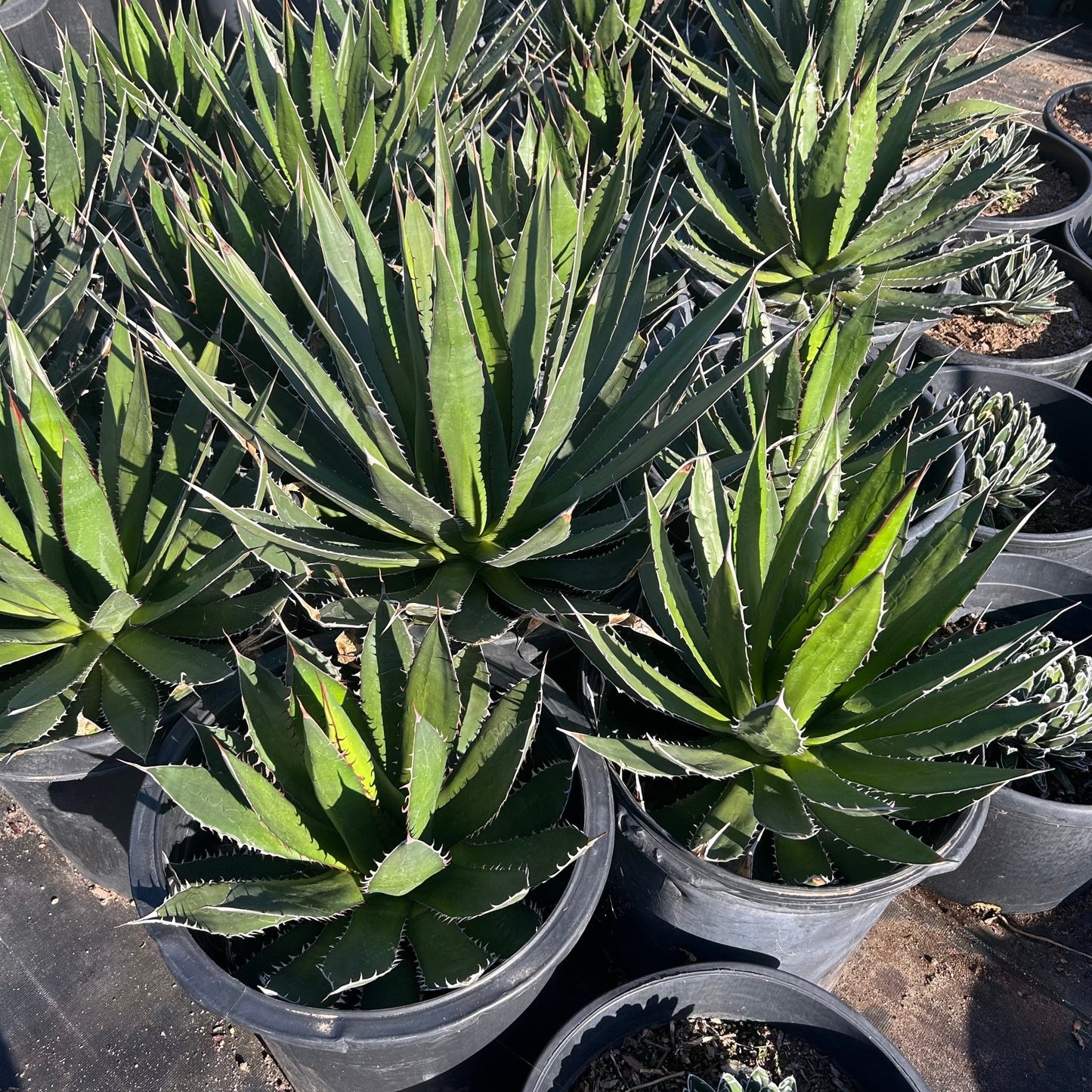
Agave horrida is one of the most strikingly armed agaves you can plant in the Phoenix Valley. Its dark green, glossy leaves are edged with dramatic black teeth and tipped with a sharp terminal spine — creating a compact, fierce rosette that commands attention in any garden. Extremely drought-tolerant and heat-hardy, Agave horrida thrives across Scottsdale, Mesa, Chandler, Gilbert, and Tempe with virtually no maintenance once established. Whether you're adding a rugged accent to a rock garden in Paradise Valley, anchoring a xeriscape bed in Peoria, or building a collector's agave display in Glendale — Agave horrida brings bold, architectural character.
Agave Horrida Plant Details
| Attribute | Detail |
|---|---|
| Scientific Name | Agave horrida |
| Common Names | Agave Horrida, Horrible Agave |
| Mature Height | 2–3 feet |
| Mature Width | 3–4 feet |
| Growth Rate | Slow to moderate — reaches full size in 5–8 years in Phoenix |
| Sun | Full sun (6+ hrs). Handles reflected heat from walls and pavement. Tolerates partial shade. |
| Water | Very low once established. Extremely drought-tolerant. |
| USDA Zones | 9–11 (Phoenix is Zone 9b–10a) |
| Soil | Well-draining required. Adapts to Arizona caliche and rocky native soils. |
| Foliage | Evergreen — dark glossy green leaves with prominent black marginal teeth |
| Bloom | Yellow flower spike up to 10–12 feet tall (monocarpic — blooms once after many years) |
Agave Horrida Uses in Phoenix Landscapes
Rock Garden Accent
Agave horrida's compact, heavily armed rosette is a natural fit for rock gardens and boulder arrangements. Its dark green color and black teeth contrast beautifully against pale desert boulders and decomposed granite. Plant it as a standalone accent or group three together for a dramatic cluster.
Xeriscape & Low-Water Beds
Once established, this agave survives on Phoenix rainfall alone. Pair it with Texas Sage, Ruellia, and Red Yucca for a colorful, water-wise bed that looks great year-round with zero irrigation headaches.
Security & Boundary Planting
The sharp teeth and terminal spines make Agave horrida an effective natural barrier. Plant along fence lines, property edges, or beneath windows as a beautiful yet functional deterrent. Space plants 3–4 feet apart for a continuous border.
Best Time to Plant Agave Horrida in Phoenix
Fall (October–November) is ideal. Warm soil promotes root growth while cooler air reduces transplant stress, giving the plant 6–8 months to establish before its first Phoenix summer. Spring (February–April) is the second-best window. Avoid planting in peak summer if possible.
How to Plant Agave Horrida
- Dig wide, not deep — 2–3x the root ball width, same depth as the container.
- Check for caliche — break through any hardpan layer for proper drainage.
- Backfill with native soil — a light 20% pumice or gravel amendment helps in heavy clay.
- Spacing — 3–4 feet apart for grouped plantings; give single specimens at least 4 feet of clearance.
- Water basin — build a 3–4 inch soil ring to direct water to the root zone.
- Mulch — 2–3 inches of decorative gravel or decomposed granite around the base.
Watering Agave Horrida in Phoenix
First Year Watering Schedule
Weeks 1–2: Every 2–3 days, deep and slow (15–20 min). Month 1–3: Every 5–7 days. Month 3–6: Every 10–14 days. After Year 1: Every 3–4 weeks in summer; little to no water in winter.
Drip Irrigation
Place one 2 GPH emitter 12–18 inches from the base. Established plants need very little supplemental water — overwatering is the leading cause of agave root rot in Phoenix.
How fast does Agave horrida grow in Phoenix?
It grows at a slow to moderate rate, reaching its full 3–4 foot spread in roughly 5–8 years. Young plants still display the dramatic black teeth that make this species so distinctive.
Is Agave horrida drought tolerant?
Extremely. Once established after the first year, it thrives on Phoenix rainfall alone and handles extended dry periods without stress.
Why is it called "horrida"?
The name comes from the Latin word for "bristly" or "prickly," referring to the prominent black marginal teeth along each leaf. Despite the name, it's a beautiful and highly prized landscape plant.
Does Agave horrida produce pups?
Yes, it can produce offsets (pups) around the base as it matures, allowing you to propagate new plants or let them fill in for a natural cluster effect.
You May Also Like
- Agave Titanota — Compact agave with bold white teeth and striking architectural form.
- Agave Lechuguilla — Narrow-leaved native agave with fierce terminal spines.
- Agave Striata — Spiky, urchin-like agave that adds fine-textured contrast.
- Agave colorata x celsii — Blue-gray hybrid with strong form and easy care.
How Many Agave Horrida Do I Need?
This is a compact specimen agave at 3 to 4 feet across. It works as a single rock-garden accent, in small groupings, or spaced into a living barrier along a boundary.
| Planting Style | How to Space |
|---|---|
| Single accent | One rosette with about 4 ft of clearance against boulders or granite. |
| Group of 3 | Space 3 to 4 ft apart, center to center, for a dramatic cluster. |
| Barrier row (per 20 ft) | About 6 to 7 plants at 3 ft spacing for a continuous spined deterrent along a fence or property edge. |
The black teeth and terminal spines are genuinely sharp, so keep rosettes at least 4 ft back from walkways, pool decks, and play areas, and use them as a deterrent rather than a path-side accent.
Agave Horrida Season-by-Season in Phoenix
- Spring (Feb–Apr): Glossy dark leaves push fresh growth and color deepens. Strong second planting window.
- Summer (May–Sep): Built for full sun and reflected heat off walls and pavement. During monsoon humidity, let fast-draining soil dry between waterings to prevent rot.
- Fall (Oct–Nov): Prime planting season. Warm soil drives strong root establishment before winter.
- Winter (Dec–Jan): Stays evergreen and armed. Hardy to about 20°F, which covers standard Valley lows, so routine frost protection is not needed; cover only in an unusual hard freeze.
At a Glance
✔ Heat-Loving (Reflected-Heat Tolerant) ✔ Drought-Tolerant ✔ Evergreen ✔ Low-Maintenance ✔ Deer & Rabbit-Resistant ✔ Cold-Hardy to 20°F
Plant It With
- Agave Titanota: bold white teeth and a compact form that echoes the armed look.
- Agave Lechuguilla: a narrow-leaved native agave with fierce spines for a tough barrier grouping.
- Agave Striata: a spiky urchin form that adds fine-textured contrast.
- Agave colorata x celsii: a soft blue-gray hybrid that balances the dark, toothy rosette.
Is Agave Horrida Right for Your Yard?
It thrives in full sun to partial shade, in fast-draining caliche or rocky soil, with almost no water once established, and it handles reflected heat and Valley cold well. The compact 3 to 4 ft size and fierce teeth make it ideal for rock gardens and security or boundary plantings. It is not a fit beside walkways, patios, or pool decks where people brush past, since the teeth and terminal spines can injure, and it will rot in a wet, poorly drained bed.
Customer Reviews
Share