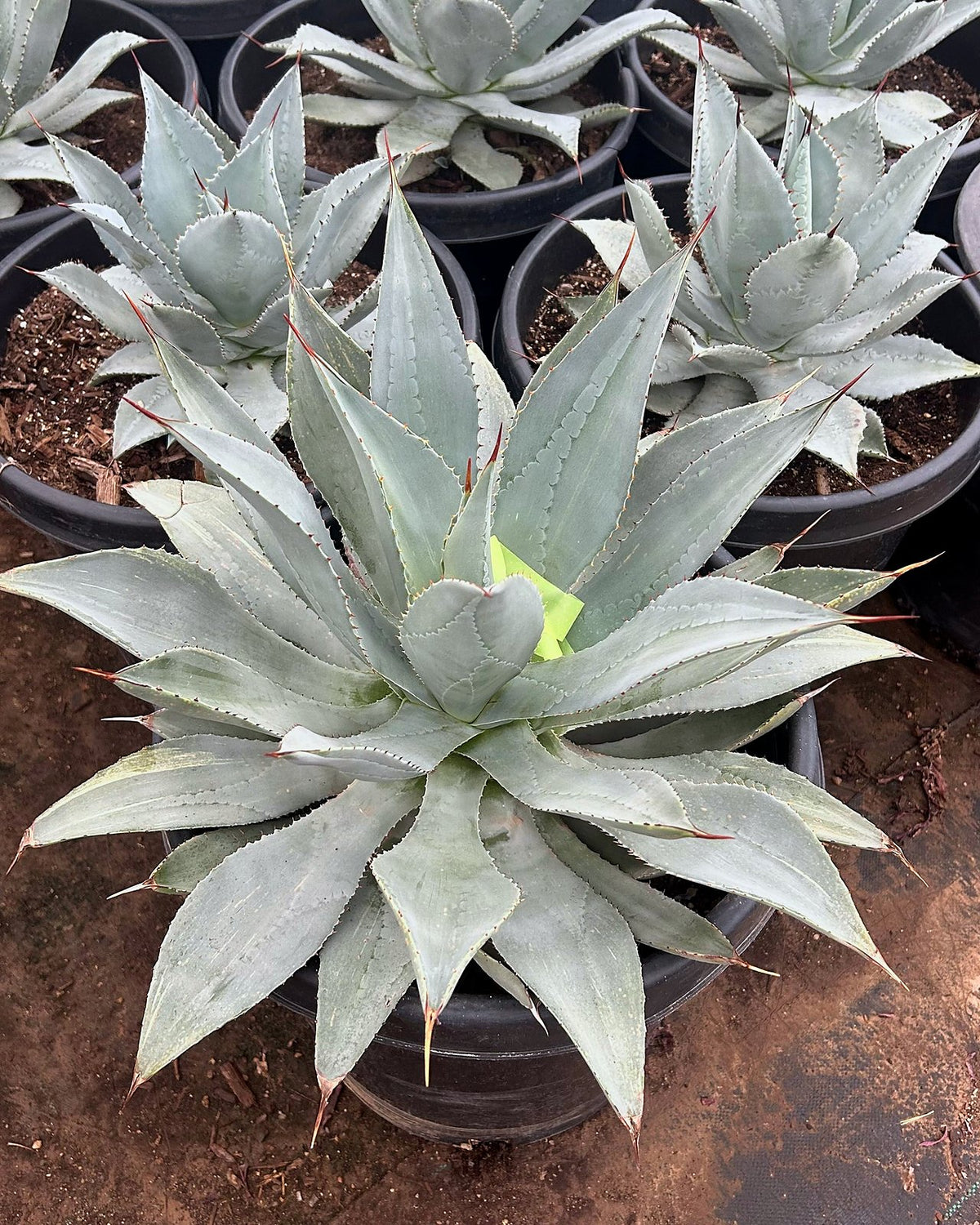


Agave Titanota
Agave Titanota
Couldn't load pickup availability
The Collector's Agave — Bold, Armored & Built for Phoenix Heat
Agave titanota (Rancho Tambor Agave) is one of the most sought-after collector agaves in the world — and it thrives spectacularly in Phoenix's brutal desert climate. Known for its compact rosette of thick, chalky blue-green leaves edged with dramatic white teeth and tipped with dark terminal spines, Agave Titanota delivers jaw-dropping sculptural impact in any landscape. Extremely drought-tolerant and virtually maintenance-free once established, it handles full sun, reflected heat, and triple-digit summers without flinching. Whether you're building a collector garden in Scottsdale, anchoring a modern courtyard in Chandler, or creating a bold container display in Mesa — Agave Titanota is the crown jewel.
Agave Titanota Plant Details
| Attribute | Detail |
|---|---|
| Scientific Name | Agave titanota |
| Common Names | Agave Titanota, Rancho Tambor Agave, Chalk Agave |
| Mature Height | 1–2 feet |
| Mature Width | 2–3 feet |
| Growth Rate | Slow to moderate — reaches mature size in 5–8 years in Phoenix |
| Sun | Full sun (6+ hrs). Handles reflected heat from walls and pavement. |
| Water | Very low once established. Highly drought-tolerant. |
| USDA Zones | 9–11 (Phoenix is Zone 9b–10a) |
| Soil | Well-draining required. Thrives in Arizona caliche and rocky native soils. |
| Foliage | Evergreen — thick, chalky blue-green leaves with white marginal teeth |
| Bloom | Tall flower stalk (monocarpic — blooms once after many years, then offsets) |
Agave Titanota Uses in Phoenix Landscapes
Collector Specimen & Focal Point
Agave Titanota is the ultimate collector agave. Its compact size, dramatic teeth, and chalky coloring make it a showstopper as a standalone specimen in rock gardens, raised planters, or prominent landscape beds. Place one on a pedestal of decomposed granite with accent boulders for maximum visual impact in Scottsdale, Paradise Valley, or Gilbert yards.
Modern Desert Container Gardens
Titanota's compact 2–3 foot spread makes it ideal for large decorative containers on patios, pool decks, and courtyard entries. Use a terracotta or concrete planter with fast-draining cactus mix. Its architectural form pairs beautifully with other collector succulents and agaves for a curated desert container garden.
Xeriscape Rock Gardens
Group Agave Titanota with complementary desert plants like Desert Spoon, Agave colorata, and Texas Sage in a gravel-mulched rock garden. The contrast between Titanota's compact, heavily armed rosette and taller, softer-textured plants creates layered visual interest that looks stunning year-round with zero supplemental water once established.
Best Time to Plant Agave Titanota in Phoenix
Fall (October–November) is ideal for planting. Warm soil encourages rapid root establishment while cooler air temperatures reduce transplant stress, giving the plant 6–8 months to settle in before its first Phoenix summer. Spring (February–April) is the second-best window. Avoid planting during peak summer heat if possible.
How to Plant Agave Titanota
- Dig wide, not deep — 2–3x the root ball width, same depth as the container.
- Check for caliche — break through any hardpan layer to ensure excellent drainage.
- Backfill with native soil — mix in 20–30% pumice or perlite for extra drainage if soil is heavy.
- Spacing — 3–4 ft apart in groupings; give single specimens 2–3 ft clearance from paths due to sharp teeth.
- Water basin — build a 3–4 inch soil ring to direct water to the root zone.
- Mulch — 2–3 inches of gravel or decorative rock around the base to retain moisture and suppress weeds.
Watering Agave Titanota in Phoenix
First Year Watering Schedule
- Weeks 1–2: Every 2–3 days, deep and slow (10–15 min)
- Month 1–2: Every 5–7 days
- Month 3–6: Every 10–14 days (7–10 days in peak summer)
- After Year 1: Every 2–3 weeks in summer; monthly or less in winter
Drip Irrigation
Place one 1–2 GPH emitter 8–12 inches from the base. Agave Titanota is highly rot-prone if overwatered — always let the soil dry completely between waterings. In Phoenix's low humidity, established plants need very little supplemental irrigation.
How fast does Agave Titanota grow in Phoenix?
Agave Titanota is a slow to moderate grower, reaching its full 1–2 foot height and 2–3 foot spread over 5–8 years. Each new leaf emerges with more dramatic teeth and coloring than the last, making it more beautiful as it matures.
Is Agave Titanota drought tolerant?
Extremely. Once established, Titanota thrives on minimal water and actually looks better when kept on the dry side. Overwatering is the most common mistake — it can cause root rot in heavy soils.
Can Agave Titanota handle Phoenix summer heat?
Yes. Agave Titanota handles full sun, reflected heat, and temperatures above 115°F without issue. Its thick, waxy leaves and compact form are perfectly adapted to extreme desert conditions.
What makes Agave Titanota different from other agaves?
Titanota is prized for its dramatic white marginal teeth, compact rosette form, and chalky blue-green coloring. Each leaf is a work of art. Unlike larger landscape agaves, Titanota stays relatively small, making it perfect for gardens, containers, and detailed plantings.
You May Also Like
- Agave titanota White Ice — a stunning white-variegated form of Titanota with even more dramatic teeth and contrast.
- Agave colorata — another compact collector agave with beautiful blue coloring and prominent teeth.
- Agave Sisalana Variegated — a striking variegated agave that adds bold color contrast to desert gardens.
- Desert Spoon (Dasylirion wheeleri) — a complementary sculptural succulent with fine-textured foliage.
How Many Agave Titanota Do I Need?
Titanota is a compact collector specimen (2 to 3 ft wide), best shown off singly, in containers, or in small curated clusters. The white marginal teeth and dark spines are sharp, so keep it back from paths and seating.
| Use | Spacing & Count |
|---|---|
| Single specimen / container | 1 plant with 2 to 3 ft of clearance from paths |
| Collector cluster | 3 plants in an odd-numbered group, 3 to 4 ft apart |
| Rock-garden grouping | Space 3 to 4 ft on center among boulders and finer-textured plants |
Agave Titanota Season-by-Season in Phoenix
- Spring (Feb–Apr): Slow, steady new leaves emerge with fresh teeth and chalk. A strong second window to plant or repot.
- Summer (May–Sep): Handles full sun, reflected heat, and 115°F-plus with ease. Keep it dry between waterings; monsoon rain (Jul–Sep) is usually plenty, and excess water in heat invites rot.
- Fall (Oct–Nov): The ideal planting season. Warm soil and mild air let it establish before winter.
- Winter (Dec–Jan): Stays evergreen but this is a frost-tender agave: leaves can scar below about 28°F. In containers, move it under cover; in the ground, drape frost cloth on the coldest nights.
At a Glance
✔ Heat-Loving (Reflected-Heat Tolerant) ✔ Drought-Tolerant ✔ Evergreen ✔ Low-Maintenance ✔ Deer & Rabbit-Resistant
Plant It With
- Agave titanota White Ice: the white-variegated form, for a matched collector pairing.
- Agave colorata x celsii: another compact blue collector agave with prominent teeth.
- Agave Sisalana Variegated: a bold variegated agave that adds larger-scale color contrast.
- Desert Spoon: a fine-textured sculptural succulent that softens the armed rosette.
Is Agave Titanota Right for Your Yard?
It thrives in full sun and reflected heat, in very fast-draining caliche, rocky soil, or a gritty container mix, and rewards a lean, dry regime. It is not a fit if your soil stays moist or you cannot protect it from frost below about 28°F, since both cold and overwatering will damage it.
Share