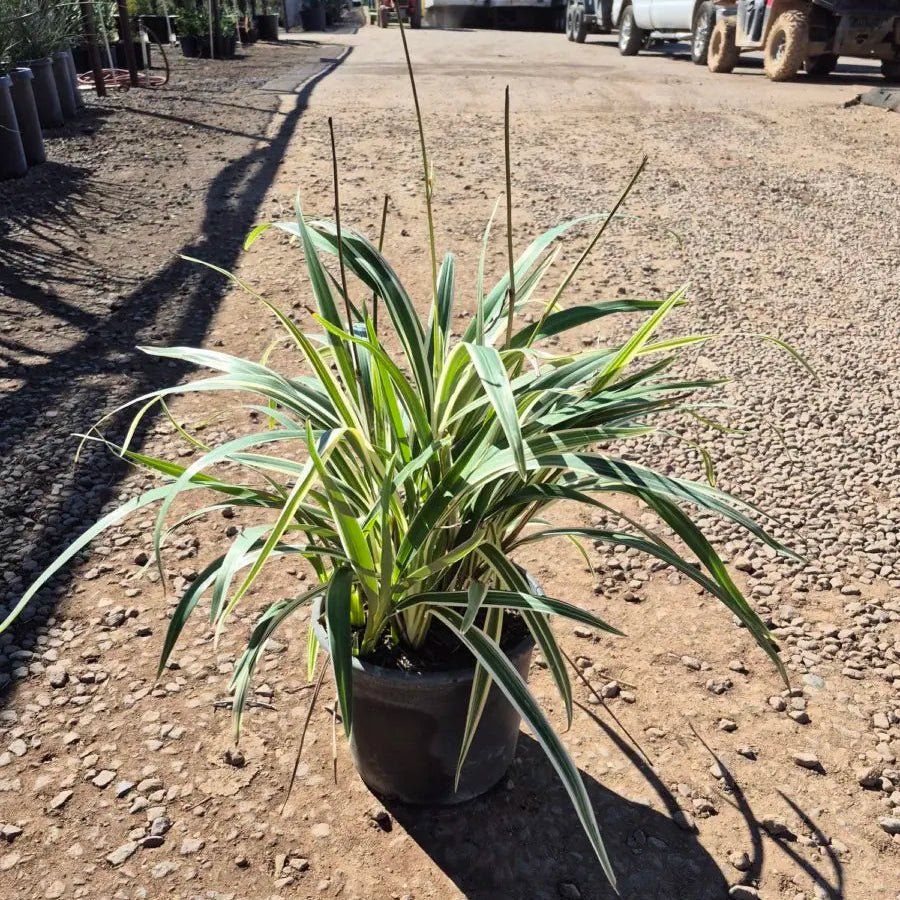

Varigated Flax Lily
Varigated Flax Lily
Couldn't load pickup availability
Phoenix's Best Evergreen Accent Grass — Variegated Flax Lily
Variegated Flax Lily (Dianella tasmanica 'Variegata') is one of the most versatile and visually striking accent plants for Phoenix and Scottsdale landscapes. With its bold, cream-edged green leaves and delicate violet-blue flowers in spring, this evergreen perennial delivers year-round structure and color with almost no effort. Drought-tolerant once established and perfectly suited to Phoenix's intense heat, it thrives in beds, borders, and containers throughout the Valley. Whether you're designing a low-maintenance yard in Chandler, adding poolside texture in Gilbert, or creating a lush border in Mesa — Variegated Flax Lily gets the job done.
Variegated Flax Lily Plant Details
| Attribute | Detail |
|---|---|
| Scientific Name | Dianella tasmanica 'Variegata' |
| Common Names | Variegated Flax Lily, Tasman Flax Lily, Variegated Dianella |
| Mature Height | 1.5–2.5 feet |
| Mature Width | 1.5–2.5 feet |
| Growth Rate | Moderate — 6–12 inches per year in Phoenix |
| Sun | Full sun to partial shade. Handles reflected heat; appreciates afternoon shade in peak summer. |
| Water | Low once established. Highly drought-tolerant. |
| USDA Zones | 8–11 (Phoenix is Zone 9b–10a) |
| Soil | Well-draining. Adapts to Arizona caliche soils with proper amendment. |
| Foliage | Evergreen — bold green leaves with cream-white margins year-round |
| Flower Color | Violet-blue in spring and early summer, followed by metallic blue berries |
Variegated Flax Lily Uses in Phoenix Landscapes
Pool-Friendly Accent Planting
Variegated Flax Lily is one of the cleanest, most pool-safe plants you can use in a Phoenix backyard. Its strap-like leaves don't shed excessively, it produces no spines or thorns, and its compact form makes it easy to tuck into tight spaces around pool decks. Plant 2–3 feet apart along the pool perimeter for a clean, textured edge, or use in clusters of 3–5 plants for a bold focal grouping.
Low-Maintenance Borders and Edges
With minimal water needs and no pruning required beyond occasional trimming of old leaves, Variegated Flax Lily is an ideal border plant for Phoenix homeowners who want beauty without the upkeep. Use it along walkways, driveways, and bed edges throughout Scottsdale, Peoria, and Tempe to create a consistent, polished look that stays attractive all year. Space plants 18–24 inches apart for dense coverage, or 2.5–3 feet apart for a more open, airy border.
Modern Desert Design
The cream-and-green variegated foliage of this Dianella pairs beautifully with the neutral tones of desert stone, concrete, and stucco walls — making it a top pick for contemporary and minimalist landscape designs across the Phoenix Valley. Combine it with Desert Spoon (Dasylirion wheeleri), Texas Sage, or Ruellia for a low-water palette that looks intentional and refined.
Shade and Part-Shade Gardens
Unlike many ornamental grasses that demand full sun, Variegated Flax Lily actually thrives under dappled shade or on the north side of walls — making it one of the few ornamental options for shadier areas of Phoenix yards. Under a large patio cover or beneath a mesquite canopy, it maintains its bold variegated color and compact form beautifully throughout the year.
Best Time to Plant Variegated Flax Lily in Phoenix
Fall planting (October–November) is ideal in Phoenix. Soil temperatures remain warm for strong root development, while cooler air temperatures reduce transplant stress. Plants get 6–8 months of root establishment before their first full Phoenix summer. Spring planting (February–April) is your second-best window. Avoid summer planting if possible — if you must plant in heat, provide extra shade and water during the first 4–6 weeks.
How to Plant Variegated Flax Lily
- Dig wide, not deep — Make the hole 2–3x the width of the root ball, but the same depth. This encourages lateral root spread in Phoenix's compacted soils.
- Check for caliche — Break through any hardpan layer beneath the hole to ensure drainage. Standing water in caliche pockets will kill the plant quickly.
- Backfill with native soil — A light mix of 80% native soil and 20% organic amendment works well. Don't over-amend — Dianella prefers lean soil.
- Spacing — Space 18–24 inches apart for borders and edging; 2.5–3 feet apart for individual accent plants or poolside groupings.
- Build a water basin — Create a 3–4 inch earthen ring around the plant to direct irrigation water to the root zone during establishment.
- Mulch — Apply 2–3 inches of bark or gravel mulch to retain soil moisture and moderate soil temperature in summer heat.
Watering Variegated Flax Lily in Phoenix
First Year Watering Schedule
- Weeks 1–2: Every 1–2 days, deep and slow (20–30 minutes per session)
- Months 1–2: Every 3–4 days as roots begin establishing
- Months 3–6: Every 7–10 days (reduce to 5–7 days during peak summer heat)
- After Year 1: Every 10–14 days in summer; every 3–4 weeks in winter
Drip Irrigation
Place drip emitters 12–18 inches from the plant's crown, not directly at the base. A 1 GPH emitter running 30–45 minutes per session is appropriate for most established plants. Once fully established (after year 1), Variegated Flax Lily can survive on very little supplemental water, making it one of the most efficient accent plants available for Phoenix desert gardens.
How fast does Variegated Flax Lily grow in Phoenix?
Expect moderate growth of 6–12 inches per year. In Phoenix's long warm season, plants can fill out noticeably between spring and fall, reaching full size of 1.5–2.5 feet within 2–3 seasons.
Is Variegated Flax Lily drought tolerant once established?
Yes — it's highly drought-tolerant after the first growing season. Once the root system is well established, it can handle extended dry periods with minimal supplemental irrigation, making it ideal for low-water Phoenix landscapes.
Does Variegated Flax Lily work near pools in Phoenix?
Absolutely. It's one of the cleanest pool-safe plants available — no spines, no heavy leaf drop, and a compact size that keeps pool edges tidy. It's a top choice for Scottsdale and Gilbert pool landscapes.
How is Variegated Flax Lily different from regular green Flax Lily?
The variegated form features striking cream-white margins along each leaf blade, giving it a much brighter, more decorative appearance than solid-green Dianella varieties. The variegated form also tends to be slightly more compact, making it ideal for refined border and accent work.
Can Variegated Flax Lily handle Phoenix summer heat?
Yes, with proper establishment and irrigation. It does best with afternoon shade during the hottest months (June–August), but in a well-irrigated spot it can handle full Phoenix summer exposure. The variegated foliage holds its cream-and-green color well even in high heat.
You May Also Like
- Little Rev Flax Lily — A compact, deep purple-leaved Dianella that pairs beautifully with the cream tones of Variegated Flax Lily for contrast planting.
- Silvery Sunproof Liriope — Another variegated grass-like accent with silvery-white leaf edges and purple flower spikes, perfect for borders and shade spots.
- Giant Lily Turf — A bolder, larger grass-like option for mass planting or dramatic groundcover in Phoenix landscapes.
- White Cloud Muhly Grass — A feathery ornamental grass with white autumn plumes that provides stunning seasonal contrast next to Variegated Flax Lily.
- Bicolor Iris — A yellow-and-white blooming accent plant with bold foliage, ideal for poolside or shaded planting areas alongside Variegated Flax Lily.
How Many Variegated Flax Lily Do I Need?
This Dianella matures to a tidy 1.5 to 2.5 foot clump, which makes it a workhorse border, edging, and mass-planting plant. Pick your spacing from how full you want the run to read:
| Planting Goal | Spacing | Plants per 10 ft edge |
|---|---|---|
| Dense, knit-together border | 18 in on center | 7 plants |
| Standard edging row | 24 in on center | 5 plants |
| Open, airy accent spacing | 30 in on center | 4 plants |
For a mass planting, figure roughly one plant per 3 to 4 square feet at 24 inch spacing.
Variegated Flax Lily Season-by-Season in Phoenix
- Spring (Feb–Apr): Sprays of violet-blue flowers rise above the foliage, followed by metallic-blue berries. A strong second planting window.
- Summer (May–Sep): Holds its cream-and-green color through the heat. In full reflected-heat exposure the leaf edges look best with afternoon shade and steady drip water; monsoon rain is a bonus.
- Fall (Oct–Nov): The best planting season in Phoenix and a comfortable stretch of fresh growth as temperatures ease.
- Winter (Dec–Jan): Stays fully evergreen and structural. Hardy well below freezing (zones 8 to 11), so no frost protection is needed in the Valley.
At a Glance
✔ Heat-Loving (Reflected-Heat Tolerant) ✔ Drought-Tolerant ✔ Pool-Friendly (Low-Litter) ✔ Evergreen ✔ Low-Maintenance
Plant It With
- Little Rev Flax Lily: a compact deep-green Dianella that contrasts the cream variegation.
- Lily Turf: a shade-loving grassy groundcover that carries the same texture into darker corners.
- Bicolor Iris: yellow blooms and upright blades for a pool-friendly accent grouping.
- Desert Spoon: a silver-green spiky specimen that anchors the softer flax lily clumps.
Is Variegated Flax Lily Right for Your Yard?
It thrives in full sun to partial shade, in well-draining soil where caliche has been broken through, and is one of the few bright variegated accents that also takes shade under patios and north walls. It is clean enough for pool edges and hardy through Valley winters. Not the right fit if you need a tall screen or a plant for a hot, fully exposed western wall with no irrigation, where the leaf tips can scorch.
Customer Reviews
Share