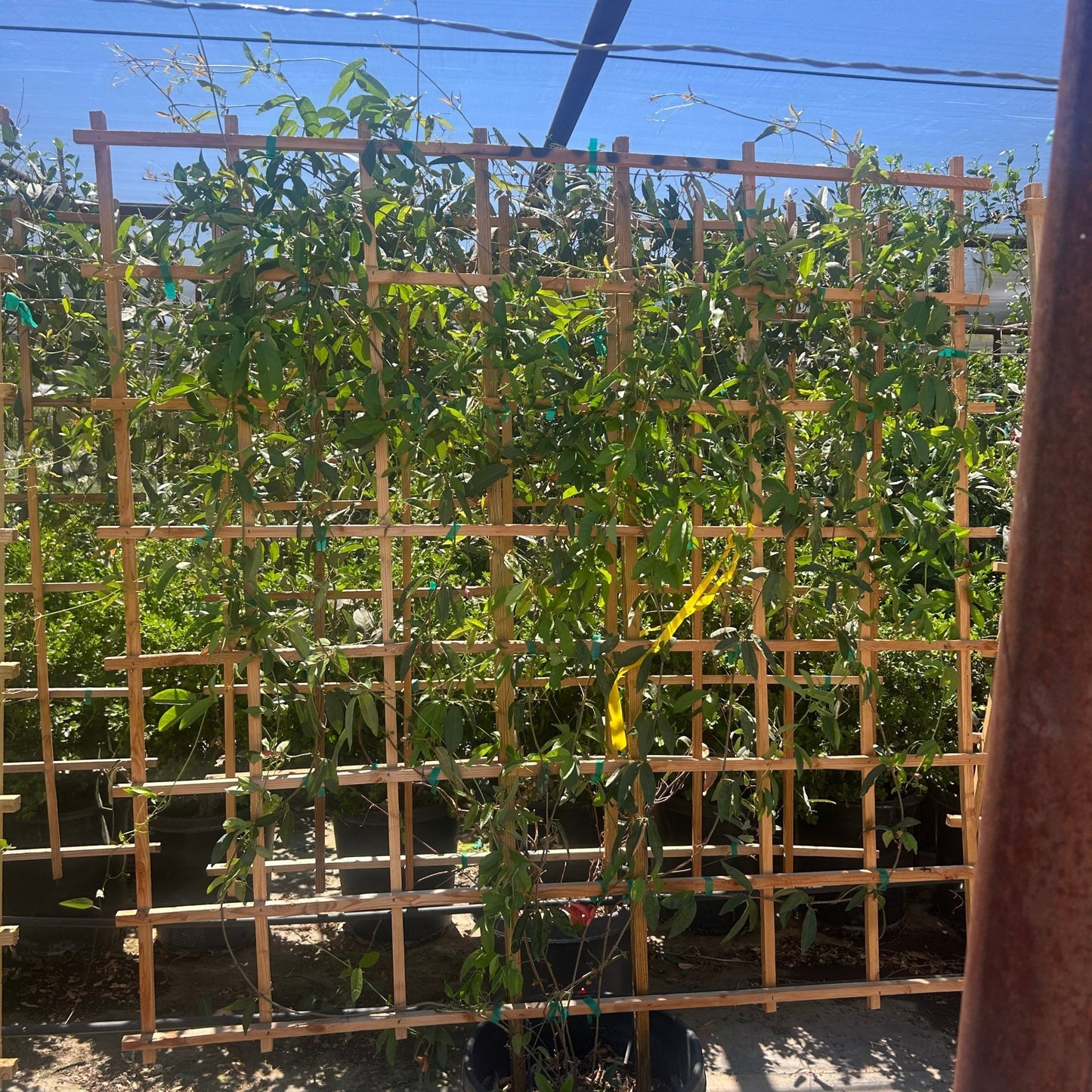

Tangerine Beauty Cross Vine Espalier
Tangerine Beauty Cross Vine Espalier
Couldn't load pickup availability
Stunning Orange Flowering Vine Trained for Arizona Walls & Fences
Tangerine Beauty Cross Vine (Bignonia capreolata 'Tangerine Beauty') is one of the most vibrant flowering espalier vines for Phoenix-area landscapes. This semi-evergreen climber produces clusters of tangerine-orange trumpet flowers from spring through fall, attracting hummingbirds and adding bold color to any wall or fence. Trained flat on a sturdy frame, it delivers dramatic vertical coverage with minimal footprint. Whether you're brightening a courtyard wall in Scottsdale, covering a block fence in Chandler, or framing an entryway in Mesa — Tangerine Beauty Cross Vine Espalier delivers showstopping color season after season.
Tangerine Beauty Cross Vine — Plant Details
| Attribute | Detail |
|---|---|
| Scientific Name | Bignonia capreolata 'Tangerine Beauty' |
| Common Names | Tangerine Beauty Cross Vine, Crossvine, Trumpet Flower Vine |
| Mature Height | 15–30 ft (on support structure) |
| Mature Width | 6–10 ft spread on trellis |
| Growth Rate | Fast — 5–8 ft per year in Phoenix |
| Sun | Full sun to partial shade. Handles reflected heat from walls. |
| Water | Low to moderate once established. Drought-tolerant. |
| USDA Zones | 6–10 (Phoenix is Zone 9b–10a) |
| Soil | Well-draining. Adapts to Arizona caliche soils. |
| Foliage | Semi-evergreen — holds most leaves year-round in Phoenix |
| Bloom Color | Tangerine-orange trumpet flowers, spring through fall |
Tangerine Beauty Cross Vine Uses in Phoenix Landscapes
Living Wall Art & Vertical Color
Trained flat against a wall or fence, Tangerine Beauty Cross Vine creates a living tapestry of orange blooms and deep green foliage. The espalier form keeps the vine tidy and controlled while maximizing visual impact. Perfect for accent walls, courtyard features, and entryway framing where you want bold, lasting color without a bulky footprint.
Fence & Block Wall Coverage
Cross Vine excels at softening plain block walls and metal fences throughout the Phoenix Valley. Its clinging tendrils grip trellises and wire supports readily. For full fence coverage: space espalier frames 6–8 ft apart. A 20 ft fence section needs 3 espalier plants for complete coverage within 2 seasons.
Hummingbird & Pollinator Garden Feature
The tubular orange flowers are a magnet for hummingbirds, butterflies, and native bees. Plant along a patio wall or pool fence where you can enjoy watching pollinators up close. Pairs beautifully with other Three Timbers hummingbird favorites like Arizona Yellow Bells Espalier and Cape Honeysuckle Espalier for continuous bloom rotation.
Best Time to Plant Tangerine Beauty Cross Vine in Phoenix
Fall (October–November) is ideal for planting espaliers in Phoenix. The soil stays warm enough for root establishment while cooler air temperatures reduce transplant stress. Your vine gets 6–8 months of root growth before facing its first Phoenix summer. Spring (February–April) is the second-best window. Avoid summer planting if possible — the combination of extreme heat and transplant shock makes establishment much harder.
How to Plant Tangerine Beauty Cross Vine Espalier
- Position the frame first — Set your espalier trellis or support 4–6 inches away from the wall to allow air circulation and prevent heat damage to foliage.
- Dig wide, not deep — Dig the hole 2–3x the width of the root ball, same depth. Center the plant at the base of the frame.
- Check for caliche — Break through any hardpan layer to ensure proper drainage. Cross Vine won't tolerate standing water.
- Backfill with native soil — A light 20% organic blend is fine. Don't over-amend.
- Build a water basin — Create a 3–4 inch soil ring around the root zone to direct water to the roots during establishment.
- Mulch — Apply 2–3 inches of bark or gravel mulch to retain moisture and keep roots cool in summer.
Watering Tangerine Beauty Cross Vine in Phoenix
First Year Watering Schedule
- Weeks 1–2: Every 1–2 days, deep and slow (20–30 min)
- Month 1–2: Every 3–4 days
- Month 3–6: Every 7–10 days (5–7 days in peak summer)
- After Year 1: Every 10–14 days in summer; every 3–4 weeks in winter
Drip Irrigation
Place two 2-GPH emitters 18–24 inches from the trunk on opposite sides. As the vine matures, extend drip lines outward to encourage wide root growth. Established Cross Vine needs very little supplemental water beyond deep soakings every 2 weeks in summer.
How fast does Tangerine Beauty Cross Vine grow in Phoenix?
Very fast — expect 5–8 feet of new growth per year in Phoenix. On an espalier frame, you can achieve full wall coverage within 1–2 growing seasons with proper watering.
Is Tangerine Beauty Cross Vine drought-tolerant?
Yes. Once established (after the first year), Cross Vine is highly drought-tolerant and thrives on Phoenix's natural rainfall supplemented with deep watering every 10–14 days in summer.
Does Cross Vine handle Phoenix summer heat?
Absolutely. Tangerine Beauty is well-adapted to desert heat and handles reflected heat from walls and concrete. It may slow its bloom cycle during the hottest weeks of July–August but rebounds strongly in September.
Is Tangerine Beauty Cross Vine evergreen in Phoenix?
Semi-evergreen. In Phoenix's mild winters, it typically holds most of its leaves. You may see some leaf drop during unusually cold snaps below 25°F, but the vine recovers quickly in spring.
You May Also Like
- Cape Honeysuckle Espalier — Another fast-growing orange bloomer perfect for walls and fences.
- Arizona Yellow Bells Espalier — Native golden trumpet flowers on an espalier frame for warm desert color.
- Pink Trumpet Espalier — Soft pink trumpet blooms trained flat for a romantic wall accent.
- Star Jasmine Espalier — Fragrant white flowers on a clean evergreen espalier for a classic look.
How Many Tangerine Beauty Cross Vine Espalier Do I Need?
Trained flat, each espalier panel fills roughly 6 to 8 feet of wall or fence once mature. Measure the run you want to cover and divide by 7 feet to estimate panels:
| Wall / fence length | Espalier panels needed |
|---|---|
| 7 ft | 1 panel |
| 14 ft | 2 panels |
| 21 ft | 3 panels |
| 35 ft | 5 panels |
With this vine's fast 5 to 8 ft per year growth, a row of panels knits into continuous coverage within one to two seasons. Set the support frame a few inches off the wall for airflow.
Tangerine Beauty Cross Vine Season-by-Season in Phoenix
- Spring (Feb to Apr): Peak bloom. Clusters of tangerine-orange trumpets cover the panel and pull in hummingbirds. Strong flush of climbing growth. A good second planting window.
- Summer (May to Sep): Heat and reflected-heat tolerant against block walls. Bloom slows in the hottest weeks of July and August, then rebounds with monsoon moisture and into September. Keep deep water on the roots.
- Fall (Oct to Nov): Prime planting season and a renewed bloom flush as nights cool. Roots establish fast in warm fall soil.
- Winter (Dec to Jan): Semi-evergreen in the Valley, holding most leaves. Genuinely cold-hardy (rated to Zone 6), it may drop some foliage below about 25°F but rebounds in spring with no cover needed.
At a Glance
✔ Pollinator-Friendly ✔ Hummingbird-Friendly ✔ Heat-Loving (Reflected-Heat Tolerant) ✔ Drought-Tolerant ✔ Low-Maintenance ✔ Cold-Hardy to 10°F
Plant It With
- Cape Honeysuckle Espalier: another fast orange bloomer for a matched run of hummingbird color along the wall.
- Orange Jubilee Espalier: tall golden-orange trumpets that echo the tangerine tones on a neighboring panel.
- Pink Trumpet Espalier: soft pink trumpets that cool down and complement the hot orange.
- Star Jasmine Espalier: fragrant white evergreen panel for contrast and year-round green.
Is Tangerine Beauty Cross Vine Espalier Right for Your Yard?
This espalier is ideal when you want fast, bold vertical color on a sunny block wall, courtyard, or fence with a slim footprint, including hot reflected-heat exposures. It is drought-tough once established and frost-hardy for the Valley. It is not the best fit if you have no support structure or want a freestanding shrub, since it needs a trellis or frame to climb and look its best.
Customer Reviews
Share