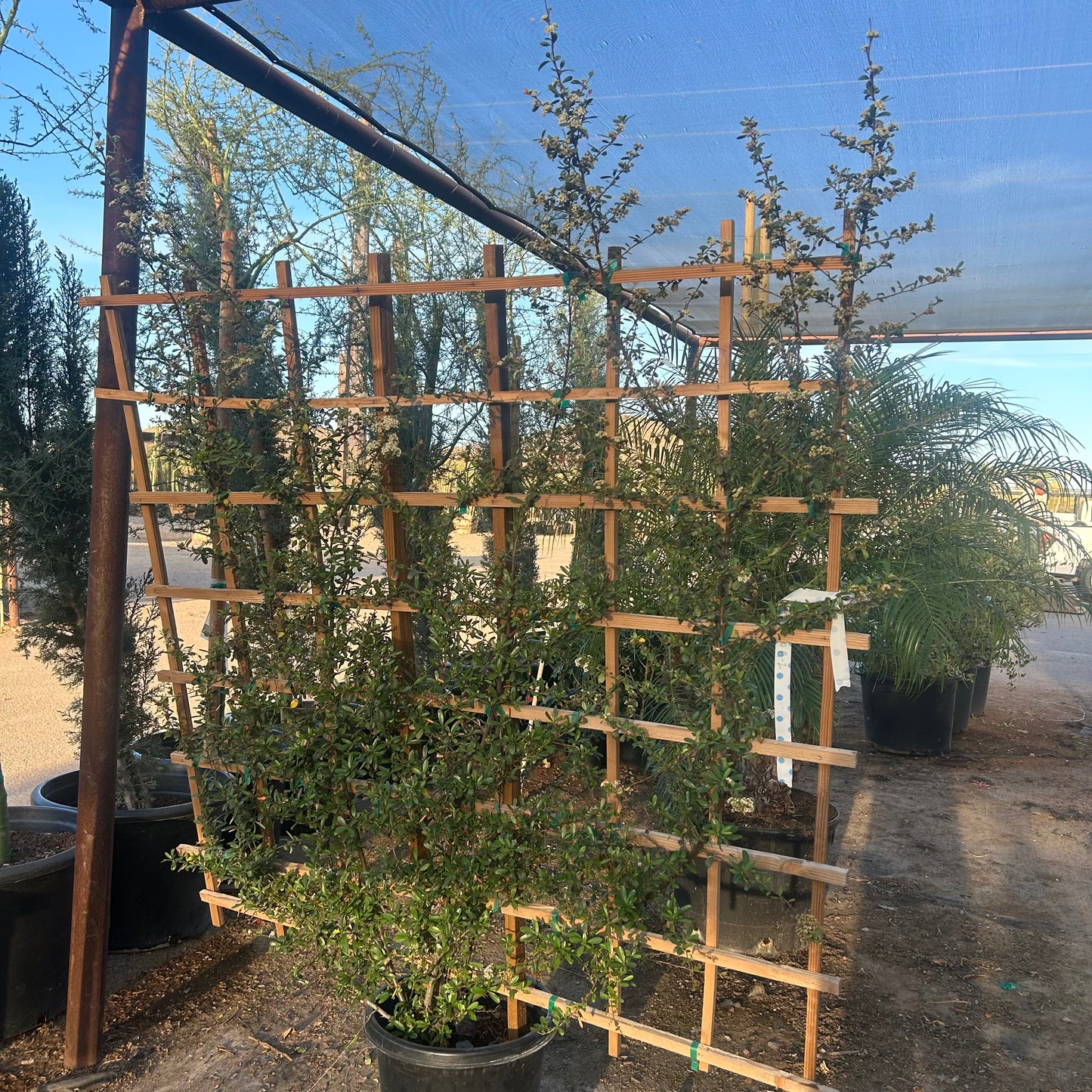


Pyracantha Espalier
Pyracantha Espalier
Couldn't load pickup availability
Pyracantha Espalier — Four-Season Color with Red Berries & White Flowers
Pyracantha (Pyracantha coccinea), commonly known as Firethorn, is the ultimate four-season espalier plant for Phoenix landscapes. This tough evergreen shrub delivers white flower clusters in spring, glossy green foliage through summer, brilliant red-orange berries in fall and winter, and thorny branches that double as a natural security barrier. Trained flat on a frame, Pyracantha creates a formal, structured wall feature that stays beautiful year-round. Whether you're adding winter berry color to a Scottsdale courtyard, creating a living security fence in Mesa, or framing a Mediterranean-style entryway in Chandler — Pyracantha Espalier is the classic choice.
Pyracantha Espalier — Plant Details
| Attribute | Detail |
|---|---|
| Scientific Name | Pyracantha coccinea |
| Common Names | Firethorn, Pyracantha, Scarlet Firethorn |
| Mature Height | 8–12 ft (on espalier frame) |
| Mature Width | 6–10 ft spread |
| Growth Rate | Moderate to Fast — 2–4 ft per year in Phoenix |
| Sun | Full sun to partial shade. Handles reflected heat from walls. |
| Water | Low once established. Highly drought-tolerant. |
| USDA Zones | 6–10 (Phoenix is Zone 9b–10a) |
| Soil | Well-draining. Adapts to Arizona caliche soils. |
| Foliage | Evergreen — glossy dark green leaves year-round |
| Berries | Bright red-orange clusters, fall through winter |
Pyracantha Espalier Uses in Phoenix Landscapes
Four-Season Wall Feature
Pyracantha is one of the few espalier plants that looks stunning in every season. Spring brings clusters of small white flowers. Summer delivers dense, glossy green coverage. Fall and winter showcase the star attraction — masses of bright red-orange berries that last for months. The formal espalier pattern creates architectural interest on any blank wall or fence.
Natural Security Barrier
Pyracantha's sharp thorns make it an excellent natural deterrent when trained along fence lines and property boundaries. The dense, thorny branches discourage intruders while looking elegant in the espalier form. For a security hedge: space espalier frames 5–6 ft apart along the fence line for overlapping thorny coverage.
Bird & Wildlife Garden Feature
The red berries are a winter food source for songbirds, mockingbirds, and other desert birds. The dense thorny branches also provide safe nesting sites. Plant along a patio wall or garden fence where you can enjoy watching birds feed. Pairs well with other Three Timbers espaliers like Star Jasmine and Cape Honeysuckle for year-round interest.
Best Time to Plant Pyracantha in Phoenix
Fall (October–November) is ideal for planting espaliers in Phoenix. The soil stays warm for root establishment while cooler air reduces transplant stress. Your plant gets 6–8 months of root growth before its first Phoenix summer. Spring (February–April) is the second-best window. Avoid summer planting if possible.
How to Plant Pyracantha Espalier
- Position the frame first — Set your espalier trellis 4–6 inches from the wall for air circulation. Wear heavy gloves when handling Pyracantha — the thorns are sharp.
- Dig wide, not deep — Dig the hole 2–3x the width of the root ball, same depth.
- Check for caliche — Break through any hardpan layer to ensure proper drainage.
- Backfill with native soil — A light 20% organic blend is fine.
- Build a water basin — Create a 3–4 inch soil ring around the root zone to direct water to the roots.
- Mulch — Apply 2–3 inches of bark or gravel mulch to retain moisture and keep roots cool.
Watering Pyracantha in Phoenix
First Year Watering Schedule
- Weeks 1–2: Every 1–2 days, deep and slow (20–30 min)
- Month 1–2: Every 3–4 days
- Month 3–6: Every 7–10 days (5–7 days in peak summer)
- After Year 1: Every 10–14 days in summer; every 3–4 weeks in winter
Drip Irrigation
Place two 2-GPH emitters 18–24 inches from the trunk on opposite sides. Established Pyracantha is very drought-tolerant and needs minimal supplemental water beyond deep soakings every 2–3 weeks in summer.
How fast does Pyracantha grow in Phoenix?
Moderate to fast — expect 2–4 feet of new growth per year. On an espalier frame, you'll have solid wall coverage within 2–3 growing seasons.
Is Pyracantha drought-tolerant?
Very. Once established, Pyracantha is one of the most drought-tolerant espalier plants available. It thrives on Phoenix's natural rainfall with supplemental deep watering every 2–3 weeks in summer.
Does Pyracantha have thorns?
Yes — Pyracantha has sharp thorns, which is actually a benefit for security plantings along property lines. Wear heavy gloves when pruning or training. The espalier form keeps thorny growth organized and away from walkways.
Are Pyracantha berries edible?
The raw berries are mildly toxic and not recommended for eating. However, they are a valuable winter food source for birds. The berries are the plant's showpiece — masses of red-orange clusters that last from fall through winter.
You May Also Like
- Star Jasmine Espalier — Fragrant white flowers on a clean evergreen frame for a classic look.
- Cape Honeysuckle Espalier — Bright orange blooms for vibrant wall color year-round.
- Lady Banks Rose Espalier — Cascading white or yellow roses on a thornless climbing frame.
- Pink Pearl Bougainvillea Espalier — Bold pink bracts for dramatic desert wall color.
How Many Pyracantha Espaliers Do I Need?
Each espalier frame covers roughly 6 ft of wall or fence at maturity. For a continuous panel or an overlapping thorny security barrier, space frames about 6 ft on-center (tighten to 5 ft where you want a denser, impenetrable line). Use this guide:
| Wall / Fence Length | Espaliers at 6 ft spacing |
|---|---|
| 6 ft | 1 |
| 12 ft | 2 |
| 18 ft | 3 |
| 24 ft | 4 |
Set each frame 4 to 6 inches off the wall for airflow, and keep the thorny panels back from walkways, gates, and pool decks where people brush past.
Pyracantha Espalier Season-by-Season in Phoenix
- Spring (Feb–Apr): Clusters of small white flowers open and feed early pollinators, followed by a flush of glossy new growth to tie in along the frame. Best time to prune and shape, wearing heavy gloves for the thorns. Strong secondary planting window.
- Summer (May–Sep): Dense, dark green coverage holds up to extreme and reflected heat with very little water. Monsoon rains (Jul–Sep) drive growth: tuck and tie new shoots to keep the panel flat and the green berries developing.
- Fall (Oct–Nov): The showpiece season: masses of red-orange berries color up and draw songbirds. Prime planting window for espaliers in Phoenix.
- Winter (Dec–Jan): Berries persist for months and foliage stays evergreen. Genuinely cold-hardy (rated to Zone 6), so Valley frosts cause no damage. No covering needed.
At a Glance
✔ Evergreen ✔ Pollinator-Friendly ✔ Heat-Loving (Reflected-Heat Tolerant) ✔ Drought-Tolerant ✔ Low-Maintenance ✔ Deer & Rabbit-Resistant ✔ Cold-Hardy to 0°F
Plant It With
- Cape Honeysuckle Espalier: vivid orange blooms that contrast the red berries and share the heat-loving, low-water habit.
- Lady Banks Rose Espalier: a thornless, cascading white-rose panel that softens the formal berry display on adjacent walls.
- Pink Pearl Bougainvillea Espalier: bold pink bracts for dramatic warm-season wall color beside the evergreen Pyracantha.
- Bower Vine Espalier: a clean evergreen espalier with pale trumpet flowers for year-round structure.
Is Pyracantha Espalier Right for Your Yard?
Pyracantha is a fit for full-sun Phoenix walls and fences where you want true four-season interest, very low water once established, and the security value of thorns, including hot, reflected-heat spots and cold-winter pockets. It adapts to caliche when the hole drains. Not a fit next to walkways, gates, pools, or play areas where the sharp thorns and mildly toxic berries are a hazard, or for a gardener who would rather not prune and tie a vigorous plant into shape a few times a year: in those cases choose a thornless flowering espalier instead.
Customer Reviews
Share