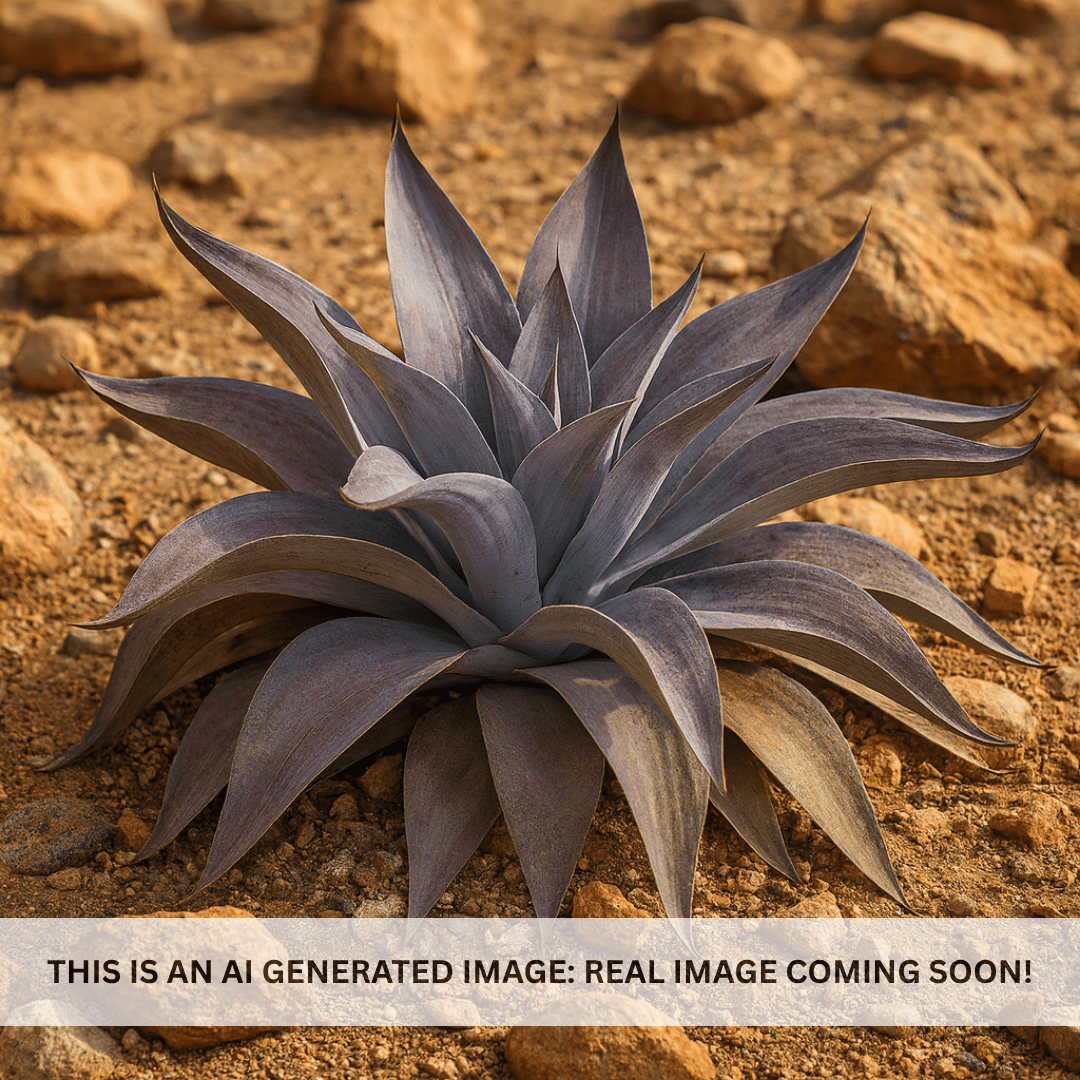

Mangave 'Aztec King'
Mangave 'Aztec King'
Couldn't load pickup availability
A Regal Agave Hybrid That Grows Fast & Never Dies After Blooming
Mangave 'Aztec King' is a majestic rosette-forming hybrid that commands attention in any Phoenix Valley landscape. This cross between Manfreda and Agave produces wide, thick leaves with a blue-green base covered in distinctive dark purple-brown spots and bumps, creating a regal, almost ancient-looking pattern. Aztec King grows significantly faster than pure agaves, reaching an impressive 2–3 feet wide within a couple of growing seasons. Best of all, unlike traditional agaves that die after blooming, Aztec King keeps growing year after year. Whether you're building a bold succulent garden in Scottsdale, anchoring a modern xeriscape in Chandler, or adding a showpiece to a Mesa patio — Mangave 'Aztec King' delivers royal presence with minimal care.
Mangave 'Aztec King' Plant Details
| Attribute | Detail |
|---|---|
| Scientific Name | × Mangave 'Aztec King' |
| Common Names | Aztec King Mangave |
| Mature Height | 1–2 feet |
| Mature Width | 2–3 feet |
| Growth Rate | Fast for a succulent — noticeably larger each growing season |
| Sun | Full sun (6+ hrs). More sun = deeper spotting and richer color. |
| Water | Low once established. Drought-tolerant. |
| USDA Zones | 8–11 (Phoenix is Zone 9b–10a) |
| Soil | Well-draining. Adapts to Arizona caliche soils with good drainage. |
| Foliage | Evergreen — blue-green with purple-brown spotted pattern |
| Key Advantage | Non-monocarpic — doesn't die after flowering like traditional agaves |
Mangave 'Aztec King' Uses in Phoenix Landscapes
Architectural Focal Point
Aztec King's broad, patterned rosette makes it a commanding centerpiece in desert landscapes. Plant as a standalone specimen in a boulder garden, courtyard planter, or entryway bed where its regal spotted pattern can be appreciated. The wide rosette form creates a bold silhouette against gravel and rock. Particularly stunning in Scottsdale and Paradise Valley modern desert designs where clean lines meet bold plant forms.
Mixed Succulent Gardens
Combine Aztec King with other mangave varieties like 'Desert Dragon' and 'Bad Hair Day' for a diverse mangave collection, or pair with contrasting succulents like Blue Elf Aloe, Silver Nickle Dyckia, and Flapjacks from Three Timbers. The spotted blue-green foliage provides a cool-toned anchor that complements both warm and cool-colored companion plants in Gilbert, Tempe, and Mesa gardens.
Containers & Poolside Plantings
Aztec King thrives in large containers, making it ideal for patios, pool decks, and outdoor living spaces throughout the Phoenix Valley. The compact but broad rosette fills a pot beautifully, and the spotted pattern creates year-round visual interest. No thorns or sharp terminal spines make it safer around high-traffic pool areas and walkways than traditional agaves.
Best Time to Plant Mangave 'Aztec King' in Phoenix
Fall (October–November) is the ideal planting window. Warm soil promotes rapid root establishment while cooler temperatures intensify the purple-brown spotting. Spring (February–April) is the second-best option. Mangaves are resilient at transplant time and handle spring planting well. Avoid peak summer transplanting if possible, though established plants handle summer heat without issue.
How to Plant Mangave 'Aztec King'
- Dig wide, not deep — hole should be 2–3x the root ball width, same depth as the container.
- Check for caliche — break through any hardpan for drainage. Mangaves tolerate slightly more moisture than agaves but still need well-drained soil.
- Backfill with native soil — a 20% pumice mix improves drainage in heavy clay.
- Spacing — 3 feet apart for borders; 4 feet for individual specimens to allow full rosette spread.
- Water basin — build a 3-inch ring to direct water to the root zone.
- Mulch — 2–3 inches of gravel or decomposed granite. Avoid bark mulch.
Watering Mangave 'Aztec King' in Phoenix
First Year Watering Schedule
- Weeks 1–2: Every 3–4 days, deep watering
- Month 1–2: Every 5–7 days
- Month 3–6: Every 10–14 days
- After Year 1: Every 2–3 weeks in summer; monthly in winter
Drip Irrigation
Place one 1-GPH emitter 8–10 inches from the plant base. Mangaves handle slightly more water than pure agaves, contributing to their faster growth rate. However, allow soil to dry between waterings to prevent root rot and maintain the best leaf coloring.
How big does Aztec King get?
Aztec King reaches 1–2 feet tall and 2–3 feet wide at maturity, making it one of the larger mangave varieties. In the ground in Phoenix with good care, expect it to reach near-full size within 2–3 growing seasons — much faster than a comparable agave.
What's the difference between Aztec King and Desert Dragon?
Aztec King is larger overall with wider, flatter leaves and a more open rosette form. Desert Dragon is more compact with narrower, more upright leaves and darker overall coloring. Both feature spotted patterns but Aztec King has a broader, more regal appearance while Desert Dragon looks more fierce and compact. Three Timbers carries both.
Does Aztec King die after flowering?
No. Like all mangaves, Aztec King is non-monocarpic — it continues growing after blooming. This is a major advantage over traditional agaves, which die after their single flowering event.
Can Aztec King handle full Phoenix summer sun?
Absolutely. Full sun brings out the deepest spotted coloring and most compact growth. It handles 115°F+ temperatures and reflected heat without issue once established.
You May Also Like
- Mangave 'Desert Dragon' — Darker, more compact mangave with fierce spotted foliage.
- Mangave 'Bad Hair Day' — Wildly textured mangave with curling, twisted leaves.
- Dragon Toes Agave — Compact agave with bold architectural form.
- Blue Elf Aloe — Cool blue-green aloe that pairs beautifully with mangave's warm-spotted tones.
- Flapjacks — Colorful paddle succulent that complements mangave rosettes in mixed beds.
How Many Mangave 'Aztec King' Do I Need?
This is a broad, fast-growing specimen rosette (mature 2 to 3 ft wide), planted for form and pattern rather than coverage. Use one as a focal point, or repeat in odd-numbered groups of 3 to 5 so each spotted rosette stands clear.
| Planting Goal | Spacing | Plants |
|---|---|---|
| Single container or focal specimen | Standalone | 1 |
| Mixed-succulent accent cluster | 3 ft apart | 3 |
| Border or bed grouping | 3 to 4 ft apart | 5 |
With no sharp terminal spine, Aztec King is one of the few rosette plants you can site comfortably right beside walkways and pool decks.
Mangave 'Aztec King' Season-by-Season in Phoenix
- Spring (Feb to Apr): Strong second planting window. Fast new growth resumes and the purple-brown spotting sharpens with rising light.
- Summer (May to Sep): Loves full sun and reflected heat, holding color and compact form even past 115°F. Allow soil to dry between waterings and ease off during humid monsoon spells to protect the crown.
- Fall (Oct to Nov): Prime planting season. Cooler nights deepen the spotting while warm soil settles the roots.
- Winter (Dec to Jan): Evergreen and non-monocarpic, so it keeps its rosette year-round. Cold-hardy to roughly 20°F, comfortably through normal Valley frost; cover only in a rare hard freeze.
At a Glance
✔ Heat-Loving (Reflected-Heat Tolerant) ✔ Drought-Tolerant ✔ Evergreen ✔ Low-Maintenance ✔ Spineless ✔ Pool-Friendly (Low-Litter) ✔ Deer & Rabbit-Resistant ✔ Cold-Hardy to 20°F
Plant It With
- Mangave 'Desert Dragon': A darker, more compact mangave that builds a coordinated spotted collection.
- Mangave 'Bad Hair Day': Wild curling leaves add texture contrast next to the broad Aztec King rosette.
- Dragon Toes Agave: A compact architectural agave that anchors the bed with bolder structure.
- Desert Spoon: Soft blue-gray fountain texture that frames the spotted rosettes.
Is Mangave 'Aztec King' Right for Your Yard?
Choose Aztec King for a full-sun bed, courtyard, or large container with good drainage, where its fast, spineless, spotted rosette gives agave drama without the hazard or the die-after-bloom downside. It is safe near pools, paths, and patios and keeps growing after it flowers. It is not a fit for deep shade (the spotting fades and the form loosens) or for soil that stays wet, since constant moisture invites crown rot.
Customer Reviews
Share