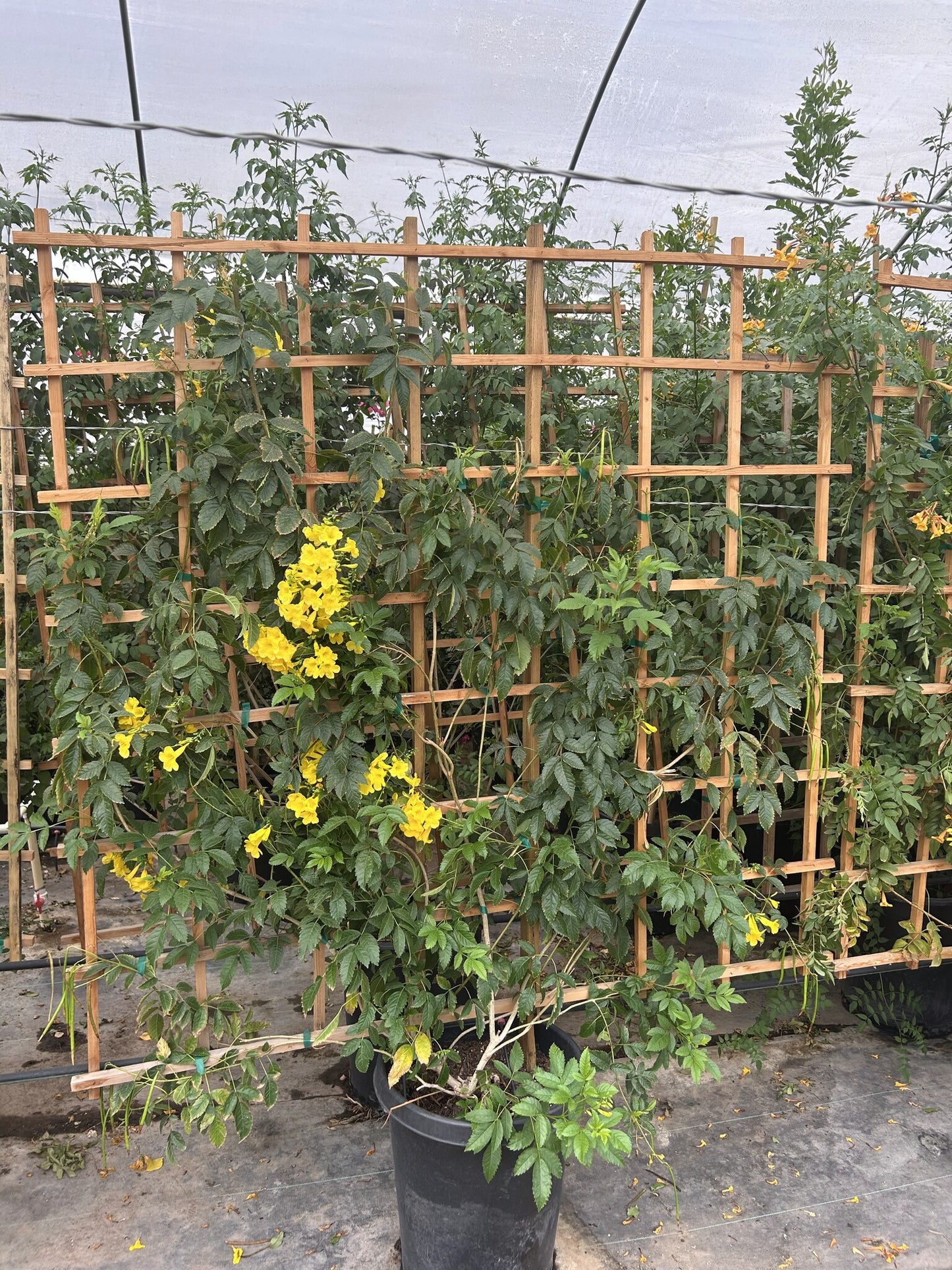


Yellow Bells Staked
Yellow Bells Staked
Couldn't load pickup availability
The Brightest Yellow Flowering Tree for Phoenix Yards
Yellow Bells Staked (Tecoma stans) is the go-to choice when you want non-stop, traffic-stopping yellow color in your Phoenix landscape. This staked form grows as a small upright tree rather than a sprawling shrub, delivering those signature bright yellow trumpet-shaped flowers from spring through fall on a clean, single-trunk structure. Fast-growing, extremely heat-tolerant, and drought-resistant once established, staked Yellow Bells is perfect for tight spaces, entryways, and anywhere you want vertical flower power without the spread. Whether you're lighting up a Scottsdale courtyard, framing a Gilbert front door, or adding color to a Mesa patio — Yellow Bells Staked delivers months of blooms.
Yellow Bells Staked Plant Details
| Attribute | Detail |
|---|---|
| Scientific Name | Tecoma stans |
| Common Names | Yellow Bells, Esperanza, Yellow Elder, Trumpetbush |
| Mature Height | 10–15 feet (staked form) |
| Mature Width | 6–8 feet |
| Growth Rate | Fast — 2–3 feet per year in Phoenix |
| Sun | Full sun (6+ hrs). Thrives in reflected heat from walls and pavement. |
| Water | Low to moderate once established. Drought-tolerant. |
| USDA Zones | 8–11 (Phoenix is Zone 9b–10a) |
| Soil | Well-draining. Adapts to Arizona caliche soils. |
| Foliage | Semi-evergreen — may drop leaves briefly in cold winters |
| Bloom Color | Bright yellow trumpet flowers, spring through fall |
| Wildlife | Attracts hummingbirds, butterflies, and bees |
Yellow Bells Staked Uses in Phoenix Landscapes
Entryway & Courtyard Accent Tree
The staked form's upright, single-trunk structure makes it ideal for flanking entryways, lining walkways, and adding height to small courtyards. Plant one on each side of a front door for a symmetrical, color-packed welcome. The compact canopy won't overwhelm tight spaces in Tempe, Chandler, or Peoria properties.
Patio & Pool-Friendly Color
Yellow Bells produces minimal litter and its root system is non-invasive, making it an excellent choice near pools, patios, and outdoor living areas. The bright yellow blooms reflect beautifully off pool water and add warm color to shaded ramadas and pergola edges.
Street & Driveway Lining
Plant staked Yellow Bells 8–10 feet apart along a driveway or property line for a stunning flowering border. The upright form stays neat without constant pruning, and the heat tolerance means it thrives in the hottest microclimate spots — parking strips, medians, and south-facing walls.
Best Time to Plant Yellow Bells Staked in Phoenix
Fall (October–November) is ideal. The soil is still warm for rapid root establishment, while cooler air reduces transplant stress. Your plant gets 6–8 months of root growth before its first Phoenix summer. Spring (February–April) is the second-best window. Avoid planting in peak summer if possible.
How to Plant Yellow Bells Staked
- Dig wide, not deep — 2–3× the root ball width, same depth.
- Check for caliche — break through any hardpan layer to ensure drainage.
- Backfill with native soil — a light 20% organic blend is fine.
- Spacing — 8–10 feet apart for a row of trees; can be planted as close as 6 feet for a denser screen.
- Water basin — build a 3–4 inch ring to direct water to the root zone.
- Mulch — 2–3 inches of gravel or bark mulch to retain moisture and moderate soil temperature.
Watering Yellow Bells Staked in Phoenix
First Year Watering Schedule
- Weeks 1–2: Every 1–2 days, deep and slow (20–30 min)
- Month 1–2: Every 3–4 days
- Month 3–6: Every 7–10 days (5–7 days in peak summer)
- After Year 1: Every 10–14 days in summer; every 3–4 weeks in winter
Drip Irrigation
Place 2 GPH emitters 18–24 inches from the trunk. Use 2–3 emitters per plant. Once established, Yellow Bells is remarkably drought-tolerant — it blooms even harder when water-stressed, making it one of the most forgiving flowering trees for forgetful gardeners.
How fast does Yellow Bells Staked grow in Phoenix?
Very fast — expect 2–3 feet of new growth per year in the Phoenix Valley. It can reach 10–15 feet within just a few seasons with regular watering during the first year.
What's the difference between Yellow Bells bush and staked?
The bush form grows as a multi-stem shrub that spreads wide. The staked form is trained to a single trunk, creating a small tree shape that's more upright and compact — ideal for tight spaces and formal designs.
Does Yellow Bells survive Phoenix summer heat?
Absolutely. It's one of the most heat-tolerant flowering plants you can grow in the desert. It handles full sun, reflected heat, and temperatures well above 110°F — and actually blooms most prolifically in the hottest months.
Is Yellow Bells evergreen in Phoenix?
Semi-evergreen. It keeps its leaves through most Phoenix winters but may drop foliage briefly during hard freezes. New growth returns quickly in spring.
You May Also Like
- Yellow Bulbine — Low-growing succulent groundcover with cheerful yellow flower spikes, perfect at the base of Yellow Bells.
- Texas Sage — Silvery-leafed desert shrub with purple blooms that pairs beautifully with Yellow Bells' warm tones.
- Desert Willow — Another fast-growing desert-adapted flowering tree with orchid-like blooms.
- Ruellia — Purple-flowering groundcover that creates stunning color contrast beneath Yellow Bells.
How Many Yellow Bells Staked Do I Need?
Staked Yellow Bells works as a single accent tree or planted in a row to line a driveway, wall, or property edge. At a 6 to 8 foot mature width, space trees about 8 feet apart for a flowering row (drop to 6 feet for a denser screen). For a symmetrical entry, plant one matched tree on each side of the door or gate.
| Row Length | Trees Needed (8 ft spacing) |
|---|---|
| 16 ft | 3 |
| 24 ft | 4 |
| 40 ft | 6 |
| 80 ft | 11 |
Yellow Bells Staked Season-by-Season in Phoenix
- Spring (Feb to Apr): New growth flushes fast and the first wave of bright yellow trumpets opens. A great second planting window once nights warm.
- Summer (May to Sep): Peak bloom season. The staked form thrives in full sun and reflected heat above 110°F, and monsoon rains drive even heavier flowering. One of the most heat-proof flowering trees you can plant.
- Fall (Oct to Nov): Prime planting season and continued blooming until the first real cold snap. Roots establish in still-warm soil.
- Winter (Dec to Jan): Semi-evergreen. It holds most leaves through mild Valley winters but can freeze back and drop foliage below about 28°F. Cover young trees on hard-frost nights; established trees flush back quickly in spring.
At a Glance
✔ Arizona Native ✔ Pollinator-Friendly ✔ Hummingbird-Friendly ✔ Heat-Loving (Reflected-Heat Tolerant) ✔ Drought-Tolerant ✔ Pool-Friendly (Low-Litter) ✔ Low-Maintenance
Plant It With
- Yellow Bells (Bush): the shrub form of the same plant, for mixing single-trunk accents with mounding mass color.
- Orange Jubilee: a taller orange-flowering Tecoma that extends the warm color palette behind the staked trees.
- Texas Sage: silvery foliage and purple blooms that contrast beautifully with the yellow trumpets.
- Desert Ruellia: a low purple-flowering filler that carpets the ground beneath the trunks.
Is Yellow Bells Staked Right for Your Yard?
Plant it in full sun with reflected heat and well-draining soil, breaking through any caliche layer at planting. The single-trunk form is ideal for tight entries, courtyards, and driveway rows where you want height and color without the spread of the bush form. It is not the best fit for a frost pocket left uncovered, since it can freeze back below about 28°F, or for deep shade where bloom drops off sharply.
Customer Reviews
Share