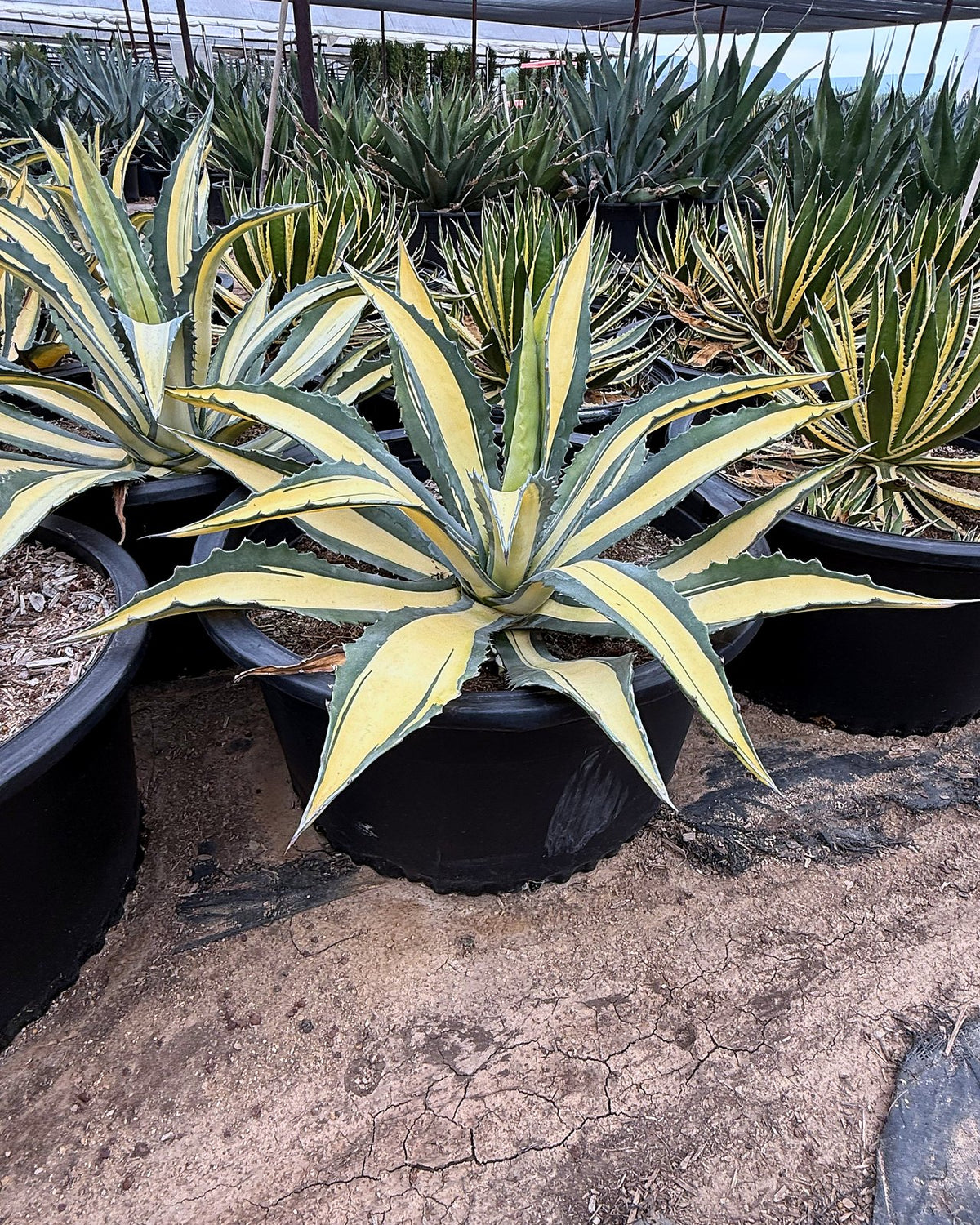


Yellow striped century plant
Yellow striped century plant
Couldn't load pickup availability
The Showstopper Variegated Agave for Phoenix Landscapes
Yellow Striped Century Plant (Agave americana 'Mediopicta Aurea') is one of the most striking variegated agaves available for Phoenix Valley landscapes. Each thick, blue-green leaf features a bold, creamy-yellow center stripe that glows in sunlight — creating a living sculpture that demands attention year-round. This heat-loving, drought-tolerant agave combines the toughness of a classic Century Plant with the visual impact of a collector's specimen. Whether you're designing a modern xeriscape in Scottsdale, creating a dramatic entry in Chandler, or adding color to a desert garden in Mesa — the Yellow Striped Century Plant delivers unforgettable curb appeal.
Yellow Striped Century Plant Details
| Attribute | Detail |
|---|---|
| Scientific Name | Agave americana 'Mediopicta Aurea' |
| Common Names | Yellow Striped Century Plant, Mediopicta Aurea Agave, Gold Centered Agave |
| Mature Height | 3–4 feet |
| Mature Width | 4–6 feet |
| Growth Rate | Moderate — fills out over 3–5 years in Phoenix |
| Sun | Full sun to partial shade. Handles reflected heat; partial shade preserves brightest color. |
| Water | Low once established. Highly drought-tolerant. |
| USDA Zones | 8–11 (Phoenix is Zone 9b–10a) |
| Soil | Well-draining. Adapts to Arizona caliche soils with proper drainage. |
| Foliage | Evergreen — blue-green with bold yellow center stripe year-round |
| Flower Color | Yellow on a tall stalk (15–25 ft) at maturity |
| Variegation | Central yellow stripe (mediopicta) — brightest in moderate sun |
Yellow Striped Century Plant Uses in Phoenix Landscapes
Sculptural Focal Point & Specimen Planting
The Yellow Striped Century Plant's vivid variegation makes it the ideal focal point for modern desert landscapes. A single specimen in a gravel bed, decorative container, or near a front entry creates instant visual impact. Its bold yellow stripe catches light beautifully against dark gravel, warm-toned walls, and the greens of neighboring plants like Texas Sage or Desert Spoon from Three Timbers.
Color Accent in Desert Gardens
Where most desert plants offer shades of green and gray, the Yellow Striped Century Plant adds a warm, golden accent that energizes any planting. Group it with blue-gray agaves like Artichoke Agave or green varieties like Octopus Agave for a stunning color contrast. Space plants 5–6 feet apart to showcase each rosette individually.
Pool-Friendly & Low-Maintenance Borders
This agave's clean rosette form and year-round color make it an excellent choice around pool areas and patios in Gilbert, Tempe, and Peoria. It drops minimal debris, requires almost no maintenance once established, and its dramatic variegation adds resort-style appeal to any outdoor living space.
Best Time to Plant Yellow Striped Century Plant in Phoenix
Fall (October–November) is ideal: soil is still warm for root establishment, cooler air reduces transplant stress, and the plant gets 6–8 months of root growth before its first Phoenix summer. Spring (February–April) is the second-best window. Avoid planting in peak summer — variegated agaves can sunburn more easily when transplanted into direct afternoon sun.
How to Plant Yellow Striped Century Plant
- Dig wide, not deep — hole should be 2–3x the root ball width and the same depth.
- Check for caliche — break through any hardpan layer to ensure drainage. This agave will rot in standing water.
- Backfill with native soil — a light 20% pumice or gravel mix improves drainage in heavy clay.
- Spacing — 5–6 ft apart for groupings; allow 4–5 ft from walkways (spiny leaf tips).
- Water basin — build a 3–4 inch ring to direct water to roots during establishment.
- Mulch — 2–3 inches of decomposed granite or gravel (avoid bark mulch against the crown).
Watering Yellow Striped Century Plant in Phoenix
First Year Watering Schedule
- Weeks 1–2: Every 3–4 days, deep and slow
- Month 1–3: Every 7–10 days
- Month 3–6: Every 10–14 days (weekly in peak summer)
- After Year 1: Every 2–3 weeks in summer; monthly or less in winter
Drip Irrigation
Place one 1–2 GPH emitter 12–18 inches from the base. Established plants need very little supplemental water. Overwatering causes root rot — when in doubt, let the soil dry completely between waterings.
How fast does the Yellow Striped Century Plant grow?
It's a moderate grower in Phoenix. Expect it to reach its full 3–4 foot height and 4–6 foot spread over 3–5 years. The variegation becomes more pronounced and striking as the rosette matures.
Is the Yellow Striped Century Plant drought tolerant?
Extremely. Once established (after about one year), it thrives on rainfall alone in most Phoenix Valley locations. Its thick leaves store water efficiently, making it one of the most low-maintenance ornamental agaves available.
Does it need shade to keep its color?
The yellow stripe stays vivid in full sun but can be even brighter with some afternoon shade. In the hottest Phoenix locations (reflected heat off west-facing walls), a bit of afternoon shade helps prevent sunburn on newly planted specimens.
What's the difference between Yellow Striped and White Striped Century Plant?
Both are variegated forms of Agave americana. The Yellow Striped (Mediopicta Aurea) has a warm, golden-yellow center stripe, while the White Striped (Mediopicta Alba) has a cool, creamy-white stripe. Both are equally tough — choose based on your color palette preference.
You May Also Like
- White Striped Century Plant — The cool-toned sibling with a creamy-white center stripe for a different variegated look.
- Variegated Century Plant — Features yellow margins instead of a center stripe for a different variegation pattern.
- Artichoke Agave — A compact, blue-gray rosette that contrasts beautifully with the Yellow Striped's warm tones.
- Octopus Agave — A flowing, spineless agave that pairs well in mixed agave plantings.
How Many Yellow Striped Century Plant Do I Need?
At 3 to 4 ft tall and 4 to 6 ft wide, this is a bold specimen agave. Use it as a single golden showpiece, or in odd-numbered groups with each rosette given room so the center stripe shows. Space by mature width using the guide below.
| Planting Use | Spacing | Plants Needed |
|---|---|---|
| Solo focal point or planter | Single plant, 5 ft clear | 1 |
| Specimen group | 5 to 6 ft on center | 3 to 5 grouped |
| Xeriscape or border run (24 ft) | 5 to 6 ft on center | 4 to 5 |
Yellow Striped Century Plant Season-by-Season in Phoenix
- Spring (Feb to Apr): Steady new-growth flush as soil warms, with the gold stripe at its brightest. Strong second window to plant and establish before summer.
- Summer (May to Sep): Established plants take full sun and reflected heat, though the pale center stripe sunburns more easily than solid-green leaves: give newly planted specimens light afternoon shade off west walls the first summer. Keep monsoon-season water light in fast-draining soil.
- Fall (Oct to Nov): Prime planting season. Warm soil and cooling air give 6 to 8 months of root growth before next summer.
- Winter (Dec to Jan): Holds its glowing evergreen form. As an Agave americana selection it is hardy to about 15°F, so it shrugs off normal Valley frost with little to no protection.
At a Glance
✔ Heat-Loving (Reflected-Heat Tolerant) ✔ Drought-Tolerant ✔ Evergreen ✔ Low-Maintenance ✔ Deer & Rabbit-Resistant ✔ Cold-Hardy to 15°F
Plant It With
- White Striped Century Plant: the cool-toned sibling for a coordinated variegated grouping.
- Variegated Century Plant: margin-striped americana for a different variegation pattern at larger scale.
- Artichoke Agave: solid blue-gray globe rosette that sets off the gold stripe.
- Octopus Agave: soft spineless arching agave for form contrast in a mixed bed.
Is Yellow Striped Century Plant Right for Your Yard?
It thrives in full sun to light afternoon shade, in caliche soil broken open and amended for drainage, and its americana toughness plus glowing gold stripe make it an easy, high-impact showpiece across the Valley. It is not a fit right against a busy walkway or pool, since the leaves carry a sharp terminal spine: set it back 4 to 5 ft from high-traffic edges.
Customer Reviews
Share