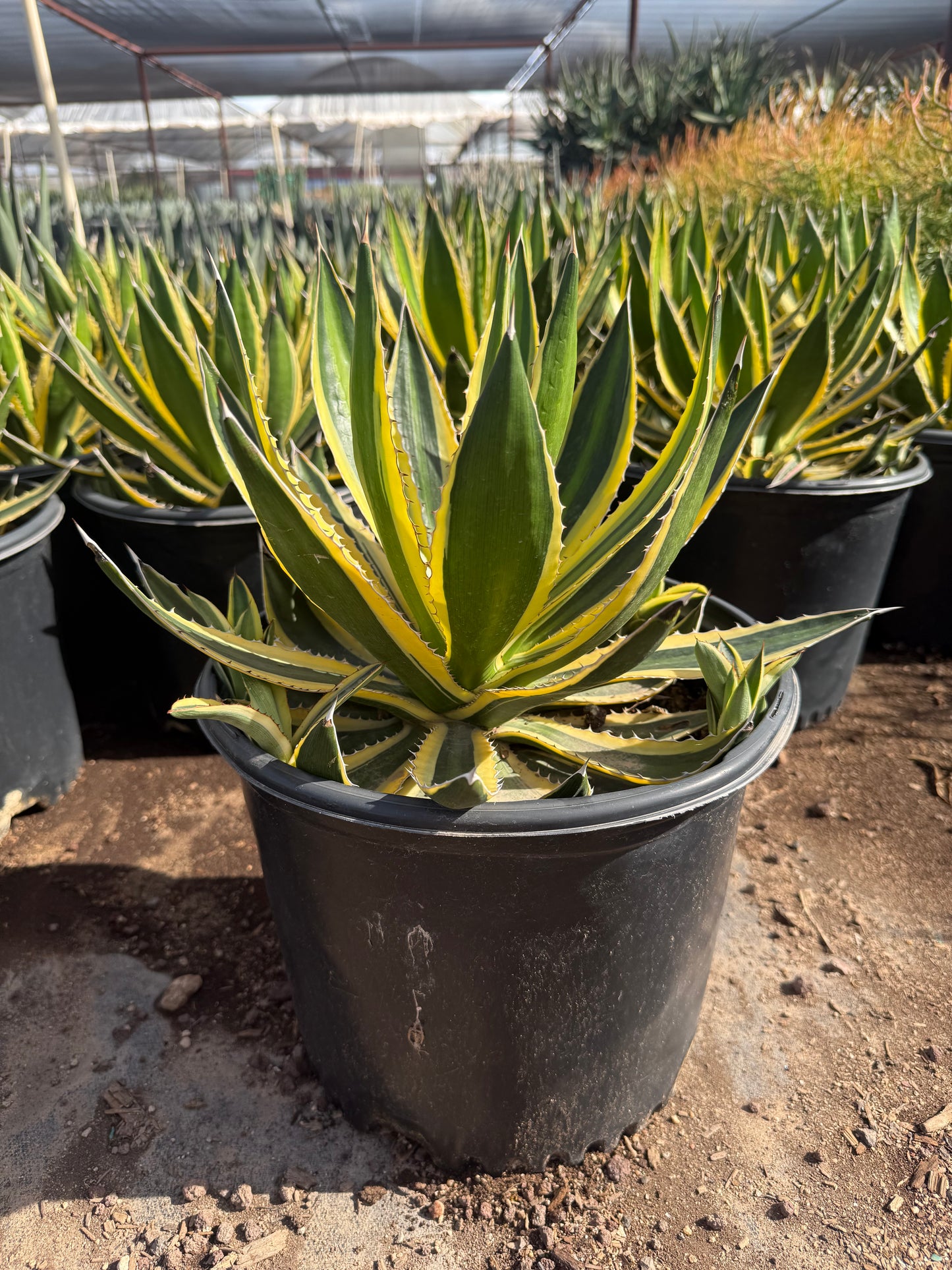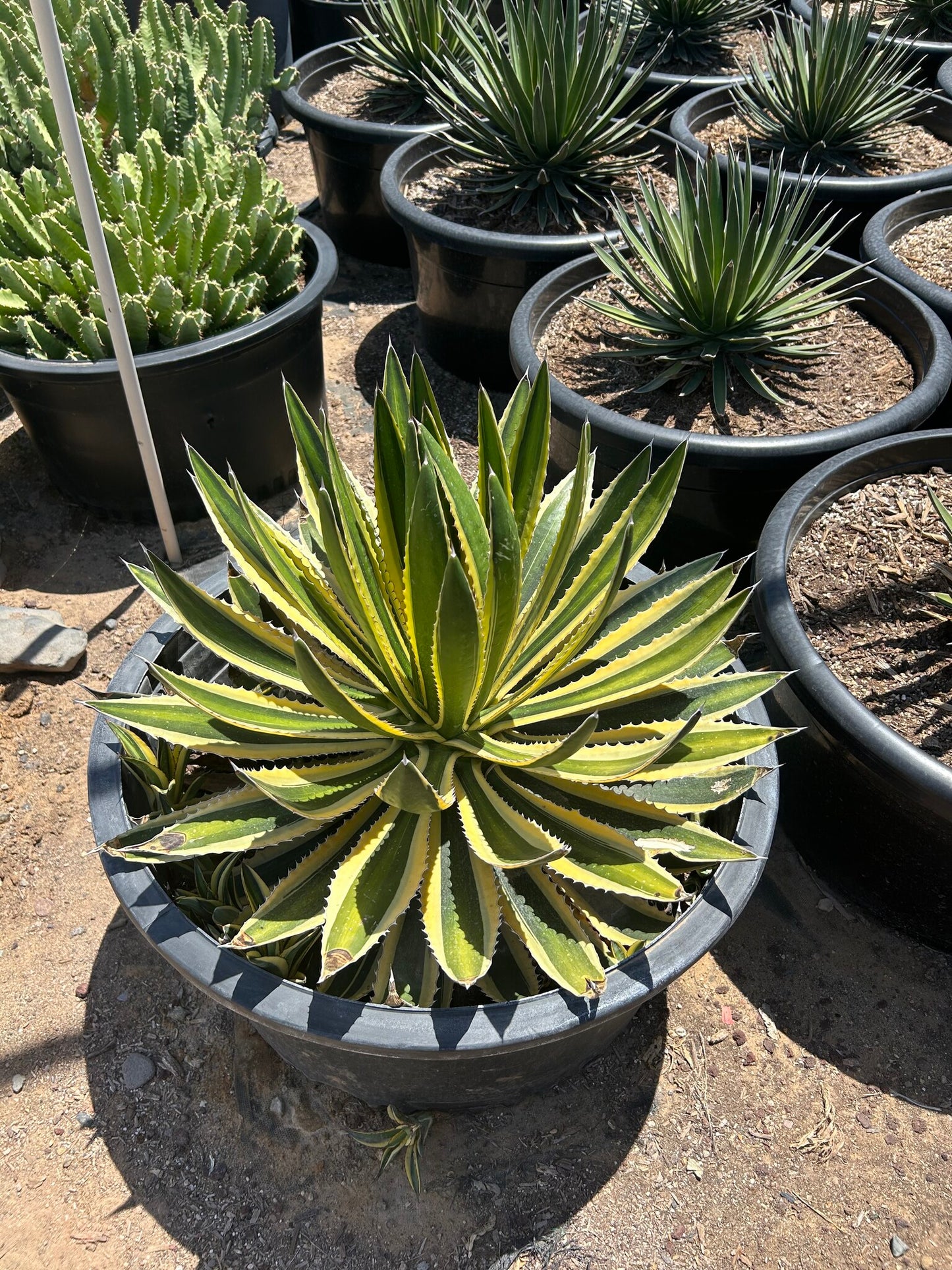


Variegated Lophantha
Variegated Lophantha
Couldn't load pickup availability
Variegated Lophantha: Bold Green-and-Gold Striped Agave for Phoenix Landscapes
Variegated Lophantha (Agave lophantha 'Variegated') is a compact, colorful agave that brings vivid green-and-gold striping to Phoenix Valley landscapes. Its glossy green leaves are lined with bright golden-yellow margins, creating one of the most striking natural color combinations available in any desert-adapted plant. Growing 2–3 feet tall and 3–4 feet wide, it's a versatile performer that handles full sun to partial shade and thrives on minimal water once established — making it ideal for Scottsdale, Chandler, Mesa, and Gilbert homeowners seeking bold color with no irrigation dependency.
Variegated Lophantha Plant Details
| Attribute | Detail |
|---|---|
| Scientific Name | Agave lophantha 'Variegated' |
| Common Names | Variegated Lophantha, Quadricolor Agave, Variegated Thorncrest Agave |
| Mature Height | 2–3 feet |
| Mature Width | 3–4 feet |
| Growth Rate | Moderate — 4–8 inches per year in Phoenix |
| Sun | Full sun to partial shade. Tolerates reflected heat from walls and pavers. |
| Water | Low once established. Highly drought-tolerant. |
| USDA Zones | 7b–11 (Phoenix is Zone 9b–10a) |
| Soil | Well-draining. Adapts to Arizona caliche soils; break through hardpan at planting. |
| Foliage | Evergreen — vivid green-and-gold striped leaves year-round |
| Leaf Margins | Fine teeth on leaf margins with a terminal spine; moderate hazard |
| Flower Color | Yellow-green bloom spike; monocarpic (blooms once at maturity) |
Variegated Lophantha Uses in Phoenix Landscapes
Color Accent in Desert Gardens
Variegated Lophantha's golden-striped leaves make it one of the most eye-catching color accents available for Phoenix desert gardens. Unlike flowering plants that bloom briefly, this agave delivers vivid green-and-gold color all year long without any supplemental care. Use it as a solo specimen in a decomposed granite bed, or group three together in a triangular arrangement for a bold, colorful mass planting. It pairs beautifully with Blue Glow Agave and Ruellia for a multi-toned desert palette.
Mixed Succulent Border
At 2–3 feet tall, Variegated Lophantha works as a mid-border anchor or front-of-border accent in mixed desert plantings. Combine it with Desert Spoon, Penstemon, and Mexican Feather Grass for a layered planting that delivers texture, movement, and color contrast. Spacing: 3–4 feet apart for borders; 4–5 feet for individual specimens allowing full spread. It's particularly effective in Mesa, Gilbert, and Chandler landscapes where its gold-striped coloring stands out against sandstone and block walls.
Container Planting
Variegated Lophantha is an excellent container plant for patios, entryways, and covered outdoor living areas. Its compact size and vivid coloring make it a natural focal point in large decorative pots. Use a well-draining cactus mix, ensure good drainage, and water less frequently than in-ground plantings. Rotate the container periodically to ensure even sun exposure for consistent variegation color.
Part-Shade Garden
Unlike many agaves that require full sun, Variegated Lophantha tolerates and even benefits from afternoon shade during Phoenix's hottest months. Use it in east-facing beds, shaded courtyards, or under the filtered canopy of a Palo Verde or Mesquite for a beautiful low-water planting in spots where other succulents struggle. The golden variegation remains vivid even in partial shade conditions.
Best Time to Plant Variegated Lophantha in Phoenix
Fall planting (October through November) is ideal — warm soil encourages root establishment while cooler air reduces transplant stress, giving the plant a full 6–8 months of root growth before its first Phoenix summer. Spring planting (February through April) is equally effective. Avoid planting in June through August when heat stress can overwhelm newly transplanted agaves.
How to Plant Variegated Lophantha
- Dig wide, not deep — excavate 2–3 times the root ball width at the same depth as the root ball.
- Check for caliche — break through any hardpan layer to ensure drainage; standing water causes crown rot.
- Backfill with native soil — a 20% organic amendment blend is fine; avoid heavy compost around the crown.
- Spacing — 3–4 feet apart for borders; 4–5 feet for individual specimens.
- Water basin — build a 3–4 inch berm around the root zone to concentrate irrigation water at the roots.
- Mulch — 2–3 inches of decomposed granite or gravel to retain moisture and regulate soil temperature.
Watering Variegated Lophantha in Phoenix
First Year Watering Schedule
- Weeks 1–2: Every 1–2 days, deep and slow (20–30 minutes)
- Months 1–2: Every 3–4 days
- Months 3–6: Every 7–10 days (every 5–7 days during peak summer)
- After Year 1: Every 10–14 days in summer; every 3–4 weeks in winter
Drip Irrigation
Place a 1 GPH drip emitter 12–18 inches from the plant base. Once established, Variegated Lophantha requires only supplemental summer irrigation during extended dry spells. Overwatering is the most common cause of failure — always let soil dry between deep waterings.
How fast does Variegated Lophantha grow in Phoenix?
Variegated Lophantha is a moderate grower, adding 4–8 inches per year in Phoenix's warm climate. Expect it to reach full size in 4–6 years from a 5-gallon start.
Does Variegated Lophantha have sharp spines?
The leaf margins have fine teeth and a sharp terminal spine. It's less hazardous than many agaves but should be planted away from high-traffic walkways, play areas, and pool coping where accidental contact is likely.
Will Variegated Lophantha hold its gold color in shade?
Yes — the golden variegation remains vivid in partial shade. In fact, very intense afternoon sun can sometimes bleach or stress the lighter leaf margins. East-facing exposures or filtered shade during Phoenix's hottest months (June through September) will maintain the best color.
Is Variegated Lophantha deer resistant?
Yes — like most agaves, it is highly deer resistant due to its firm, spined leaves. Excellent for properties bordering desert preserves in Scottsdale, Cave Creek, and north Phoenix.
Will Variegated Lophantha produce pups?
Yes — Agave lophantha is known for producing offsets (pups) around the base. Remove and replant them once they develop their own root system to propagate additional plants at no cost.
You May Also Like
Variegated Blue Glow Agave — A luminous compact agave with creamy-white leaf margins and the refined form of Blue Glow; perfect companion for Variegated Lophantha.
Blue Glow Agave — A sleek, symmetrical compact agave with a glowing red-and-yellow leaf margin; outstanding color contrast partner to Variegated Lophantha.
Variegated Squid Agave — A spineless, flowing agave with creamy variegation; the safest variegated agave for high-traffic areas.
Jet Tip Agave — A compact agave with dramatic jet-black spine tips for striking contrast in modern desert garden designs.
Parry's Agave — A bold silver-blue rosette with a symmetrical powdery form; excellent structural pairing with Variegated Lophantha's warm gold tones.
How Many Variegated Lophantha Do I Need?
This is a compact specimen agave (mature 3 to 4 feet wide), used as a color accent, in small groups, or as a mid-border anchor rather than a hedge. It has fine marginal teeth and a terminal spine, so keep it back from walkways and pool decks. Space on 3 to 4 foot centers.
| Planting Goal | Spacing | Plants Needed |
|---|---|---|
| Single container or focal accent | n/a | 1 |
| Triangular color cluster | 3 to 4 ft apart | 3 to 5 (odd numbers) |
| 12 ft mid-border run | 3 ft apart | 4 to 5 |
Variegated Lophantha Season-by-Season in Phoenix
- Spring (Feb to Apr): Active growth and the brightest gold striping of the year. Prime second planting window before the heat.
- Summer (May to Sep): Tolerates full sun and reflected heat, but intense raw afternoon sun can bleach the lighter margins. Filtered or afternoon shade keeps the gold vivid. Let soil dry between waterings through monsoon humidity to prevent rot.
- Fall (Oct to Nov): Best planting season. Warm soil and mild air give roots an easy start.
- Winter (Dec to Jan): Evergreen and one of the more cold-tolerant variegated agaves, hardy into the teens. It shrugs off normal Valley winters, though hard radiational frosts can lightly tip-burn the variegated margins.
At a Glance
✔ Heat-Loving (Reflected-Heat Tolerant) ✔ Drought-Tolerant ✔ Evergreen ✔ Low-Maintenance ✔ Deer & Rabbit-Resistant ✔ Cold-Hardy to 15°F
Plant It With
- Variegated Blue Glow Agave: cream-margined compact rosette that complements the gold striping.
- Blue Glow Agave: red-and-yellow margins for bold color contrast.
- Variegated Squid Agave: spineless flowing form for a softer companion texture.
- Parry's Agave: silver-blue rosette that grounds the warm gold tones.
Is Variegated Lophantha Right for Your Yard?
It thrives in full sun to filtered afternoon shade, in fast-draining or amended caliche soil, with low water once established, and it is hardy enough to take normal Valley winters in stride. Ideal as a year-round color accent in beds, borders, and containers. Not the best fit right against high-traffic walkways or pool coping, since the fine teeth and terminal spine can catch passers-by, and not for spots that stay wet or poorly drained.
Customer Reviews
Share