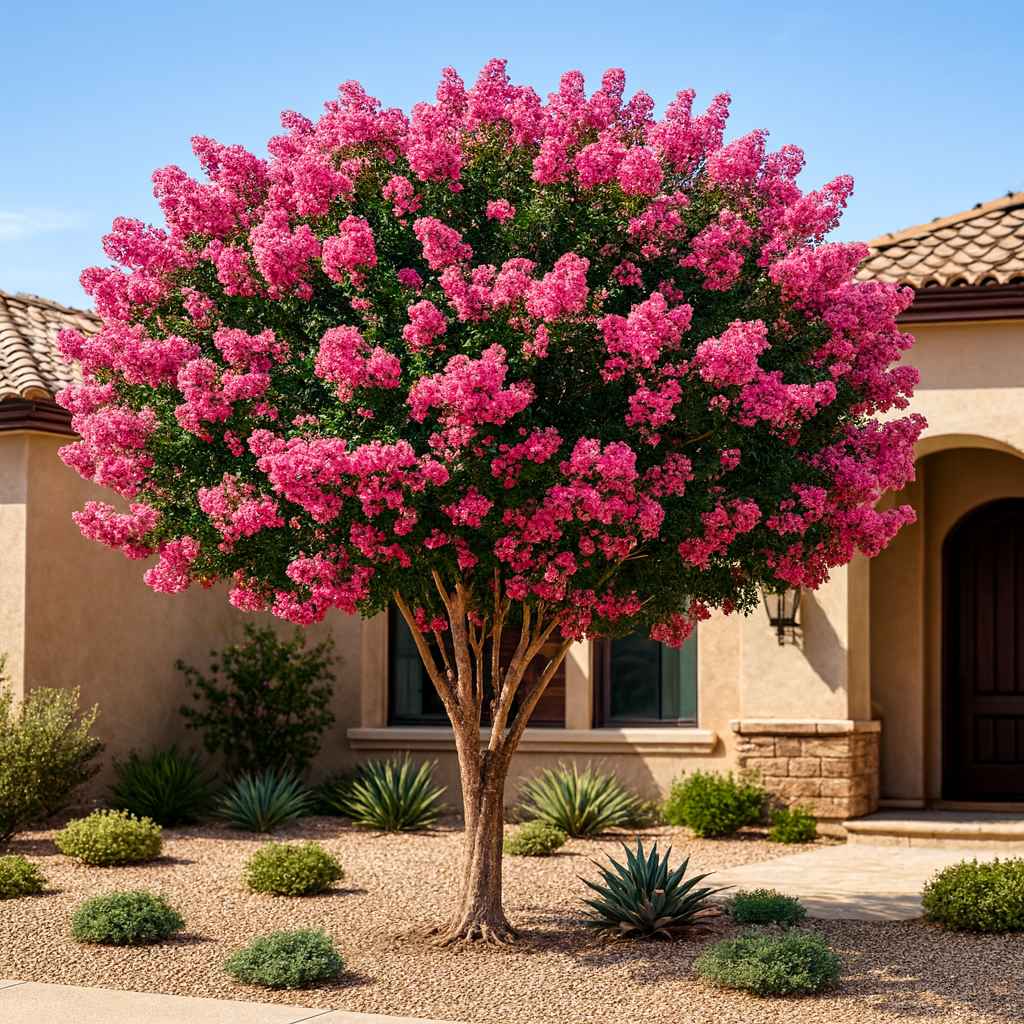


Pink Crape Myrtle
Pink Crape Myrtle
Couldn't load pickup availability
Phoenix's Most Vibrant Summer Flowering Patio Tree — Pink Crape Myrtle
Pink Crape Myrtle (Lagerstroemia indica) is Phoenix's most spectacular summer-blooming patio tree. This deciduous tree erupts in stunning pink blooms from June through September, bringing color to the desert landscape when most trees simply survive. With moderate water needs and remarkable heat tolerance, it thrives in the most challenging Phoenix conditions. Whether you're creating a colorful focal point in Scottsdale, adding shade and beauty to a Gilbert patio, or lining a driveway in Chandler — Pink Crape Myrtle delivers season after season.
Pink Crape Myrtle Plant Details
| Attribute | Detail |
|---|---|
| Scientific Name | Lagerstroemia indica |
| Common Names | Pink Crape Myrtle, Crape Myrtle, Crepe Myrtle |
| Mature Height | 10–25 feet |
| Mature Width | 8–15 feet |
| Growth Rate | Moderate to fast, about 1–2 feet per year in Phoenix |
| Sun | Full sun (6+ hrs) with good air circulation. Avoid hot reflected-heat spots against west walls and pavement. |
| Water | Moderate. Tolerates short dry spells once established, but blooms best with regular deep summer watering. |
| USDA Zones | 7–10 (Phoenix is Zone 9b–10a) |
| Soil | Well-draining. Adapts to Arizona caliche soils. |
| Foliage | Deciduous — drops leaves in winter; brilliant fall color |
| Bloom Color | Vibrant pink, summer through early fall |
| Bloom Season | June–September (peak summer bloom) |
Pink Crape Myrtle Uses in Phoenix Landscapes
Summer Color Focal Point
When Phoenix summer heat silences most landscapes, Pink Crape Myrtle takes center stage. Its bold pink flower clusters appear in June and last through September, creating a vivid focal point during the desert's hottest months. Plant it where it can be seen from patios, pools, or street view in Mesa, Tempe, or Peoria for maximum visual impact.
Shade Patio Tree
With a mature canopy spread of 8–15 feet, Pink Crape Myrtle provides meaningful shade over patios and outdoor living spaces. Its multi-trunk form creates an airy canopy that filters afternoon sun without blocking cooling breezes, ideal for shading patios in Scottsdale and Chandler as long as the tree itself sits away from hot west walls. Pair it with Desert Spoon or Texas Sage underneath for a layered desert garden look.
Driveway and Entry Accent
Crape Myrtles are classic statement trees for lining driveways and framing entryways. Plant two flanking your front entry or space them 15–20 feet apart along a driveway for a formal boulevard effect. Their upright form and spectacular summer blooms create a welcoming approach in Gilbert, Glendale, and Surprise neighborhoods.
Planting Near a Pool
Pink Crape Myrtle drops spent flowers all summer, leaves in late fall, and dry seed capsules over winter, so it is not a tree for the water's edge. Its root system is non-invasive, so it works well near patios and walls; around a pool, set it 15–20 feet back and downwind so blooms and leaves stay out of the water. Available in 25 gallon size for immediate impact.
Best Time to Plant Pink Crape Myrtle in Phoenix
Fall planting (October–November) is ideal for Pink Crape Myrtle in Phoenix. The cooler air reduces transplant stress while warm soil encourages root development, giving the tree 6–8 months to establish before its first Phoenix summer. Spring planting (February–April) is the second-best window — plant before temperatures exceed 90°F so roots can settle in before the heat hits. Avoid summer planting whenever possible; if you must plant in summer, shade the root zone and water daily for the first month.
How to Plant Pink Crape Myrtle
- Dig wide, not deep — excavate a hole 2–3x the root ball width, same depth as the container.
- Check for caliche — break through any hardpan layer beneath the hole to ensure proper drainage.
- Backfill with native soil — a light 20% organic compost blend is fine; avoid heavy amendment.
- Spacing — 12–15 ft apart for a canopy row; 20+ ft as a standalone specimen tree.
- Water basin — build a 3–4 inch soil ring around the drip line to direct irrigation to roots.
- Mulch — apply 2–3 inches of bark or gravel mulch to retain moisture and regulate soil temperature.
Watering Pink Crape Myrtle in Phoenix
First Year Watering Schedule
- Weeks 1–2: Every 1–2 days, deep and slow (20–30 min drip or slow hose)
- Months 1–2: Every 3–4 days
- Months 3–6: Every 7–10 days (every 5–7 days during peak summer)
- After Year 1: Every 7–14 days in summer, 10–21 days in spring and fall, and 14–21 days in winter, soaking about 2 feet deep
Drip Irrigation
Place drip emitters 18–24 inches from the trunk at the drip line. A 2–4 GPH emitter works well for established trees. Run the system for 30–60 minutes per cycle to ensure deep soil penetration. Once established, it still needs regular deep watering, especially in summer, to keep blooming well.
How fast does Pink Crape Myrtle grow in Phoenix?
Pink Crape Myrtle is a moderate to fast grower in the Phoenix Valley, typically adding 1–2 feet per year under full sun with regular irrigation. A 25 gallon tree planted in fall will typically reach 10–14 feet within 3 years.
Is Pink Crape Myrtle drought tolerant once established?
It tolerates short dry spells once established, but it is not a desert tree and blooms best with regular deep watering. Plan on watering every 7–14 days in summer, 10–21 days in spring and fall, and 14–21 days in winter, soaking about 2 feet deep. Monsoon rains can stretch the summer interval, but keep up deep watering through the heat.
Can Pink Crape Myrtle survive Phoenix summer heat?
Absolutely. Pink Crape Myrtle actually thrives in Phoenix's intense summer heat and is one of the few trees that blooms prolifically during triple-digit temperatures. Give it full sun with good air circulation, but keep it away from hot west walls and reflected heat off pavement, where leaves can scorch.
Does Pink Crape Myrtle lose its leaves in winter?
Yes — Pink Crape Myrtle is deciduous and will drop its leaves in late fall or early winter. Before dropping, the foliage often turns attractive shades of orange and red. The bare winter form with attractive exfoliating bark adds winter interest, and new growth returns vigorously each spring.
How do I avoid "crape murder" — the bad pruning practice?
Crape murder refers to severe topping of crape myrtles, which disfigures the tree and is unnecessary. Pink Crape Myrtle blooms on new growth, so no heavy pruning is required. Simply remove crossing branches, dead wood, and any suckers from the base in late winter. Let the tree develop its natural graceful form.
You May Also Like
Dynamite Red Crape Myrtle — The same heat-loving crape myrtle in bold red; pairs beautifully with Pink Crape Myrtle for a multi-color display.
White Crape Myrtle — Elegant white blooms on the same heat-tough crape myrtle for a classic, clean look in Phoenix landscapes.
Desert Willow — A fast-growing flowering patio tree native to the Southwest, with pink-purple trumpet flowers throughout summer.
Chaste Tree — A fragrant flowering patio tree with purple blooms in summer, similar in size to crape myrtle.
Anacacho Orchid Tree — A semi-evergreen small patio tree with white-pink orchid-like flowers, perfect companion planting near crape myrtle.
How Many Pink Crape Myrtle Do I Need?
Pink Crape Myrtle works as a single flowering focal point or a repeated row along a drive. With a mature spread of 8 to 15 feet, space trees 12 to 15 feet apart for a connected canopy row, or give a standalone specimen 20 feet of clearance to develop its full vase shape.
| Use | Spacing | Trees needed |
|---|---|---|
| Single patio or entry focal point | standalone | 1 |
| Matched pair flanking an entry | 10–15 ft apart | 2 |
| Driveway canopy row, 60 ft | 15 ft on center | 4–5 |
Pink Crape Myrtle Season-by-Season in Phoenix
- Spring (Feb–Apr): Fresh leaves push out and the tree builds the new wood it will bloom on. Best second planting window before the heat arrives.
- Summer (May–Sep): The main show. Vibrant pink flower clusters cover the canopy June through September and keep blooming through triple-digit heat. Monsoon rains help, but keep up regular deep watering.
- Fall (Oct–Nov): Late blooms fade and foliage turns orange and red before dropping. Prime planting season for new trees.
- Winter (Dec–Jan): Deciduous and fully dormant, showing off attractive exfoliating bark. Very cold-hardy, rated to about 5°F, so no frost protection is needed in the Valley.
At a Glance
✔ Heat-Loving ✔ Pollinator-Friendly ✔ Shade-Providing ✔ Low-Maintenance ✔ Cold-Hardy to 5°F
Plant It With
- White Crape Myrtle: the same heat-tough tree in clean white for a multi-color summer display.
- Purple Crape Myrtle: deep purple blooms that layer beautifully with the pink for a bold flowering row.
- Desert Willow: a native flowering patio tree with pink-purple trumpets that echo the crape myrtle's color and bloom season.
- Anacacho Orchid Tree: a small orchid-flowered companion that extends the soft pink-white theme near the patio.
Is Pink Crape Myrtle Right for Your Yard?
Pink Crape Myrtle thrives in full sun away from hot reflected-heat walls and pavement, in well-draining or caliche soil, and rewards you with months of summer color exactly when the desert needs it most. Its non-invasive roots suit patios and walkways, but plant it well back from a pool, since it drops spent flowers, leaves, and seed capsules. It is not the best fit for a deep-shade spot, where bloom drops off sharply, or for a year-round evergreen screen, since it goes bare in winter.
Customer Reviews
Share