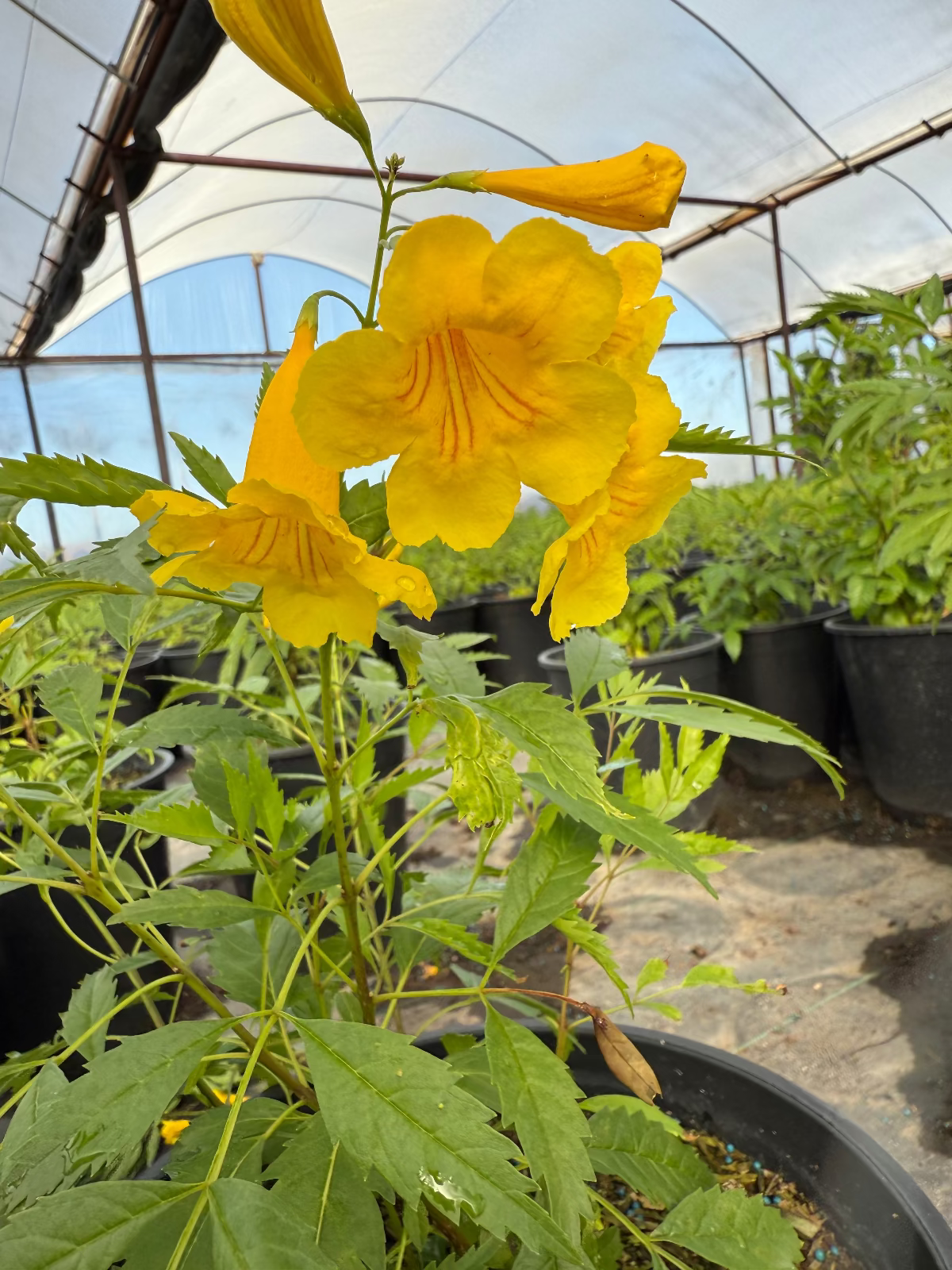


Orange Jubilee Staked
Orange Jubilee Staked
Couldn't load pickup availability
Orange Jubilee in Tree Form — A Stunning Flowering Accent for Phoenix Yards
Orange Jubilee Staked (Tecoma x 'Orange Jubilee') is the tree-form version of Phoenix's favorite orange-flowering shrub. Trained on a single trunk with a rounded canopy, this staked specimen delivers the same explosive orange-red trumpet blooms as the bush form but with a cleaner, more formal silhouette. Whether you're framing an entryway in Scottsdale, adding a flowering patio tree in Gilbert, or creating a colorful focal point in a Chandler courtyard — the staked Orange Jubilee combines non-stop blooms with an elegant tree shape.
Orange Jubilee Staked Plant Details
| Attribute | Detail |
|---|---|
| Scientific Name | Tecoma x 'Orange Jubilee' |
| Common Names | Orange Jubilee Tree, Staked Orange Jubilee, Tecoma Orange Jubilee |
| Mature Height | 10–12 feet |
| Mature Width | 6–8 feet |
| Growth Rate | Fast — 3–5 feet per year in Phoenix |
| Sun | Full sun (6+ hrs). Handles reflected heat from walls. |
| Water | Low to moderate once established. Drought-tolerant. |
| USDA Zones | 9–11 (Phoenix is Zone 9b–10a) |
| Soil | Well-draining. Adapts to Arizona caliche soils. |
| Foliage | Semi-evergreen — may drop some leaves in cold winters |
| Bloom Color | Orange-red trumpet flowers |
Orange Jubilee Staked Uses in Phoenix Landscapes
Entryway & Courtyard Tree
The staked tree form gives Orange Jubilee a formal, upright structure that's perfect for flanking entryways, lining walkways, or anchoring courtyard gardens. The single trunk creates clear space underneath for underplanting with groundcovers like Trailing Lantana or Angelita Daisy.
Patio & Pool Tree
Orange Jubilee Staked makes an excellent small patio tree. Its manageable size (10–12 feet), bright flowers, and ability to attract hummingbirds make it ideal for outdoor living spaces. It won't overwhelm a pool area and its roots are non-invasive — safe near hardscaping in Mesa, Tempe, and Peoria.
Flowering Street Tree or Border
Line a driveway or property edge with staked Orange Jubilee for a colorful border that blooms from spring through fall. Space 6–8 feet apart for a continuous canopy of orange. The tree form keeps the base clear for easy mowing or mulching underneath.
Best Time to Plant Orange Jubilee Staked in Phoenix
Fall (October–November) is the ideal planting window. Warm soil promotes fast root establishment while cooler air reduces transplant stress. Spring (February–April) is the second-best option. The staked form may need a support stake for the first season until the trunk strengthens.
How to Plant Orange Jubilee Staked
- Dig wide, not deep — 2–3x the root ball width, same depth as the container.
- Check for caliche — break through any hardpan layer for proper drainage.
- Backfill with native soil — a light 20% organic blend is fine.
- Spacing — 6–8 feet apart for a row; give standalone specimens 8+ feet of space.
- Staking — keep the nursery stake in place for the first year to support the single trunk.
- Mulch — 2–3 inches of bark or gravel mulch around the base, keeping it away from the trunk.
Watering Orange Jubilee Staked in Phoenix
First Year Watering Schedule
Weeks 1–2: Every 1–2 days, deep and slow (20–30 min). Month 1–2: Every 3–4 days. Month 3–6: Every 7–10 days (5–7 days in peak summer). After Year 1: Every 10–14 days in summer; every 3–4 weeks in winter.
Drip Irrigation
Place two 2 GPH emitters 18–24 inches from the trunk on opposite sides. Established trees are drought-tolerant but bloom more heavily with consistent deep watering during the growing season.
What's the difference between Orange Jubilee Bush and Orange Jubilee Staked?
Same plant, different training. The bush form grows as a multi-stemmed shrub. The staked form is trained on a single trunk to create a small tree shape — cleaner look, more formal, with clear space underneath for underplanting.
How fast does the staked form grow?
Very fast — expect 3–5 feet of growth per year. A 5-gallon staked specimen can reach 8–10 feet within 2 growing seasons with regular watering.
Does it attract hummingbirds?
Yes. The tubular orange flowers are a top hummingbird attractant in the Phoenix Valley. You'll see them visiting from spring through fall.
Will it freeze back in Phoenix winters?
Minor tip dieback may occur during hard freezes, but it bounces back vigorously in spring. In most Phoenix winters it stays semi-evergreen with little cold damage.
You May Also Like
Orange Jubilee Bush — The multi-stemmed shrub form for hedges and mass plantings.
Yellow Bells Staked — Bright yellow trumpet flowers in tree form.
Red Bird of Paradise — Fiery red-orange blooms on a heat-loving desert shrub.
Desert Willow — Native flowering tree with orchid-like blooms for Phoenix yards.
How Many Orange Jubilee Staked Do I Need?
As a single-trunk flowering tree, Orange Jubilee Staked is most often used as a specimen or in a spaced row. Plant one as a focal point at an entry or courtyard, flank a doorway with a matched pair, or line a driveway in odd-numbered groups so each rounded canopy stands clear. Space trees 6 to 8 feet apart for a connected row.
| Driveway / Border Run | Trees Needed (7 ft spacing) |
|---|---|
| 14 ft | 2 trees |
| 21 ft | 3 trees |
| 35 ft | 5 trees |
| 50 ft | 7 trees |
Keep the trunk a few feet clear of pool decks and walkways so the canopy and dropped flowers stay off the hardscape.
Orange Jubilee Staked Season-by-Season in Phoenix
- Spring (Feb–Apr): Fast new growth fills the canopy and the first orange-red trumpets open. Best second planting window; keep the support stake until the trunk firms up.
- Summer (May–Sep): Peak bloom through extreme and reflected heat, drawing hummingbirds all season. Monsoon rains (Jul–Sep) trigger heavier flushes of color.
- Fall (Oct–Nov): Prime planting season with continued bloom until the first cool snap. Roots establish quickly in warm fall soil.
- Winter (Dec–Jan): Semi-evergreen in mild winters. A hard freeze below about 28°F can cause leaf drop or tip dieback, with vigorous spring recovery. Cover young trees on frost nights and delay pruning until growth resumes.
At a Glance
✔ Hummingbird-Friendly ✔ Pollinator-Friendly ✔ Heat-Loving (Reflected-Heat Tolerant) ✔ Drought-Tolerant ✔ Pool-Friendly (Low-Litter) ✔ Low-Maintenance
Plant It With
- Orange Jubilee Bush: the multi-stemmed shrub form for hedges and mass color behind the tree.
- Arizona Yellow Bells: golden trumpets from the same Tecoma family for a warm color echo.
- Mexican Bird of Paradise: fiery red-orange blooms on a heat-loving companion shrub.
- Desert Ruellia: a low purple-flowering shrub to underplant beneath the clear trunk.
Is Orange Jubilee Staked Right for Your Yard?
Orange Jubilee Staked is a strong fit when you want a small flowering tree with a clean single trunk for an entry, courtyard, or pool-adjacent patio in full sun and well-drained caliche soil. The clear trunk leaves room to underplant and keeps the base tidy. It is not the best choice for a frost pocket or for a fully hands-off planting, since the young trunk needs staking and a hard freeze can cause tip dieback that you prune out in spring.
Customer Reviews
Share