

Mimosa
Mimosa
Couldn't load pickup availability
Phoenix's Showstopping Pink Summer Shade Tree — Mimosa Tree
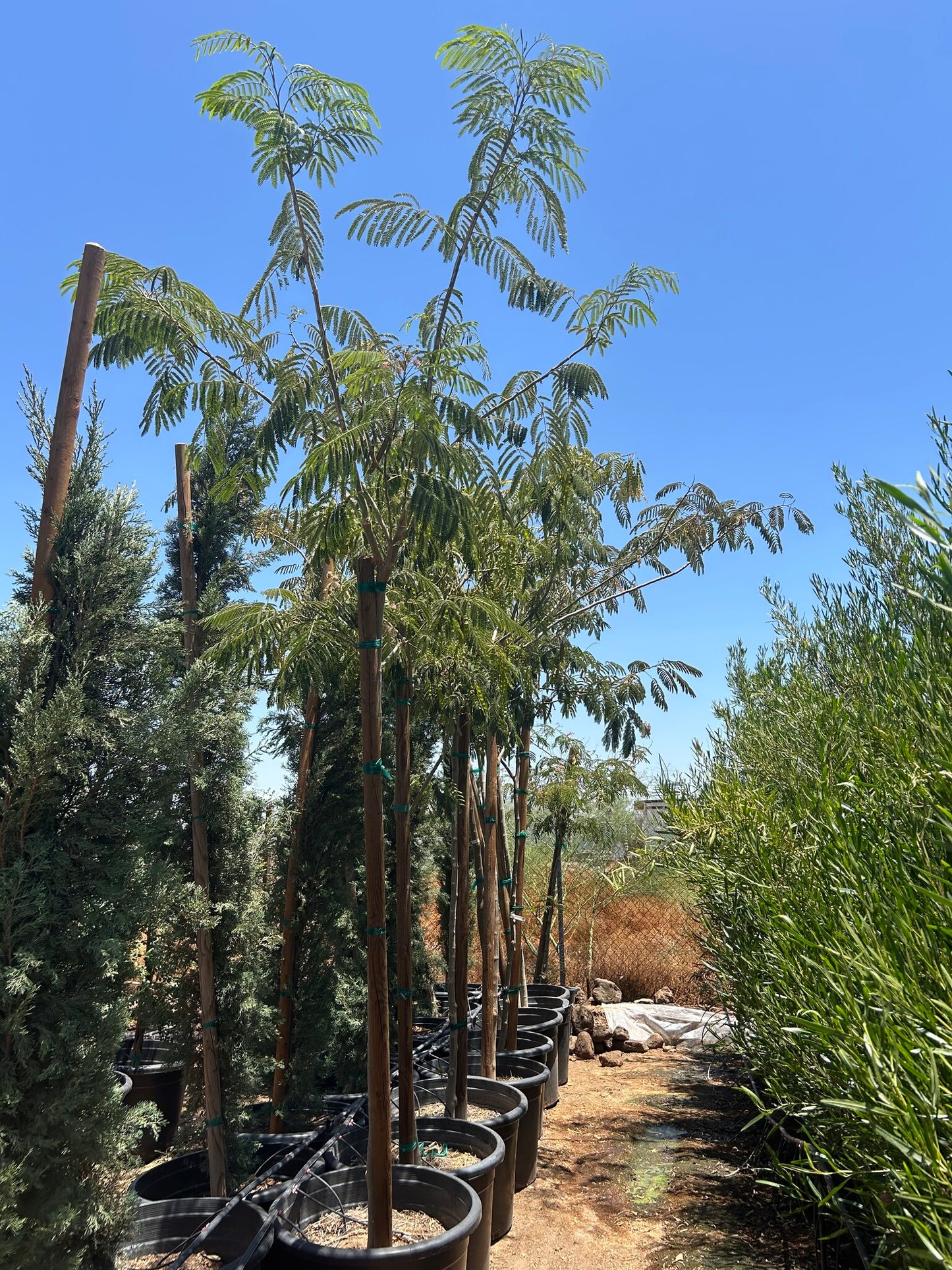
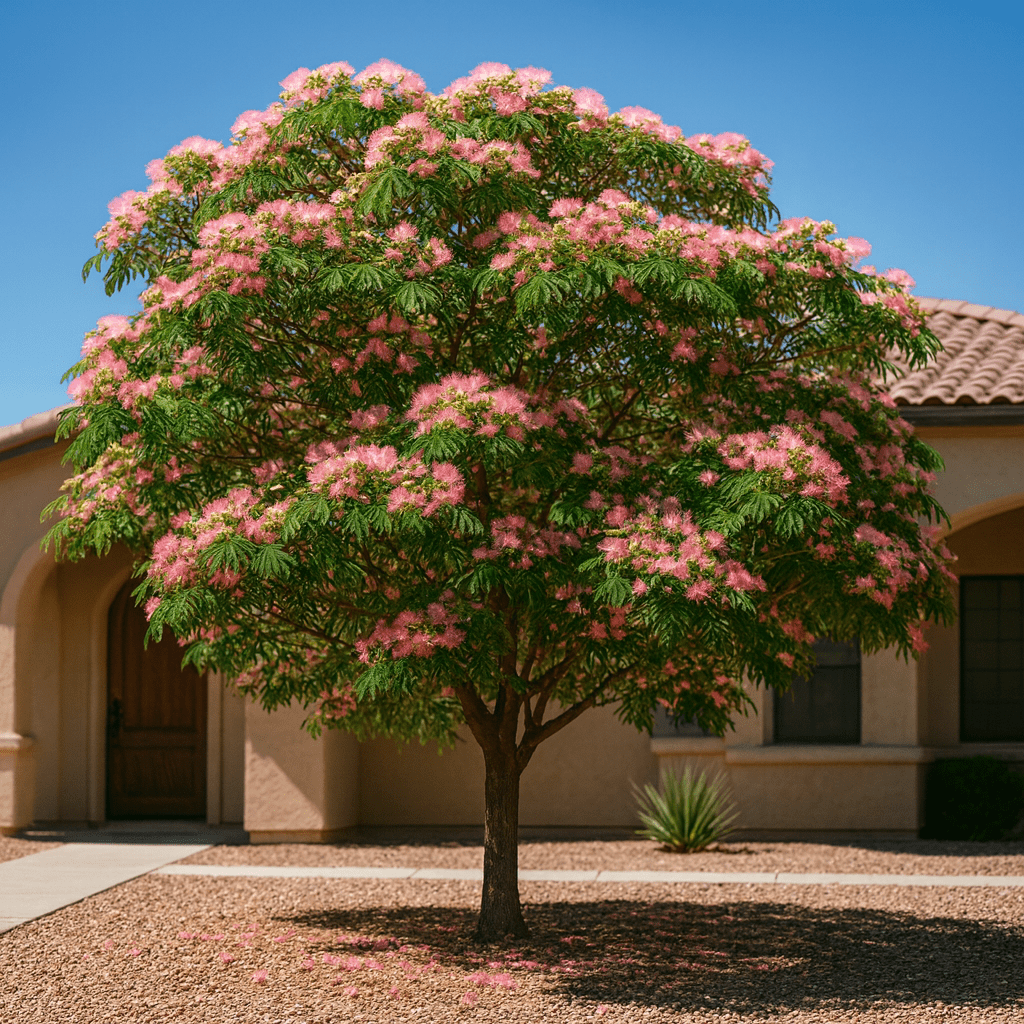
Mimosa Tree (Albizia julibrissin) is Phoenix's most spectacular summer-blooming shade tree. This fast-growing deciduous tree erupts into clouds of fluffy pink powder-puff blooms from May through July, creating a lush tropical canopy above patios, courtyards, and desert landscapes. Drought-adapted once established, the Mimosa handles Phoenix's extreme heat with ease. Whether you're adding a breathtaking focal point in Scottsdale, a shaded retreat in Chandler, or a pollinator paradise in Gilbert — Mimosa Tree gets the job done.
Mimosa Tree Plant Details
| Attribute | Detail |
|---|---|
| Scientific Name | Albizia julibrissin |
| Common Names | Mimosa Tree, Persian Silk Tree, Pink Silk Tree |
| Mature Height | 20–30 feet |
| Mature Width | 20–30 feet |
| Growth Rate | Fast — 3–5 feet per year in Phoenix |
| Sun | Full sun (6+ hrs). Handles reflected heat from walls. |
| Water | Low to moderate once established. Drought-tolerant after year 1. |
| USDA Zones | 6–9 (Phoenix is Zone 9b–10a — plant in open exposures for best airflow) |
| Soil | Well-draining. Adapts to Arizona caliche soils with proper bed prep. |
| Foliage | Deciduous — feathery fern-like leaves; drops in winter |
| Bloom Color | Pink, fluffy powder-puff clusters (May–July) |
| Wildlife | Attracts hummingbirds, butterflies, and native bees |
Mimosa Tree Uses in Phoenix Landscapes
Summer Flowering Shade Tree
No tree in the Phoenix Valley delivers summer color quite like the Mimosa. Its wide, umbrella-like canopy — spreading 20–30 feet — provides light filtered shade that cools patios without blocking all airflow. Blooms appear in May and last through July, right when Phoenix homeowners need beauty and shade most. Pair with Desert Spoon or Agave underneath for a low-water understory that stays attractive year-round.
Patio and Courtyard Focal Point
Mimosa's spreading canopy and stunning pink blooms make it the ultimate statement tree for patios, courtyards, and entryways. Plant 15–20 feet from a patio edge so the canopy arches overhead without dropping seed pods directly onto seating. In Scottsdale and Peoria, it's become a signature tree in modern desert and Mediterranean-style landscapes. For a clean look, combine with Texas Sage and Ruellia along the border.
Pollinator and Wildlife Garden
The nectar-rich pink blooms of Mimosa are irresistible to hummingbirds, bees, and butterflies throughout summer. If you're building a wildlife-friendly yard in Mesa or Tempe, Mimosa makes the perfect centerpiece — providing food and light habitat while also serving as an ornamental. Its feathery bipinnate foliage also adds soft tropical texture unlike any other Arizona tree.
Desert-Modern Accent Tree
Mimosa's graceful silhouette — arching horizontal branches and airy canopy — fits beautifully into desert-modern and xeriscape designs. Its deciduous nature means it sheds in winter, letting warming sunlight through during cooler months and then leafing back out before the brutal Phoenix summer. Plant as a solo specimen in an open lawn or gravel bed for maximum visual impact. In Gilbert and Chandler, it pairs well with Blue Palo Verde and Desert Willow for a layered canopy design.
Best Time to Plant Mimosa Tree in Phoenix
Fall planting (October–November) is ideal. Soil stays warm enough for root establishment, while cooler air temperatures reduce transplant stress. A fall-planted Mimosa gets 6–8 months of root growth before facing its first Phoenix summer — dramatically improving survival and long-term performance. Spring (February–April) is the second-best window. Avoid planting in summer if possible, as extreme heat makes establishment much harder without intensive irrigation.
How to Plant Mimosa Tree
- Dig wide, not deep — Excavate 2–3x the root ball width, same depth as the container.
- Check for caliche — Break through any hardpan layer with a breaker bar to ensure drainage below the root zone.
- Backfill with native soil — A light 20% organic amendment is fine; avoid heavy compost that retains too much moisture.
- Spacing — Plant 20–25 feet from structures and other large trees; 15 feet minimum from patio edges.
- Water basin — Build a 3–4 inch earthen ring around the drip line to direct water to the roots.
- Mulch — Apply 2–3 inches of bark or decomposed granite mulch to retain soil moisture and regulate temperature.
Watering Mimosa Tree in Phoenix
First Year Watering Schedule
Weeks 1–2: Water every 1–2 days, deep and slow (20–30 minutes). Months 1–2: Every 3–4 days. Months 3–6: Every 7–10 days (every 5–7 days in peak summer). After Year 1: Every 10–14 days in summer; every 3–4 weeks in winter. Established Mimosa trees are surprisingly drought-tolerant for their size.
Drip Irrigation
Install a 2–4 GPH emitter 18–24 inches from the trunk during establishment, then move it outward as the tree grows. Once established (2+ years), Mimosa needs minimal supplemental irrigation in the Phoenix winter months. In summer, one deep weekly watering at the drip line is sufficient for an established tree.
How fast does Mimosa Tree grow in Phoenix?
Mimosa is one of Phoenix's fastest-growing ornamental trees, typically adding 3–5 feet per year under good conditions. A 25-gallon nursery tree can reach 15+ feet within 2–3 years of planting in Phoenix's warm climate.
Is Mimosa Tree drought tolerant once established?
Yes — once established after year 1, Mimosa Tree is surprisingly low-water for Phoenix landscapes. In winter, it requires little to no supplemental irrigation. In summer, one deep weekly watering is sufficient for a mature tree.
When does Mimosa bloom in Phoenix?
Mimosa typically blooms from May through July in the Phoenix Valley. The fluffy pink powder-puff flowers appear as temperatures rise, and blooms can last 6–8 weeks depending on heat and water conditions. It's one of the showiest summer-blooming trees available in the Valley.
Can Mimosa Tree survive Phoenix's extreme summer heat?
Yes — Mimosa is well-adapted to Phoenix's hot, dry climate. Full sun and reflected heat from walls or pavement don't slow it down. The key is proper establishment watering during the first summer. After that, it handles the desert heat on its own.
Does Mimosa Tree work near pools?
Mimosa is not the ideal choice immediately adjacent to a pool due to seed pod drop in late summer. However, planted 20–25 feet away with the canopy arching toward the pool area, it creates beautiful dappled shade without excessive mess. For a pool-side tree with minimal litter, consider Desert Willow or Crape Myrtle instead.
You May Also Like
Desert Willow — A fast-growing Arizona native with trumpet-shaped blooms in pink, burgundy, and white from spring through fall.
Crape Myrtle Tree — Phoenix's most popular summer-blooming shade tree, with explosive clusters of red, pink, or purple flowers June through September.
Anacacho Orchid Tree — A stunning small flowering tree with delicate white and pink orchid-like blooms; perfect for smaller yards in Scottsdale and Chandler.
Blue Palo Verde — Arizona's state tree; a drought-tough native with brilliant yellow spring blooms and a graceful open canopy.
How Many Mimosa Tree Do I Need?
Mimosa is a fast, wide-spreading specimen shade tree at 20 to 30 feet across, so it almost always works best as a single focal point. Use a small grouping only on large open lots where each canopy has room to arch out fully.
| Planting | Spacing | Notes |
|---|---|---|
| Single specimen | 20 to 25 ft from structures and large trees; 15 ft min from patio edges | The standard use: one tree as a courtyard or patio centerpiece. |
| Open-lot grouping of 3 | 25 ft on center | Only on large properties; gives each canopy room to spread. |
| Spaced canopy row | 25 to 30 ft on center | For a light filtered-shade allee along a drive or open bed. |
Mimosa Tree Season-by-Season in Phoenix
- Spring (Feb to Apr): Leafs back out with feathery fern-like foliage after winter dormancy. Strong root-growth window and a good second planting time.
- Summer (May to Sep): The headline season. Fluffy pink powder-puff blooms from May through July draw hummingbirds, bees, and butterflies, with light filtered shade below. Handles full sun and reflected heat; monsoon rains push fast growth.
- Fall (Oct to Nov): Prime planting window. Foliage begins to thin and seed pods mature and drop.
- Winter (Dec to Jan): Deciduous and bare, letting warming sun through. Very cold-hardy (to roughly 0°F), so Valley frost is no concern.
At a Glance
✔ Pollinator-Friendly ✔ Hummingbird-Friendly ✔ Heat-Loving (Reflected-Heat Tolerant) ✔ Drought-Tolerant ✔ Shade-Providing ✔ Low-Maintenance ✔ Cold-Hardy to 0°F
Plant It With
- Desert Willow: a fast native with trumpet blooms spring through fall to layer color under the Mimosa canopy.
- Anacacho Orchid Tree: a smaller flowering tree that extends the bloom show into a mixed grove.
- Blue Palo Verde: Arizona's native state tree, whose yellow spring bloom precedes the Mimosa's summer pink.
- Desert Spoon: an evergreen architectural understory that holds form while the Mimosa is bare in winter.
Is Mimosa Tree Right for Your Yard?
Mimosa thrives in full sun and open exposures with good airflow, tolerates reflected heat, and grows fast in well-drained caliche soil once the hardpan is broken for drainage. It is drought-tolerant after the first year and cold-hardy through any Valley winter. Give it 20 to 30 feet of clear width. It is not a fit right next to a pool or patio seating: it drops feathery leaves and seed pods, so set it back 20 to 25 feet and let the canopy reach toward the space instead.
Customer Reviews
Share