
Kelly's Choice
Kelly's Choice
Couldn't load pickup availability
Stunning Coral-Pink Blooms on Spineless Pads — The Perfect Prickly Pear for Phoenix Patios & Gardens
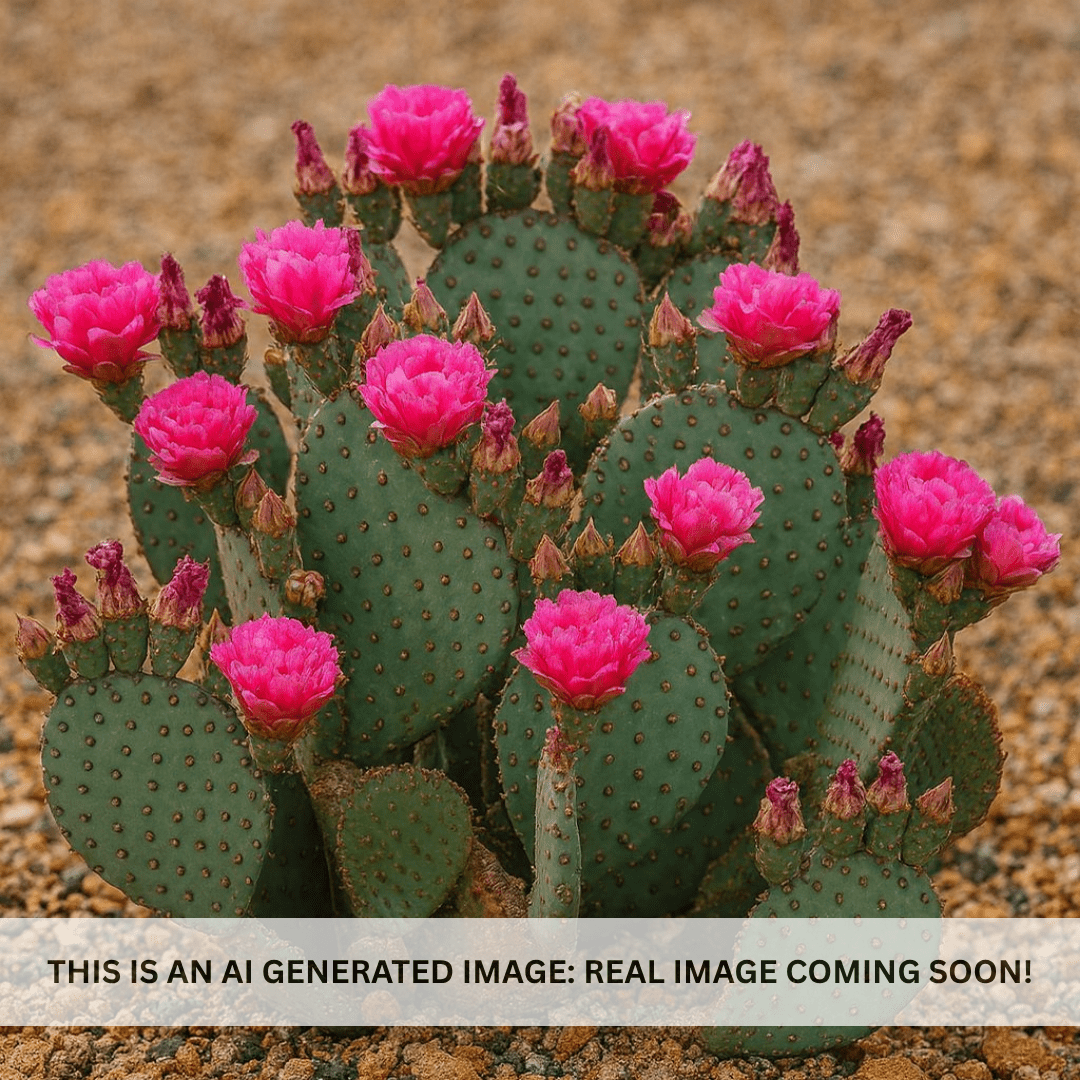
Kelly’s Choice (Opuntia ‘Kelly’s Choice’) is one of the most beautiful hybrid prickly pears available for Phoenix Valley landscapes. This compact, spineless prickly pear produces waves of luminous coral-pink to peach flowers with golden undertones each spring — a color palette you won’t find on any native Opuntia. Growing just 2–3 feet tall and 4–6 feet wide, it’s perfectly scaled for patios, poolside plantings, and small desert gardens. Whether you’re designing a colorful courtyard in Scottsdale, softening a modern landscape in Chandler, or adding a low-water showpiece in Mesa — Kelly’s Choice delivers knockout blooms without the spines.
Kelly’s Choice Plant Details
| Attribute | Detail |
|---|---|
| Scientific Name | Opuntia ‘Kelly’s Choice’ (Chiffon hybrid series) |
| Common Names | Kelly’s Choice Prickly Pear, Kelly’s Choice Opuntia |
| Mature Height | 2–3 feet (up to 4 feet at maturity) |
| Mature Width | 4–6 feet |
| Growth Rate | Moderate — 1–2 new pads per season in Phoenix |
| Sun | Full sun (6+ hrs). Handles reflected heat from walls. |
| Water | Low once established. Drought-tolerant. |
| USDA Zones | 8–11 (Phoenix is Zone 9b–10a) |
| Soil | Well-draining. Adapts to Arizona caliche soils. |
| Foliage | Evergreen — blue-green spineless pads year-round |
| Bloom Color | Coral-pink to peach with golden undertones — spring |
Kelly’s Choice Uses in Phoenix Landscapes
Patio & Poolside Planting
The spineless pads make Kelly’s Choice one of the safest prickly pears to plant near pools, patios, and outdoor living areas. Its compact 2–3 foot height keeps it in scale with seating areas and planter beds. The coral-pink spring blooms create a stunning focal point visible from both indoors and out — perfect for entertaining spaces in Gilbert, Tempe, or Paradise Valley.
Color Accent in Modern Desert Design
Kelly’s Choice’s unusual coral-peach flowers stand out against gravel, decomposed granite, and concrete hardscape. Plant it in groups of 3 for a mass color effect, or use a single specimen in a decorative pot. It pairs beautifully with Purple Prickly Pear, Agave, and Desert Marigold for a year-round color palette.
Low-Maintenance Borders & Beds
Use Kelly’s Choice along walkways, garden borders, or foundation plantings where you want beauty without thorns. Its spreading habit fills 4–6 feet of ground with blue-green pads that look attractive even when not in bloom. Ideal for front-yard xeriscapes in Peoria, Glendale, and Surprise.
Best Time to Plant Kelly’s Choice in Phoenix
Fall (October–November) is the ideal planting window. Soil stays warm for root establishment while cooler air reduces transplant stress. Your Kelly’s Choice gets 6–8 months of root growth before its first Phoenix summer. Spring (February–April) is the second-best window. Avoid planting in peak summer if possible.
How to Plant Kelly’s Choice
- Dig wide, not deep — 2–3x the root ball width, same depth
- Check for caliche — break through any hardpan layer so water drains freely
- Backfill with native soil — a light 20% organic blend is fine for this hybrid
- Spacing — 4–5 ft apart for mass plantings; 5–6 ft for individual specimens
- Water basin — build a 3–4 inch ring to direct water to the root zone
- Mulch — 2–3 inches of gravel or decomposed granite to retain moisture
Watering Kelly’s Choice in Phoenix
First Year Watering Schedule
- Weeks 1–2: Every 3–4 days, deep and slow
- Month 1–3: Every 7–10 days
- Month 3–6: Every 10–14 days (weekly in peak summer)
- After Year 1: Every 2–3 weeks summer; monthly or less winter
Drip Irrigation
Place one 1-GPH emitter 12–18 inches from the base. Established Kelly’s Choice plants need very little supplemental water — their fleshy pads store moisture efficiently through Phoenix’s dry months.
How fast does Kelly’s Choice grow in Phoenix?
Expect 1–2 new pads per growing season. Plants fill out to their mature 4–6 foot spread within 3–4 years in full sun with well-draining soil.
Is Kelly’s Choice really spineless?
Yes — Kelly’s Choice produces smooth, spine-free pads. It may have small glochids (tiny hair-like bristles) at the areoles, but these are far less aggressive than traditional prickly pear spines. It’s one of the safest Opuntia varieties for high-traffic areas.
What makes Kelly’s Choice different from other prickly pears?
Kelly’s Choice is a hybrid from the Chiffon series, bred specifically for its exceptional coral-pink to peach flower color. Most native prickly pears produce yellow flowers — Kelly’s Choice’s warm pink tones are rare and highly sought after by landscape designers.
Does Kelly’s Choice handle Phoenix summer heat?
Absolutely. While it’s a hybrid, Kelly’s Choice is fully adapted to Zone 9b–10a conditions and thrives in temperatures above 110°F with full sun exposure.
You May Also Like
- Baby Rita Prickly Pear — compact purple-padded prickly pear with magenta blooms
- Purple Prickly Pear — stunning purple pads that intensify in winter cold and summer heat
- Spineless Prickly Pear — large thornless Opuntia for edible fruit and safe landscaping
- Beaverita Prickly Pear — another beautiful hybrid with showy pink flowers
- Engelmann’s Prickly Pear — classic native prickly pear with yellow blooms and purple fruit
How Many Kelly's Choice Do I Need?
This is a compact, spreading prickly pear that fills 4 to 6 feet wide, so it works as a low color mass or a spineless border. Space plants about 4.5 feet on center for a continuous drift, or set a single specimen with 5 to 6 feet of room. Because the pads are smooth, it is safe to use right along patios and pool decks.
| Bed or border length | Plants needed (4.5 ft centers) |
|---|---|
| 9 ft | 3 plants |
| 13 ft | 4 plants |
| 18 ft | 5 plants |
| 27 ft | 7 plants |
Kelly's Choice Season-by-Season in Phoenix
- Spring (Feb to Apr): Peak show. Waves of coral-pink to peach flowers open across the pads, drawing bees. New pad growth begins. Strong second window to plant.
- Summer (May to Sep): Fully heat-adapted and thrives above 110°F in full sun and reflected heat. Pads stay blue-green and plump; a deep soak every few weeks keeps it looking fresh through the monsoon.
- Fall (Oct to Nov): Prime planting season, giving 6 to 8 months of root growth before next summer. An occasional light second flush of bloom can appear.
- Winter (Dec to Jan): Evergreen pads hold all winter. One of the more cold-tolerant Opuntias, taking brief dips to around 15°F, though young pads can show edge nip on a hard freeze.
At a Glance
✔ Spineless ✔ Pool-Friendly (Low-Litter) ✔ Heat-Loving (Reflected-Heat Tolerant) ✔ Drought-Tolerant ✔ Pollinator-Friendly ✔ Evergreen ✔ Low-Maintenance ✔ Cold-Hardy to 15°F
Plant It With
- Baby Rita: compact purple-padded prickly pear with magenta blooms for a color-contrast pairing.
- Beaverita Prickly Pear: another showy pink-flowering hybrid to extend the spring color.
- Beavertail Prickly Pear: low native with magenta spring blooms for a layered low planting.
- Engleman's Prickly Pear: classic yellow-flowered Arizona native to anchor the larger background.
Is Kelly's Choice Right for Your Yard?
It thrives in full sun and reflected heat, fast-draining soil amended through any caliche, and a low border, patio, or poolside spot where its spineless pads and coral blooms shine. It is hardy to about 15°F and very low-water once established. Not the best fit in a deep-shade location or a yard with heavy rabbit and javelina pressure, since the smooth pads are easier for animals to browse than spiny natives.
Customer Reviews
Share