

Golden Barrel
Golden Barrel
Couldn't load pickup availability
The Iconic Golden Barrel Cactus for Phoenix Desert Landscapes
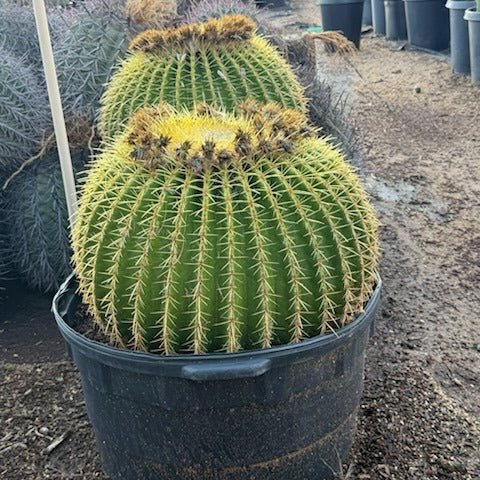
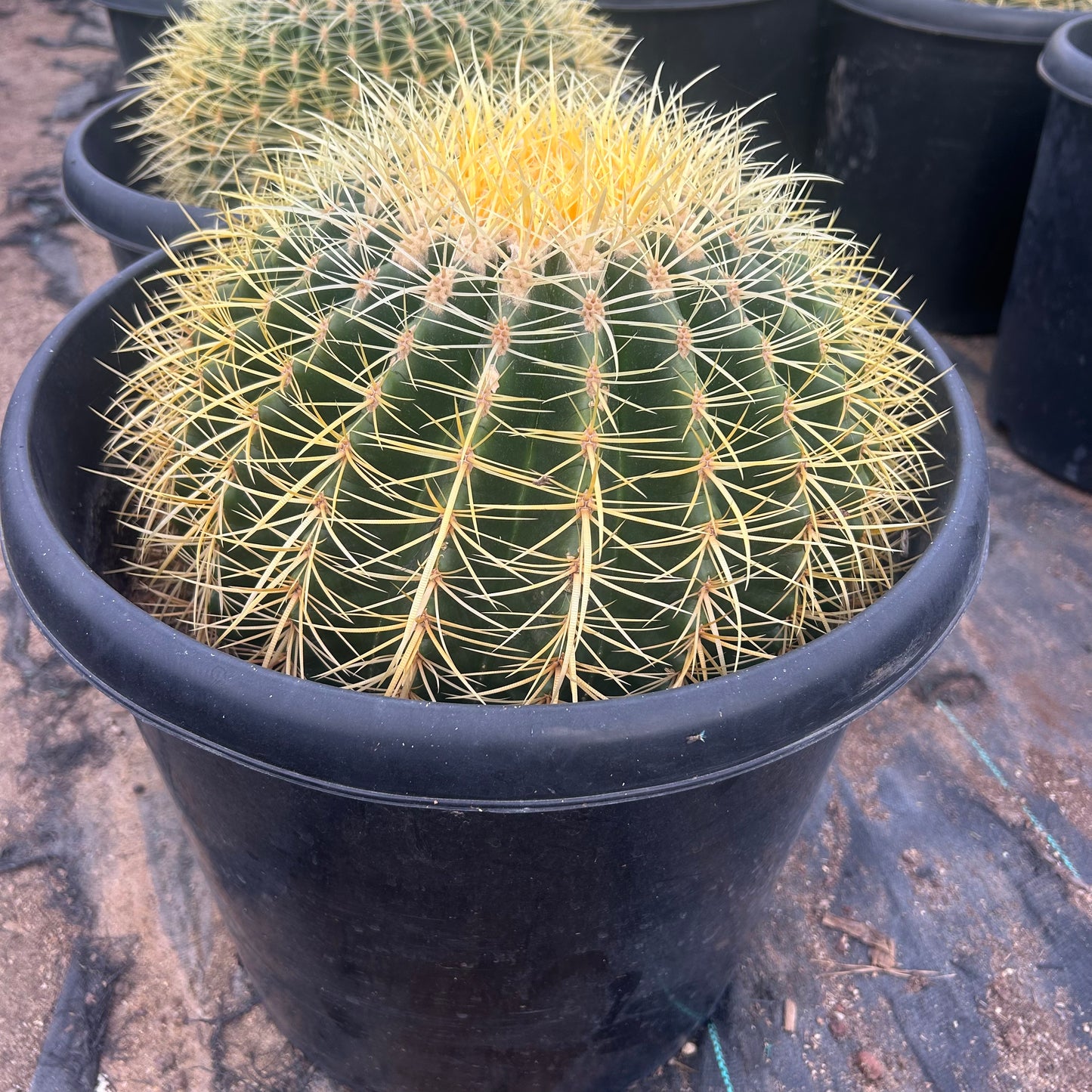
Echinocactus grusonii (Golden Barrel Cactus) is the most recognizable barrel cactus in the world — and one of the best-performing landscape plants in the Phoenix Valley. Its perfectly spherical form, dense golden spines, and bulletproof toughness make it the go-to accent for xeriscapes, rock gardens, and modern desert designs across Scottsdale, Mesa, Chandler, and Gilbert. Once established, Golden Barrel thrives on almost no water and zero maintenance, delivering stunning golden color year-round.
Golden Barrel Cactus Plant Details
| Attribute | Detail |
|---|---|
| Scientific Name | Echinocactus grusonii |
| Common Names | Golden Barrel Cactus, Mother-in-Law's Cushion, Golden Ball Cactus |
| Mature Height | 1–3 feet |
| Mature Width | 1–3 feet |
| Growth Rate | Slow — 1–2 inches per year in Phoenix |
| Sun | Full sun (6+ hrs). Thrives in reflected heat from walls and pavement. |
| Water | Very low once established. Highly drought-tolerant. |
| USDA Zones | 9–11 (Phoenix is Zone 9b–10a) |
| Soil | Well-draining. Adapts to Arizona caliche soils with added drainage. |
| Foliage | Evergreen — golden spines provide year-round color |
| Bloom Color | Bright yellow ring of flowers at the crown (mature specimens, summer) |
Golden Barrel Cactus Uses in Phoenix Landscapes
Mass Plantings & Desert Garden Displays
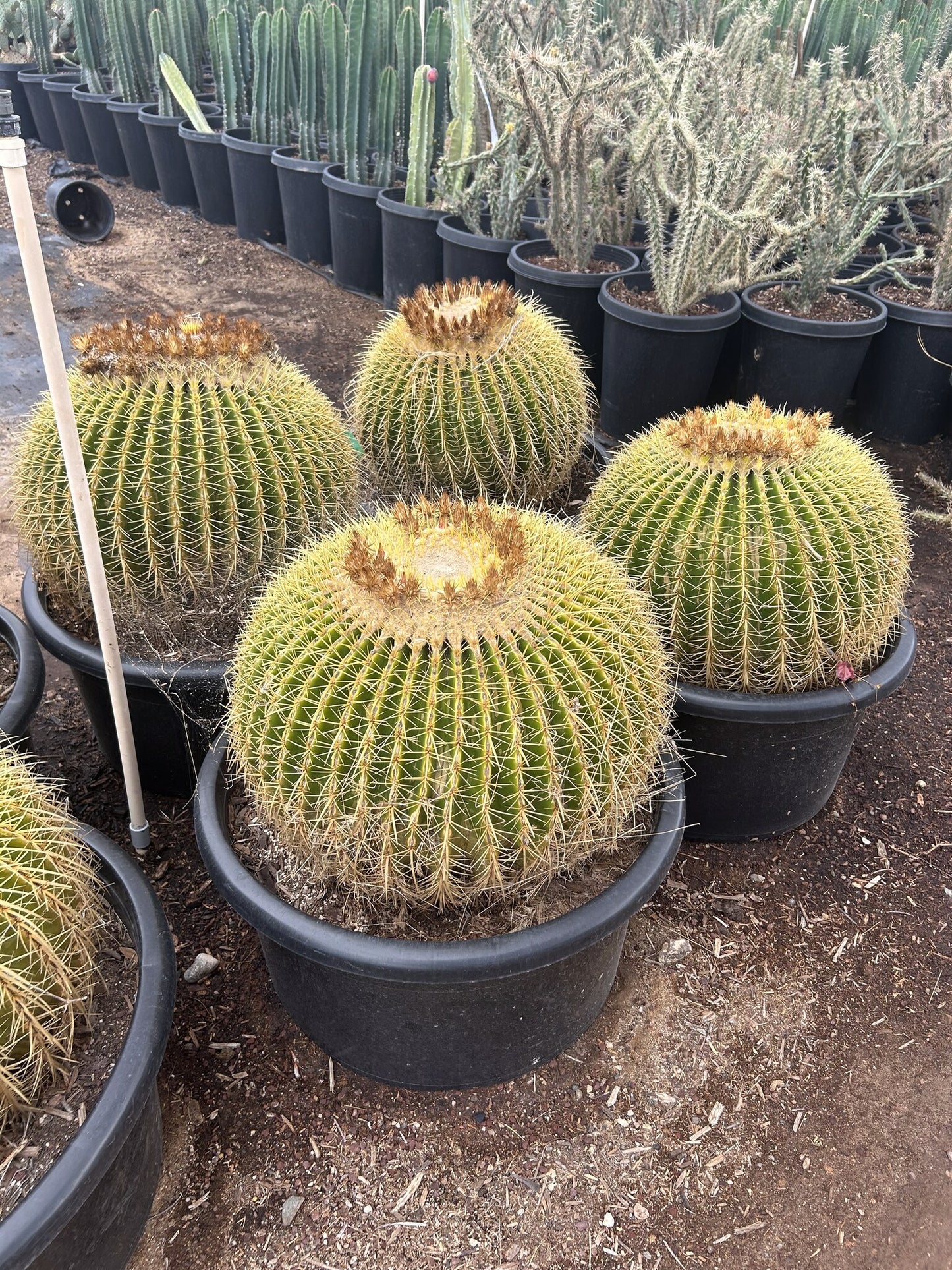
Nothing beats a group of Golden Barrels planted together in a gravel bed or rock garden. Arrange 5–10 barrels in staggered clusters among boulders and decomposed granite for a museum-quality desert display. This look is a signature of high-end Scottsdale and Paradise Valley landscapes. Space barrels 2–3 feet apart for visual impact while allowing room for growth.
Modern Desert Courtyard Accent
A single large Golden Barrel in a raised planter or gravel pocket makes a bold architectural statement. The perfect sphere contrasts beautifully with angular walls, steel planters, and minimalist hardscape. Pair with Agave or Desert Spoon for a clean, contemporary desert aesthetic popular across Tempe and North Scottsdale.
Xeriscape & HOA-Approved Landscapes
Golden Barrel is one of the most HOA-friendly cacti in the Valley — clean form, no leaf drop, no irrigation headaches. It checks every water-conservation box for communities in Peoria, Glendale, Surprise, and Gilbert that mandate drought-tolerant plantings. Once established, it survives on rainfall alone most of the year.
Pool-Adjacent & Patio Plantings
Golden Barrel's compact footprint and zero-litter habit make it ideal for pool areas. No falling leaves, no invasive roots, no messy flowers. Position barrels at least 3 feet from walkways so spines stay safely out of reach, and enjoy the golden glow reflecting off pool water.
Best Time to Plant Golden Barrel Cactus in Phoenix
Fall (October–November) is the ideal planting window. Warm soil promotes root establishment while cooler air reduces transplant shock. Your Golden Barrel gets 6–8 months of mild weather before its first Phoenix summer. Spring (February–April) is the second-best window. Avoid transplanting in peak summer heat when possible.
How to Plant Golden Barrel Cactus
- Dig wide, not deep — excavate a hole 2–3x the root ball width, same depth. Barrel cacti have shallow root systems.
- Check for caliche — break through any hardpan layer completely. Standing water kills barrel cacti fast.
- Backfill with native soil — mix in 20–30% pumice or perlite if your soil is heavy clay.
- Spacing — 2–3 feet apart for mass plantings; 3+ feet for standalone specimens.
- Water basin — build a shallow 3–4 inch soil ring to direct water to the root zone during establishment.
- Mulch — apply 2–3 inches of gravel or decomposed granite. Avoid organic bark against the cactus base.
Watering Golden Barrel Cactus in Phoenix
First Year Watering Schedule
- Weeks 1–2: Every 5–7 days, deep and slow
- Month 1–3: Every 10–14 days
- Month 3–12: Every 2–3 weeks (every 10–14 days in peak summer)
- After Year 1: Every 3–4 weeks in summer; no supplemental water in winter
Drip Irrigation
Place a single 1-GPH emitter 8–12 inches from the base. Run for 30–45 minutes per session. Established Golden Barrels in the ground often need no irrigation outside extreme summer heat. Overwatering is the #1 killer — when in doubt, don't water.
How fast does Golden Barrel Cactus grow in Phoenix?
Golden Barrel is a slow grower — expect 1–2 inches of diameter per year. A 1-gallon plant may take 8–10 years to reach full size (2–3 feet across). Larger container sizes from Three Timbers give you instant impact. Our 15 and 25 gallon specimens are already substantial focal-point size.
Is Golden Barrel Cactus native to Arizona?
No — Echinocactus grusonii is native to central Mexico and is actually endangered in the wild. However, it performs exceptionally well in Phoenix's climate, thriving in our heat, low humidity, and alkaline soils as if it were a native species.
Can Golden Barrel Cactus handle full Phoenix summer sun?
Yes. Golden Barrel thrives in full sun, including reflected heat from walls and pavement. In fact, it needs at least 6 hours of direct sun daily to maintain its compact, spherical shape. Plants grown in too much shade become elongated and lose their iconic form.
What's the difference between Golden Barrel and Golden Barrel Clusters?
A standard Golden Barrel is a single round specimen. Golden Barrel Clusters are multi-headed specimens where several barrels grow fused together from a shared base. Clusters are rarer, more dramatic, and ideal for large focal-point plantings. Three Timbers carries both.
You May Also Like
- Golden Barrel Clusters — multi-headed Golden Barrel specimens for dramatic desert garden focal points.
- Blue Barrel — striking blue-gray barrel cactus that pairs beautifully with golden tones.
- Mexican Fire Barrel — bold red-spined barrel for high-contrast desert designs.
- Fishhook Barrel — native Arizona barrel with hooked spines and wildlife-friendly fruit.
- Golden Barrel - Bareroot — budget-friendly bareroot Golden Barrels for mass planting projects.
How Many Golden Barrel Cactus Do I Need?
This is a slow, single-globe barrel that matures 1 to 3 feet across, and it looks best planted in odd-numbered clusters rather than a row. For the signature staggered-group look, space barrels 2 to 3 feet apart center to center. Keep them at least 3 feet off walkways and pool decks so the spines stay out of reach. Coverage below assumes 2.5-foot centers.
| Area to fill | Barrels at 2.5 ft spacing |
|---|---|
| 16 sq ft | 3 barrels |
| 36 sq ft | 6 barrels |
| 64 sq ft | 10 barrels |
For a single courtyard focal point, give one large barrel a clear 3-foot footprint and skip the grouping.
Golden Barrel Cactus Season-by-Season in Phoenix
- Spring (Feb to Apr): The barrel firms up and greens as warmth returns. A strong second window to plant once frost risk has passed.
- Summer (May to Sep): Fully in its element, thriving in full sun and reflected heat off walls and pavement. Mature crowns push a ring of bright yellow flowers. Keep the root zone dry between waterings through monsoon humidity, since overwatering is the main killer.
- Fall (Oct to Nov): Prime planting season. Warm soil and easing heat let roots settle in before winter.
- Winter (Dec to Jan): Holds its golden evergreen form but is the tender season. This Mexican species can scar below about 28 to 30°F, so cover young plants on hard-freeze nights and favor a warm south or west wall.
At a Glance
✔ Heat-Loving (Reflected-Heat Tolerant) ✔ Drought-Tolerant ✔ Evergreen ✔ Low-Maintenance ✔ Pollinator-Friendly ✔ Pool-Friendly (Low-Litter) ✔ Deer & Rabbit-Resistant
Plant It With
- Golden Barrel Clusters: multi-headed barrels that add drama and scale to a golden grouping.
- Blue Barrel: a cool blue-gray barrel that contrasts the golden tones in a barrel collection.
- Mexican Fire Barrel: bold red spines for high-contrast warmth alongside the gold.
- Fishhook Barrel: the rugged Arizona native barrel for an authentic desert pairing.
Is Golden Barrel Cactus Right for Your Yard?
It thrives in full sun and reflected heat with sharp drainage, keeps a clean zero-litter habit perfect for pool surrounds and HOA beds, and asks for almost no water once established. It is not a fit in shady spots, where it stretches and loses its globe shape, or in low, poorly drained ground, where standing water rots the roots. Give it frost protection on the coldest Phoenix nights, since it can scar below the upper 20s.
Customer Reviews
Share