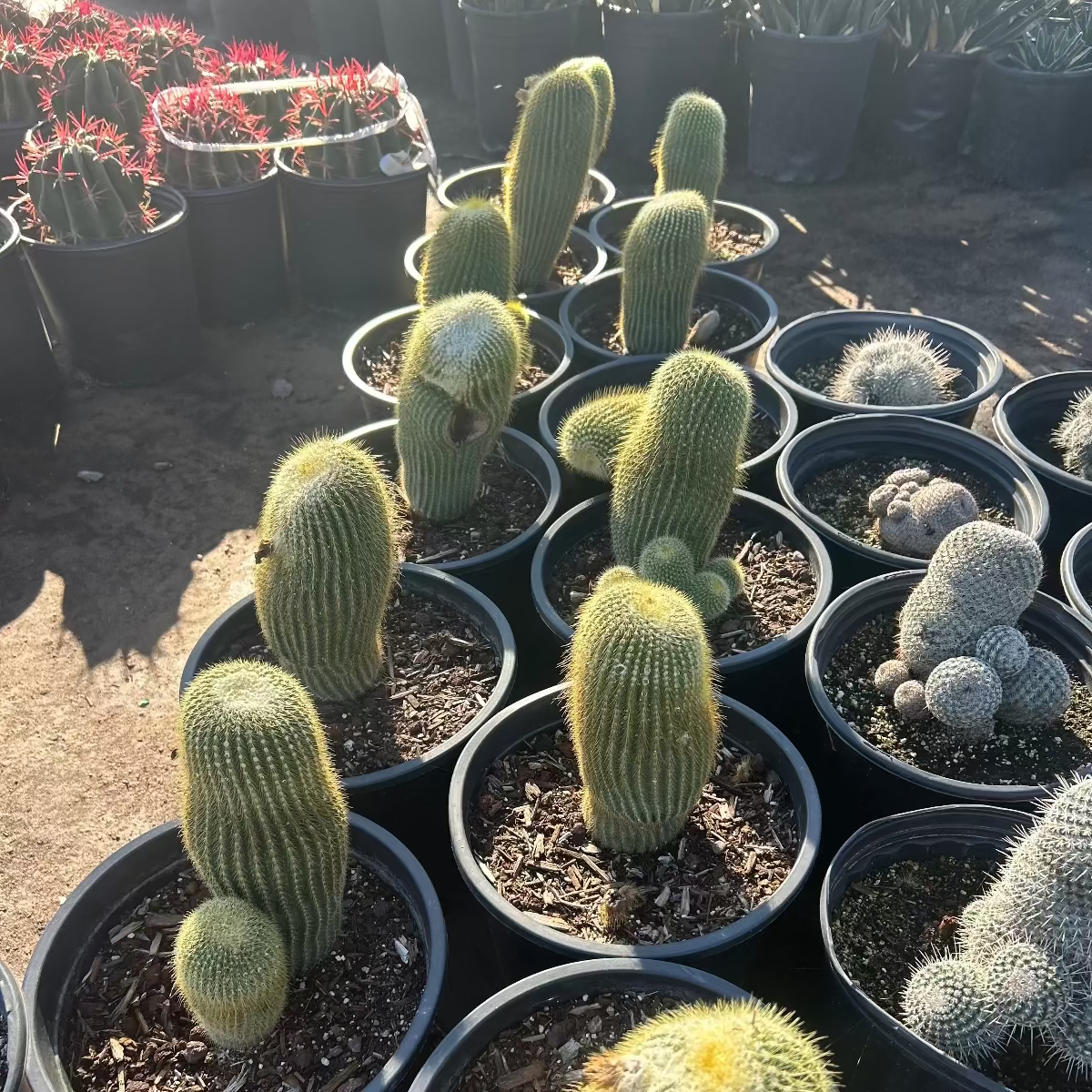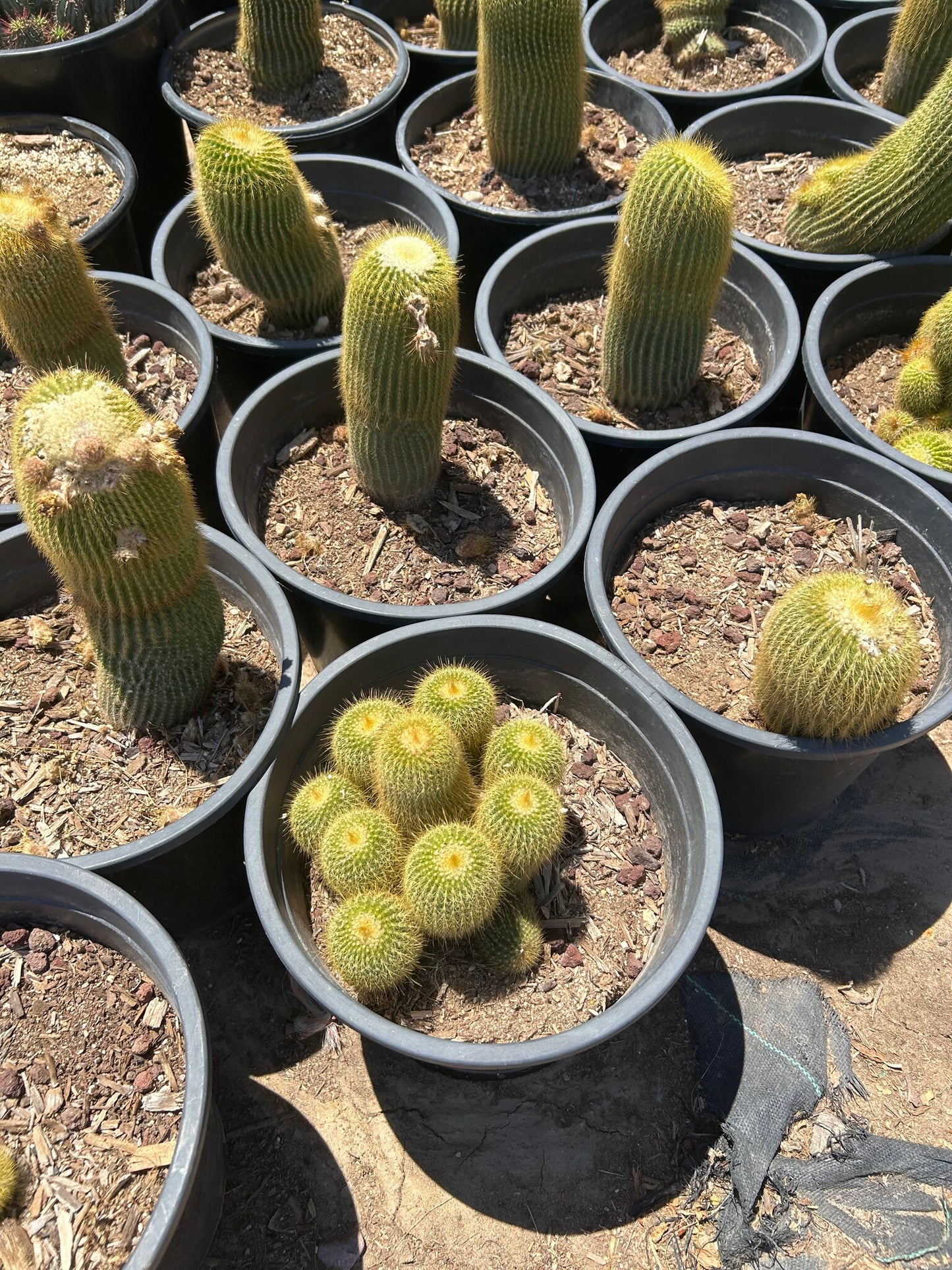


Golden Ball
Golden Ball
Couldn't load pickup availability
The Best Golden Spine Cactus for Phoenix Desert Gardens
Notocactus leninghausii (Golden Ball Cactus) is one of the most eye-catching small barrel cacti you can grow in the Phoenix Valley. Its dense coat of soft golden-yellow spines glows in the sunlight, and neat cylindrical columns eventually cluster into sculptural mounds. This low-water, heat-loving cactus thrives with almost zero maintenance once established. Whether you're designing a modern desert courtyard in Scottsdale, filling a rock garden bed in Mesa, or adding a bright accent to a Chandler patio — Golden Ball delivers year-round color without the fuss.
Golden Ball Cactus Plant Details
| Attribute | Detail |
|---|---|
| Scientific Name | Notocactus leninghausii (syn. Parodia leninghausii) |
| Common Names | Golden Ball Cactus, Golden Torch, Lemon Ball Cactus |
| Mature Height | 1–3 feet |
| Mature Width | 8–12 inches per column; clusters spread 1–2 feet |
| Growth Rate | Slow — 1–2 inches per year in Phoenix |
| Sun | Full sun to light afternoon shade. Handles reflected heat from walls. |
| Water | Very low once established. Highly drought-tolerant. |
| USDA Zones | 9–11 (Phoenix is Zone 9b–10a) |
| Soil | Well-draining. Adapts to Arizona caliche soils with added drainage. |
| Foliage | Evergreen — golden spines provide year-round color |
| Bloom Color | Bright yellow flowers in spring and summer |
Golden Ball Cactus Uses in Phoenix Landscapes
Rock Garden Focal Point
Golden Ball's glowing spines and tidy columnar form make it a natural centerpiece for rock gardens. Plant a single specimen among decomposed granite and desert boulders for instant visual impact, or group three at staggered heights for a sculptural cluster. Pairs beautifully with dark gravel mulch that makes the golden color pop.
Container & Patio Accent
Because Golden Ball stays compact, it's one of the best cacti for decorative pots on patios, pool decks, and courtyard entries. Choose a wide, shallow ceramic pot with drainage holes and fill with cactus mix. The soft spines are safer around walkways than many barrel cacti, making it ideal for high-traffic outdoor living spaces in Tempe and Gilbert.
Mixed Desert Border Plantings
Use Golden Ball as a mid-height accent in desert borders alongside Texas Sage, Desert Spoon, and Ruellia. Its bright golden tone contrasts with silver and green foliage, creating layered texture without extra water. Space plants 12–18 inches apart in a staggered line for a natural desert garden look.
Xeriscape & Low-Water HOA Landscapes
Golden Ball checks every box for water-conscious HOA-approved landscapes across Peoria, Glendale, and Surprise. Once established, it survives on rainfall alone in most Phoenix winters and needs only occasional deep watering in summer. Zero pruning, zero leaf litter, zero pest issues.
Best Time to Plant Golden Ball Cactus in Phoenix
Fall (October–November) is the ideal planting window. The soil is still warm enough to encourage root growth, but cooler air temperatures reduce transplant stress. Your Golden Ball gets 6–8 months of mild weather to establish roots before its first Phoenix summer. Spring (February–April) is the second-best window. Avoid planting in the peak summer heat if possible.
How to Plant Golden Ball Cactus
- Dig wide, not deep — excavate a hole 2–3x the width of the root ball but only as deep as the root ball itself.
- Check for caliche — if you hit a hardpan layer, break through it completely to ensure drainage. Standing water will rot cactus roots fast.
- Backfill with native soil — mix in 20–30% pumice or perlite for extra drainage if your native soil is heavy clay.
- Spacing — plant 12–18 inches apart for a grouped display; 24+ inches for standalone specimens.
- Water basin — build a shallow 3–4 inch soil ring around the base to direct water to the root zone.
- Mulch — apply 2–3 inches of gravel or decomposed granite mulch. Avoid organic bark mulch directly against cactus stems.
Watering Golden Ball Cactus in Phoenix
First Year Watering Schedule
- Weeks 1–2: Every 3–4 days, deep and slow
- Month 1–3: Every 7–10 days
- Month 3–6: Every 10–14 days (every 7 days in peak summer)
- After Year 1: Every 2–3 weeks in summer; little to no supplemental water in winter
Drip Irrigation
Place a single 1-GPH emitter 6–8 inches from the base. Run for 30–45 minutes per watering session. Established Golden Ball cacti in the ground may need no irrigation at all outside of extreme summer heat.
How fast does Golden Ball Cactus grow in Phoenix?
Golden Ball is a slow grower — expect 1–2 inches of height per year. Over time, the main column produces offsets that form attractive clusters. A 1-gallon plant will take several years to reach its mature height of 2–3 feet, but the golden spines look stunning from day one.
Is Golden Ball Cactus drought tolerant?
Extremely. Once established (after the first year), Golden Ball is one of the most drought-tolerant cacti available. It stores water in its stem and can survive extended dry periods with no supplemental irrigation. Overwatering is a bigger risk than underwatering.
Are the spines on Golden Ball Cactus sharp?
Golden Ball has relatively soft, flexible spines compared to most barrel cacti. While you still want to handle it with gloves, it's one of the safer cactus options for areas near walkways, patios, and pool decks where people might brush against it.
Does Golden Ball Cactus flower?
Yes — Golden Ball produces bright yellow, satiny flowers at the crown of the plant, typically in spring and summer. Blooms last several days and are a cheerful bonus on an already colorful cactus. Mature, well-established plants bloom most reliably.
You May Also Like
- Notocactus magnificus — a larger, globe-shaped Notocactus with blue-green ribs and contrasting yellow spines.
- Golden Barrel — the classic golden barrel cactus for bold, rounded focal points in desert landscapes.
- Gymnocalycium saglionis — a dramatic large chin cactus with curving spines and pink-white flowers.
- Easter Lily Cactus — compact barrel cactus with showstopping large white or pink blooms.
- Monk's Hood Cactus — unique geometric cactus with star-shaped ribs and a sculptural silhouette.
How Many Golden Ball Cactus Do I Need?
This is a slow, clustering column cactus whose clumps spread only 1 to 2 feet, so it is planted as a small specimen or in tight groupings and containers rather than a hedge. Because the spines are soft and flexible, it is one of the safer choices near walkways and pool decks. Grouping guide below uses 18-inch centers.
| Planting use | Spacing (on center) | Layout |
|---|---|---|
| Single accent | n/a | One column among boulders in dark granite |
| Sculptural cluster | 18 in apart | Group of 3 at staggered heights |
| Mixed border drift | 18 in apart | 5 plants read across roughly 6 to 8 ft of bed edge |
Golden Ball Cactus Season-by-Season in Phoenix
- Spring (Feb to Apr): Bright satiny yellow flowers open at the crown and offsets begin to form. A good second window to plant.
- Summer (May to Sep): Continues blooming into the warm season and takes full sun and reflected heat, though it appreciates light afternoon shade in the most brutal west-facing spots. Keep the soil dry between waterings through monsoon humidity.
- Fall (Oct to Nov): Prime planting season. Warm soil and mild air let roots establish before winter.
- Winter (Dec to Jan): Holds its golden evergreen columns. Comfortable through normal Phoenix winters; in a hard freeze give young plants a warm wall or light frost cover.
At a Glance
✔ Heat-Loving (Reflected-Heat Tolerant) ✔ Drought-Tolerant ✔ Evergreen ✔ Low-Maintenance ✔ Pollinator-Friendly ✔ Pool-Friendly (Low-Litter) ✔ Deer & Rabbit-Resistant
Plant It With
- Golden Barrel: the classic golden globe, a bolder rounded companion in a gold-themed bed.
- Gymnocalycium saglionis: a large chin cactus with curving spines and pale flowers for texture contrast.
- Easter Lily Cactus: a compact bloomer with big trumpet flowers to extend the color season.
- Monk's Hood: a geometric ribbed cactus that adds sculptural shape beside the golden columns.
Is Golden Ball Cactus Right for Your Yard?
It thrives in full sun to light afternoon shade with fast drainage, and its soft spines make it one of the friendlier cacti for patios, pool surrounds, and high-traffic borders. It is happiest with very little water once established. It is not a fit in soggy, poorly drained ground, where overwatering and standing moisture quickly rot the roots.
Customer Reviews
Share