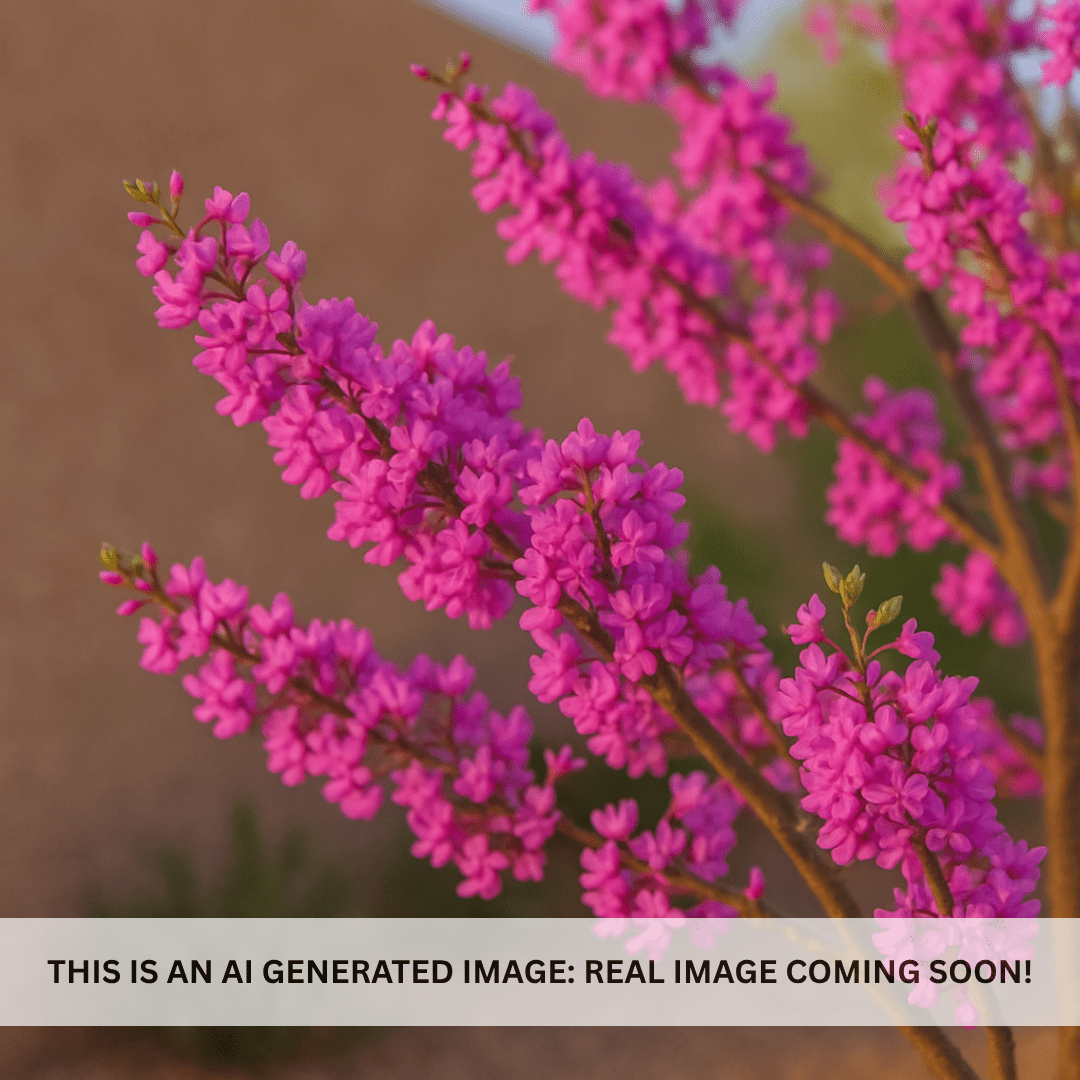


Eastern Redbud
Eastern Redbud
Couldn't load pickup availability
Eastern Redbud — A Classic Spring-Flowering Ornamental Tree for Phoenix
Eastern Redbud (Cercis canadensis) is one of America's most beloved ornamental trees, and it thrives in the Phoenix Valley with a little afternoon shade. Famous for its lavender-pink flowers that cover bare branches in early spring, this deciduous tree adds a romantic, lush look to desert landscapes. Heart-shaped leaves provide filtered shade through summer, then turn soft yellow in fall. Whether you're planting a flowering accent in a shaded Scottsdale courtyard, adding spring color to a Mesa side yard, or creating a garden focal point in Gilbert — the Eastern Redbud brings four-season beauty to Phoenix landscapes.
Eastern Redbud Plant Details
| Attribute | Detail |
|---|---|
| Scientific Name | Cercis canadensis |
| Common Names | Eastern Redbud, Judas Tree, American Redbud |
| Mature Height | 20–30 feet |
| Mature Width | 25–35 feet |
| Growth Rate | Moderate — 1–2 feet per year in Phoenix |
| Sun | Full sun to partial shade. Afternoon shade recommended in Phoenix for best performance. |
| Water | Moderate. Regular deep watering, especially during summer months. |
| USDA Zones | 4–9 (Phoenix is Zone 9b–10a) |
| Soil | Well-draining. Adapts to Arizona caliche soils with proper drainage. |
| Foliage | Deciduous — heart-shaped leaves turn yellow in fall |
| Bloom | February–March in Phoenix; lavender-pink flowers on bare branches |
Eastern Redbud Uses in Phoenix Landscapes
Understory Shade Tree
Eastern Redbud excels as an understory tree, planted beneath taller shade trees like Palo Verde or Ash. It thrives in the dappled light and adds a layered, lush look to Phoenix gardens. The heart-shaped leaves create a soft, non-desert aesthetic that many homeowners love.
Spring Flowering Accent
The Eastern Redbud's lavender-pink spring bloom is one of the most beautiful displays in any Phoenix garden. Plant it where you'll see it from indoors — near a kitchen window, front entry, or patio. The flowers appear on bare branches before leaves, creating a dramatic effect against walls, fences, or desert backdrop plantings.
East or North-Facing Foundation Planting
Eastern Redbud performs best in Phoenix when planted on the east or north side of a structure, where it gets morning sun and afternoon shade. This makes it ideal for foundation plantings, side yards, and courtyard gardens in Tempe, Chandler, and Scottsdale. Pair with shade-tolerant understory plants like Ruellia from Three Timbers.
Best Time to Plant Eastern Redbud in Phoenix
Fall (October–November) is the ideal planting window. The tree enters dormancy and establishes roots during Phoenix's mild winter months. By spring, it's ready to bloom. Winter planting (December–February) also works well for container-grown stock. Avoid summer planting — Eastern Redbud needs extra protection from extreme heat during establishment.
How to Plant Eastern Redbud
- Dig wide, not deep — 2–3x the root ball width, same depth as the container.
- Check for caliche — Break through any hardpan layer for excellent drainage.
- Backfill with amended soil — Mix 20–30% compost with native soil for this species.
- Spacing — 20–25 ft from other trees; 15+ ft from structures for a single specimen.
- Water basin — Build a 3–4 inch soil ring around the root zone to direct water to the roots.
- Mulch — 3–4 inches of bark mulch around the base to retain moisture and keep roots cool.
Watering Eastern Redbud in Phoenix
First Year Watering Schedule
- Weeks 1–2: Every 1–2 days, deep and slow (20–30 minutes per session)
- Months 1–2: Every 3–4 days
- Months 3–6: Every 5–7 days (every 3–4 days during peak summer)
- After Year 1: Every 7–10 days in summer; every 2–3 weeks in winter
Drip Irrigation
Place 2–4 emitters 18–24 inches from the trunk, each delivering 2–4 GPH. Eastern Redbud needs more consistent watering than Texas or Mexican Redbud, especially during Phoenix summers. Keep the root zone moist but never waterlogged.
Does Eastern Redbud need shade in Phoenix?
Eastern Redbud benefits from afternoon shade in Phoenix. Plant on the east or north side of a structure, or beneath a taller canopy tree. It can handle full sun in milder Valley locations but may show leaf scorch during peak summer without some protection.
How is Eastern Redbud different from Texas and Mexican Redbud?
Eastern Redbud grows larger (20–30 ft vs 12–20 ft), has bigger heart-shaped leaves, and produces lavender-pink flowers (vs the deeper magenta of Texas/Mexican varieties). It needs more water and benefits from afternoon shade, while the others tolerate full desert sun better.
When does Eastern Redbud bloom in Phoenix?
Eastern Redbud blooms in February through March in Phoenix — one of the earliest flowering trees of the season. The lavender-pink flowers appear on bare branches before new leaves emerge.
Is Eastern Redbud deciduous?
Yes. Eastern Redbud drops its leaves in late fall after a brief display of yellow fall color. It's bare through winter, then bursts into bloom on bare branches in late February before leafing out in March.
You May Also Like
- Texas Redbud — A more heat-tolerant Redbud variety with magenta-pink flowers, ideal for full-sun locations.
- Mexican Redbud — The most drought-tolerant Redbud, with compact size and wavy-edged leaves.
- Jacaranda Tree — A larger flowering shade tree with spectacular purple spring blooms.
- Purple Orchid Tree — Another stunning purple-flowering ornamental for Phoenix landscapes.
How Many Eastern Redbud Do I Need?
Eastern Redbud is a broad flowering specimen and understory tree (mature spread 25 to 35 feet). In most yards a single tree is plenty, set as a focal point where you can see the early spring bloom from a window or patio, ideally on the east or north side for afternoon shade. For a layered woodland-style planting, group 2 to 3 spaced 22 to 25 feet on center so the wide canopies do not crowd. The table below estimates counts at 22-foot spacing.
| Run length | Trees needed (22 ft on center) |
|---|---|
| 22 ft | 2 trees |
| 44 ft | 3 trees |
| 66 ft | 4 trees |
| 110 ft | 6 trees |
Eastern Redbud Season-by-Season in Phoenix
- Spring (Feb to Apr): The signature season. Lavender-pink flowers cover bare branches in February and March, one of the earliest tree blooms in the Valley, followed by heart-shaped leaves. Strong fall-into-spring is its preferred establishment window.
- Summer (May to Sep): Provides soft filtered shade but needs afternoon protection and steady deep water; in full reflected heat the leaf edges can scorch. Give it an east or north exposure or an overstory canopy.
- Fall (Oct to Nov): Prime planting season. Foliage turns soft yellow before dropping.
- Winter (Dec to Jan): Deciduous and bare, showing its branch structure. Extremely cold-hardy (to roughly -20°F), so Valley frost is never an issue.
At a Glance
✔ Pollinator-Friendly ✔ Shade-Providing ✔ Cold-Hardy to -20°F
Plant It With
- Texas Redbud: a more heat- and sun-tolerant cousin for hotter spots in the same garden.
- Mexican Redbud: the most drought-tolerant redbud, compact for tighter corners.
- Jacaranda Tree: a tall overstory bloomer that can provide the afternoon shade this redbud appreciates.
- Purple Orchid Tree: another purple-flowering accent to extend the bloom season.
Is Eastern Redbud Right for Your Yard?
This is the right tree if you want a lush, non-desert flowering accent with early spring color and soft filtered shade, and you can give it an east or north exposure, afternoon shade, and regular deep water. It is exceptionally cold-hardy and pollinator-friendly. It is not a fit for a hot, full-sun, reflected-heat spot on minimal water, since the leaves scorch and the tree needs more moisture than a true desert species.
Customer Reviews
Share