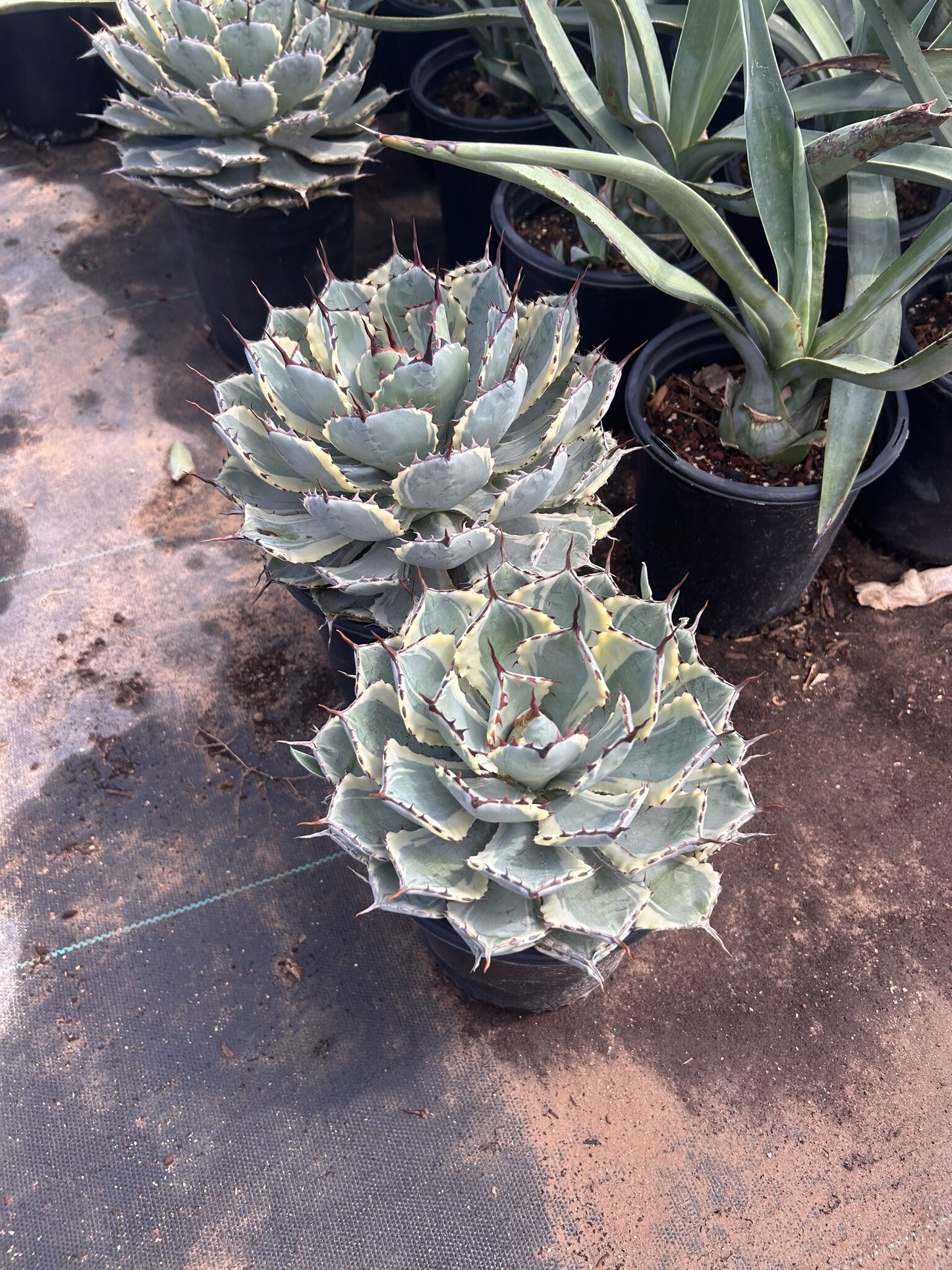


Dwarf Butterfly Agave
Dwarf Butterfly Agave
Couldn't load pickup availability
The Perfect Miniature Agave for Phoenix Containers and Rock Gardens
Dwarf Butterfly Agave (Agave potatorum) is a compact, symmetrical agave prized for its broad, paddle-shaped leaves tipped with dark red-brown terminal spines. Each leaf is edged with subtle teeth and covered in a powdery blue-gray coating that gives the entire rosette a silvery, sculptural appearance. Staying small enough to thrive in containers for years, Dwarf Butterfly Agave is the ideal choice for homeowners who want bold agave character without the sprawl. Whether you're building a collector's rock garden in Scottsdale, adding a statement pot to a Gilbert patio, or tucking an accent into a Chandler courtyard — Dwarf Butterfly Agave packs dramatic desert style into a compact footprint.
Dwarf Butterfly Agave Plant Details
| Attribute | Detail |
|---|---|
| Scientific Name | Agave potatorum |
| Common Names | Dwarf Butterfly Agave, Butterfly Agave Dwarf Form |
| Mature Height | 1–2 feet |
| Mature Width | 1–2 feet |
| Growth Rate | Slow — reaches mature size in 5–8 years in Phoenix |
| Sun | Full sun to light shade. Handles reflected heat from walls. |
| Water | Low once established. Highly drought-tolerant. |
| USDA Zones | 9–11 (Phoenix is Zone 9b–10a) |
| Soil | Well-draining. Adapts to Arizona caliche soils with amendment. |
| Foliage | Evergreen — powdery blue-gray with dark terminal spines |
| Special Feature | Compact rosette stays under 2 feet — perfect for pots and tight spaces |
Dwarf Butterfly Agave Uses in Phoenix Landscapes
Container and Patio Showpiece
Dwarf Butterfly Agave is one of the best agaves for long-term container growing. Its compact 1–2 foot rosette fits beautifully in a 12–16 inch decorative pot and won't outgrow its space for years. The silvery blue leaves look stunning in terra cotta, matte black, or weathered concrete planters. Place it on a front porch, poolside table, or courtyard entry for instant desert sophistication.
Rock Garden and Cactus Collection Accent
Tucked among boulders, decomposed granite, and companion cacti, Dwarf Butterfly Agave adds architectural form at ground level. Its compact size makes it easy to fit into tight spaces between larger plants. Pair with Cream Spike Agave and Shark Tooth Agave for a curated collection of contrasting textures and colors. For a 6-foot rock garden bed, 3–4 plants create a striking grouping.
Low Border or Pathway Edging
Planted 18–24 inches apart, Dwarf Butterfly Agave creates a sculptural low border along walkways, garden bed edges, or courtyard perimeters. The blue-gray color provides year-round contrast against warm-toned gravel and pavers. Its slow growth means minimal maintenance and no pruning for years.
Best Time to Plant Dwarf Butterfly Agave in Phoenix
Fall (October–November) is the ideal planting window. Warm soil encourages root establishment while cooler air temperatures reduce transplant stress. This gives the plant 6–8 months of root growth before its first Phoenix summer. Spring (February–April) is the second-best option. Avoid summer planting when possible.
How to Plant Dwarf Butterfly Agave
- Dig wide, not deep — Excavate a hole 2–3x the width of the root ball, same depth.
- Check for caliche — Break through any hardpan layer for proper drainage.
- Backfill with native soil — Add 20% pumice or perlite for improved drainage in heavy soils.
- Spacing — 18–24 inches apart for border plantings; 2–3 feet for standalone specimens.
- Water basin — Build a 2–3 inch soil ring around the base to direct water to roots.
- Mulch — 2–3 inches of gravel mulch to retain moisture and keep the crown dry.
Watering Dwarf Butterfly Agave in Phoenix
First Year Watering Schedule
Weeks 1–2: Every 2–3 days, deep and slow (15–20 minutes per session).
Months 1–2: Every 4–5 days.
Months 3–6: Every 7–10 days (every 5–7 days during peak summer).
After Year 1: Every 14–21 days in summer; monthly or less in winter.
Drip Irrigation
Place a single 0.5–1 GPH emitter 10–12 inches from the base. Dwarf Butterfly Agave is sensitive to overwatering — always err on the dry side. Once established (2+ years), it can survive on rainfall alone in most Phoenix winters.
How big does Dwarf Butterfly Agave get?
Dwarf Butterfly Agave stays compact at 1–2 feet tall and 1–2 feet wide, making it one of the smallest agaves available. It's perfect for containers and small garden spaces where larger agaves would be overwhelming.
Is Dwarf Butterfly Agave the same as regular Butterfly Agave?
Both are Agave potatorum, but the dwarf form stays significantly smaller. Standard Butterfly Agave can reach 2–3 feet tall and 3–4 feet wide. The dwarf version tops out around 1–2 feet in both dimensions — roughly half the size.
Can Dwarf Butterfly Agave handle full Phoenix sun?
Yes — it thrives in full sun, including reflected heat off walls and concrete. In especially hot microclimates, a touch of afternoon shade can help preserve the blue-gray leaf color, but it's not required.
Does Dwarf Butterfly Agave have sharp spines?
It has small marginal teeth and a dark terminal spine at each leaf tip. The teeth are not as aggressive as some agaves, but it's still best to give it a few inches of clearance from high-traffic walkways.
You May Also Like
Butterfly Agave — The full-sized version with broader leaves and a more commanding presence in landscape beds.
Cream Spike Agave — A compact variegated agave with creamy white margins for striking container displays.
Shark Tooth Agave — Bold toothed margins and a compact form for dramatic textural contrast.
Snowfall Agave — White-marked leaves with a frosty look, perfect for pairing with blue-toned agaves.
How Many Dwarf Butterfly Agave Do I Need?
At just 1 to 2 ft wide, Dwarf Butterfly Agave is a small-scale accent best used singly, in tight clusters, or as a low border. Use these spacings as a guide:
| Planting Style | Spacing | 10 ft Run / Area |
|---|---|---|
| Low border / edging | 18 to 24 in apart | 5 to 6 plants per 10 ft |
| Cluster of 3 to 5 | 2 ft apart | 3 to 5 plants per grouping |
| Single specimen / container | 2 to 3 ft clearance | 1 plant |
Plant in odd-numbered groups of 3 or 5 so each silvery rosette reads as its own sculpture, or feature one in a 12 to 16 inch pot as a patio centerpiece.
Dwarf Butterfly Agave Season-by-Season in Phoenix
- Spring (Feb to Apr): Best second planting window. The rosette pushes fresh powder-blue leaves and the silvery coating is at its brightest.
- Summer (May to Sep): Handles full sun and reflected heat off walls and concrete. In the hottest west-facing spots a little afternoon shade keeps the blue color crisp. Keep the fast-draining soil on the dry side through monsoon rain (Jul to Sep) to avoid crown rot.
- Fall (Oct to Nov): Prime planting season. Warm soil and cooling air let roots establish before winter.
- Winter (Dec to Jan): Stays evergreen but is frost-tender. Expect leaf-tip burn below about 28°F. On hard-frost nights cover the plant or pull containers under cover.
At a Glance
✔ Heat-Loving (Reflected-Heat Tolerant) ✔ Drought-Tolerant ✔ Evergreen ✔ Low-Maintenance ✔ Deer & Rabbit-Resistant
Plant It With
- Butterfly Agave: the full-sized form of the same species for a small-to-large scale pairing.
- Cream Spike: a compact variegated agave with creamy margins for striking container groupings.
- Blue Glow Agave: smooth blue-green rosettes with red margins that echo the silvery tones.
- Desert Spoon: a larger silvery fountain of foliage that frames the low rosettes.
Is Dwarf Butterfly Agave Right for Your Yard?
Dwarf Butterfly Agave thrives in full Phoenix sun to light shade, loves reflected heat, and needs fast-draining soil (break through caliche, add pumice, and keep it dry). Its tiny footprint is ideal for pots, courtyards, rock gardens, and low borders. It is not a fit if you need a frost-proof plant for an exposed yard, since it can burn below about 28°F and benefits from cover on hard-frost nights.
Customer Reviews
Share