

Dragon Tree
Dragon Tree
Couldn't load pickup availability
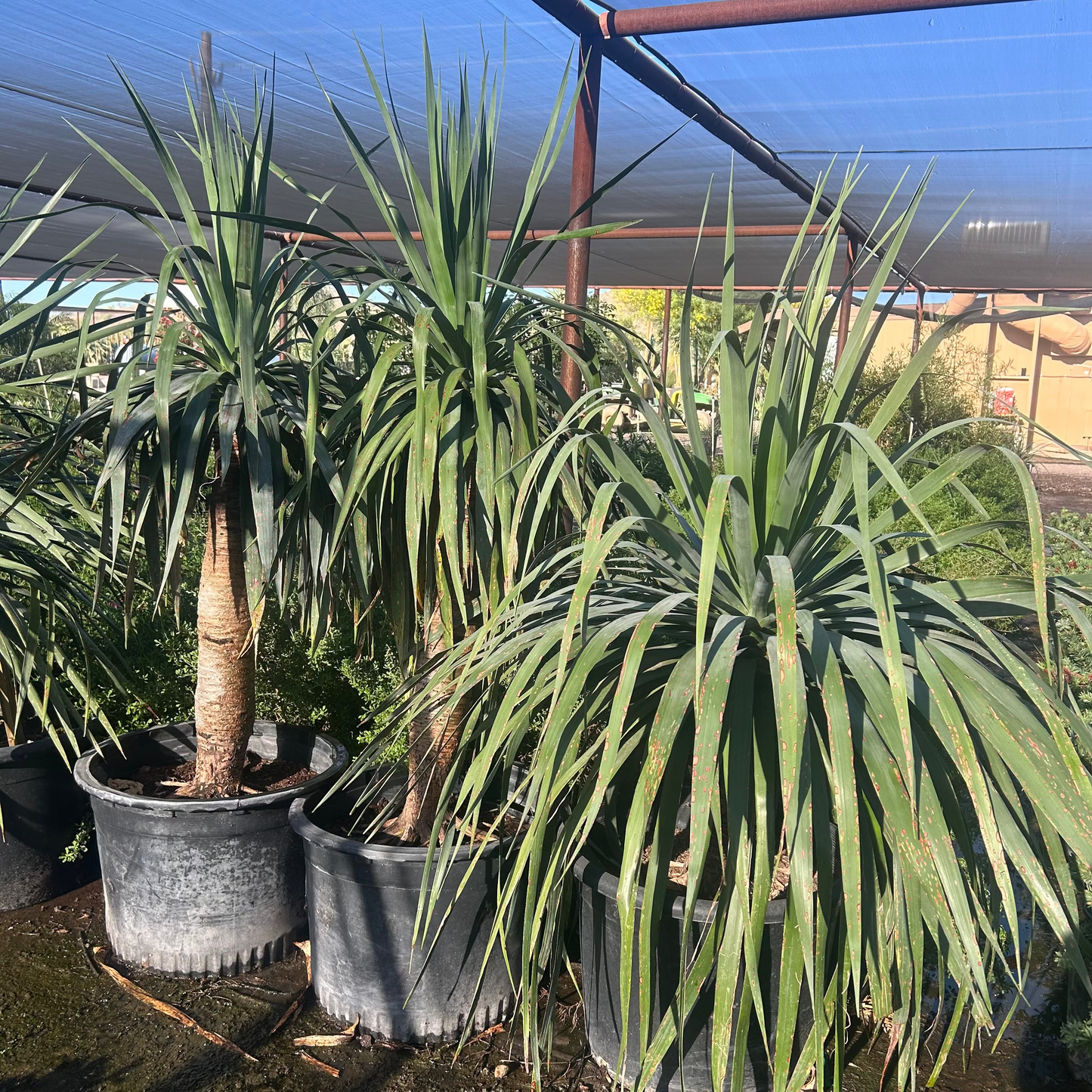
Dragon Tree — A Bold Sculptural Tree for Modern Phoenix Landscapes
Dragon Tree (Dracaena draco) is one of the most striking architectural trees you can plant in the Phoenix Valley. With its thick trunk, dramatic branching canopy, and rosettes of stiff blue-green sword-shaped leaves, the Dragon Tree looks like a living sculpture. Incredibly drought-tolerant and virtually maintenance-free once established, this ancient species thrives in the desert heat. Whether you're creating a modern desert courtyard in Scottsdale, anchoring a xeriscaped front yard in Mesa, or adding a bold focal point to a Chandler patio — the Dragon Tree delivers year-round drama with almost zero effort.
Dragon Tree Plant Details
| Attribute | Detail |
|---|---|
| Scientific Name | Dracaena draco |
| Common Names | Dragon Tree, Drago, Dragon's Blood Tree |
| Mature Height | 15–25 feet |
| Mature Width | 10–15 feet |
| Growth Rate | Slow to moderate — 1–2 feet per year in Phoenix |
| Sun | Full sun to partial shade. Handles reflected heat from walls and concrete. |
| Water | Very low once established. Extremely drought-tolerant. |
| USDA Zones | 9–12 (Phoenix is Zone 9b–10a) |
| Soil | Well-draining. Adapts to Arizona caliche soils with ease. |
| Foliage | Evergreen — dense rosettes of blue-green sword-shaped leaves year-round |
| Native Range | Canary Islands, Morocco — adapted to hot, arid climates |
Dragon Tree Uses in Phoenix Landscapes
Modern Desert Focal Point
The Dragon Tree's sculptural silhouette makes it the ultimate statement piece for modern desert design. Plant one as a standalone specimen in a gravel courtyard or against a clean stucco wall for maximum visual impact. Its architectural form pairs perfectly with minimalist hardscaping, boulders, and low-water groundcovers like Trailing Lantana from Three Timbers.
Xeriscaped Front Yard Anchor
If you're replacing a water-hungry lawn with a drought-tolerant landscape, the Dragon Tree is an ideal centerpiece. Surround it with Desert Spoon, Agave, and Yellow Bells for a layered desert garden that looks intentional and upscale. One mature Dragon Tree can define an entire front yard in Scottsdale, Tempe, or Gilbert.
Pool and Patio Feature
Dragon Trees are excellent near pools — they don't drop messy flowers or heavy leaf litter, and their tropical-meets-desert look complements resort-style outdoor living spaces. Plant 8–10 feet from pool edges. Their slow growth means they won't outgrow tight spaces for many years.
Best Time to Plant Dragon Tree in Phoenix
Spring (March–May) is the ideal planting window for Dragon Trees in Phoenix. Warm soil temperatures encourage root establishment, and the tree has the full growing season ahead to settle in before winter. Fall (October–November) is a solid second choice. Avoid winter planting, as Dragon Trees prefer warmth for establishment.
How to Plant Dragon Tree
- Dig wide, not deep — 2–3x the root ball width, same depth as the container.
- Check for caliche — Break through any hardpan layer to ensure excellent drainage. Dragon Trees are sensitive to waterlogging.
- Backfill with native soil — No amendment needed. Sandy, rocky native soil is ideal.
- Spacing — 10–15 ft from other trees or structures for a single specimen.
- Water basin — Build a 3–4 inch soil ring around the root zone for the first year only.
- Mulch — 2–3 inches of gravel or decomposed granite (not bark mulch) to match the desert aesthetic and prevent root rot.
Watering Dragon Tree in Phoenix
First Year Watering Schedule
- Weeks 1–2: Every 2–3 days, deep and slow (15–20 minutes per session)
- Months 1–2: Every 5–7 days
- Months 3–6: Every 10–14 days
- After Year 1: Every 2–3 weeks in summer; monthly or less in winter
Drip Irrigation
Place 1–2 emitters 12–18 inches from the trunk, each delivering 1–2 GPH. Dragon Trees are extremely drought-tolerant once established and can survive on rainfall alone in most Phoenix-area locations. Overwatering is a bigger risk than underwatering — ensure the soil dries completely between sessions.
How fast does a Dragon Tree grow in Phoenix?
Dragon Trees are slow to moderate growers, adding 1–2 feet per year in Phoenix. They reward patience — a 15-gallon nursery specimen will develop its signature thick trunk and branching canopy over 5–10 years.
Is Dragon Tree drought tolerant?
Extremely. Once established, Dragon Trees are one of the most drought-tolerant ornamental trees available for Phoenix landscapes. They evolved in the arid Canary Islands and thrive with minimal supplemental water.
Can Dragon Tree handle full Phoenix summer heat?
Yes. Dragon Trees handle full desert sun and temperatures above 110°F without issue. They also tolerate reflected heat from walls and pavement, making them ideal for urban landscapes.
Is Dragon Tree frost sensitive?
Dragon Trees handle light frost (down to about 25°F) but can sustain damage in prolonged hard freezes. In the Phoenix metro area, they do well year-round. In higher-elevation areas like north Scottsdale, provide frost cloth during rare cold snaps.
Does Dragon Tree have invasive roots?
No. Dragon Trees have a compact, non-aggressive root system, making them safe near foundations, pools, and hardscaping.
You May Also Like
- Joshua Tree — Another iconic sculptural desert tree for dramatic landscape statements.
- Desert Museum Palo Verde — A fast-growing native shade tree with yellow blooms and no thorns.
- Bottle Brush Tree — A colorful evergreen tree with red bottle-brush flowers and low water needs.
- Japanese Privet Tree — A lush evergreen option for privacy screening with a more tropical feel.
How Many Dragon Tree Do I Need?
Dragon Tree is a slow-growing architectural specimen (mature spread 10 to 15 feet), not a hedge plant. In most yards a single tree is the right call: set it as a standalone focal point in a courtyard, gravel bed, or against a clean wall where its branching silhouette can be seen in full. For a bolder modern statement, plant in an odd-numbered group of 3 spaced 8 to 10 feet apart so each rosette canopy stands clear. Keep it 8 feet or more from walkways and pool edges so the stiff leaf tips stay out of traffic.
Dragon Tree Season-by-Season in Phoenix
- Spring (Feb to Apr): Best planting window. Warming soil drives the slow flush of new rosette growth at the branch tips. Mature trees may push a tall spike of creamy flowers.
- Summer (May to Sep): Fully at home in extreme heat and reflected sun, holding its blue-green color through triple-digit days with very little water. Monsoon rains are usually plenty.
- Fall (Oct to Nov): A solid secondary planting window as temperatures ease and the tree continues slow, steady growth.
- Winter (Dec to Jan): Stays fully evergreen. Hardy to about 25°F, so it sails through normal Valley winters; in a rare hard freeze or in cooler north Scottsdale pockets, drape frost cloth to protect the foliage.
At a Glance
✔ Heat-Loving (Reflected-Heat Tolerant) ✔ Drought-Tolerant ✔ Pool-Friendly (Low-Litter) ✔ Evergreen ✔ Low-Maintenance
Plant It With
- Desert Museum Palo Verde: a soft, thornless flowering canopy that contrasts the dragon tree's stiff form.
- Joshua Tree: another bold sculptural specimen for a high-drama modern desert grouping.
- Desert Spoon: a spherical evergreen rosette that echoes the dragon tree at ground level.
- Red Yucca: a low, soft-textured accent with summer bloom spikes to soften the base.
Is Dragon Tree Right for Your Yard?
This is the right tree if you want a low-water, evergreen sculptural specimen for full sun and reflected heat, with a non-invasive root system that is safe near pools and foundations. It thrives in fast-draining native or caliche soil and asks for almost nothing once established. It is not a fit if you need quick shade or a fast screen, since it grows slowly, or if your site sits in a cold pocket that regularly drops below the mid-20s without frost protection.
Customer Reviews
Share