

Crested Blue Myrtle
Crested Blue Myrtle
Couldn't load pickup availability
Rare Crested Collector Cactus for Phoenix Desert Gardens
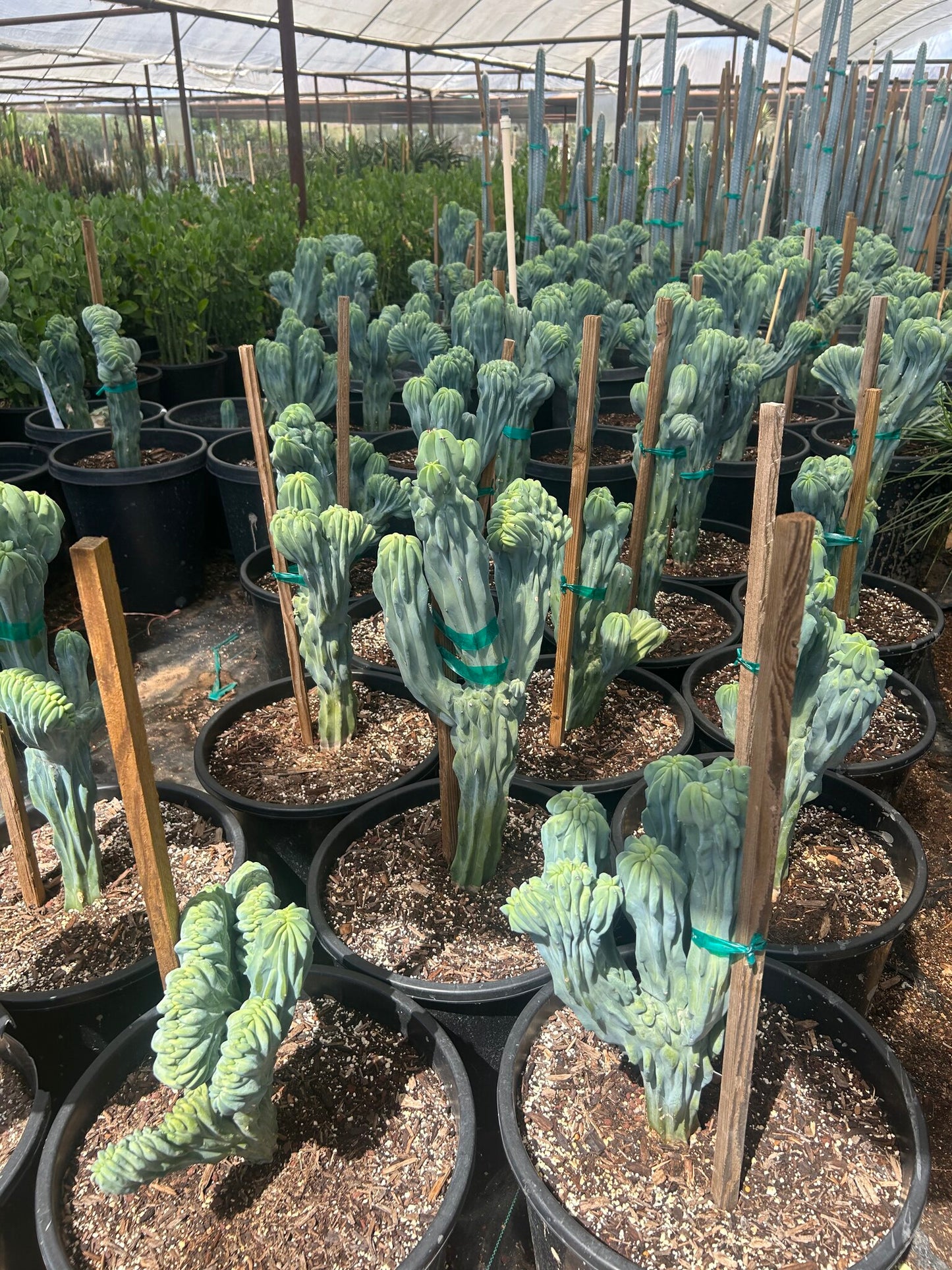
Crested Blue Myrtle (Myrtillocactus geometrizans f. cristata) is one of the rarest and most visually captivating cacti you can add to a Phoenix Valley landscape or collection. Instead of growing in normal columnar form, the crested mutation produces spectacular fan-shaped, brain-like undulating growth that looks like a living sculpture. Each plant is completely unique — no two crests are alike. Despite its exotic collector status, Crested Blue Myrtle is surprisingly tough in the Phoenix heat and thrives on minimal water once established. Whether you're building a curated cactus collection in Scottsdale, adding a show-stopping focal point in Paradise Valley, or designing a modern desert courtyard in Gilbert — this is the plant that stops people in their tracks.
Crested Blue Myrtle Plant Details
| Attribute | Detail |
|---|---|
| Scientific Name | Myrtillocactus geometrizans f. cristata |
| Common Names | Crested Blue Myrtle, Crested Blue Candle, Crested Bilberry Cactus |
| Mature Height | 2–4 feet (crested form stays more compact) |
| Mature Width | 2–4 feet (fan-shaped spread) |
| Growth Rate | Slow to Moderate — crested forms grow slower than standard columns |
| Sun | Full sun to light afternoon shade. Handles reflected heat from walls. |
| Water | Low once established. Drought-tolerant. |
| USDA Zones | 9–11 (Phoenix is Zone 9b–10a) |
| Soil | Well-draining. Adapts to Arizona caliche and rocky desert soils. |
| Foliage | Evergreen — blue-green crested fans year-round |
| Form | Crested (fasciated) — unique wavy, fan-shaped growth pattern |
Crested Blue Myrtle Uses in Phoenix Landscapes
Collector Focal Point
Crested Blue Myrtle is the crown jewel of any serious cactus collection. Plant it front-and-center in a raised bed, decorative container, or rock garden where its unique brain-like form can be appreciated up close. Each specimen is one-of-a-kind, making it a true conversation piece in Scottsdale, Paradise Valley, and Cave Creek gardens.
Modern Desert Courtyard Accent
The sculptural, organic form of a crested cactus pairs beautifully with clean-lined contemporary architecture and minimalist desert design. Place a single Crested Blue Myrtle against a stucco wall or in a geometric planter for maximum visual contrast. Complement with smooth river rock, decomposed granite, and architectural companions like Totem Pole Cactus or Blue Ghost Cereus.
Container & Patio Specimen
Crested Blue Myrtle's compact size makes it ideal for large decorative containers on patios, pool decks, and covered porches across Mesa, Chandler, and Tempe. Use a well-draining cactus mix and a pot with drainage holes. Containers also make it easy to protect the plant from rare hard freezes by moving it to a sheltered location.
Best Time to Plant Crested Blue Myrtle in Phoenix
Fall (October–November) is the ideal planting window. Warm soil encourages root establishment while cooler air reduces transplant stress, giving the plant 6–8 months to settle in before its first Phoenix summer. Spring (February–April) is the second-best window. Avoid summer planting if possible, as crested forms can be more sensitive to transplant shock in extreme heat.
How to Plant Crested Blue Myrtle
- Dig wide, not deep — excavate a hole 2–3× the root ball width, same depth as the container.
- Check for caliche — break through any hardpan layer completely. Crested cacti are especially sensitive to poor drainage.
- Backfill with native soil — mix in 20–30% pumice or perlite for extra drainage if your soil is heavy clay.
- Spacing — 3–4 feet apart if grouping; give individual specimens plenty of room to showcase their form.
- Water basin — build a 3–4 inch soil ring around the root zone to direct water during establishment.
- Mulch — 2–3 inches of decorative rock or gravel (not bark) to keep the root zone dry and prevent rot.
Watering Crested Blue Myrtle in Phoenix
First Year Watering Schedule
- Weeks 1–2: Every 4–5 days, deep and slow.
- Month 1–3: Every 7–10 days.
- Month 3–6: Every 10–14 days (weekly in peak summer).
- After Year 1: Every 2–3 weeks in summer; monthly or less in winter. Overwatering is the #1 killer of crested cacti — when in doubt, let it dry out.
Drip Irrigation
Place 1 emitter 12 inches from the base, delivering 1 GPH. Run for 20–30 minutes per session. Crested forms store water efficiently and need less irrigation than standard columnar cacti. Always err on the side of underwatering.
What makes Crested Blue Myrtle different from regular Blue Myrtle?
Crested Blue Myrtle is a naturally occurring mutation (fasciation) of the standard Blue Myrtle Cactus. Instead of growing straight columnar stems, the growth point fans out into a wavy, undulating crest that resembles coral or a brain. Each crested specimen is genetically unique, which is why they're prized by collectors.
How rare is Crested Blue Myrtle?
Very rare. Cresting is an uncommon genetic mutation that occurs randomly in a small percentage of Blue Myrtle seedlings. Crested specimens command premium prices because they can't be reliably reproduced from seed — they must be propagated from cuttings of existing crested plants.
Can Crested Blue Myrtle handle Phoenix summer heat?
Yes, with proper placement. Crested Blue Myrtle handles full Arizona sun and reflected heat, though it may appreciate light afternoon shade during the most intense weeks of summer (June–July). Once established, it's surprisingly heat-tolerant for such an exotic-looking plant.
Does Crested Blue Myrtle revert to normal growth?
Occasionally, a crested cactus may send up a normal columnar shoot alongside the crested fan. These can be pruned off if you prefer to maintain the pure crested form, or left to grow for an interesting mixed appearance.
You May Also Like
- Blue Myrtle Cactus — The standard columnar form of the same species. Beautiful blue-green columns that complement the crested variety.
- Micro Crested Blue Myrtle — A smaller, more compact crested form perfect for containers and tight spaces.
- Totem Pole Cactus — Smooth, spineless columns with unique knobby texture. Another collector favorite.
- Blue Ghost Cereus — Powdery blue columnar cactus with a ghostly appearance. Stunning alongside crested forms.
- Crested San Pedro — Another prized crested columnar cactus with dramatic fan-shaped growth.
How Many Crested Blue Myrtle Do I Need?
Crested Blue Myrtle is a slow, one-of-a-kind collector specimen that matures around 2 to 4 feet across, so it is almost always planted as a single living sculpture rather than in runs. Set it front and center in a raised bed, container, or rock-garden vignette where the fan can be seen up close. If you are building a crested-and-columnar collector grouping, use this spacing:
| Planting | Spacing |
|---|---|
| Single focal specimen | Allow a 4 to 5 ft clear viewing zone |
| Collector grouping of 3 | 3 to 4 ft apart, staggered |
| Mixed crest-and-column bed | 3 to 4 ft between plants |
Each crest is unique, so a single well-placed plant usually has more impact than a row.
Crested Blue Myrtle Season-by-Season in Phoenix
- Spring (Feb to Apr): New crested growth resumes as the soil warms, slowly widening the fan. A good second planting window once frost risk passes.
- Summer (May to Sep): Heat-tough once established, but in the most intense weeks (June to July) light afternoon shade keeps the blue-green crest from scorching in full reflected sun. Ease off water during monsoon humidity to prevent rot.
- Fall (Oct to Nov): Prime planting season. Warm soil and mild air let it settle in before winter.
- Winter (Dec to Jan): Evergreen and handsome, but this is a frost-tender Mexican species. Expect damage in the upper 20s°F: site it in a warm microclimate, or grow it in a pot you can move to shelter on hard-freeze nights.
At a Glance
✔ Heat-Loving (Reflected-Heat Tolerant) ✔ Drought-Tolerant ✔ Evergreen ✔ Low-Maintenance ✔ Deer & Rabbit-Resistant
Plant It With
- Blue Myrtle Cactus: the standard blue-green columnar form of the same species, a natural pairing that shows off the crest's mutation.
- Micro Crested Blue Myrtle: a smaller compact crest for the front of a collector grouping or container.
- Crested San Pedro: another prized crested column with dramatic fan-shaped growth for a curated crest bed.
- Blue Ghost: a powdery blue columnar cactus whose ghostly color stands beautifully behind the crest.
Is Crested Blue Myrtle Right for Your Yard?
Crested Blue Myrtle is a great fit for a collector who wants a sculptural focal point in a bright spot with sharp drainage, a modern courtyard, or a moveable container, with light afternoon shade in peak summer. Give it lean, fast-draining soil and go easy on water. It is not a fit for a frost-exposed bed left unprotected through winter, or a heavy, poorly draining spot where the crest is prone to rot.
Customer Reviews
Share