

Cape Honeysuckle Staked
Cape Honeysuckle Staked
Couldn't load pickup availability
Phoenix's Most Vivid Flowering Vine — Cape Honeysuckle Staked
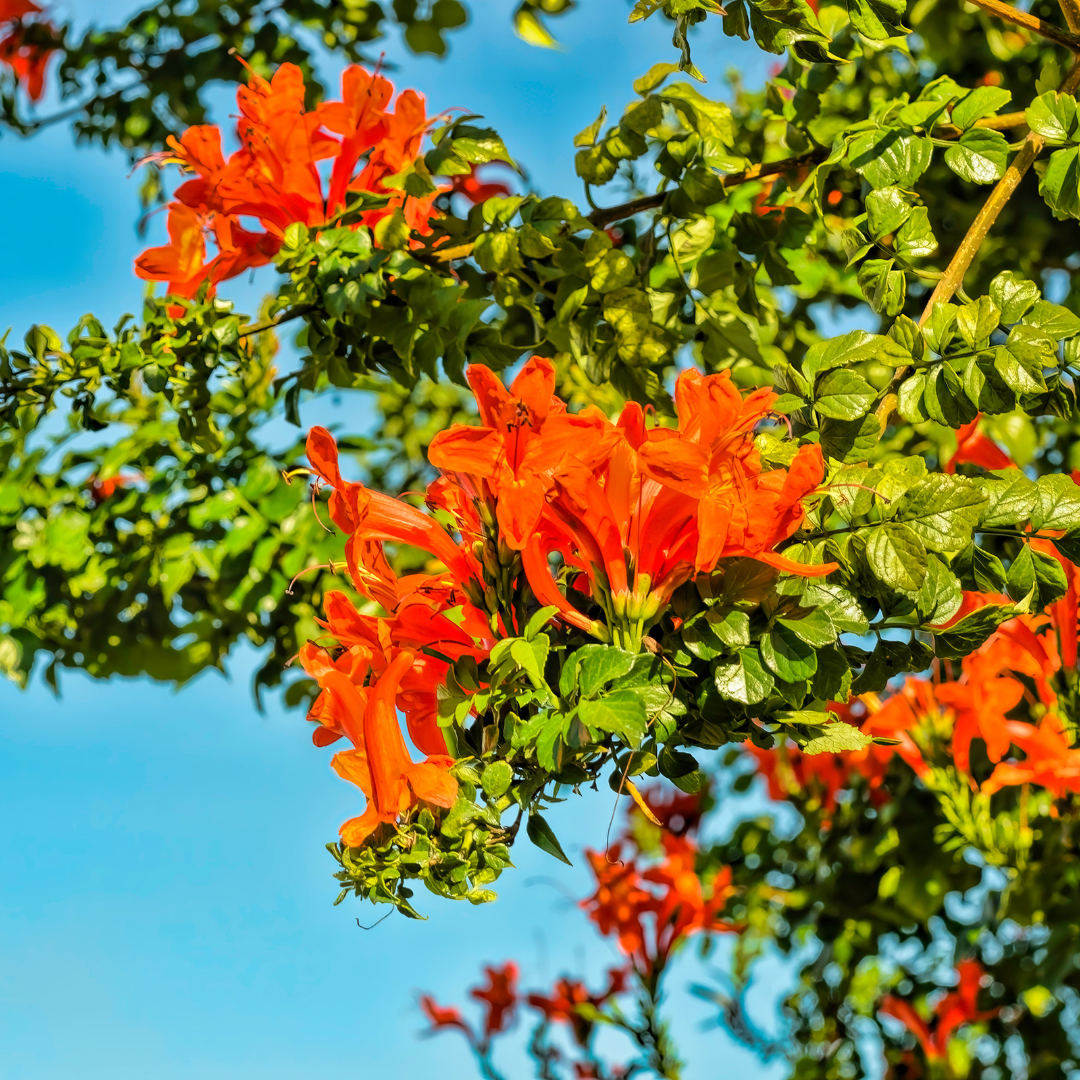
Cape Honeysuckle (Tecoma capensis) is the most brilliantly colored flowering vine available for Phoenix landscapes. With its non-stop display of vivid orange-red tubular blooms from summer through fall — exactly when most plants look spent — it transforms walls, fences, and trellises into a cascade of tropical color. Staked and trained for immediate vertical impact, Three Timbers' Cape Honeysuckle is ready to climb from day one. Whether you're creating a bold color statement in Scottsdale, covering a block wall in Chandler, or attracting hummingbirds in Mesa — Cape Honeysuckle delivers unmatched flowering performance in Phoenix heat.
Cape Honeysuckle Plant Details
| Attribute | Detail |
|---|---|
| Scientific Name | Tecoma capensis |
| Common Names | Cape Honeysuckle, Cape Tecoma, Bignonia capensis |
| Mature Height | 6–10 feet as a shrub; 15–25 feet as a trained vine |
| Mature Width | 4–8 feet as a shrub |
| Growth Rate | Fast — 3–6 feet per year in Phoenix |
| Sun | Full sun (6+ hrs). Handles reflected heat from walls. |
| Water | Low once established. Moderately drought-tolerant. |
| USDA Zones | 9–11 (Phoenix is Zone 9b–10a) |
| Soil | Well-draining. Adapts to Arizona caliche soils. |
| Foliage | Semi-evergreen — may lose some leaves in cold winters |
| Bloom Color | Vivid orange-red; blooms summer through fall |
Cape Honeysuckle Uses in Phoenix Landscapes
Wall & Fence Coverage
Cape Honeysuckle is one of the fastest ways to cover a block wall or chain-link fence in Phoenix with color. When staked and trained, it climbs rapidly — covering significant wall space in a single season. The vivid orange-red blooms against a tan or white wall create a dramatic focal point visible from the street. Plant 6–8 feet apart along a fence for solid coverage: 20 ft fence — 3–4 plants; 40 ft fence — 6–7 plants.
Hummingbird & Pollinator Garden
Cape Honeysuckle's tubular orange-red blooms are among the top hummingbird attractors in the Phoenix Valley. If you want hummingbirds visiting your yard all summer and fall, plant Cape Honeysuckle along a south- or west-facing wall or trellis. It's also attractive to butterflies and beneficial insects. Pair with Red Salvia and Desert Willow for a multi-season hummingbird habitat.
Espalier & Trellis Planting
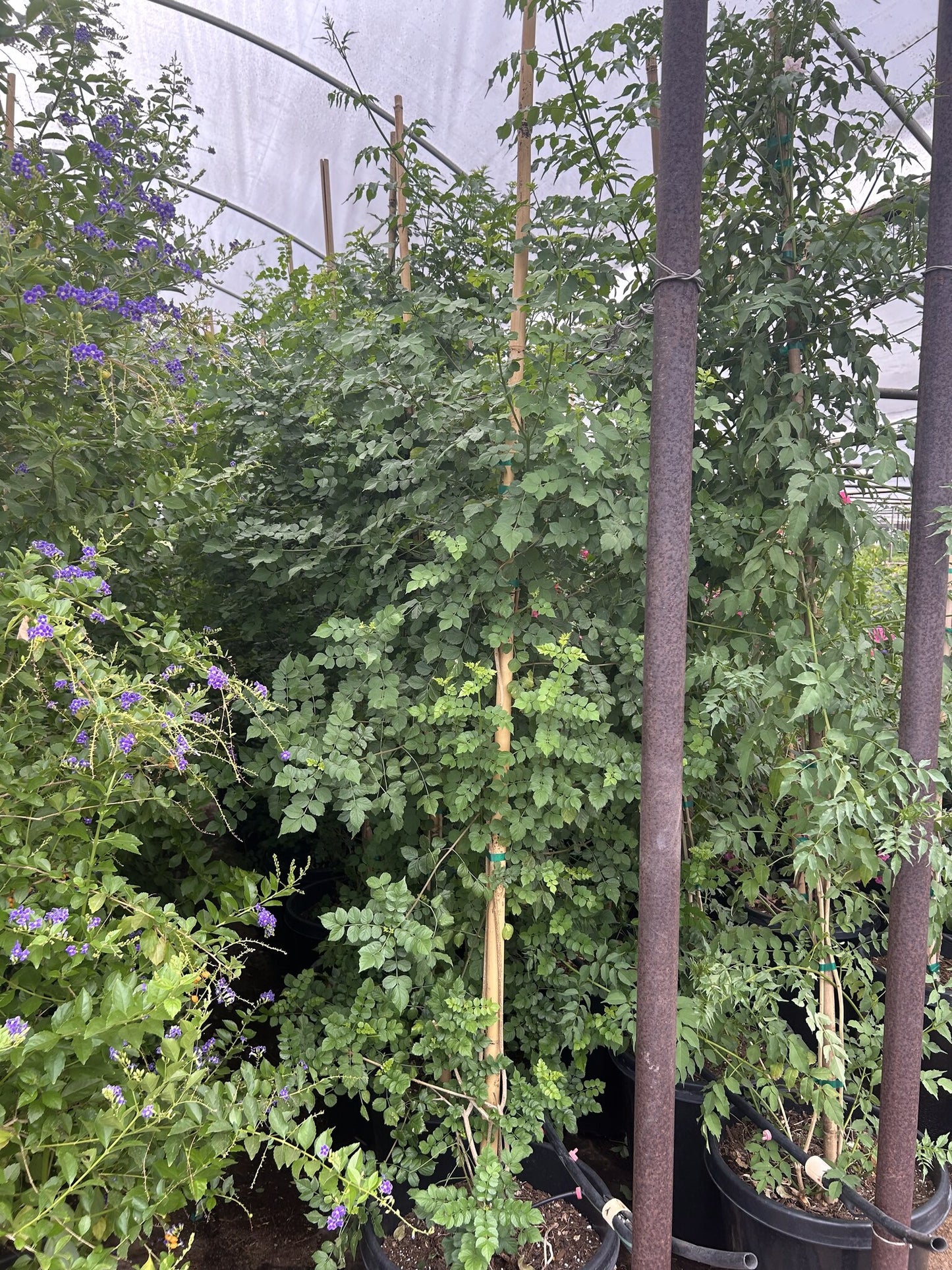
Staked Cape Honeysuckle is ready to be trained against walls, pergolas, and decorative trellises. Its flexible stems can be guided along supports to create an espalier pattern — a living artwork of green foliage and vivid blooms on a flat wall surface. This technique maximizes color impact in narrow spaces like side yards and courtyard walls in Scottsdale and Tempe.
Screening & Privacy Along Warm Walls
On south- and west-facing walls where reflected heat kills most plants, Cape Honeysuckle thrives. Planted in a row along a hot wall with trellis support, it creates a dense, colorful privacy screen that performs best during Phoenix's hottest months — the opposite of most flowering plants.
Best Time to Plant Cape Honeysuckle in Phoenix
Spring (March–May) is ideal — warm soil and lengthening days trigger immediate growth and flowering in the same season. Fall (September–October) is the second-best option. Avoid winter planting; Cape Honeysuckle is frost-sensitive and benefits from warm establishment temperatures. In Phoenix, it's one of the few plants that actually performs better when planted in warmer weather.
How to Plant Cape Honeysuckle
- Dig wide, not deep — 2–3x the root ball width, same depth as the container.
- Check for caliche — break through any hardpan layer to ensure proper drainage.
- Backfill with native soil — a 20% organic amendment blend helps with establishment.
- Spacing — 6–8 ft apart for wall coverage; 4–5 ft for dense screening.
- Install support — attach to a trellis, fence wire, or wall hooks before or immediately after planting.
- Mulch — 2–3 inches of bark or gravel mulch retains moisture and keeps roots cool.
Watering Cape Honeysuckle in Phoenix
First Year Watering Schedule
- Weeks 1–2: Every 1–2 days, deep and slow (20–30 min drip)
- Months 1–2: Every 3–4 days
- Months 3–6: Every 7–10 days (every 5–7 days during peak summer)
- After Year 1: Every 10–14 days in summer; every 3–4 weeks in winter
Drip Irrigation
Place a 2 GPH emitter 18–24 inches from the base. Cape Honeysuckle is moderately drought-tolerant once established but produces its best flowering display with regular summer irrigation. In Phoenix, deep watering every 10–14 days during summer maximizes blooming and vine growth.
How fast does Cape Honeysuckle grow in Phoenix?
Very fast — expect 3–6 feet of new growth per year, particularly during warm months. In Phoenix's long hot season, it can achieve impressive coverage in a single growing season when watered regularly and given a support structure to climb.
Is Cape Honeysuckle drought tolerant?
Moderately so. It tolerates dry conditions better than most flowering vines but performs best with regular deep watering during summer. Without irrigation in Phoenix's hottest months, flowering may reduce. It's not as drought-tolerant as Oleander or Desert Spoon but far tougher than tropical plants.
Will Cape Honeysuckle survive Phoenix winters?
Yes — in Phoenix's Zone 9b–10a, Cape Honeysuckle is essentially evergreen and returns vigorously each spring. Hard freezes below 25°F can damage stems, but established plants recover quickly. If frost is forecast, a light covering can protect tender new growth.
Does Cape Honeysuckle attract hummingbirds?
Absolutely — it's one of the top hummingbird plants in Phoenix. The tubular orange-red flowers are shaped perfectly for hummingbird feeding and bloom continuously through the hottest months when hummingbirds are most active in the Valley.
How do I train Cape Honeysuckle on a wall?
Attach horizontal wire guides or trellis panels to the wall before planting. As new growth emerges, gently tie stems to the support with soft plant ties. Guide horizontal stems along the wall to encourage spread; tie vertical stems upward for height. Prune after the main bloom cycle to shape and encourage branching.
You May Also Like
- Bower Vine — A climbing vine with soft pink blooms — a beautiful companion or alternative to Cape Honeysuckle's orange-red color on trellises and fences.
- Purple Sky Flower — A staked flowering accent with purple blooms that creates stunning color contrast alongside Cape Honeysuckle's orange.
- Red Oleander — A fast-growing shrub with red blooms that pairs beautifully with Cape Honeysuckle for a hot-color summer garden.
- Desert Willow — A native flowering tree with orchid-like pink blooms that attracts the same hummingbirds as Cape Honeysuckle.
- Ruellia — A low-growing purple-flowering groundcover that works beautifully as a border plant beneath a Cape Honeysuckle trellis.
How Many Cape Honeysuckle Staked Do I Need?
Staked Cape Honeysuckle is trained vertically, so plan by run length along the wall or fence you want to cover. At 6 to 8 ft spacing each plant fills a wide span once established:
| Wall / Fence Run | Plants Needed (6–8 ft spacing) |
|---|---|
| 15 ft | 2–3 plants |
| 25 ft | 3–4 plants |
| 40 ft | 5–6 plants |
| 60 ft | 8–9 plants |
For a denser, faster screen tighten spacing to 4 to 5 ft. As a single staked specimen on a courtyard trellis or pergola post, one plant is plenty.
Cape Honeysuckle Staked Season-by-Season in Phoenix
- Spring (Feb–Apr): New growth flushes hard as soil warms. A great second planting window and the time to set up trellis ties and guide young stems vertically.
- Summer (May–Sep): Peak performance. Vivid orange-red blooms keep coming through extreme and reflected heat, and the monsoon flush adds fast new growth. One of the few vines that flowers best in the hottest months.
- Fall (Oct–Nov): Prime planting season and a strong continued bloom that draws migrating and resident hummingbirds.
- Winter (Dec–Jan): Semi-evergreen in the Valley. Hard freezes below about 25°F can damage stems and tender new growth. Cover on hard frost nights and prune out any dieback in early spring; established plants recover fast.
At a Glance
✔ Hummingbird-Friendly ✔ Pollinator-Friendly ✔ Heat-Loving (Reflected-Heat Tolerant) ✔ Drought-Tolerant ✔ Evergreen ✔ Low-Maintenance
Plant It With
- Cape Honeysuckle: the shrub form of the same plant for filling beds below a staked trellis run.
- Arizona Yellow Bells: a Tecoma cousin in golden-yellow that extends the warm-color, hummingbird theme.
- Mexican Honeysuckle: soft orange tubular blooms and a mounding habit to anchor the base of the wall.
- Bottlebrush Bush: red bottlebrush flowers and another reliable hummingbird magnet for the same hot exposure.
Is Cape Honeysuckle Staked Right for Your Yard?
Yes if you have a full-sun wall, fence, pergola, or trellis (including brutal south- and west-facing reflected-heat spots), well-draining or amended caliche soil, and you want fast vertical color plus hummingbirds through the hottest half of the year. Not a fit if you need a tidy, self-supporting shrub with no training, a plant for deep shade, or something that will sail through a hard freeze untouched: in a cold snap below about 25°F expect stem damage and plan to cover it.
Customer Reviews
Share