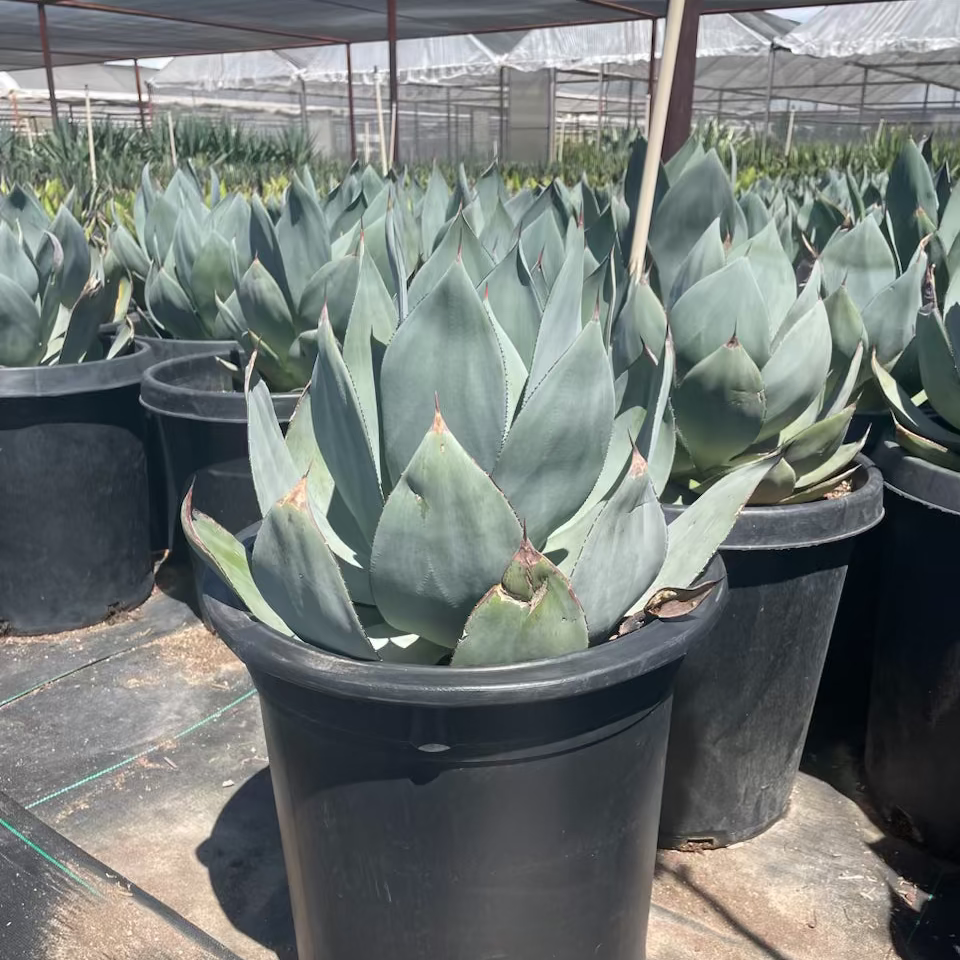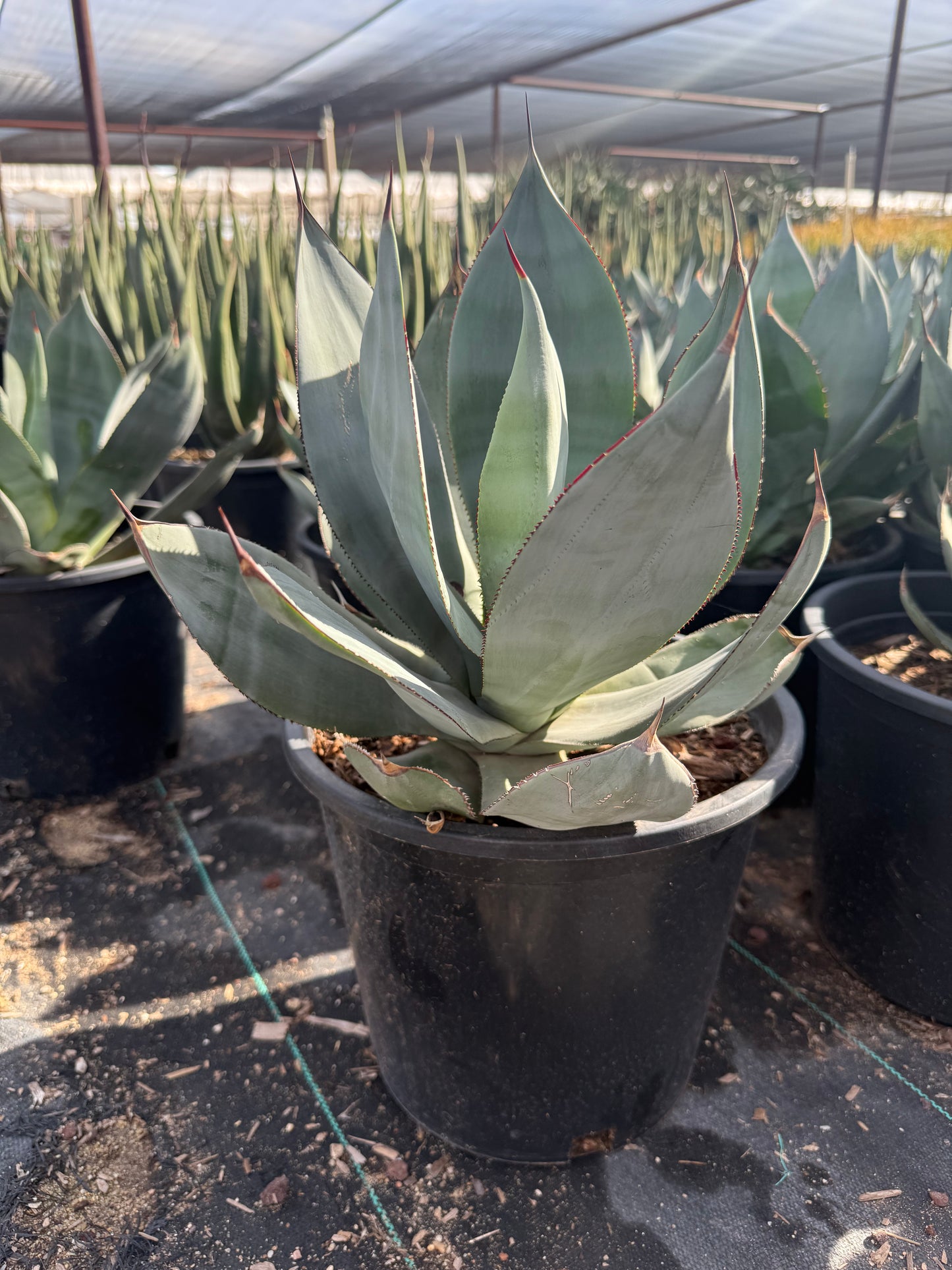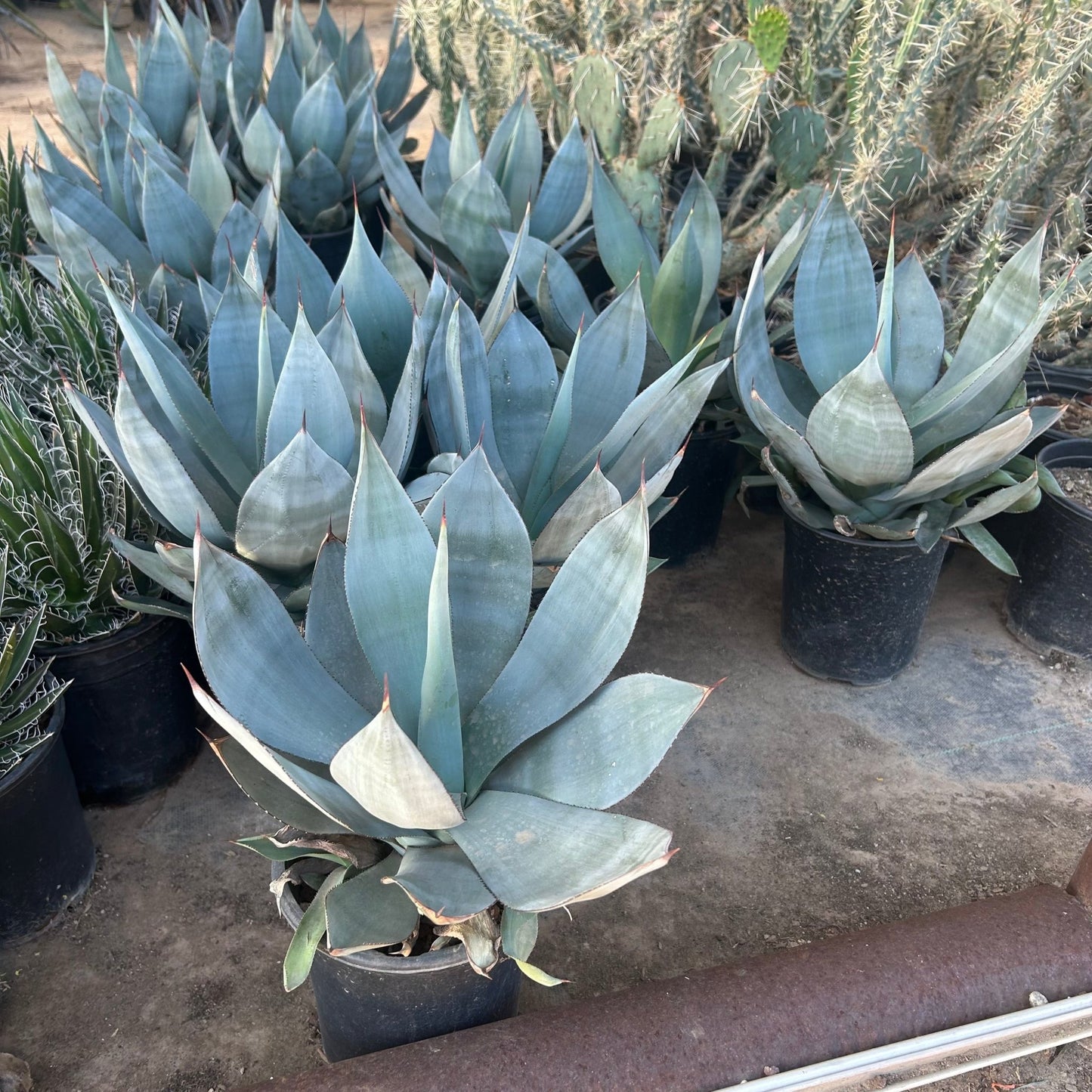


Agave celsii 'nova'
Agave celsii 'nova'
Couldn't load pickup availability
The Sleekest Compact Agave for Modern Phoenix Landscapes
Agave celsii 'Nova' is a refined, eye-catching selection of the classic Agave celsii — prized for its exceptionally smooth, blue-green leaves and clean symmetrical rosette. This compact agave tops out at just 2–3 feet tall and 3–4 feet wide, making it the perfect scale for courtyards, containers, entryways, and modern xeriscape designs throughout the Phoenix Valley. Like its parent species, 'Nova' tolerates partial shade better than most agaves — a rare trait that opens up planting options under desert trees, on north-facing walls, and in covered patios. Whether you're creating a curated succulent collection in Scottsdale, designing a minimalist desert courtyard in Tempe, or adding sculptural accents in Mesa — Agave celsii 'Nova' delivers polished desert elegance with virtually zero maintenance.
Agave Celsii 'Nova' Plant Details
| Attribute | Detail |
|---|---|
| Scientific Name | Agave celsii 'Nova' |
| Common Names | Agave Nova, Celsii Nova Agave |
| Mature Height | 2–3 feet |
| Mature Width | 3–4 feet |
| Growth Rate | Slow to moderate — reaches mature size in 3–5 years in Phoenix |
| Sun | Full sun to partial shade. One of the most shade-tolerant agaves. |
| Water | Very low once established. Extremely drought-tolerant. |
| USDA Zones | 8–11 (Phoenix is Zone 9b–10a) |
| Soil | Well-draining required. Thrives in Arizona caliche and rocky native soils. |
| Foliage | Evergreen — smooth blue-green leaves with a clean, polished appearance |
| Bloom | Yellow-green flower spike (monocarpic — blooms once after 10–15 years) |
Agave Celsii 'Nova' Uses in Phoenix Landscapes
Modern Xeriscape & Minimalist Design
The 'Nova' selection's exceptionally clean lines and smooth leaf texture make it a designer's favorite for modern desert landscapes. Its compact, symmetrical rosette looks museum-quality against white gravel, Cor-ten steel planters, or polished concrete walls. Plant a trio of varying sizes for a gallery-quality vignette, or use a single large specimen as a standalone focal point.
Container & Courtyard Focal Point
At 2–3 feet tall, Agave celsii 'Nova' is perfectly scaled for decorative containers, entryway planters, and courtyard accents. A 10/15-gallon or 25-gallon specimen in a sleek pot instantly elevates a patio or front entrance. The smooth leaves and soft terminal spines make it safer than many agaves for high-traffic areas near doorways.
Shade-Tolerant Succulent Garden
'Nova' thrives in partial shade conditions that would stress most agaves. Plant it under palo verde canopies, on north-facing garden walls, or in the filtered light of covered patios. Combine with Tiger Aloe, Soft-Leaf Yucca, and shade-loving euphorbias for a sophisticated low-water garden in challenging light conditions.
Best Time to Plant Agave Celsii 'Nova' in Phoenix
Fall (October–November) is the ideal planting window. Warm soil promotes root growth while cooler air reduces transplant stress, giving the plant a full cool season to establish before summer. Spring (February–April) is a strong second option. Avoid summer planting — transplant shock in extreme Phoenix heat can stall growth for months.
How to Plant Agave Celsii 'Nova'
- Dig wide, not deep — hole should be 2–3x the root ball width, same depth as the container.
- Check for caliche — break through any hardpan layer. Agave Nova will rot in waterlogged soil.
- Backfill with native soil — no amendments needed. Avoid rich compost that retains moisture.
- Spacing — 3–4 feet apart for groupings; 5+ feet for individual specimens.
- Water basin — build a shallow 2-inch ring for initial watering; remove after establishment.
- Mulch — 2–3 inches of gravel or decomposed granite. Never use bark mulch against the rosette base.
Watering Agave Celsii 'Nova' in Phoenix
First Year Watering Schedule
Weeks 1–2: Every 3–4 days, deep and slow. Month 1–2: Every 5–7 days. Month 3–6: Every 10–14 days. After Year 1: Every 2–4 weeks in summer; monthly or less in winter. Established 'Nova' needs very little supplemental water.
Drip Irrigation
Place one 1-GPH emitter 12–18 inches from the plant base. Overwatering causes root rot faster than underwatering causes stress — always err on the dry side.
What's the difference between Agave celsii and Agave celsii 'Nova'?
'Nova' is a selected cultivar with smoother, more refined leaves and a tidier overall form. The standard Agave celsii may have slightly rougher leaf texture and less uniform symmetry. 'Nova' is preferred for contemporary and modern landscape designs where a polished look is the goal.
How fast does Agave celsii 'Nova' grow?
Slow to moderate. A 1-gallon plant reaches its full 3–4 foot spread in 3–5 years. Larger 10/15-gallon and 25-gallon specimens provide near-instant impact and are the most popular sizes for landscape installations.
Does Agave celsii 'Nova' produce pups?
Yes — it freely produces offsets around the base over time. These can be left for a natural clumping effect or separated and replanted. Pups are ready to divide when they reach 6–8 inches.
Is Agave celsii 'Nova' cold hardy in Phoenix?
Yes — it handles Phoenix's occasional winter cold snaps with ease, tolerating temperatures down to about 20°F. It is well-suited to all microclimates in the Phoenix Valley including higher-elevation areas like Fountain Hills and Cave Creek.
You May Also Like
Agave Celsii — The parent species with a slightly more rustic look, available at a lower price point.
Agave Chiapensis — Another compact, shade-tolerant agave that pairs perfectly with 'Nova' in mixed plantings.
Desert Spoon — A larger rosette-forming succulent for dramatic scale contrast in agave gardens.
Tiger Aloe — Compact striped succulent that thrives in the same partial shade as 'Nova'.
Red Yucca — Coral flower spikes add vertical interest and color contrast to agave groupings.
How Many Agave Celsii 'Nova' Do I Need?
This is a compact specimen agave that also clumps with age. Use it as a container focal point, or in small odd-numbered groups for a polished succulent bed:
| Use | Spacing | Notes |
|---|---|---|
| Container / entry accent | 1 plant | Smooth leaves and soft tips make it a clean patio or doorway piece. |
| Designer vignette | 3 plants, 3–4 ft apart | Vary the sizes for a gallery-style modern grouping. |
| Connected bed | 5+ plants, 3–4 ft apart | Rosettes and pups knit into a cohesive low planting over time. |
For a 100 sq ft modern succulent bed, about 7 to 9 plants at 3.5 ft spacing fills in well as they mature.
Agave Celsii 'Nova' Season-by-Season in Phoenix
- Spring (Feb–Apr): Strong second planting window. Smooth new leaves push from the center and pups emerge at the base.
- Summer (May–Sep): Takes full sun but also accepts afternoon shade, one of the few agaves that does. Reduce water during monsoon so the crown never sits wet.
- Fall (Oct–Nov): Prime planting season. Warm soil plus mild air gives the best root establishment of the year.
- Winter (Dec–Jan): Holds its clean evergreen rosette. Hardy to about 20°F, so normal Valley winters are no issue; cover only in a rare hard freeze.
At a Glance
✔ Heat-Loving (Reflected-Heat Tolerant) ✔ Drought-Tolerant ✔ Evergreen ✔ Low-Maintenance ✔ Deer & Rabbit-Resistant ✔ Cold-Hardy to 20°F
Plant It With
- Agave Celsii: the parent species, for a relaxed companion to the polished 'Nova' form.
- Agave Chiapensis: another compact shade-tolerant agave for mixed plantings.
- Desert Spoon: a larger rosette that adds scale contrast in the same bed.
- Red Yucca: coral bloom spikes for vertical color above the low rosettes.
Is Agave Celsii 'Nova' Right for Your Yard?
It is an ideal fit for modern, compact plantings in full sun or partial shade with fast-draining or rocky caliche soil, including tricky north-wall and tree-canopy spots. It needs little water and handles normal Valley frost. It is not a fit if your soil holds water, since wet crowns rot, or if you need a large-scale statement plant: 'Nova' stays deliberately compact.
Customer Reviews
Share