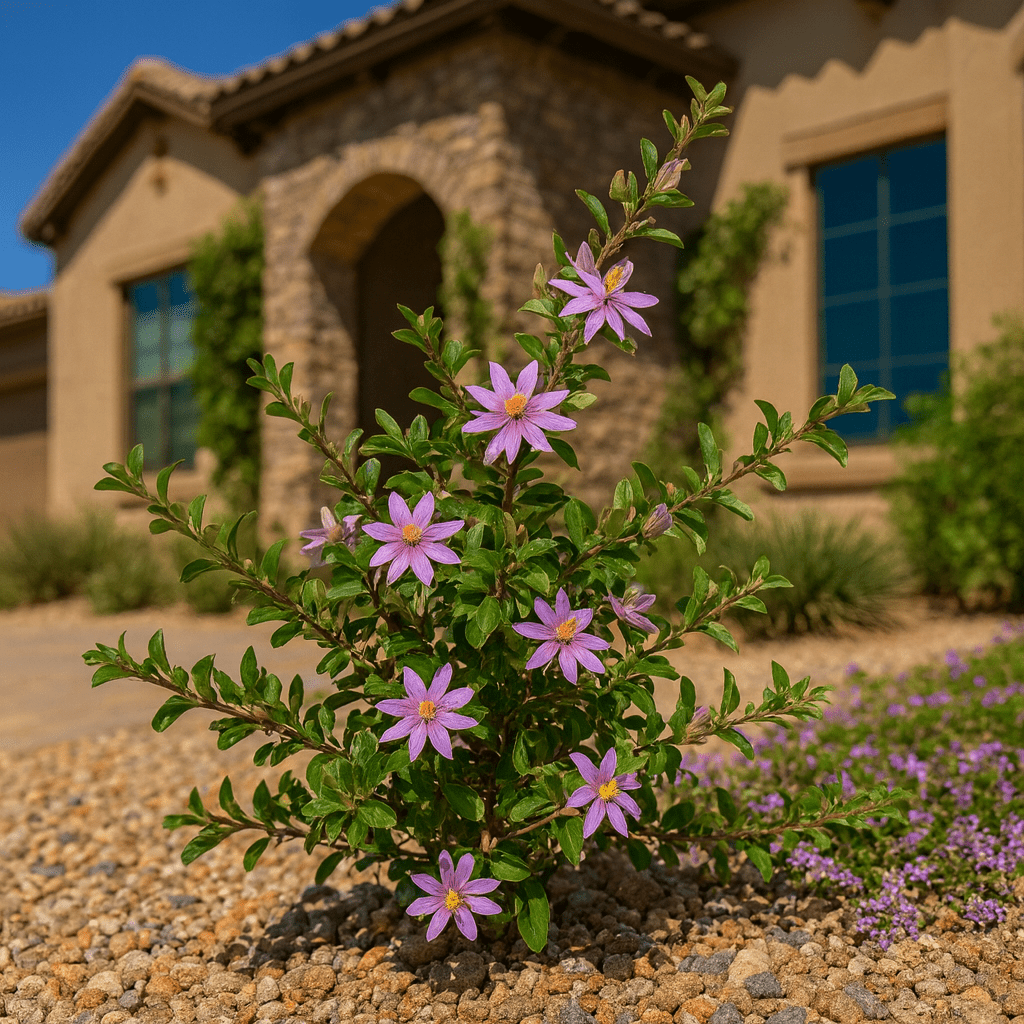

Lavender Starflower
Lavender Starflower
Couldn't load pickup availability
Phoenix's Year-Round Flowering Shrub — Lavender Starflower for Desert Landscapes
Lavender Starflower (Grewia caffra), also known as African Crossberry, is one of Phoenix's most reliable and beautiful flowering shrubs. Native to southern Africa, this elegant evergreen produces delicate, five-petaled, star-shaped flowers in soft lavender-purple with contrasting yellow stamens — blooming from spring through fall and nearly year-round in Phoenix's mild winters. While most plants rest during cooler months, Lavender Starflower keeps flowering, giving Scottsdale, Chandler, and Tempe gardens continuous color all year. Hardy in Zones 9–11, drought-tolerant once established, and adaptable to full sun or partial shade — it's one of the most versatile performers available for the Phoenix Valley.
Lavender Starflower Plant Details
| Attribute | Detail |
|---|---|
| Scientific Name | Grewia caffra |
| Common Names | Lavender Starflower, African Crossberry, Lavender Star |
| Mature Height | 8–12 ft. |
| Mature Width | 6–8 ft. |
| Growth Rate | Moderate — 2–3 ft. per year in Phoenix |
| Sun | Full sun to partial shade. Handles reflected heat from walls well. |
| Water | Low to moderate once established. Highly drought-tolerant after year one. |
| USDA Zones | 9–11 (Phoenix is Zone 9b–10a) |
| Soil | Well-draining. Adapts readily to Arizona caliche soils. |
| Foliage | Evergreen — stays green year-round |
| Bloom Color | Lavender-purple with contrasting yellow stamens |
| Bloom Season | Spring through fall; near year-round in Phoenix |
Lavender Starflower Uses in Phoenix Landscapes
Year-Round Color Shrub for Desert Gardens
Lavender Starflower fills the gap left by most desert shrubs that bloom only seasonally. While plants like Bougainvillea rest in cooler months and Texas Sage blooms in pulses, Lavender Starflower continues producing its charming star-shaped blooms almost continuously throughout the Phoenix growing season and beyond. Plant it as the constant color anchor in a mixed desert shrub bed, pairing it with Ruellia and Desert Spoon for a low-water, year-round display in Gilbert, Peoria, or Glendale gardens.
Privacy Hedge and Screen
At 8–12 feet tall with a dense, upright to arching habit, Lavender Starflower works beautifully as a flowering privacy screen. Unlike purely structural hedges, this one bursts with lavender blooms all season, creating a living wall that's both functional and beautiful. For a 20-foot privacy run: plant 3–4 shrubs spaced 5–6 ft. apart. For a 40-foot screen: 6–8 plants spaced 5–6 ft. apart.
Foundation Planting and Entryway Feature
Lavender Starflower's refined, star-shaped flowers and clean evergreen foliage make it ideal for high-visibility spots near entryways, driveways, and building foundations. The soft lavender-purple blooms complement stucco walls, desert neutrals, and modern Arizona architecture beautifully. Pair it with Blue Hibiscus or Lavender for a tonal purple-themed entryway planting that looks polished year-round.
Low-Water Pollinator Garden
The nectar-rich flowers of Lavender Starflower attract native bees, butterflies, and hummingbirds throughout the extended bloom season. It's an excellent anchor for a water-wise pollinator garden in Phoenix, providing wildlife habitat while thriving on minimal irrigation. Pair with Gaura Pink and Salvia for a flowing, naturalistic pollinator bed.
Best Time to Plant Lavender Starflower in Phoenix
Fall (October–November) is the ideal planting window for Lavender Starflower in the Phoenix Valley. Warm soil temperatures support root establishment, while cooler air temperatures reduce transplant stress. Six to eight months of root growth before Phoenix's first summer gives the plant the resilience needed to thrive through triple-digit heat. Spring (February–April) is the second-best window, and you may even catch early blooms shortly after planting. Avoid summer planting if possible, as new transplants struggle to establish during peak Phoenix heat.
How to Plant Lavender Starflower
- Dig wide, not deep — excavate 2–3x the root ball width and the same depth. Avoid planting too deep.
- Check for caliche — break through any hardpan caliche layer to ensure proper water drainage. Caliche is common in Arizona and traps water around roots if not addressed.
- Backfill with native soil — a light 20% organic amendment mix is fine; Lavender Starflower adapts well to native desert soils.
- Spacing — plant 5–6 ft. apart for hedges and screens; 6–8 ft. apart for individual specimens.
- Water basin — build a 3–4 inch soil ring around the plant to direct irrigation water to the root zone.
- Mulch — apply 2–3 inches of bark or gravel mulch to retain moisture and regulate soil temperature through Phoenix summers.
Watering Lavender Starflower in Phoenix
First Year Watering Schedule
Consistent irrigation through the first year is key to establishing deep roots before Phoenix summer heat arrives.
- Weeks 1–2: Water every 1–2 days, deep and slow (20–30 minutes per session)
- Months 1–2: Water every 3–4 days
- Months 3–6: Water every 7–10 days (every 5–7 days during peak Phoenix summer)
- After Year 1: Every 10–14 days in summer; every 3–4 weeks in winter
Drip Irrigation
Install drip emitters 18–24 inches from the trunk, using 1–2 GPH emitters per plant. For hedge plantings, place two emitters per shrub on opposite sides of the root zone. Once established, Lavender Starflower thrives on very low supplemental irrigation, especially through Phoenix winters.
How fast does Lavender Starflower grow in Phoenix?
In Phoenix's warm climate, Lavender Starflower grows 2–3 feet per year. Most plants reach 6–8 feet within 3 seasons, providing excellent screening and flowering coverage relatively quickly.
Is Lavender Starflower drought-tolerant?
Yes — once established after its first year, Lavender Starflower is quite drought-tolerant. It still benefits from deep watering every 2 weeks in Phoenix summers, but requires far less water than many flowering shrubs.
How does Lavender Starflower compare to Texas Sage?
Both are excellent low-water flowering shrubs for Phoenix. Texas Sage (Leucophyllum) blooms in purple pulses triggered by humidity and rain. Lavender Starflower blooms more continuously throughout the season, giving you consistent color rather than spectacular but brief shows.
Can Lavender Starflower handle Phoenix summer heat?
Yes — it's well-adapted to desert heat with appropriate watering. Established plants handle full Phoenix sun with minimal stress. In the hottest western exposures, some afternoon shade improves performance through the peak of summer.
Does it work as a privacy screen?
Absolutely. Lavender Starflower's upright habit and dense evergreen foliage make it one of the better flowering privacy screens available for Phoenix landscapes. It reaches 8–12 feet at maturity and maintains its screening density year-round.
You May Also Like
- Blue Hibiscus (Alyogyne huegelii) — a close companion with similar lavender-blue blooms and the same low-water, full-sun adaptability for Phoenix landscapes.
- Texas Sage (Leucophyllum frutescens) — a classic Phoenix flowering shrub that complements Lavender Starflower in mixed low-water hedges.
- Gaura Pink (Oenothera lindheimeri) — a graceful perennial with butterfly-like pink blooms that pairs beautifully with Lavender Starflower in pollinator garden designs.
- Desert Spoon (Dasylirion wheeleri) — a structural desert accent that provides bold texture contrast to Lavender Starflower's soft, flowing form.
- Lilac Vine (Hardenbergia violacea) — a climbing vine option that offers similar lavender-purple coloring for fence lines and trellises.
How Many Lavender Starflowers Do I Need?
For a flowering privacy screen or hedge, space plants about 5 feet apart on center, using the shrub's 6 to 8 foot mature width. Closer spacing fills in to a solid wall faster; wider spacing lets each plant show its arching form.
| Hedge / Screen Run | Plants Needed (5 ft spacing) |
|---|---|
| 10 ft | 2 plants |
| 20 ft | 4 plants |
| 30 ft | 6 plants |
| 40 ft | 8 plants |
| 50 ft | 10 plants |
Lavender Starflower Season-by-Season in Phoenix
- Spring (Feb–Apr): Bloom ramps up strongly with new growth, covering the shrub in lavender-purple stars. Best second planting window of the year and prime time for a light shaping prune.
- Summer (May–Sep): Keeps flowering through extreme heat and reflected wall warmth, slowing only in the most brutal stretches. Monsoon humidity often triggers a fresh flush. In the hottest west-facing spots, a little afternoon shade keeps it looking its best.
- Fall (Oct–Nov): Prime planting season and a strong second bloom as temperatures ease. Growth and flowering stay vigorous well into late fall.
- Winter (Dec–Jan): Stays evergreen and often keeps a few blooms through Phoenix's mild winters. It is frost-sensitive, though: expect leaf or tip damage below about 28 to 30°F, so cover young plants on hard frost nights and site it in a warm spot near a wall.
At a Glance
✔ Pollinator-Friendly ✔ Hummingbird-Friendly ✔ Heat-Loving (Reflected-Heat Tolerant) ✔ Drought-Tolerant ✔ Evergreen ✔ Low-Maintenance
Plant It With
- Texas Sage: a classic purple-blooming low-water shrub that complements the lavender flowers in a mixed hedge.
- Blue Hibiscus: similar lavender-blue blooms and full-sun, low-water habit for a tonal purple planting.
- Desert Spoon: bold architectural rosette that contrasts with the soft, flowing form.
- Lilac Vine: a climbing companion that echoes the purple coloring on a nearby fence or trellis.
Is Lavender Starflower Right for Your Yard?
It thrives in full sun to part shade with room to reach 6 to 8 feet wide, in well-drained soil broken free of caliche, and rewards you with near year-round lavender color on very little water once established. Its nectar-rich blooms make it a magnet for bees, butterflies, and hummingbirds. It is not the right fit for an unprotected low spot that collects cold air, since hard frost below about 28 to 30°F can nip the foliage, or for a spot where you cannot give a young plant its first season of regular water.
Customer Reviews
Share