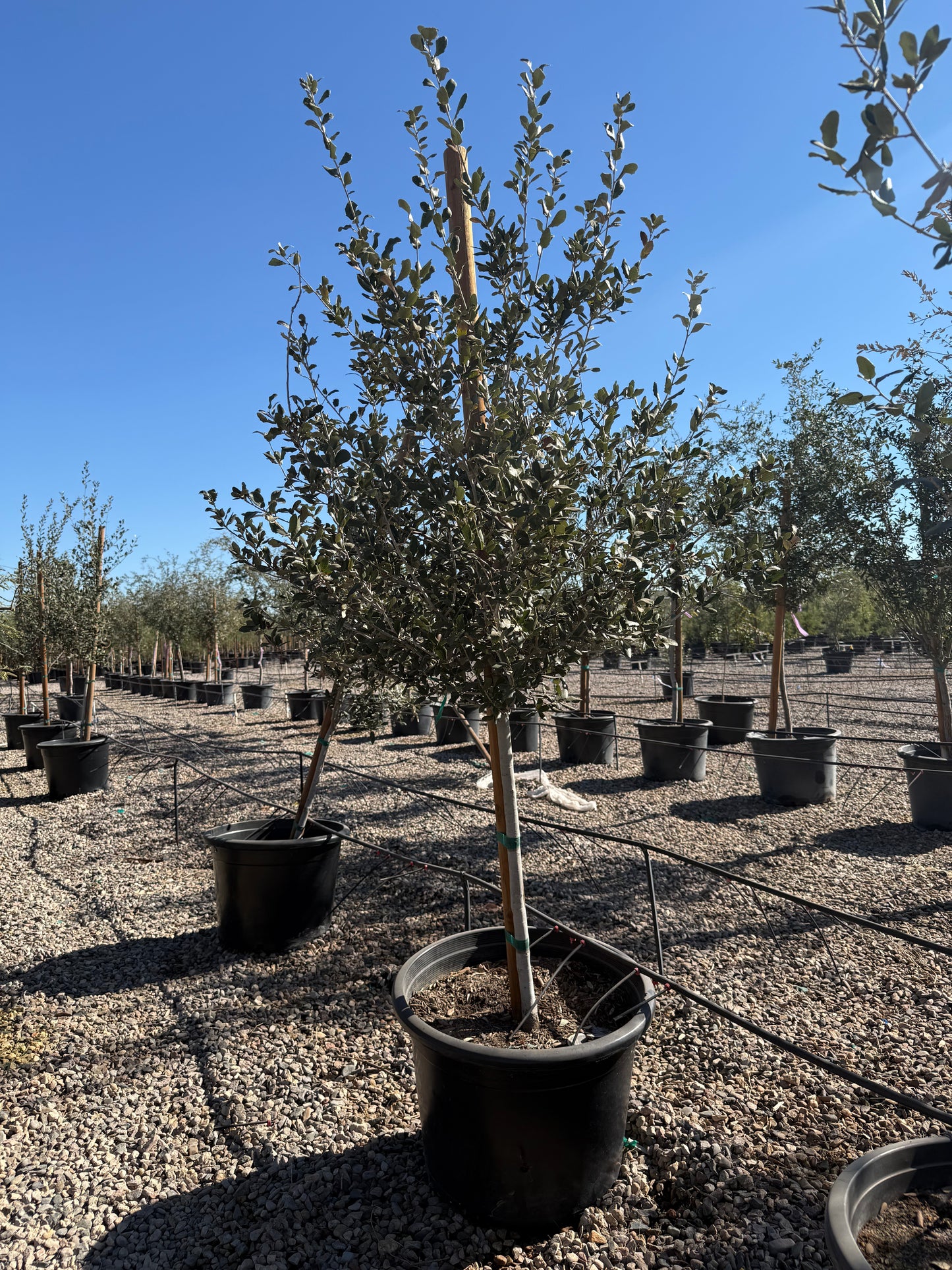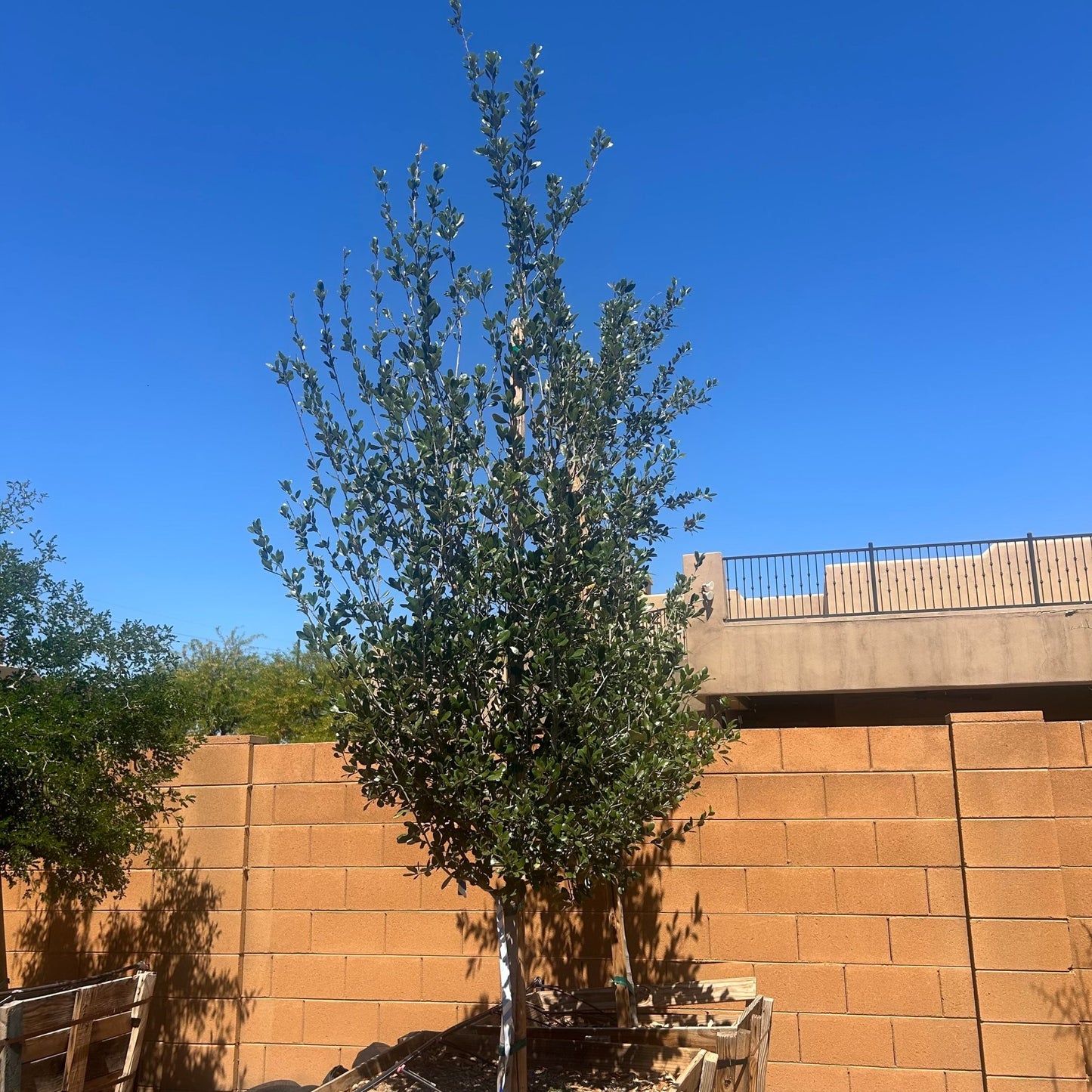


Joan Lionetti Texas Live Oak
Joan Lionetti Texas Live Oak
Couldn't load pickup availability
Joan Lionetti Texas Live Oak (Quercus fusiformis) – Evergreen Shade Tree for Phoenix
The Joan Lionetti Texas Live Oak (Quercus fusiformis 'Joan Lionetti') is a superior cultivar of Texas Live Oak selected for its compact, symmetrical form, dense evergreen canopy, and outstanding tolerance to the desert Southwest's extreme heat and alkaline soils. Unlike many oaks that struggle in the low desert, the Joan Lionetti thrives in Phoenix, Scottsdale, and the greater Valley of the Sun, delivering broad, deep shade from its spreading canopy of tough, leathery dark green leaves. Its deep root system and high drought tolerance make it one of the most dependable large shade trees available for water-wise Arizona landscapes, and its timeless classic form adds lasting curb appeal and property value.
| Plant Details | |
|---|---|
| Common Name | Joan Lionetti Texas Live Oak |
| Scientific Name | Quercus fusiformis 'Joan Lionetti' |
| Plant Type | Evergreen to semi-evergreen large shade tree |
| Mature Height | 25–40 ft |
| Mature Spread | 30–50 ft |
| Growth Rate | Moderate (1–2 ft/year) |
| Sun Exposure | Full Sun |
| Water Needs | Low to moderate once established |
| Flower Color | Inconspicuous yellow-green catkins |
| Bloom Season | Spring |
| Hardiness Zones | USDA Zones 7–11 |
| Soil | Adaptable; tolerates rocky, sandy, loamy, and alkaline soils; excellent drainage preferred |
| Available Sizes | 24"/25 Gal · 36" Box |
Why Plant Joan Lionetti Texas Live Oak in Phoenix?
The Joan Lionetti Texas Live Oak is one of the premier large shade trees for hot, dry, alkaline Phoenix-area landscapes. Its combination of deep shade, evergreen coverage, and exceptional heat and drought tolerance sets it apart from most oaks. Homeowners and landscape professionals choose it for:
- Expansive, deep shade – Its wide-spreading canopy provides substantial shade for patios, pools, driveways, and outdoor living areas, reducing cooling costs and improving outdoor comfort.
- Evergreen coverage – Unlike many deciduous oaks, Joan Lionetti stays green year-round (with minimal leaf drop in spring as new leaves emerge), providing consistent privacy and beauty.
- Extreme drought tolerance – Deep, fibrous roots seek out moisture well below the surface, allowing the tree to survive on minimal irrigation once established.
- Alkaline and poor soil tolerance – Thrives in Arizona's caliche-heavy, alkaline soils that defeat many other oaks and shade trees.
- Long-lived landscape investment – Texas Live Oaks are among the longest-lived trees in the Southwest, providing generations of shade and beauty with minimal maintenance.
Best Time to Plant Joan Lionetti Texas Live Oak in the Phoenix Area
Plant Joan Lionetti Texas Live Oak in early spring (February–April) or fall (September–November). Spring planting gives the tree warm temperatures to establish roots before summer heat. Fall planting allows a full cool-weather root establishment period before facing its first Phoenix summer. Both windows are preferred over summer planting, which significantly stresses young trees and demands intense irrigation management to prevent fatal heat stress.
How to Plant Joan Lionetti Texas Live Oak
- Choose a spacious, sunny location – Plan for a mature spread of 30–50 feet. Plant well away from structures, fences, and underground utilities to allow full root and canopy development.
- Dig a wide, shallow hole – Make the planting hole 2–3 times wider than the root ball, but no deeper than the root ball height. Wide, shallow holes encourage the lateral root spread Texas Live Oaks need.
- Manage caliche – If you encounter a caliche layer, break through it to allow water drainage and root penetration. In severe cases, consider raised planting or amending a larger planting basin.
- Position the root ball – Set the tree so the root flare (where trunk meets roots) sits at or slightly above grade. Planting too deep is a leading cause of long-term decline in oaks.
- Backfill with native soil – Avoid heavy soil amendment. Native backfill encourages roots to extend into surrounding soil. Tamp lightly to remove large air pockets.
- Build a watering basin – Create a 6-inch berm around the drip line to concentrate irrigation over the root zone during the establishment period.
- Mulch generously – Apply 3–4 inches of coarse organic mulch (shredded wood, bark) over the root zone. Mulch conserves moisture, moderates soil temperature, and suppresses weeds. Keep mulch 6 inches clear of the trunk.
Watering Guide for Joan Lionetti Texas Live Oak
Proper watering during establishment is critical for long-term health. Texas Live Oaks develop deep, extensive root systems that make them highly drought-tolerant once established, but they need consistent deep irrigation in their first 2–3 years:
- First year: Water every 3–5 days in summer; every 7–10 days in spring and fall; every 2–3 weeks in winter. Always water deeply to 24–36 inches to encourage deep root development.
- Year 2–3 (transitional): Gradually reduce frequency — every 7–10 days in summer; every 2–3 weeks in spring and fall; monthly or natural rainfall in winter.
- Established (year 3+): Water every 2–4 weeks in summer during extreme heat; rely on rainfall in other seasons. Well-established trees often survive entirely on natural rainfall in Phoenix's cooler months.
- Signs of overwatering: Yellowing leaves, weeping bark, crown dieback. Ensure soil drains well between irrigations.
- Signs of underwatering: Leaf curl, premature leaf drop, branch dieback. Increase frequency and depth during extended heat waves.
Frequently Asked Questions
Is Joan Lionetti Texas Live Oak truly evergreen in Phoenix?
Yes, it is nearly evergreen in the low desert. In spring, the tree undergoes a brief "cedar elm" leaf exchange — dropping old leaves as new ones emerge simultaneously — so it is rarely bare. Some minimal leaf drop may occur during unusually cold winters.
How big does Joan Lionetti Texas Live Oak get?
At maturity, expect 25–40 feet in height with a broad, spreading canopy of 30–50 feet. It is a large-scale shade tree — plan accordingly and give it plenty of room to spread its full canopy without conflict from structures.
Does Joan Lionetti Texas Live Oak produce acorns?
Yes. Like all Texas Live Oaks, Joan Lionetti produces small acorns that attract quail, doves, and other wildlife. Acorn production typically begins after 5–7 years and increases as the tree matures.
Is Joan Lionetti Texas Live Oak deer resistant?
Moderately. Deer will browse young shoots and foliage if populations are high and other food sources are scarce. Mature trees with bark above browse height are generally less impacted. Protect young transplants with tree guards if deer are a known concern in your area.
How drought-tolerant is Joan Lionetti Texas Live Oak compared to other oaks?
Texas Live Oak (Quercus fusiformis) is among the most drought-tolerant oaks available for the Southwest. It significantly outperforms Valley Oak, Blue Oak, and many other species in Phoenix's extreme conditions. Its deep tap root and adaptable root system make it one of the most reliable oak choices for low-water Arizona landscapes.
Can Joan Lionetti Texas Live Oak handle Phoenix's alkaline soils?
Yes. This is one of its greatest advantages. Unlike many oaks that develop iron chlorosis (yellowing from iron deficiency) in alkaline soils, Texas Live Oak is well-adapted to the high-pH caliche-laden soils common throughout the Phoenix metro area.
You May Also Like
- Mastic Tree (Pistacia lentiscus)
- Shamel Ash (Fraxinus uhdei)
- Evergreen Elm (Ulmus parvifolia)
- Ghost Gum (Corymbia papuana)
How Many Joan Lionetti Texas Live Oaks Do I Need?
This is a large, wide-spreading shade tree (30 to 50 feet across at maturity), so it is planted as a single specimen or in a widely spaced grove, never as a hedge. Give each tree full room so the canopies can develop without crowding:
| Planting Goal | Spacing & Count |
|---|---|
| Single shade specimen | 1 tree, 25-30+ ft from structures, walls, and pools |
| Matched front-yard pair | 2 trees, 30 ft apart |
| Open grove / park feel | 3-5 trees, 35-40 ft on center |
Because the canopy and root spread are wide, keep the trunk well back from foundations, block walls, and pool decks at planting time.
Joan Lionetti Texas Live Oak Season-by-Season in Phoenix
- Spring (Feb-Apr): Brief leaf exchange (old leaves drop as new ones push) plus inconspicuous catkins, so the tree is rarely bare. Prime first planting window to root before summer.
- Summer (May-Sep): Comes into its own as a deep, cooling shade canopy through the worst Valley heat and reflected heat. Keep young trees on deep, regular water; established oaks coast on infrequent deep soakings. Monsoon rain is a bonus.
- Fall (Oct-Nov): Excellent second planting window. Warm soil and mild air let the wide root system establish before winter.
- Winter (Dec-Jan): Holds its evergreen canopy through Valley winters. Cold-hardy well below freezing (USDA zone 7), so frost is a non-issue here and no protection is needed.
At a Glance
✔ Heat-Loving (Reflected-Heat Tolerant) ✔ Drought-Tolerant ✔ Evergreen ✔ Shade-Providing ✔ Low-Maintenance ✔ Cold-Hardy to 5°F
Plant It With
- Mastic Tree: tough evergreen shade and screening tree that pairs well in a low-water shade-tree palette.
- Southern Live Oak: companion evergreen oak with the same classic spreading canopy for a larger grove.
- Evergreen Elm: fast broad-canopy shade tree to fill in quickly alongside the slower oak.
- Ghost Gum: striking white-barked evergreen shade tree for height and contrast nearby.
Is Joan Lionetti Texas Live Oak Right for Your Yard?
This oak thrives in full sun, takes Valley reflected heat, and is one of the few oaks genuinely suited to caliche-heavy, high-pH desert soil as long as the planting hole drains. It is the right choice for a large yard, park strip, or estate landscape where you want a long-lived, deep-shade evergreen canopy. It is not a fit for small yards, tight courtyards, or planting close to pools and foundations, since the canopy and roots spread 30 to 50 feet wide and the tree drops acorns and a flush of old leaves each spring.
Customer Reviews
Share