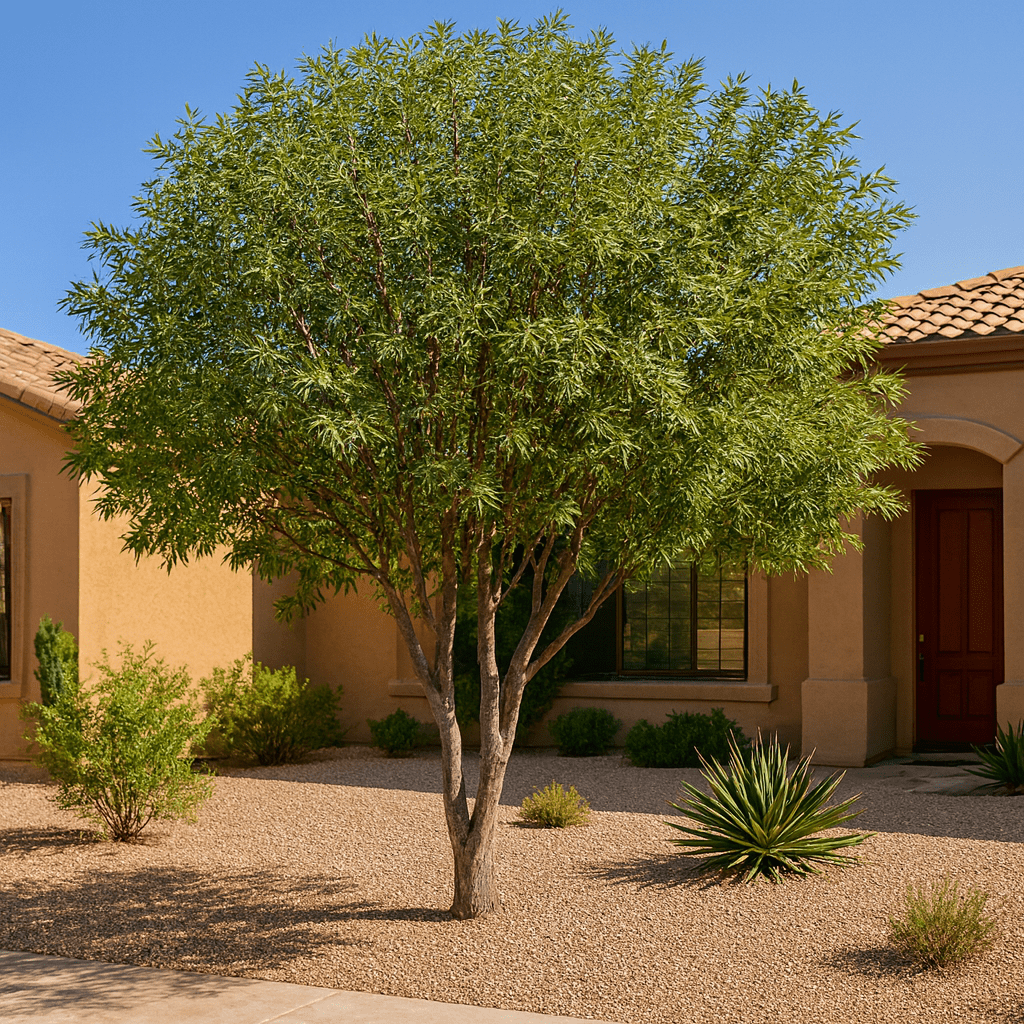


Ghost Gum
Ghost Gum
Couldn't load pickup availability
Ghost Gum (Corymbia papuana) – Striking White-Bark Shade Tree for Phoenix
The Ghost Gum (Corymbia papuana, formerly Eucalyptus papuana) is one of the most visually dramatic shade trees available for Phoenix-area landscapes. Its smooth, luminous white-to-cream bark glows in the sun and moonlight, creating a sculptural presence that few other trees can match. Native to Australia's Northern Territory and central desert regions, Ghost Gum is superbly adapted to Phoenix's extreme heat, low rainfall, and alkaline soils. It grows rapidly into a tall, graceful tree with a spreading canopy of blue-green foliage, clusters of creamy white flowers that attract pollinators and birds, and year-round ornamental appeal. For homeowners and designers seeking a fast-growing, low-maintenance shade tree with extraordinary visual impact, the Ghost Gum is an exceptional choice.
| Plant Details | |
|---|---|
| Common Name | Ghost Gum, Smooth-barked Apple |
| Scientific Name | Corymbia papuana (syn. Eucalyptus papuana) |
| Plant Type | Evergreen large shade tree |
| Mature Height | 30–60 ft |
| Mature Spread | 20–40 ft |
| Growth Rate | Fast (3–5 ft/year with irrigation) |
| Sun Exposure | Full Sun |
| Water Needs | Low to moderate once established |
| Flower Color | Creamy white |
| Bloom Season | Spring through summer |
| Bark | Smooth white to cream, shedding |
| Hardiness Zones | USDA Zones 9–11 |
| Soil | Well-draining; tolerates sandy, rocky, and alkaline soils |
| Available Sizes | 24"/25 Gal · 36" Box · 48" Box |
Why Plant Ghost Gum in Phoenix?
Ghost Gum is one of the rare trees that combines breathtaking ornamental beauty with outstanding desert adaptability. In Phoenix's brutal summer heat, it not only survives but thrives. Landscape professionals and homeowners choose Ghost Gum for:
- Dramatic white bark – The smooth, peeling cream-white bark is Ghost Gum's defining feature — it creates a luminous focal point day and night, adding architectural interest unlike any other shade tree.
- Fast shade – Ghost Gum is one of the fastest-growing shade trees available for Phoenix, reaching 20+ feet within a few years with adequate irrigation, making it ideal for new construction or properties that need shade quickly.
- Extreme heat and drought tolerance – Australian desert origins give Ghost Gum exceptional resilience to Phoenix's 115°F summer temperatures and low rainfall.
- Wildlife value – Creamy white flower clusters attract bees, butterflies, and nectar-feeding birds including hummingbirds.
- Year-round beauty – Blue-green foliage, white bark, and seasonal blooms provide ornamental interest in every season.
Best Time to Plant Ghost Gum in the Phoenix Area
Plant Ghost Gum in early spring (February–April) or fall (September–November). Spring planting allows the tree to establish an extensive root system before its first summer, while fall planting takes advantage of moderate temperatures and winter rains to minimize transplant stress. Avoid planting in peak summer (June–August) unless you can commit to intensive watering to protect young trees from heat stress during the critical establishment period.
How to Plant Ghost Gum
- Select a spacious, sunny location – Ghost Gum grows large and fast. Allow 20–30 feet of clearance from structures, power lines, and hardscaping. Plant where its dramatic form can be appreciated as a specimen or focal-point tree.
- Dig a wide, shallow hole – Excavate 2–3 times wider than the root ball, and no deeper than its height. Eucalyptus and Corymbia species develop extensive lateral root systems — a wide hole encourages healthy root spread.
- Check for and break through caliche – In Phoenix soils with caliche layers, break through to allow drainage and root penetration. Ghost Gum will not tolerate standing water around its root zone.
- Place the root ball – Position the tree so the root flare sits level with or slightly above grade. Never bury the trunk flare, as this can lead to collar rot.
- Backfill with native soil – Ghost Gum is adapted to lean, well-drained soils. Backfill with unamended native soil to encourage roots to expand into the surrounding area.
- Water deeply – Irrigate immediately and thoroughly after planting. Keep the root zone consistently moist (not waterlogged) for the first 4–8 weeks.
- Stake if needed – Larger specimens may benefit from temporary staking to stabilize the root ball during initial establishment. Remove stakes after 12 months to allow the trunk to strengthen.
- Mulch – Apply 3–4 inches of coarse mulch over the root zone to conserve moisture and moderate soil temperature.
Watering Guide for Ghost Gum
Ghost Gum is drought-tolerant once established, but fast establishment and optimal growth require consistent deep watering in the first two years:
- First year: Water every 3–5 days in summer; every 7–10 days in spring and fall; every 2–3 weeks in winter. Deep watering to 24–36 inches encourages the deep root system that makes Ghost Gum so drought-hardy.
- Year 2+ (established): Water every 10–14 days in summer; every 3–4 weeks in spring and fall; rely on natural rainfall in winter. Established Ghost Gums are remarkably drought-hardy and often thrive with minimal supplemental irrigation.
- Signs of overwatering: Yellowing leaves, soft or weeping bark, root rot. Ghost Gum requires excellent drainage — avoid planting in low-lying or poorly draining areas.
- Signs of underwatering: Wilting, gray-green leaf color, early leaf drop. Increase frequency and depth during extreme heat events (110°F+).
Frequently Asked Questions
How fast does Ghost Gum grow?
Ghost Gum is one of the fastest-growing trees available for Phoenix landscapes. With regular irrigation, it can add 3–5 feet per year, reaching 20+ feet within 5 years of planting. Its growth rate slows somewhat as it matures and irrigation is reduced.
Is Ghost Gum messy?
Like all Corymbia and Eucalyptus species, Ghost Gum sheds bark, seed capsules, and leaves periodically. This is part of its natural growth cycle and is most noticeable in spring and after storms. For most homeowners, the ornamental value of the white bark far outweighs the minimal cleanup.
Is Ghost Gum safe near pools and patios?
Ghost Gum's extensive root system can eventually impact hardscaping and plumbing. Plant at least 15–20 feet from pool walls, foundations, and underground irrigation lines. Its canopy drop zone should also be considered when siting near pool areas.
Does Ghost Gum tolerate frost?
Ghost Gum is cold-hardy to approximately 25–28°F, making it suitable for all areas of the Phoenix metro. Young trees may suffer tip damage in rare hard freezes, but established trees recover quickly.
Can Ghost Gum be pruned into a smaller form?
Ghost Gum can be selectively limbed up and pruned to maintain clearance and a desirable form, but it is a naturally large tree. It is not suited for repeated heavy shearing. For tight spaces, consider a smaller-maturing alternative such as Shoestring Acacia or African Sumac.
You May Also Like
- Shamel Ash (Fraxinus uhdei)
- African Sumac (Searsia lancea)
- Willow Acacia (Acacia salicina)
- Evergreen Elm (Ulmus parvifolia)
How Many Ghost Gum Do I Need?
Ghost Gum matures into a large specimen shade tree (20 to 40 ft wide), so most yards need only one as a luminous focal point. For a driveway or property-line shade line, space trees about 30 ft on center so each spreading canopy and white trunk stands clear:
| Row length | Trees needed (30 ft on center) |
|---|---|
| 30 ft | 1 to 2 |
| 60 ft | 2 to 3 |
| 90 ft | 3 to 4 |
| 120 ft | 4 to 5 |
As a single specimen, allow 20 to 30 ft of clearance from walls, pools, foundations, and underground lines so the lateral roots and shedding bark have room.
Ghost Gum Season-by-Season in Phoenix
- Spring (Feb to Apr): Strong flush of blue-green growth plus creamy white flower clusters that draw bees and nectar birds. Best spring planting window, before the heat arrives.
- Summer (May to Sep): Thrives in reflected heat and 110-plus degree days once established. Monsoon storms can prompt natural bark and limb shedding, so expect some litter after wind and rain.
- Fall (Oct to Nov): Prime planting season. Cooler temperatures let roots establish quickly ahead of winter while days stay warm enough for steady growth.
- Winter (Dec to Jan): Evergreen and structural through the cool season. Hardy to about 25 to 28 degrees F, so it holds across the Valley. Cover young trees on rare hard-freeze nights; established trees shrug off light frost.
At a Glance
✔ Heat-Loving (Reflected-Heat Tolerant) ✔ Drought-Tolerant ✔ Evergreen ✔ Shade-Providing ✔ Pollinator-Friendly ✔ Hummingbird-Friendly ✔ Low-Maintenance ✔ Cold-Hardy to 25°F
Plant It With
- African Sumac: another fast, heat-proof evergreen for a mixed shade canopy.
- Evergreen Elm: broad filtered shade that complements Ghost Gum's vertical white trunk.
- Fruitless Olive Tree: silver-gray foliage that sets off the luminous bark, with no messy fruit.
- Desert Willow: native flowering accent to layer in beside the larger Ghost Gum.
Is Ghost Gum Right for Your Yard?
Ghost Gum thrives in full sun and reflected heat, in well-drained native or caliche-broken soil, with room to reach 30 to 60 ft tall and 20 to 40 ft wide. It is a fast, dramatic shade and specimen tree for larger desert yards. It is not a fit if you have a small lot, want a tidy poolside tree, or cannot give it 20-plus ft of clearance, since it sheds bark, capsules, and leaves and develops wide roots.
Customer Reviews
Share