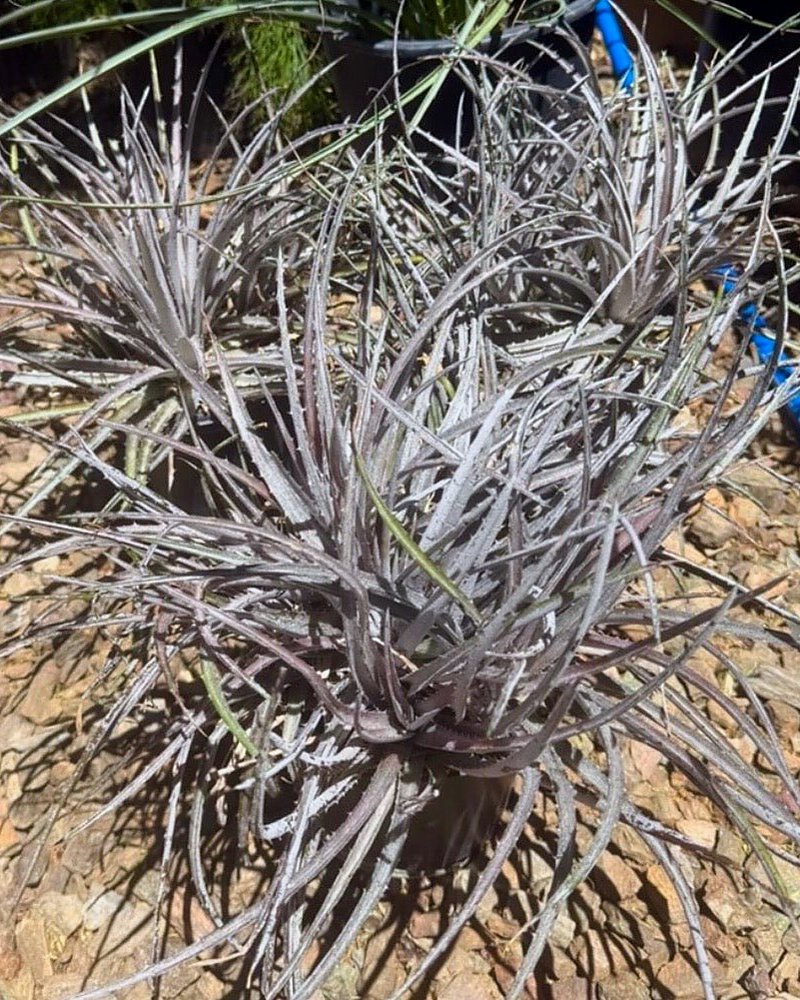

Burgundy Ice Dyckia
Burgundy Ice Dyckia
Couldn't load pickup availability
The Most Striking Burgundy Succulent for Phoenix Desert Gardens
Burgundy Ice Dyckia (Dyckia 'Burgundy Ice') is one of the most visually dramatic low-water succulents you can grow in the Phoenix Valley. This terrestrial bromeliad forms a tight, symmetrical rosette of deep burgundy-to-near-black leaves armed with silver spines that catch the light beautifully. Whether you're designing a modern desert courtyard in Scottsdale, adding bold color to a rock garden in Chandler, or filling containers on a Mesa patio — Burgundy Ice Dyckia delivers year-round sculptural impact with almost zero maintenance.
Burgundy Ice Dyckia Plant Details
| Attribute | Detail |
|---|---|
| Scientific Name | Dyckia 'Burgundy Ice' |
| Common Names | Burgundy Ice Dyckia, Burgundy Ice Bromeliad |
| Mature Height | 12–18 inches |
| Mature Width | 18–24 inches |
| Growth Rate | Moderate — produces offsets freely to form clumps |
| Sun | Full sun (6+ hrs). Handles reflected heat from walls and pavement. |
| Water | Low once established. Highly drought-tolerant. |
| USDA Zones | 9–11 (Phoenix is Zone 9b–10a) |
| Soil | Well-draining. Adapts to Arizona caliche soils with good drainage. |
| Foliage | Evergreen — deep burgundy to near-black year-round |
| Bloom | Bright orange-red flowers on tall stalks in spring |
Burgundy Ice Dyckia Uses in Phoenix Landscapes
Modern Desert Garden Accent
The deep burgundy color and architectural rosette form make Burgundy Ice Dyckia a perfect focal point in modern desert landscapes. Plant it against light-colored gravel or decomposed granite where the dark foliage creates maximum contrast. It pairs beautifully with Silver Nickle Dyckia and Blue Elf Aloe for a jewel-toned succulent garden.
Container and Patio Planting
Burgundy Ice Dyckia thrives in containers, making it ideal for patios, pool decks, and courtyard gardens throughout Scottsdale, Tempe, and Gilbert. Use a well-draining cactus mix and a pot with drainage holes. The compact size and bold color make it a standout in mixed succulent arrangements.
Rock Garden and Border Planting
Plant Burgundy Ice Dyckia along walkways, garden borders, or tucked into rock gardens. Space plants 18–24 inches apart for a continuous border. Over time, offsets will fill in gaps to create a dense, colorful groundcover. The spiny leaves also provide a natural deterrent along property edges.
Best Time to Plant Burgundy Ice Dyckia in Phoenix
Fall (October–November) is the ideal planting window. Warm soil encourages fast root establishment while cooler air reduces transplant stress, giving the plant 6–8 months to settle in before its first Phoenix summer. Spring (February–April) is a solid second choice. Avoid planting in the peak summer months if possible.
How to Plant Burgundy Ice Dyckia
- Dig wide, not deep — 2–3x the root ball width, same depth as the container
- Check for caliche — break through any hardpan layer to ensure drainage
- Backfill with native soil mixed with 20% perlite or pumice for extra drainage
- Spacing — 18–24 inches apart for borders; 12–15 inches for tight container groupings
- Water basin — build a 2–3 inch ring around the plant to direct water to roots
- Mulch — 2–3 inches of decorative gravel to retain moisture and suppress weeds
Watering Burgundy Ice Dyckia in Phoenix
First Year Watering Schedule
Weeks 1–2: Every 2–3 days, deep soak. Month 1–2: Every 4–5 days. Month 3–6: Every 7–10 days (every 5–7 days in peak summer). After Year 1: Every 10–14 days in summer; every 3–4 weeks in winter.
Drip Irrigation
Place one 1-GPH emitter 6–8 inches from the base. Established Burgundy Ice Dyckia is extremely drought-tolerant and needs minimal supplemental water once roots are established.
How fast does Burgundy Ice Dyckia grow in Phoenix?
Individual rosettes reach full size within 1–2 years. The plant freely produces offsets (pups) that can be separated and replanted or left to form an attractive clump over time.
Is Burgundy Ice Dyckia drought-tolerant once established?
Extremely. Once established, it survives on rainfall alone in most Phoenix winters and needs only occasional deep watering during summer. It handles Phoenix's extreme heat, including reflected heat from walls and pavement.
What's the difference between Burgundy Ice Dyckia and other Dyckia varieties?
Burgundy Ice stands out for its exceptionally dark burgundy-to-near-black foliage and contrasting silver spines. Most other Dyckia varieties lean green, gray, or silver. The intense color makes Burgundy Ice one of the most sought-after cultivars for desert gardens.
Can Burgundy Ice Dyckia handle full Phoenix summer sun?
Yes. Full sun intensifies the burgundy color. In partial shade, the leaves may take on more green tones. For the deepest color, plant in a spot with at least 6 hours of direct sun.
You May Also Like
Silver Nickle Dyckia — a silvery contrast companion for mixed Dyckia borders. Grape Jelly Dyckia — purple-toned rosettes with a grape-like hue. Grand Marnier Dyckia — bright orange-edged leaves for warm-toned gardens. Blue Elf Aloe — compact blue-green rosettes that pair beautifully in succulent beds. Variegated Flapjacks — bold paddle-shaped leaves with cream and pink variegation.
How Many Burgundy Ice Dyckia Do I Need?
At 18 to 24 in wide and freely offsetting, Burgundy Ice Dyckia knits into a low, spiny color mass. Plant on roughly 20 in centers (about 2.25 plants per sq ft area when massed) and let the pups fill the gaps.
| Area to Cover | Plants at 18 in spacing | Plants at 24 in spacing |
|---|---|---|
| 10 sq ft | 5 plants | 3 plants |
| 25 sq ft | 11 plants | 6 plants |
| 50 sq ft | 22 plants | 13 plants |
| 100 sq ft | 44 plants | 25 plants |
For a single jewel-toned accent in a pot or rock pocket, one rosette is plenty: it will clump on its own.
Burgundy Ice Dyckia Season-by-Season in Phoenix
- Spring (Feb–Apr): Tall stalks of bright orange-red flowers draw hummingbirds. New offsets push from the base. A solid secondary planting window.
- Summer (May–Sep): Full sun deepens the burgundy-to-black color. Thrives in extreme and reflected heat. Keep water occasional so the crown never sits wet through monsoon humidity.
- Fall (Oct–Nov): Prime planting season. Roots establish fast in warm soil before winter.
- Winter (Dec–Jan): Evergreen rosette holds color. Tolerates light Valley frost, but protect from hard freezes below about 25°F, especially in containers where roots chill faster.
At a Glance
✔ Heat-Loving (Reflected-Heat Tolerant) ✔ Drought-Tolerant ✔ Hummingbird-Friendly ✔ Pollinator-Friendly ✔ Evergreen ✔ Low-Maintenance ✔ Deer & Rabbit-Resistant
Plant It With
- Silver Nickle Dyckia: a silvery rosette that contrasts the near-black foliage in a mixed Dyckia border.
- Grape Jelly Dyckia: purple-toned rosettes that extend the jewel-tone palette.
- Grand Marnier Dyckia: bright orange-edged leaves for warm contrast.
- Variegated Flapjacks: bold cream-and-pink paddles that lighten the grouping.
Is Burgundy Ice Dyckia Right for Your Yard?
Burgundy Ice Dyckia thrives in full sun and reflected heat, in fast-draining soil or containers, with very little water and no pruning. It is a perfect low, colorful accent for rock gardens, borders, and pots. It is not a fit right against high-traffic walkways or play areas, since the silver spines are sharp, or in shady, poorly drained beds where the color fades and the crown can rot.
Customer Reviews
Share