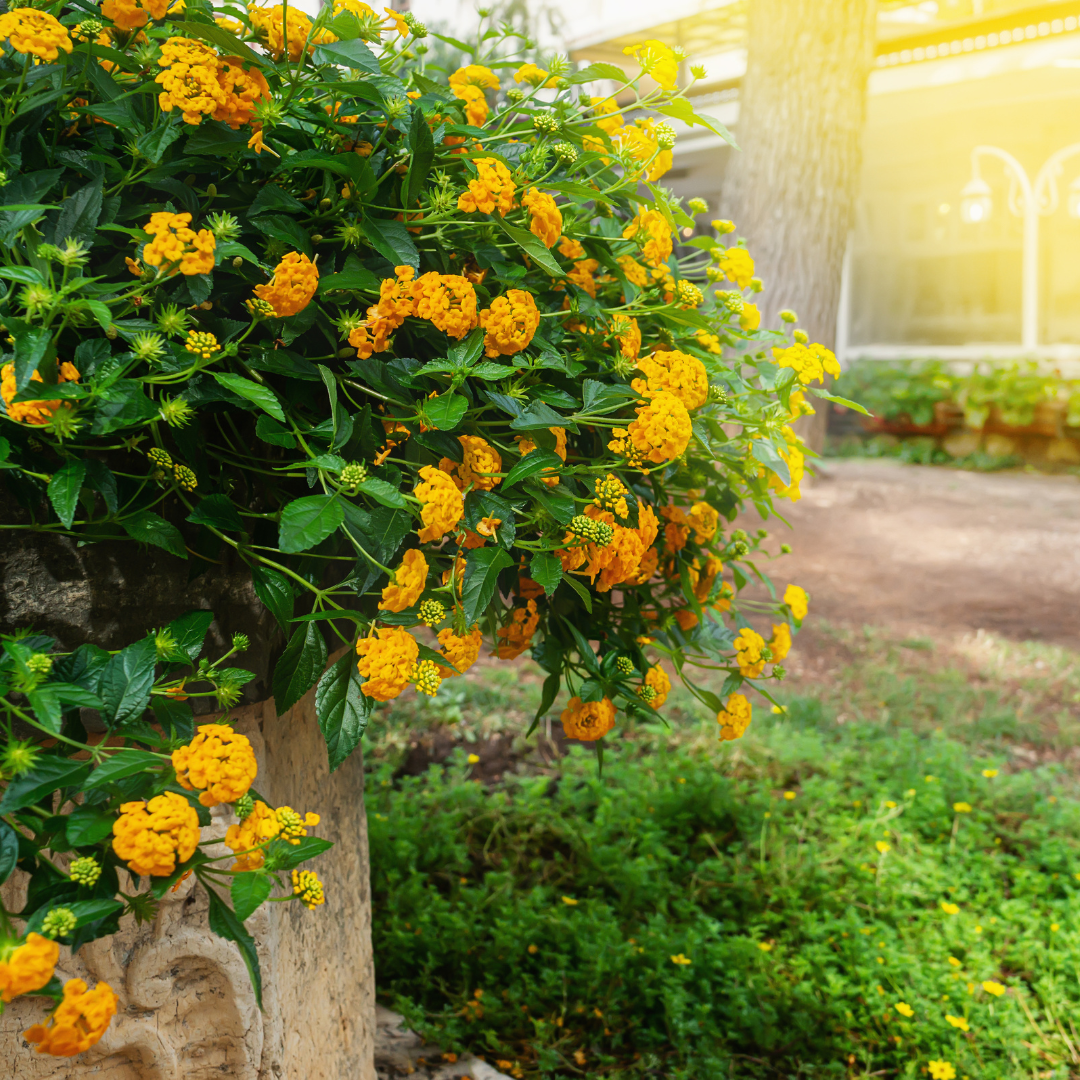

Yellow Trailing Lantana
Yellow Trailing Lantana
Couldn't load pickup availability
The Toughest Cascading Groundcover for Phoenix Heat
Yellow Trailing Lantana (Lantana montevidensis) is one of the most dependable flowering groundcovers in the Phoenix Valley. This low-growing, spreading perennial blankets the ground with dense foliage and cheerful clusters of bright yellow flowers from spring through fall — often blooming year-round in mild Phoenix winters. Extremely drought-tolerant, heat-resistant, and virtually maintenance-free once established, Yellow Trailing Lantana cascades beautifully over walls, slopes, and raised beds. Whether you're covering a bare hillside in Scottsdale, softening a retaining wall in Mesa, or adding color to a Gilbert rock garden — Yellow Trailing Lantana is the answer.
Yellow Trailing Lantana Plant Details
| Attribute | Detail |
|---|---|
| Scientific Name | Lantana montevidensis |
| Common Names | Yellow Trailing Lantana, Weeping Lantana, Creeping Lantana |
| Mature Height | 1–2 feet |
| Mature Width | 4–6 feet (trails and cascades) |
| Growth Rate | Fast — 2–3 feet of spread per year in Phoenix |
| Sun | Full sun (6+ hrs). Thrives in reflected heat from walls and pavement. |
| Water | Very low once established. Highly drought-tolerant. |
| USDA Zones | 8–11 (Phoenix is Zone 9b–10a) |
| Soil | Well-draining. Adapts to sandy, rocky, and Arizona caliche soils. |
| Foliage | Semi-evergreen — stays green most of the year in Phoenix |
| Bloom Color | Bright yellow flower clusters, spring through fall (often year-round) |
| Wildlife | Attracts butterflies, bees, and hummingbirds |
Yellow Trailing Lantana Uses in Phoenix Landscapes
Cascading Over Walls & Raised Beds
Yellow Trailing Lantana's weeping habit makes it perfect for cascading over retaining walls, raised planters, and elevated garden beds. Plant 3–4 feet apart along the top edge and let the stems spill over for a dramatic waterfall of yellow blooms. A stunning effect along property walls in Chandler, Tempe, and Peoria.
Slope & Erosion Control
The fast-spreading root system stabilizes slopes and embankments while smothering weeds. Plant 3–4 feet apart on a hillside and Yellow Trailing Lantana will knit together into a tough, colorful erosion-resistant mat within one growing season. Pair with Winter Blaze Emu Bush for a red-and-yellow slope display.
Desert Rock Garden & Groundcover
Mass-plant Yellow Trailing Lantana through gravel beds and around boulders for a low-maintenance carpet of color. It looks stunning alongside agaves, yuccas, and Desert Spoon — providing soft, flowing contrast to the structural shapes of desert succulents.
Best Time to Plant Yellow Trailing Lantana in Phoenix
Fall (October–November) is ideal. The soil is still warm for rapid root establishment, while cooler air reduces transplant stress. Your plant gets 6–8 months to root in before its first Phoenix summer. Spring (February–April) is the second-best window. Avoid summer planting if possible.
How to Plant Yellow Trailing Lantana
- Dig wide, not deep — 2–3× the root ball width, same depth.
- Check for caliche — break through any hardpan layer to ensure drainage.
- Backfill with native soil — Lantana prefers lean soil. No amendments needed.
- Spacing — 3–4 feet apart for groundcover; 2–3 feet for faster wall coverage.
- Water basin — build a small ring to direct water to roots during establishment.
- Mulch — 2–3 inches of gravel mulch to retain moisture and suppress weeds.
Watering Yellow Trailing Lantana in Phoenix
First Year Watering Schedule
- Weeks 1–2: Every 2–3 days, deep and slow
- Month 1–2: Every 4–5 days
- Month 3–6: Every 7–10 days (every 5–7 days in peak summer)
- After Year 1: Every 2–3 weeks in summer; rainfall is usually sufficient in winter
Drip Irrigation
Place a 1 GPH emitter 8–12 inches from the plant center. One emitter per plant is sufficient. Established Yellow Trailing Lantana is remarkably drought-tolerant — overwatering actually reduces bloom production, so keep it on the dry side for maximum flowers.
How fast does Yellow Trailing Lantana spread in Phoenix?
Very fast. Expect 2–3 feet of new spread per year. A single 1-gallon plant can cover a 4–6 foot area within one growing season with regular first-year watering.
Does Yellow Trailing Lantana bloom year-round in Phoenix?
Nearly. It blooms most heavily from spring through fall, but in mild Phoenix winters it often continues producing flowers with little interruption. It may go semi-dormant briefly after hard freezes.
Is Yellow Trailing Lantana toxic to pets?
Lantana berries can be mildly toxic if ingested. Trailing Lantana produces fewer berries than upright varieties, but keep this in mind if you have pets or small children who might nibble on plants.
Can it handle Phoenix summer heat and reflected heat?
Absolutely. Yellow Trailing Lantana is one of the most heat-tolerant groundcovers available. It thrives in full sun, reflected heat from walls and pavement, and temperatures well above 110°F.
You May Also Like
- Yellow Bulbine — Low-growing succulent groundcover with yellow flower spikes, perfect for borders alongside Lantana.
- Ruellia — Purple-flowering groundcover that creates vibrant color contrast with yellow Lantana.
- Zexmenia — Native golden-yellow flowering groundcover with similar heat and drought tolerance.
- Winter Blaze Emu Bush — Red-flowering spreading groundcover that pairs beautifully with yellow Lantana for year-round color.
How Many Yellow Trailing Lantana Do I Need?
Each plant trails out to 4 to 6 feet wide, so it covers a lot of ground from a few plants. At 3 to 4 foot spacing the plants knit into a continuous mat in one season. Use the coverage table to estimate counts:
| Area to Cover | At 3 ft spacing | At 4 ft spacing |
|---|---|---|
| 100 sq ft | 11 plants | 6 plants |
| 200 sq ft | 22 plants | 12 plants |
| 300 sq ft | 33 plants | 19 plants |
For a wall-top cascade, plant a single row 3 feet apart and let the stems spill over.
Yellow Trailing Lantana Season-by-Season in Phoenix
- Spring (Feb–Apr): Bloom ramps up fast as nights warm and stems push new spreading growth. Butterflies and hummingbirds arrive. A prime second planting window.
- Summer (May–Sep): Peak performance. Thrives in reflected heat off walls and pavement above 110°F and blooms all season, flushing harder with monsoon rain.
- Fall (Oct–Nov): The best planting season in Phoenix, with bloom continuing strongly.
- Winter (Dec–Jan): Semi-evergreen and often keeps flowering through mild Valley winters. A hard freeze can knock it back; shear off frost-burned stems in late February and it re-sprouts vigorously.
At a Glance
✔ Pollinator-Friendly ✔ Hummingbird-Friendly ✔ Heat-Loving (Reflected-Heat Tolerant) ✔ Drought-Tolerant ✔ Low-Maintenance
Plant It With
- Yellow Bulbine: a low succulent with matching yellow spikes for the front of the bed.
- Baja Ruellia: purple blooms for a high-contrast yellow-and-purple carpet.
- Zexmenia: a tough golden-flowering groundcover with the same heat and drought tolerance.
- Purple Trailing Lantana: the purple twin for a two-tone trailing sweep.
Is Yellow Trailing Lantana Right for Your Yard?
It thrives in full sun with 6 or more hours of light, in lean well-draining soil where caliche has been broken through, and on slopes, wall tops, and open beds where it has room to trail 4 to 6 feet. It loves reflected heat and needs very little water once established. Not the right fit if you have pets that graze on plants, since lantana foliage and berries are mildly toxic if eaten, or if you want a tidy plant that never needs shearing.
Share